INVEST
 PLANT
PLANT
 SOFTWOODS
 HARDWOODS
 CALCULATORS
 RESOURCES
 PROGRAMS

Softwoods
Learn More
AGROFORESTRY • SYSTEMS • DESIGN • PLANNING TOOLS
🌱 Quick answer: Agroforestry is the intentional integration of trees with crops or livestock to create farming systems that improve soil health, water retention, biodiversity, climate resilience, and long-term productivity.
Common agroforestry systems include alley cropping, silvopasture, windbreaks, riparian buffers, food forests, and tree-crop intercropping systems.
Agroforestry is used by small farms, homesteads, plantations, conservation projects, and regenerative agriculture systems to combine food production, tree planting, livestock integration, climate adaptation, and long-term land value on the same acreage.
This guide explains the major agroforestry systems, shows typical tree spacing, introduces planning calculators, and includes an interactive agroforestry planner for designing tree loops, alleys, spacing, and long-term canopy growth.
Use the links below to jump to the main agroforestry systems, benefits, calculators, design tools, and planning resources on this page.
Agroforestry includes several system types, each designed to combine trees with crops, livestock, water protection, or food production in different ways. The best system depends on your goals, climate, land shape, equipment needs, and the long-term role you want trees to play on the property.
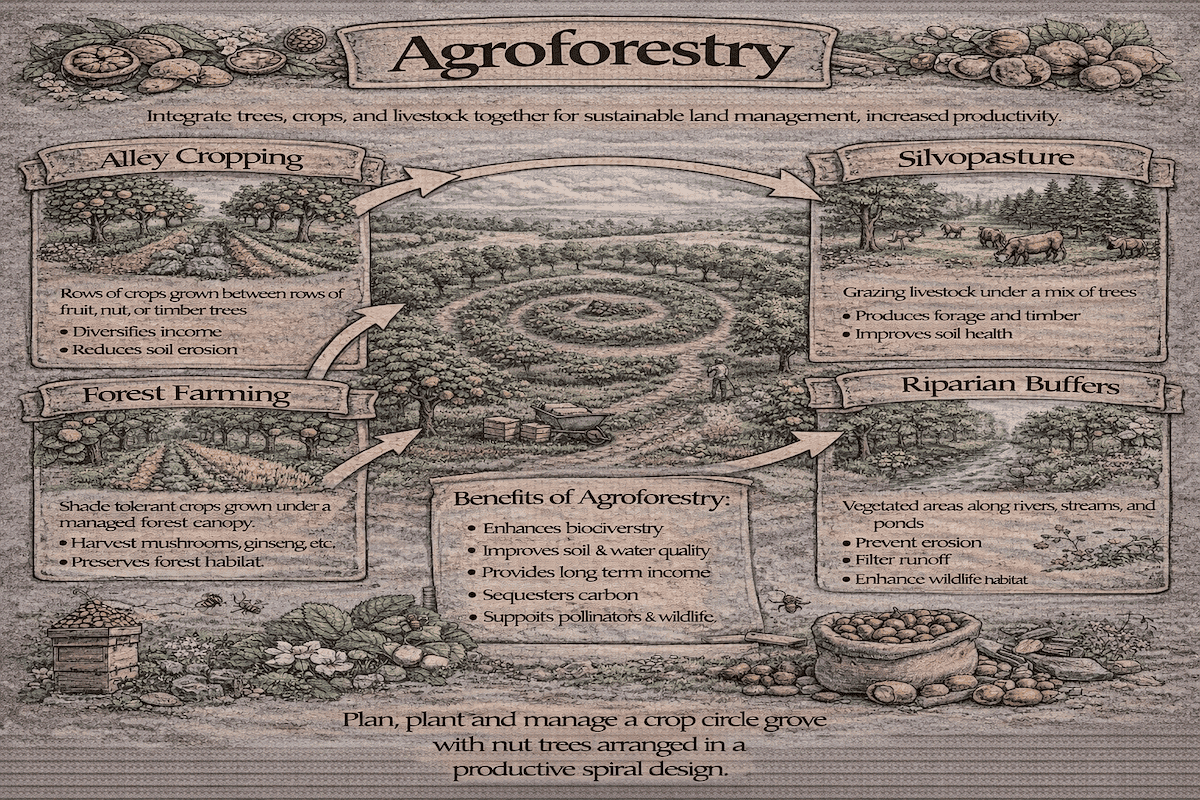
Alley cropping places trees in rows or patterned bands with crops grown in the alleys between them. This system can improve soil health, reduce wind exposure, and create long-term tree income while keeping land in active crop production.
Silvopasture combines trees, forage, and livestock in one managed system. Trees provide shade, shelter, and long-term timber or nut value, while pasture beneath them continues to support grazing animals.
Riparian buffers use trees and vegetation planted along streams, rivers, ponds, or drainage channels. These systems help stabilize banks, filter runoff, protect water quality, and create wildlife habitat while improving the ecological health of the landscape.
Windbreaks are rows of trees or shrubs planted to reduce wind speed and protect crops, livestock, soil, and buildings. They can reduce erosion, conserve moisture, improve field conditions, and make surrounding agricultural land more productive.
Food forests are multi-layered planting systems that combine canopy trees, understory fruit trees, shrubs, vines, herbs, and groundcovers. These systems are designed to mimic natural forest structure while producing food, habitat, mulch, biodiversity, and long-term resilience.
Feel free to share this agroforestry infographic on your website or blog. Please include a link back to this page as the source.
Tree spacing in agroforestry depends on the purpose of the system, the mature size of the trees, and the amount of light, airflow, and access needed between plantings. Some systems use wide alleys for crops or grazing, while others use tighter spacing to create shelter, privacy, or dense ecological function.
The table below shows common starting points for several major agroforestry systems. Final spacing should always be adjusted for tree species, canopy spread, equipment access, irrigation, and long-term management goals.
| System | Typical Spacing |
|---|---|
| Alley Cropping | 30–80 ft between rows |
| Silvopasture | 20–40 ft between trees |
| Windbreak | 8–16 ft between trees, often in multiple rows |
| Food Forest | Variable by layer, species, and canopy size |
For more exact layout planning, use the Tree Spacing Calculator to compare planting distances and estimate how many trees fit within a given area.
Year 1: Establishment phase (light competition)
Year 5: Canopy interaction begins
Year 10: System maturity impacts yield and shade
Year 20+: Fully developed agroforestry ecosystem
Agroforestry systems provide multiple environmental and economic benefits by combining trees with crops, livestock, or both. By designing landscapes where trees function as long-term infrastructure, agroforestry can improve farm productivity while restoring ecological balance.
When properly designed, agroforestry landscapes can produce multiple outputs from the same land area—including food, timber, nuts, fruit, habitat, and carbon storage—while improving long-term environmental sustainability.
Most agroforestry failures aren’t concept failures—they’re layout failures. Spacing, access, sunlight, and year-by-year canopy growth decide whether crops thrive in the alleys or get shaded out. That’s why this page is built around a planner, not just definitions.
Agroforestry integrates trees with crops and/or livestock to build soil health, stabilize water cycles, and create multiple yields (food, timber, nuts/fruit, fodder, habitat, carbon). Intercropping is the broader practice of mixing crops; agroforestry is the long-lived tree-based version that shapes the microclimate for decades.
Try it: use the interactive planner below to place trees in loops (spirals), visualize curved alleys between loops, and click years forward to see how the system changes as trees mature. If you can’t keep sunlight and access working at year 10, your plan needs adjustment now.
Agroforestry works best when the layout is intentional. Use the interactive planner below to visualize tree loops (spirals), the crop alleys between loops, and how a mixed system evolves over time.
Black walnut is typically established using directly sown seed, 2-year bare-root seedlings, or 3-year plug/seedling transplants. In this planner scenario, 220 black walnut trees are planted within a 3.5-acre spiral layout, spaced 25 feet apart.
White oak is typically established using 2-year bare-root seedlings or 3-year plug transplants. In this planner scenario, 300 white oak trees are planted within a 3.5-acre spiral layout, spaced 20 feet apart.
Black cherry is typically established using 3-year seedling transplants, which offer strong survival rates when properly sited and maintained. In this planner scenario, 400 black cherry trees are planted within a 3.5-acre spiral layout, spaced 18 feet apart with 18 feet between spiral rows, allowing each tree adequate spacing for long-term crown development, root expansion, and soil health.
Hard maple (sugar maple) is typically established using 3-year seedling transplants, which offer strong survival rates when properly sited and maintained. In this planner scenario, 280 sugar maple trees are planted within a 3.5-acre spiral layout, spaced 22 feet apart with 22 feet between spiral rows, allowing each tree adequate spacing for long-term crown development, root expansion, and soil health.
Yellow birch is typically established using 3-year transplants, which offer strong survival rates when properly sited and maintained. In this planner scenario, 300 yellow birch trees are planted within a 3.5-acre spiral layout, spaced 20 feet apart with 20 feet between spiral rows, allowing each tree adequate spacing for long-term crown development, root expansion, and soil health.
American chestnut is typically established using 3-year hybrid transplants, which provide strong survival rates when properly sited and maintained. In this planner scenario, 220 American chestnut trees are planted within a 3.5-acre spiral layout, spaced 25 feet apart with 25 feet between spiral rows. This configuration ensures ample room for long-term canopy development.
Mahogany is typically established using nursery-grown transplants, often 2–3 years old, which offer reliable survival when properly sited and managed. In this planner scenario, 220 mahogany trees are planted within a 3.5-acre spiral layout, spaced 25 feet apart with 25 feet between spiral rows. This spacing supports long-term crown development, deep root expansion, and healthy airflow.
Teak plantings are commonly established with well-hardened nursery seedlings or clonal stock that are 2–3 years old, selected for uniform growth and durability. In this planner example, a total of 220 teak trees are arranged across a 3.5-acre spiral planting pattern. Trees are set on 25-foot centers, with equal spacing between spiral rows, creating an open structure that encourages strong trunk formation.
Rosewood is typically established using carefully raised nursery transplants, often 2–3 years old, to ensure strong early growth and successful establishment. In this planner scenario, 220 rosewood trees are integrated into a 3.5-acre spiral planting design. The trees are spaced at 25-foot intervals, with 25 feet between spiral rows, providing sufficient room for mature canopy spread and deep root development.
White pine is commonly established using 2–3 year nursery-grown plug transplants, which provide reliable survival when properly sited and cared for. In this planner scenario, 300 white pine trees are arranged within a 3.5-acre spiral planting pattern, spaced 20 feet apart with 20 feet between spiral rows. This layout balances efficient land use with sufficient room for mature canopy formation.
Western red cedar is typically established using 2–3 year nursery-grown seedlings, valued for their resilience and strong establishment when properly sited and maintained. In this planner scenario, 400 western red cedar trees are planted within a 3.5-acre spiral layout, spaced 18 feet apart with 18 feet between spiral rows. This spacing provides each tree with adequate room for vertical growth.
Hybrid poplar is commonly established using fast-growing nursery transplants or cuttings, selected for rapid early growth and high establishment success. In this planner scenario, 480 hybrid poplar trees are planted within a 3.5-acre spiral configuration, spaced 16 feet apart with 16 feet between spiral rows. This tighter, uniform spacing supports straight trunk formation and efficient canopy development.
Orchard apples are typically established using 8-foot spear transplants chosen for their quick establishment and vigorous early growth. In this planner scenario, 2,000 apple trees are integrated into a 3.5-acre spiral planting design, with trees spaced 6 feet apart and 10 feet between spiral rows. This high-density arrangement promotes manageable tree structure and controlled canopy development.
Orchard pears are typically established using 7-foot spear transplants chosen for their quick establishment and vigorous early growth. In this planner scenario, 2,000 pear trees are integrated into a 3.5-acre spiral planting design, with trees spaced 6 feet apart and 10 feet between spiral rows. This high-density arrangement promotes manageable tree structure and controlled canopy development.
Orchard peaches are typically established using 6-foot spear transplants chosen for their quick establishment and vigorous early growth. In this planner scenario, 2,000 peach trees are integrated into a 3.5-acre spiral planting design, with trees spaced 6 feet apart and 10 feet between spiral rows. This high-density arrangement promotes manageable tree structure and controlled canopy development.
Use the buttons to advance or reverse the future tree value
Are you optimizing for food production, soil building, wind protection, timber value, or carbon storage? Your goal determines loop radius, alley width, and species mix.
Keep curved alleys wide enough for tools, harvesting, and irrigation. A simple rule: plan the alleys for today’s equipment, then verify canopy space for year 10–20.
Mix functions on purpose: nitrogen fixation, pollinator habitat, biomass for mulch, and deep-rooted “nutrient pumps” that cycle minerals back to the surface.
Tree systems are dynamic. Growing the spiral with each year helps visitors understand pruning, thinning, and why early decisions affect survival and yield decades later.
Alley cropping is a practical form of agroforestry where tree loops (or lines) of trees or shrubs are planted with wide alleys in between. The alleys are used for annual crops, hay, or pasture. Over time, the trees add value through timber, fruit, nuts, or biomass, while the alleys provide yearly harvests and keep cash flow moving.
By aligning tree loops with prevailing winds, farmers can create windbreaks that protect crops from drying winds and erosion. Deep-rooted trees help bring nutrients up from deeper soil layers, while surface roots and leaf litter build fertile topsoil. In hot, dry climates, alley cropping can reduce water stress and provide shade for livestock and shade-tolerant crops.
Alley cropping can be adapted to small homesteads and large farms alike. A few loops of nut or fruit trees with vegetable beds or grains in between can turn a conventional field into a thriving, multi-layered food system.

Agroforestry systems often host far more biodiversity than single-crop fields. Trees and shrubs supply habitat, food, and nesting sites for birds, insects, and beneficial predators that help keep pests in balance. Understory plants, cover crops, and ground covers further increase diversity at the soil surface.
As the system matures, deep root networks stabilize slopes and protect watersheds. Fallen leaves and pruned branches add organic matter, feeding soil organisms and building dark, carbon-rich topsoil. These living soils absorb and store more water, reduce runoff, and help buffer farms against drought and flooding.
In addition to ecological benefits, diversified systems can provide multiple income streams for farmers: timber, poles, fruits, nuts, fodder, fuelwood, mushrooms, medicinals, and more. A well-designed agroforestry system functions like a forest that grows food and income year after year.
In the industrialized West, forests that grow food are rare. Most landscapes are divided into separate zones: cropland here, forest there, pasture somewhere else. By re-integrating trees into fields and pastures, agroforestry revives the ancient pattern of tree-based food systems common in many parts of the world.
Across Europe, Latin America, Africa, and Asia, farmers have long used mixed tree–crop systems to shelter coffee, cacao, spices, fruit trees, and annual crops. Modern agroforestry and alley cropping build on this heritage, combining traditional wisdom with contemporary tools and planning methods.
As climate change accelerates, forests that grow food are becoming more valuable. They can cool local temperatures, hold water in the landscape, and buffer farms from shocks. Agroforestry gives farmers a toolkit to design their own food forests, tailored to their climate, soils, and goals.
Agroforestry is the intentional integration of trees with crops and/or livestock to improve productivity, soil health, water cycling, biodiversity, and long-term resilience. Trees act as permanent infrastructure that shapes microclimate and nutrient cycling over years or decades.
Alley cropping plants trees in rows (or patterns) with crop alleys in between for access and sunlight. In the interactive planner on this page, those alleys can be modeled as curved spaces between tree loops (spirals), which helps visualize how layout affects cropping area and future shade.
Choose spacing based on your primary goal (food, timber, windbreak, shade, silvopasture, carbon) and the access you need for equipment or grazing. Size alleys for sunlight at maturity, then plan for canopy expansion over 10–20 years using pruning, thinning, and species selection to prevent the alleys from closing in.
Yes. Agroforestry can store carbon in trees and soils while improving microclimate, reducing erosion, and strengthening resilience to heat and drought. Long-term benefits increase when trees are maintained, protected from stress, and managed for decades. Learn more on our climate change and reforestation pages.
Start with a target tree count and spacing, then model access lanes and crop alleys before planting. Use the interactive planner to visualize tree loops (spirals), measure alley widths, and step years forward to see how canopy growth changes sunlight and usable cropping area.
Partner with us in a land management project to repurpose agricultural lands into appreciating tree assets. We have partnered with growingtogive.org , a 501c3 nonprofit, to create tree planting partnerships with land donors.
We have partnered with growingtogive.org, a Washington State nonprofit to create a land and tree partnership program that repurposes agricultural land into appreciating tree assets.
The program utilizes privately owned land to plant trees that would benefit both the landowner and the environment.
If you have 100 acres or more of flat, fallow farmland and would like to plant trees, then we would like to talk to you. There are no costs to enter the program. You own the land; you own the trees we plant for free and there are no restrictions; you can sell or transfer the land with the trees anytime.
Copyright © All rights reserved Tree Plantation