 INVEST
 PLANT
PLANT
 SOFTWOODS
 HARDWOODS
 CALCULATORS
 RESOURCES
 PROGRAMS

Softwoods
Learn More




Main types of hardwood flooring—including solid hardwood, engineered planks, reclaimed wood, bamboo, and tropical species—to find the best option for durability, sustainability, and style.
HARDWOOD FLOORS • TYPES • DURABILITY
Wondering what the different types of hardwood floors are? The main types of hardwood flooring include solid hardwood, engineered hardwood, reclaimed wood flooring, bamboo flooring, and tropical hardwood floors. Each option differs in construction, durability, moisture resistance, appearance, and long-term maintenance requirements.
🪵 Hardwood flooring can last for decades—or even more than a century — especially when it can be sanded, refinished, and properly maintained over time.
On this page, we’ll compare the main types of hardwood floors, explain where each one performs best, and show how they compare with laminate, vinyl, tile, and carpet for different rooms and lifestyles.
Well-installed hardwood floors can last more than 100 years and may be refinished multiple times during their lifespan. Unlike many synthetic flooring materials, hardwood can often be sanded, repaired, and restored rather than replaced.
Note: The best hardwood floor for your space depends on moisture levels, subfloor type, traffic, budget, desired appearance, and how much maintenance you are willing to do over time.
Natural hardwood floors offer a timeless combination of beauty, durability, and warmth that fits everything from rustic homes to modern interiors. Made from real wood, they showcase distinctive grain patterns, natural color variation, and the character that makes each floor unique.
Popular species include domestic favorites such as oak, maple, walnut, and cherry. Each species has its own look and performance profile—oak is a classic all-around choice, maple offers a cleaner contemporary appearance, walnut brings rich dark tones, and cherry develops deeper color as it ages.
One of the biggest advantages of natural hardwood is its long service life. Because many hardwood floors can be sanded and refinished, they can recover from wear, adapt to changing design preferences, and remain attractive for decades with proper care.
Solid hardwood floors are the traditional standard in premium flooring. Each plank is cut from a single piece of wood, typically around 3/4 inch thick, which gives it strength, longevity, and the ability to be refinished multiple times over its life.
Solid hardwood is commonly installed on or above grade in rooms such as living rooms, dining rooms, hallways, and bedrooms. In these spaces, it offers excellent durability, a substantial feel underfoot, and the classic appearance many homeowners want.
Because solid wood naturally expands and contracts with humidity changes, it is more sensitive to moisture than some other flooring options. Prolonged dampness can cause cupping, gapping, or warping, which is why solid hardwood is usually not the best choice for basements, full bathrooms, or other below-grade areas without strong moisture control.
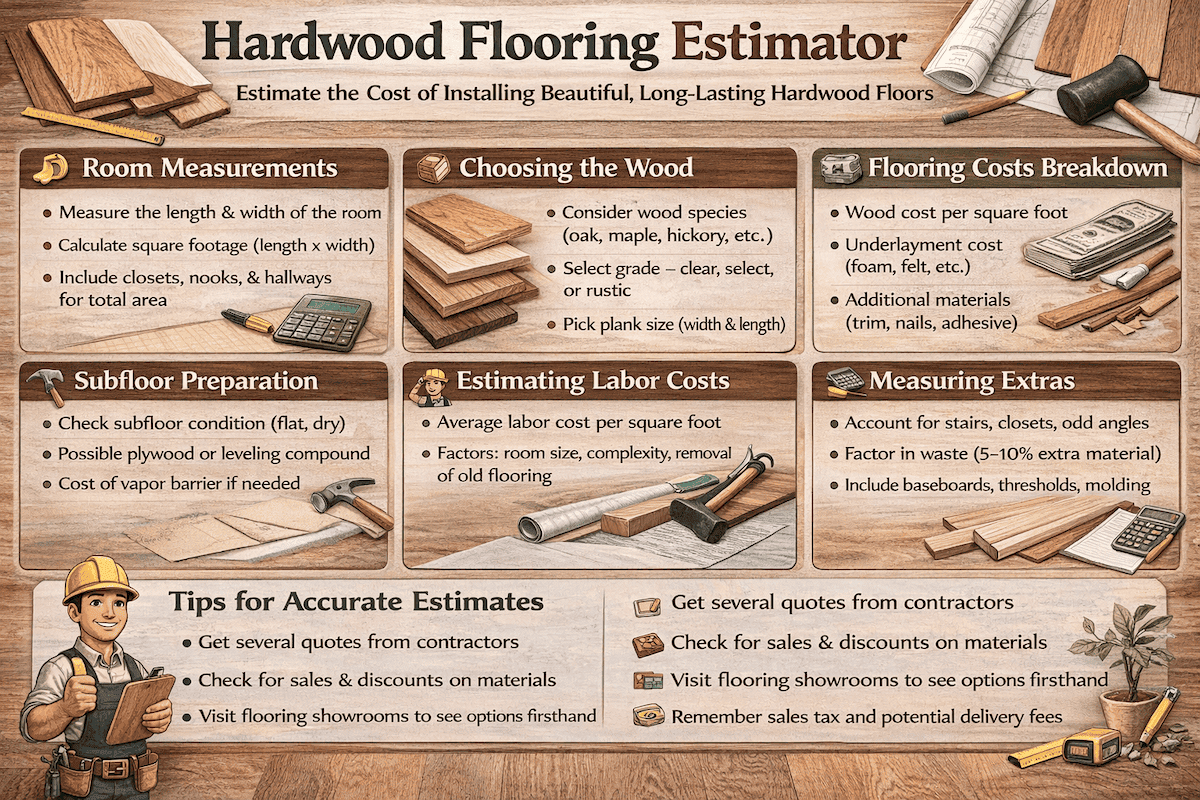
Feel free to share this hardwood flooring estimator infographic on your website or blog. Please include a link back to this page as the source.

Engineered hardwood floors are a modern flooring solution designed to solve some of the limitations of solid planks. Instead of being made from a single piece of wood, engineered boards are constructed in layers. The top layer—the one you see and walk on—is a veneer of real hardwood (oak, maple, hickory, walnut, etc.). This surface layer captures the natural beauty, grain, and texture of traditional hardwood floors.
Beneath the veneer, the core and bottom layers are typically built from high-density fiberboard (HDF) or plywood arranged in cross-grain patterns. This layered construction resists expansion and contraction, giving engineered hardwood greater dimensional stability than solid wood when exposed to changes in humidity and temperature.
The result is a hardwood product that can be installed in locations where solid wood would struggle—such as over concrete slabs, in finished basements, or in climates with large seasonal humidity swings. Many engineered floors can be installed as a floating floor, glued down, or nailed/stapled, giving homeowners and installers more flexibility during renovation projects.
While the top hardwood layer of engineered flooring is thinner than solid planks, many products still allow for one or two refinishes over their lifetime, especially premium options with thicker wear layers. For homeowners who want the look of real wood everywhere in the home—including lower levels—engineered hardwood is often the best balance of appearance, performance, and price.

Reclaimed hardwood floors are a fusion of sustainability and historical charm, appealing to homeowners who value both environmental responsibility and the patina of age. This type of flooring is created using wood salvaged from old buildings, barns, warehouses, and decommissioned industrial sites, giving new life to lumber that would otherwise be discarded.
The process of reclaiming wood lowers our carbon footprint, conserves forest resources, and reduces landfill waste, aligning with the goals of green building and eco-conscious remodeling. Each plank of reclaimed hardwood tells a story through its distinctive grains, nail holes, saw marks, and knots—imperfections that designers and homeowners now view as assets rather than flaws.
Because reclaimed flooring is often milled from old-growth timber, it can be exceptionally dense and stable, with tight grain patterns that are rare in today’s commercial forestry. This gives reclaimed floors a unique look that is difficult to replicate with new wood. For rustic homes, urban lofts, and farmhouse-inspired interiors, reclaimed hardwood delivers warmth, authenticity, and a strong sustainability message underfoot.
When shopping for reclaimed wood, look for suppliers who document the source of the material and properly kiln-dry and treat it for insects. You can also look for third-party certifications such as FSC (Forest Stewardship Council) to verify responsible handling and re-use.

Bamboo hardwood floors have emerged as a renewable-resource, eco-friendly flooring option, combining sustainability with impressive durability. While bamboo is technically a type of grass rather than a true hardwood tree, it behaves like hardwood when processed into flooring.
Bamboo’s rapid growth rate—reaching maturity in 4–7 years compared to several decades for many hardwoods—allows for faster replenishment than typical forest species. This makes bamboo flooring an attractive choice for homeowners who want to reduce their environmental impact without sacrificing a modern, clean-lined look.
Bamboo flooring is manufactured in several formats: horizontal and vertical grain planks that show off the natural nodes, and strand-woven bamboo, where fibers are compressed under high pressure for increased hardness and dent resistance. Strand-woven bamboo often tests as hard—or harder—than some traditional hardwoods on the Janka scale.
Style-wise, bamboo floors come in a diverse range of colors and finishes, from pale blond and natural tones to carbonized browns and gray-washed contemporary looks. This allows homeowners to match floors with cabinetry, wall colors, and furnishings just as they would with oak or maple. When shopping, look for products with low-VOC finishes and adhesives and consider certifications such as FSC or similar sustainability labels.
Explore eco-friendly flooring options that can reduce pressure on natural forests while still delivering durability and style.
Bamboo is one of the fastest-growing renewable materials on Earth and is widely used for flooring, furniture, and building products. Learn how bamboo flooring compares to traditional hardwood in durability, sustainability, harvest cycles, and environmental impact.
Explore bamboo guide →Reclaimed wood flooring repurposes lumber from historic buildings, barns, and factories, preserving natural forest resources while adding distinctive character and history to modern homes. Discover how reclaimed hardwood is sourced, processed, and used in flooring projects.
Explore reclaimed wood →
Tropical hardwood floors, including popular varieties like teak, mahogany, ipe, and jatoba, stand out for their extraordinary durability and hardness. These species are often selected for high-traffic homes, upscale commercial spaces, and demanding applications where long-term wear resistance is essential.
Sourced from the lush forests of tropical regions, these woods evolved to withstand intense sun, heat, and insect pressure. As a result, many tropical hardwoods are naturally dense, oily, and decay-resistant, making them suitable for both interior flooring and, in some cases, outdoor decking applications.
Visually, tropical hardwood floors are celebrated for their rich, deep hues that range from honey golds and warm browns to dramatic reds and chocolate tones. Their distinctive grain patterns, color variation, and natural luster add a sense of luxury and depth to any space. In a room with neutral walls and simple furnishings, a tropical hardwood floor can become the main design feature.
Because of limited availability, harvesting regulations, and the cost of importing, tropical hardwood floors typically carry a higher price tag than many domestic species. When choosing these premium materials, it’s important to prioritize responsibly sourced lumber—look for FSC certification or verifiable sustainable forestry practices to ensure that your exotic floor supports, rather than harms, sensitive forest ecosystems.

In today’s era of environmental awareness, eco-friendly hardwood flooring options have become increasingly popular among homeowners who want sustainability without sacrificing beauty, durability, or long-term performance. Two of the most important green choices are reclaimed wood floors and bamboo flooring, both of which can help reduce pressure on natural forests when sourced responsibly.
Reclaimed hardwood repurposes lumber from old barns, factories, warehouses, and historic homes, preserving existing forest resources while adding a distinctive aged character that new flooring often cannot match. Bamboo, although technically a grass rather than a tree, is valued for its rapid growth cycle and ability to provide a hardwood-like appearance with much shorter harvest intervals.
Homeowners interested in sustainable wood floors may also consider species grouped under fruitwood, which can offer attractive grain patterns, warm natural color, and a unique alternative to more common hardwood flooring materials. Whether you choose oak, maple, bamboo, fruitwood, or reclaimed lumber, sourcing remains one of the most important factors in determining the overall environmental impact of a flooring project.
If you prefer newly milled hardwood, look for species that are domestically grown and harvested under recognized certification standards. Labels such as the Forest Stewardship Council (FSC) and the Sustainable Forestry Initiative (SFI) indicate that the wood was produced in ways designed to protect biodiversity, support local communities, and maintain long-term forest health.
Eco-friendly flooring also includes the products used above and below the boards. Today, homeowners can choose low-VOC (volatile organic compound) finishes, sealers, underlayments, and adhesives that are better for indoor air quality and the environment. Combined with sustainably sourced wood, these materials help create a healthier home while still delivering the timeless beauty and performance of hardwood floors.
When comparing hardwood vs laminate flooring, the most important difference is what you’re actually walking on. Laminate flooring merely imitates hardwood using a printed image layer over fiberboard, while real hardwood floors are made from solid wood or a hardwood veneer over a stable core.
Laminate can be a budget-friendly, scratch-resistant option for busy households, but it cannot be sanded or refinished. Once the wear layer is damaged, the planks must be replaced. Hardwood, by contrast, can be refinished multiple times, repaired in small areas, and often lasts several decades. It also adds more resale value and a sense of authenticity that laminate can’t quite match.
Another common comparison is hardwood vs carpet. Carpet offers softness, insulation, and noise reduction, making it appealing for bedrooms and playrooms. However, it also traps dust, allergens, and pet dander and can stain or wear out relatively quickly in high-traffic zones.
Hardwood floors are easier to keep clean and don’t harbor allergens, which is a big plus for people with allergies or asthma. Hardwood also provides a more upscale, versatile backdrop for changing furniture and décor. Many homeowners compromise by using hardwood in main living areas and hallways while reserving carpet for a few quieter, cozy rooms.
Choosing between hardwood vs tile flooring often comes down to moisture and comfort. Tile (ceramic, porcelain, or stone) is extremely durable, water-resistant, and a natural fit for bathrooms, mudrooms, and some kitchens. It’s cooler and harder underfoot, which can be a plus in hot climates but less comfortable in colder regions.
Hardwood floors, on the other hand, offer warmth, a softer feel, and a more forgiving surface if you stand for long periods or drop items. In open-concept homes, many people prefer hardwood in living and dining areas, using tile only where water exposure is highest.
Modern luxury vinyl plank (LVP) flooring can closely mimic the appearance of wood at a lower cost and with excellent water resistance. It’s a strong contender for basements, laundry rooms, and rentals where easy maintenance is a priority.
Still, real hardwood flooring remains unmatched for long-term value, repairability, and environmental credentials. Hardwood can be refinished, contributes to a higher-end look and feel, and is made from renewable natural materials. Vinyl, while practical, is synthetic, non-refinishable, and eventually destined for disposal rather than restoration.
When narrowing down the best hardwood floors for your home, consider three main factors: where the floor will be installed, how much traffic it will receive, and how important refinishing and long-term value are to you.
Finally, think about finish sheen (matte vs glossy), plank width (traditional strips vs wide plank flooring), and color (natural, light, mid-tone, or dark stains). These details can dramatically change how large, bright, or cozy your rooms feel.
From natural and solid hardwood to engineered, reclaimed, bamboo, and tropical hardwood, there is a type of hardwood floor for every style and budget. By understanding the pros and cons of each category—and how hardwood compares to laminate, carpet, tile, and vinyl—you can choose a floor that fits your lifestyle now and continues to beautify your space for years to come.
The most common types of hardwood floors are solid hardwood, engineered hardwood, reclaimed wood flooring, bamboo flooring, and tropical hardwood floors. Each offers a different balance of durability, moisture resistance, sustainability, and cost, so the “best” type depends on how you use the room, your climate, and your budget.
Solid hardwood planks are milled from a single piece of wood and can usually be sanded and refinished multiple times. Engineered hardwood has a real-wood wear layer bonded to a plywood or high-density fiberboard (HDF) core, which makes it more dimensionally stable in the face of moisture and temperature swings. Solid hardwood is best above grade in drier spaces, while engineered hardwood is often preferred for basements, concrete slabs, and humid regions.
Reclaimed hardwood flooring is made from lumber salvaged from old barns, factories, and other deconstructed buildings. Choosing reclaimed wood helps conserve forests, reduces landfill waste, and delivers one-of-a-kind character—nail holes, patina, and saw marks that you simply don’t get in new flooring. It’s a great option if you want both eco-friendly hardwood and a story under your feet.
Technically, bamboo is a grass, but when it’s processed into planks it behaves very similarly to hardwood flooring. Strand-woven bamboo can be harder than many traditional wood species, and its rapid growth rate makes it one of the most sustainable flooring options. Look for high-quality bamboo from reputable manufacturers and check for low-VOC finishes if indoor air quality is a priority.
Tropical hardwood floors (such as teak and mahogany) are extremely durable and beautiful, but sustainability depends on the source. For an eco-friendlier choice, look for certifications such as FSC (Forest Stewardship Council) or SFI and ask your supplier about legal, responsible harvesting. When responsibly sourced, tropical hardwoods can deliver long service life that offsets their higher upfront cost.
If sustainability is your top concern, consider reclaimed hardwood floors, certified domestic species (like FSC white oak or maple), or bamboo flooring. Pair these with low-VOC finishes and adhesives to protect indoor air quality. Asking your retailer about certification labels and finish chemistry is an easy way to compare eco-friendly hardwood options.
Hardwood vs laminate: Laminate flooring uses a printed image layer over fiberboard and can
mimic wood at a lower price, but it cannot be refinished and is more easily damaged by water. True hardwood
can be sanded and renewed, and usually adds more value to a home.
Hardwood vs tile: Tile is very water resistant and ideal for baths and entries, while hardwood
offers more warmth underfoot and a quieter, more inviting feel in living spaces and bedrooms.
Hardwood vs vinyl: Luxury vinyl can handle spills and pets with ease, but it’s still a synthetic
surface. Hardwood flooring offers a natural, long-lasting surface that can be repaired and refinished instead of
replaced.
For busy households with kids or pets, choose harder species such as hickory, hard maple, or white oak, or a tough strand-woven bamboo. A matte or low-sheen finish and lightly textured surface help hide micro-scratches and everyday wear. Area rugs at entries, felt pads under furniture, and regular sweeping will keep high-traffic hardwood floors looking beautiful for many years.
Copyright © All rights reserved Tree Plantation