


 INVEST
 PLANT
PLANT
 SOFTWOODS
 HARDWOODS
 CALCULATORS
 RESOURCES
 PROGRAMS

Softwoods
Learn More
CONCRETE • POSTS • COST
Wondering how much concrete you need for fence posts? This post hole concrete calculator estimates bags of concrete, total cost, and water required using your post hole diameter, depth, and total number of posts.
🧱 Quick answer: Many standard fence post holes require about 1.5–2 bags of 50-lb concrete per hole, but larger posts, wider holes, deeper frost lines, and gate posts often need more.
Example: A typical 10-inch diameter × 30-inch deep hole often uses about 1.5–2 bags of 50-lb concrete or about 1 bag of 80-lb concrete, depending on how full you pour the hole and the post size.
The smartest approach is to calculate from your actual hole dimensions and your total post count so you do not run short, overbuy, or underestimate project cost.
Small changes in hole width and depth can dramatically increase concrete use. A hole that is only a couple of inches wider or deeper may require much more concrete across a full fence line with dozens of posts.
A common rule of thumb is about 1.5–2 bags of 50-lb concrete per hole for many standard fence posts set in holes around 10–12 inches in diameter and 24–30 inches deep. Lighter-duty posts may use less, while larger posts, deeper installations, and gate posts usually need more.
Concrete needed per hole = π × radius² × depth, then convert that hole volume into bags of premixed concrete based on the yield of the bag size you plan to buy.
The calculator below makes that easy by using your exact hole dimensions and post count to estimate volume per hole, bags of premixed concrete, total gallons of water, and overall concrete cost.
Use this as a fast sanity check, then scroll to the calculator for a more exact estimate.
| Common hole setup | Typical 50-lb bags / hole | Typical 80-lb bags / hole | Notes |
|---|---|---|---|
| 8" dia × 24" deep | ~1 | ~1/2 | Light fence, mild soils |
| 10" dia × 30" deep | ~1.5–2 | ~1 | Very common residential setup |
| 12" dia × 36" deep | ~3–4 | ~2 | Deeper set / heavier loads |
| Gate posts (typical) | Often +25–50% | Often +25–50% | More load + leverage |
This calculator provides the estimated volume per post hole, bags of premixed concrete per hole, total bags needed, total gallons of water required, and the overall cost of premixed concrete for your project.
Whether you are building a short backyard fence or pricing out a longer fence line, this tool helps you estimate materials more accurately and avoid costly surprises before installation day.
Feel free to share this fence post calculator infographic on your website or blog. Please include a link back to this page as the source.
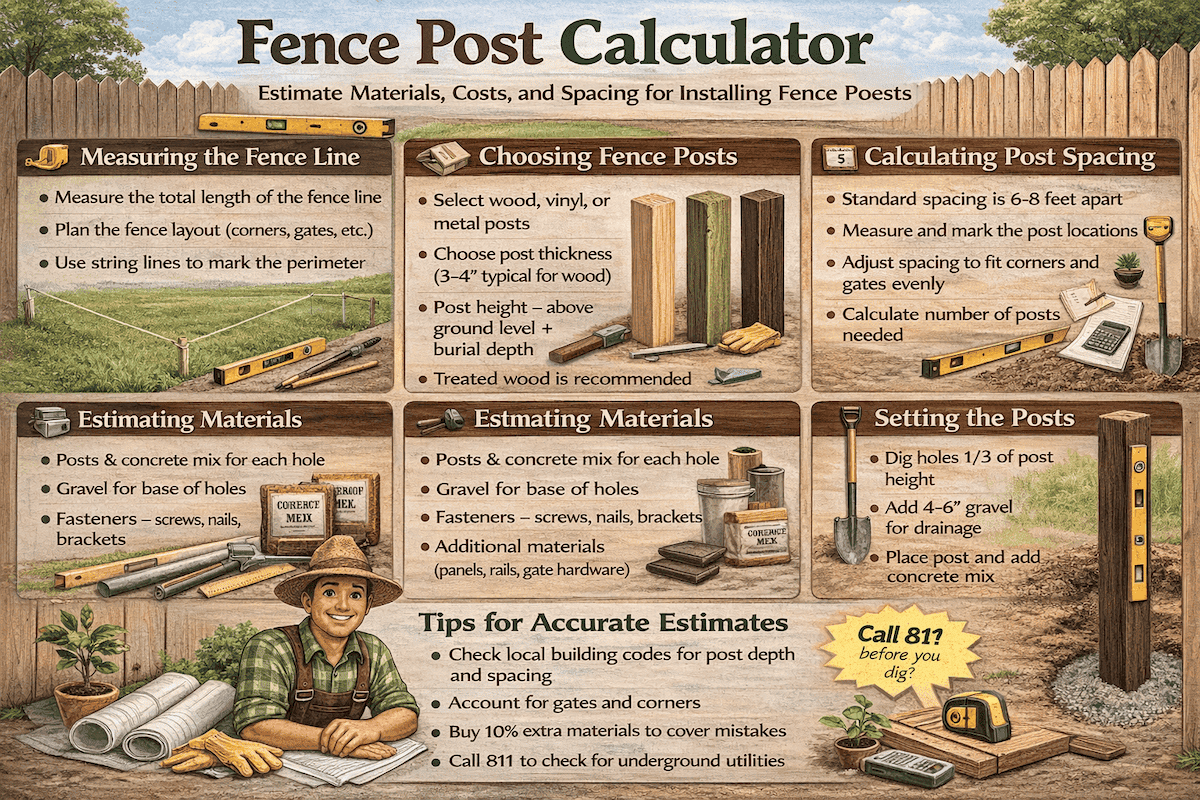
💡 Taking a few minutes to plan ahead can prevent costly mistakes, damaged utilities, and unstable fence posts.
Concrete volume per hole = π × (radius²) × depth. Convert inches to feet first, then multiply by the number of holes. Finally, divide by your selected bag yield to estimate how many concrete bags you need.
If you don’t want to do conversions, use the calculator below—it performs the math and estimates cost and water.
Before using the calculator, it helps to understand how much concrete each bag size typically yields. This quick reference can help you estimate materials faster for fence posts, gate posts, and corner posts.
| Bag Size | Approximate Yield | Best Use |
|---|---|---|
| 40 lb concrete bag | ~0.30 cubic feet | Small post holes and light-duty projects |
| 50 lb concrete bag | ~0.375 cubic feet | Common residential fence post installations |
| 60 lb concrete bag | ~0.45 cubic feet | Heavier residential posts and deeper holes |
| 80 lb concrete bag | ~0.60 cubic feet | Gate posts, corner posts, and large holes |
Actual yield can vary slightly by brand, water content, and mix type, so always check the bag label before purchasing.
One of the easiest ways to budget a fence project is to estimate the concrete cost per linear foot. This helps compare different fence layouts, post spacing options, and total project costs before you buy materials.
A simple formula is:
For example, if your fence uses $240 worth of concrete and the fence length is 120 feet, your concrete cost is about $2.00 per linear foot.
This number becomes even more useful when comparing standard line posts to heavier corner posts and gate posts, which often require deeper holes and more concrete.
Many homeowners use a post hole concrete calculator to compare DIY material costs with contractor-installed fence pricing. Even when labor is excluded, knowing your concrete requirements helps you estimate the real savings of doing the work yourself.
| Project Type | Typical Cost Range | What It Includes |
|---|---|---|
| DIY materials only | Lower upfront cost | Concrete, posts, gravel, fasteners, and tools |
| DIY + tool rental | Moderate cost | Materials plus auger or digging equipment rental |
| Contractor-installed fence posts | Higher total cost | Labor, hauling, layout, installation, and materials markup |
Exact savings depend on local labor rates, soil conditions, fence length, and gate complexity, but accurate concrete estimates are one of the first steps in building a realistic fence budget.
Enter your post hole depth, diameter, gravel base, bag size, price per bag, and post count to estimate how many concrete bags you need, how much water to add, and your total project cost.
Every tree planted is a metric waiting to be measured by a tree calculator.
It depends on hole diameter, depth, and post size. A common rule is a hole ~3× the post width and 1/3–1/2 of the post length in the ground. For a 4×4 post in a 10–12 in (25–30 cm) hole, expect roughly 1.5–2 bags of 50–60 lb fast-setting mix; larger posts or deeper holes require more.
Bury 1/3–1/2 of the post length, and at least to/below your local frost line to reduce heave. Typical residential runs: 2–3 ft (0.6–0.9 m) for 6–8 ft fences, deeper for gate posts or high-wind areas.
Fast-setting mixes set in ~20–40 minutes and are great for small projects and quick bracing removal. Standard mixes have longer working time, useful in heat, for large holes, or when aligning multiple posts. Both reach comparable strengths when cured per instructions.
Yes, many manufacturers allow dry-setting—pour dry mix around the post and water per bag directions. It’s convenient for small holes and good drainage soils. For poor drainage or structural posts (e.g., gates), premixing often yields more reliable hydration.
Light handling is often possible after a few hours with fast-set concrete, but wait 24–48 hours before loading posts; full cure takes up to 28 days. Wind bracing during early cure helps keep posts plumb.
Copyright © All rights reserved Tree Plantation