


 INVEST
 PLANT
PLANT
 SOFTWOODS
 HARDWOODS
 CALCULATORS
 RESOURCES
 PROGRAMS

Softwoods
Learn More
FAST-GROWING • TIMBER • HIGH ROI
Wondering what a Paulownia tree is and why it’s gaining attention worldwide? Paulownia (often called the Empress or Princess Tree) is one of the fastest-growing hardwood trees, valued for rapid growth, high-yield timber, and plantation potential.
🌳 Quick answer: Paulownia is valuable because it grows extremely fast, can be harvested in 5–7 years, produces lightweight yet strong timber, and can regrow after cutting through coppicing.
Examples: Paulownia wood is used for furniture, veneer, cabinetry, musical instruments, surfboards, and lightweight construction, while plantations are used for timber production, carbon projects, and agroforestry systems.
Native to Asia and now cultivated globally, Paulownia is increasingly used in high-density plantations, regenerative agriculture systems, and fast-rotation forestry where speed, yield, and adaptability are key advantages.
Paulownia is an ultra-fast-growing hardwood species prized for its exceptional growth rate, lightweight yet durable timber, and ability to thrive in a wide range of climates.
🚀 Did you know? Paulownia can grow up to 10–15 feet per year and reach harvestable size in as little as 5–7 years—making it one of the fastest ROI timber trees in the world.
In addition to timber production, Paulownia trees offer significant environmental benefits. Their large leaves help improve soil organic matter, their root systems support soil structure, and their rapid growth makes them effective for carbon capture and land restoration.
Key insight: Paulownia is not just a fast-growing tree—it is a short-rotation timber system that combines rapid growth, repeat harvest potential, and strong market demand.
Paulownia, also known as the Empress Tree or Princess Tree, is a fast-growing deciduous species native to China, Korea, and Japan. It is widely recognized for its ornamental beauty, exceptional growth rate, and high-value timber. Although often marketed as a “hardwood,” Paulownia is botanically classified as a hardwood (angiosperm)—not a softwood—because it is a broadleaf tree. However, its wood is unusually lightweight, soft, and easy to work, which is why it is sometimes mistaken for, or compared to, softwoods.
In fact, Paulownia behaves more like species such as basswood in terms of weight, workability, and growth characteristics—blurring the line between traditional hardwood and softwood performance. This unique combination makes it especially valuable for applications requiring strength-to-weight efficiency.
Paulownia thrives in temperate to subtropical climates with warm summers and mild winters. It performs best in well-drained soils and is commonly found along riverbanks, open woodlands, and reclaimed or disturbed lands—making it an excellent candidate for land restoration and agroforestry systems.
Paulownia tomentosa and Paulownia elongata clones are genetically identical trees propagated through cuttings or tissue culture to replicate desirable traits such as rapid growth, straight form, and high timber yield.
Cloning provides several key advantages:
Both species are exceptionally fast-growing and well-suited for reforestation, afforestation, and commercial plantation systems. Their timber is prized globally for its lightweight strength and dimensional stability.
While cloning ensures consistency and performance, maintaining genetic diversity is important for long-term resilience. Blending cloned and seed-grown trees can help reduce risk from pests, disease, and environmental stress—supporting a more sustainable and adaptive plantation model.
The terms hardwood and softwood refer to a tree’s botanical classification—not necessarily the hardness of its wood. Paulownia is technically a hardwood (angiosperm), even though its wood is light and soft. In contrast, pine is a true softwood (gymnosperm), while basswood—like Paulownia—is a hardwood with very soft, lightweight characteristics.
| Tree Type | Botanical Class | Growth Rate | Wood Density | Workability | Common Uses |
|---|---|---|---|---|---|
| Paulownia | Hardwood (Angiosperm) | Ultra-fast (10–15 ft/year) | Very low (lightweight) | Excellent (easy to cut, stable) | Furniture, veneer, surfboards, instruments |
| Pine | Softwood (Gymnosperm) | Fast | Low to medium | Good (resinous, knots common) | Construction lumber, framing, paper |
| Basswood | Hardwood (Angiosperm) | Moderate | Very low (soft hardwood) | Excellent (ideal for carving) | Carving, crafts, lightweight panels |
Feel free to share this Paulownia Empress Tree infographic on your website or blog. Please include a link back to this page as the source.
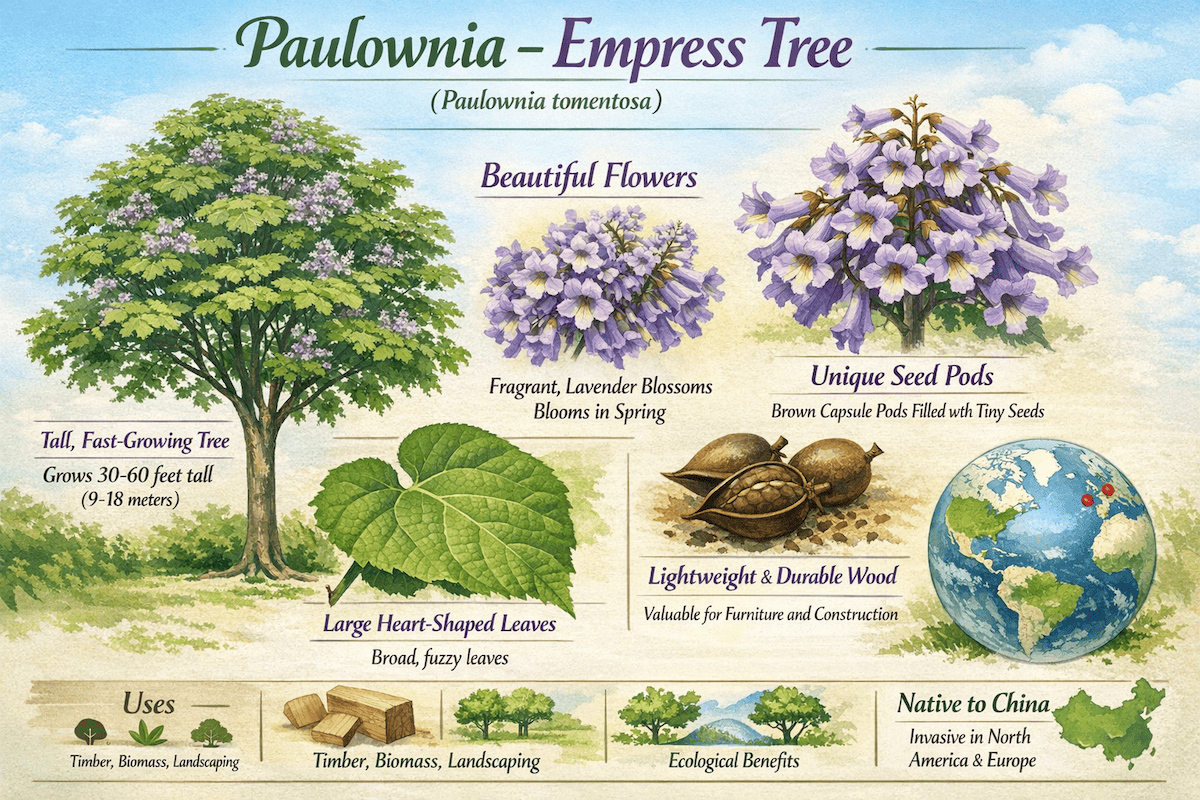
As pressure continues to increase on natural forests and traditional timber resources, interest in plantation-grown Paulownia Empress trees is rising rapidly. Paulownia is now recognized as one of the most promising trees for high-yield biomass production, thanks to its extraordinary growth speed, strong coppicing ability, and capacity to generate large amounts of usable wood fiber in a relatively short time. For growers seeking a fast-rotation tree crop, Paulownia offers a compelling combination of speed, sustainability, and commercial potential.
Native to China and cultivated throughout Asia for centuries, Paulownia—often called the Empress Tree or Princess Tree—has earned a reputation as one of the fastest-growing hardwood trees in the world. Under favorable conditions, young trees can grow 8 to 15 feet in a single season, and well-managed plantations can produce trees reaching 40 to 60 feet in height within 8 to 10 years. This aggressive growth habit allows Paulownia to produce substantial above-ground biomass far more quickly than many conventional plantation species.
Today, improved Paulownia planting stock is often propagated through tissue culture and cloning, allowing growers to establish plantations with uniform trees selected for desirable traits such as rapid growth, straight trunks, disease resistance, and reliable biomass yield. This consistency is especially important in large-scale biomass projects, where predictable rotation cycles, even stand development, and efficient harvest planning can significantly improve long-term profitability.
Although Paulownia is botanically classified as a hardwood because it is a broadleaf tree, its wood is unusually lightweight, soft, and easy to work. In many ways, it behaves more like low-density hardwoods such as basswood or poplar than dense, slow-growing hardwood species. The wood is pale in color, often compared visually to ash, with a generally straight grain and a subtle transition between sapwood and heartwood. While it is not typically valued for heavy structural applications, these same low-density characteristics make it highly attractive for biomass, fiber, pellets, chips, and other renewable wood-based products.
One of Paulownia’s biggest advantages is its ability to regrow from the stump after harvest, a trait known as coppicing. This means growers may be able to harvest multiple biomass rotations from the same root system without fully replanting each cycle. That can reduce establishment costs, shorten the timeline to the next harvest, and improve the economics of plantation management over time. For biomass-focused operations, this regenerative capacity makes Paulownia especially attractive as a renewable energy tree crop.
In addition to its production advantages, Paulownia can play a role in broader sustainability strategies. Fast-growing tree plantations can help capture carbon, stabilize soils, reduce erosion, and provide an alternative source of renewable raw material that may reduce harvesting pressure on slower-growing natural forests. When integrated into well-managed plantation systems, Paulownia can support the development of bioenergy, biofuels, wood pellets, fiber products, and other climate-smart bioproducts.
Tree farmers may have the potential to generate significant returns from biomass Paulownia Empress tree plantations, particularly where site conditions, spacing, genetics, and local biomass markets align. Fast growth, repeat harvest potential, and high per-acre biomass production make Paulownia one of the more intriguing candidates for growers exploring long-term plantation value.
With its exceptional growth rate, renewable harvest potential, and suitability for a wide range of biomass applications, Paulownia Empress trees offer a powerful model for sustainable plantation forestry. For landowners, growers, and investors looking toward the future of renewable energy and tree-based agriculture, Paulownia stands out as a species that combines ecological value with real commercial promise.
Not all biomass tree species perform equally. Growth rate, ability to regenerate (coppice), and total yield per acre play a major role in long-term profitability. The table below compares Paulownia with other leading biomass species used in plantation systems worldwide.
| Species | Growth Rate | Coppicing Ability | Biomass Yield (Dry Tons/Acre/Year) | Rotation Cycle | Estimated Profitability / Acre |
|---|---|---|---|---|---|
| Paulownia | Ultra-fast (10–15 ft/year) | Excellent (multiple harvests) | 10–20+ | 5–10 years | $20K–$40K+ |
| Eucalyptus | Very fast | Excellent | 8–15 | 5–8 years | $10K–$25K |
| Hybrid Poplar | Fast | Good | 6–12 | 6–12 years | $8K–$18K |
| Willow (Short Rotation) | Fast | Excellent | 5–10 | 3–5 years | $6K–$15K |
| Loblolly Pine | Moderate-fast | Limited | 3–7 | 15–25 years | $5K–$12K |
*Estimates vary based on climate, soil quality, spacing, management practices, and local biomass markets. Use a biomass calculator or plantation planning tool for site-specific projections.
Estimate biomass yield, harvest cycles, coppicing performance, and per-acre profitability across multiple tree species and climate regions. Compare dry vs green tons and model short-rotation biomass systems with confidence.
A well-managed 1-acre Paulownia biomass plantation can produce substantial wood fiber in a relatively short period of time. Exact numbers vary by climate, irrigation, soil quality, spacing, genetics, and harvest age, but the example below shows why Paulownia is often considered one of the most promising short-rotation biomass trees.
| Planting Density | 400–600 trees per acre |
| Growth Timeline | Rapid establishment in year 1, harvest window commonly 5–10 years depending on biomass goals |
| Estimated Biomass Yield | 50–150+ dry tons per acre per rotation |
| Coppicing Potential | Yes — trees may regrow from the stump for future harvest cycles |
| Potential Gross Revenue | Approximately $10,000–$40,000+ per acre per rotation, depending on biomass pricing and end use |
| Best Uses | Wood chips, pellets, bioenergy feedstock, fiber products, and renewable bioproduct markets |
Example scenario: If a plantation is stocked at 500 trees per acre and produces 100 dry tons of biomass over an 8-year rotation, the project may offer attractive returns where strong biomass markets exist. Faster regrowth after harvest can further improve long-term economics by reducing replanting costs and shortening future production cycles.
Important: Real-world profitability depends on land cost, irrigation, fertilization, harvest method, transportation, local processing access, and whether the crop is sold as raw biomass or upgraded into higher-value products.
A well-designed 1-acre Crop Circle Paulownia biomass plantation can significantly increase tree density, improve light distribution, and create a more efficient production layout for short-rotation harvests. By planting at a higher density and optimizing the growing pattern, a Crop Circle configuration may increase per-acre biomass production and, in some systems, shorten the harvest cycle by approximately 1 year compared to conventional row planting.
| Planting Density | Up to 1,500 trees per acre |
| Growth Timeline | Accelerated establishment in year 1, with harvest potential commonly in 4–9 years depending on biomass goals and management intensity |
| Estimated Biomass Yield | 90–225+ dry tons per acre per rotation |
| Coppicing Potential | Yes — trees may regrow from the stump for future biomass harvest cycles |
| Potential Gross Revenue | Approximately $18,000–$60,000+ per acre per rotation, depending on biomass pricing, plantation management, and end market |
| Best Uses | Wood chips, pellets, bioenergy feedstock, fiber products, carbon-smart biomass systems, and renewable wood-based industrial markets |
Example scenario: If a Crop Circle plantation is established at 1,500 trees per acre and produces 150–200 dry tons of biomass over a 7-year rotation, it may substantially outperform a conventional lower-density planting on a per-acre basis. The tighter, more efficient configuration can improve land-use intensity and bring the plantation to harvest sooner, strengthening total return potential over time.
Important: Actual results depend on genetics, irrigation, fertility, spacing within each circle, local climate, harvest method, transportation costs, and market pricing. Crop Circle systems are best presented as a high-efficiency plantation model with the potential to increase output, reduce time to harvest, and improve per-acre economics when properly managed.
Paulownia wood is prized for its rare combination of light weight, dimensional stability, workability, and sustainability. Harvested from one of the world’s fastest-growing hardwood trees, Paulownia has become an increasingly attractive material for furniture, cabinetry, millwork, veneers, musical instruments, specialty crafts, lightweight panels, and select construction uses. For manufacturers, woodworkers, and plantation growers alike, Paulownia offers a unique blend of performance and renewable value.
In the right applications, Paulownia wood delivers a highly desirable mix of beauty, performance, and sustainability. Its light weight, stability, and versatility make it a premium option for manufacturers and craftsmen, while its fast growth and renewable harvest potential make it appealing for plantation forestry, agroforestry, and climate-smart wood production systems.
With proper pruning, paulownia trees can produce straight, cylindrical poles free of side branches and deformities, reaching heights of 18 feet and diameters of 10–12 inches. These lightweight yet sturdy poles are ideal for construction as they resist sagging under heavy loads. In Asia, 4-year-old paulownia plantations yield pole wood used for roof ridge poles and rafters, supporting concrete and clay-tiled roofs. Villagers note that these poles offer greater strength and less sagging compared to traditional conifer poles used in older homes.
Paulownia timber can be finely sliced or peeled without compromising its structural integrity. In Taiwan, sawlogs are sliced to 1/1000 inch and veneered onto paper for decorative applications. Additionally, paulownia veneer is used to enhance the aesthetic appeal of composite timber products. As high-quality veneer timber becomes scarce and expensive, paulownia emerges as a cost-effective alternative. Veneer wood represents one of the highest-value uses for this versatile species.
Paulownia wood is ideal for moldings due to its ease of tooling, lightweight nature, strength, and ability to achieve a fine finish. These characteristics make it a popular choice for construction and interior design applications.
The empress tree is a viable option for the paper industry, thanks to its fast growth and ability to support repeatable 5-year harvest cycles. After harvesting, the stumps regenerate new trees, often tripling tree density and profits from the original planting. This sustainable method enables continuous harvests without the need for replanting.
Coppicing, a traditional forestry technique, involves cutting trees down to ground level and allowing them to regrow. Paulownia trees adapt well to this practice and exhibit the following traits:
Paulownia wood is rot-resistant, unappealing to termites, and dries quickly with minimal defects. It is excellent for paneling, carving, and machining. However, stumps should be removed after harvesting to prevent regrowth, which can damage structures like driveways.
Often called the "wonder tree," paulownia offers an eco-friendly alternative to rainforest timber. Its wood is as light as balsa yet strong as hardwoods, with a beautiful grain. It is highly sought after for applications like hollow wood surfboards, fetching $10–11 per board foot.
Pruning paulownia trees early and consistently encourages the development of clear boles, enhancing their economic value. Clear wood is more desirable than knot-studded wood for lumber and veneer, making early limb pruning essential for long-term profitability.
Paulownia’s rapid growth offers both opportunities and challenges. While it allows plantation managers to profit quickly on smaller plots, the tree’s abundant seeds can spread widely, potentially becoming invasive and disrupting natural habitats.
When planting paulownia, select flat, well-drained sites, as the tree does not tolerate flooding or waterlogged conditions. Sandy loam is ideal. Consider enriching the soil with a nitrogen-fixing bean crop, like soy, a year before planting. Prepare the land with parallel tilling and disking before planting. For biomass production, space trees 5 feet apart in rows 15 feet on-center to accommodate mechanized harvesters.

Partner with us in a land management project to repurpose agricultural lands into appreciating tree assets. We have partnered with growingtogive.org , a 501(c)(3) nonprofit, to create tree-planting partnerships with land donors.
We have partnered with growingtogive.org , a Washington State nonprofit, to create a land and tree partnership program that repurposes agricultural land into appreciating tree assets.
The program utilizes privately owned land to plant trees that benefit both the landowner and the environment.
If you have 100 acres or more of flat, fallow farmland and would like to plant trees, we would like to talk to you. There are no costs to enter the program. You own the land; you own the trees we plant for free, and there are no restrictions—you can sell or transfer the land with the trees anytime.
Paulownia, often called the Empress Tree or Princess Tree, is a fast-growing deciduous tree native to China, Korea, and Japan. It is known for its huge heart-shaped leaves, fragrant spring flowers, and lightweight, straight-grained timber. Today Paulownia is planted worldwide for timber, biomass, agroforestry, and ornamental use.
Under good site and management conditions, Paulownia can add 10–15 feet of height in its first growing season and reach about 60 feet tall in roughly 10 years. Well-managed plantations often plan a 7–10 year harvest cycle for biomass or small-diameter timber, with selected trees grown longer for higher-value logs and veneer.
Two of the most common plantation types are Paulownia tomentosa and Paulownia elongata. Commercial operations frequently use clonal material propagated via cuttings or tissue culture to capture desirable traits such as rapid growth, straight stems, good form, and disease tolerance. Cloning delivers uniform plantations, but many growers still mix in non-clonal stock or other species to maintain overall genetic diversity and resilience.
Paulownia thrives in temperate and subtropical climates with warm, moist summers and relatively mild winters. Trees prefer deep, well-drained sandy loams and full sun. They are often planted along riverbanks, in open woodlands, and in disturbed areas such as old fields and road edges. Avoid waterlogged sites, compacted soils, and locations with persistent hard freezes or very late spring frosts that can damage new shoots.
Botanically, Paulownia is a hardwood broadleaf tree, but its timber behaves more like a very lightweight softwood. The wood is pale, with a subtle transition between heartwood and sapwood, and has a fine, straight grain. It is lighter and less strong than traditional construction timbers, which is why it is favored for specialized timber, veneer, and biomass energy rather than heavy structural framing.
Because Paulownia is lightweight, stable, and easy to machine, it is used in:
For larger projects, you can estimate the value of individual trees or small woodlots using our Tree Value Calculator.
Well-managed biomass Paulownia plantations can produce substantial yield because of the tree’s rapid growth and ability to be harvested on short rotations. Under favorable conditions, tree farmers can potentially earn tens of thousands of dollars per acre over a 10-year rotation from repeated biomass harvests, depending on stocking density, log size, and local markets. Use the Tree Value Calculator together with the Tree Spacing Calculator to compare different planting and harvest scenarios.
Paulownia can be grown from seed, root cuttings, or tissue-cultured plantlets. Large commercial plantations typically rely on clonal starter plants that are produced in nurseries using tissue culture. This method preserves the growth rate, stem form, and wood quality of the parent tree and gives more predictable results in the field. Smaller growers may also use suckers or root sprouts to expand local plantings.
Spacing depends on your goals:
Many growers start with dense spacing, then thin and prune for better form. To experiment with different layouts and stocking levels, use the Tree Spacing Calculator to see how many Paulownia trees fit per acre at various spacings.
Yes. Paulownia is an excellent coppice species. After the main stem is harvested, new shoots emerge from the stump or root system and can be trained into one or more replacement stems. This makes Paulownia particularly well suited to coppice forestry and biomass systems, where multiple harvests are taken from the same rootstock over several decades.
In some regions, especially where Paulownia tomentosa escapes into disturbed areas, the species is considered potentially invasive. Responsible growers reduce risk by:
Always check local regulations and extension guidance before establishing large plantings of any potential weed tree.
Paulownia’s rapid growth and big leaf area enable it to capture carbon quickly, helping offset emissions when used in durable wood products or well-managed bioenergy systems. Plantations also provide:
To estimate the carbon stored in your trees, try the Tree Carbon Calculator.
Although Paulownia is a powerful fast-growing timber and biomass species, it is not a magic tree. Common challenges include:
As with any plantation project, it’s wise to start with a small test plot, gather local data, and adjust your spacing, pruning, and harvest schedule as you learn how Paulownia performs on your site.
For many smallholders, Paulownia offers a flexible mix of benefits: fast shade, light but useful timber, biomass fuel, and potential income from poles, boards, or specialty products. When planted thoughtfully alongside other softwoods and hardwood timber species, Paulownia can play a valuable role in diversified woodlots, agroforestry systems, and family-scale plantations.
Copyright © All rights reserved Tree Plantation