



 INVEST
 PLANT
PLANT
 SOFTWOODS
 HARDWOODS
 CALCULATORS
 RESOURCES
 PROGRAMS

Softwoods
Learn More
SPRUCE TREES • SOFTWOOD • FORESTS & TIMBER
Wondering what spruce trees are used for and how to grow them successfully? Spruce trees (genus Picea) are cold-hardy evergreen conifers known for their fast growth, strong softwood, symmetrical shape, and ecological importance. They thrive in cool climates with moist, well-drained soils and are widely found across Canada, northern Europe, Scandinavia, and Siberia.
🌲 Quick answer: Spruce trees are valued for construction lumber, paper production, musical instruments, windbreaks, and Christmas trees, while also providing wildlife habitat, soil stabilization, and forest ecosystem support.
Examples: Popular species include Norway spruce, blue spruce, Sitka spruce, white spruce, and black spruce, each used for timber, landscaping, shelterbelts, and specialty wood products.
Spruce trees are easily recognized by their stiff, four-sided needles that grow from small woody pegs and by their hanging cones. Their combination of lightweight strength, durability, and straight grain makes spruce one of the most important softwoods in global forestry and construction.
Spruce is one of the most important tonewoods in the world—used for guitars, violins, and pianos—because its high strength-to-weight ratio allows it to vibrate clearly and project sound efficiently.
Spruce trees are evergreen conifers from the genus Picea, native to the northern hemisphere. They are recognized by their stiff, four-sided, needle-like leaves, which grow individually from small, woody pegs on their branches, and by their hanging cones.
These cold-hardy softwood trees thrive in cooler climates with consistent moisture and well-drained soils. They are commonly found across Canada, northern Europe, and high-latitude regions where rainfall and seasonal conditions support steady growth.
Known for their light weight, strength, and durability, spruce wood is widely used for framing homes, furniture, paper products, and musical instruments. Their symmetrical shape and dense foliage also make them a favorite for Christmas trees and windbreak plantings.
Ecologically, spruce trees play a critical role by providing habitat for wildlife, stabilizing soil, and supporting watershed health. Their needles, rich in vitamin C and natural resins, have also been used traditionally to make teas and remedies for colds and respiratory support.
Despite their many benefits, spruce forests face increasing pressure from climate change, pests, and habitat loss. Sustainable planting and forest management are essential to preserve these valuable trees and the ecosystems they support.
Feel free to share this spruce trees infographic on your website or blog. Please include a link back to this page as the source.
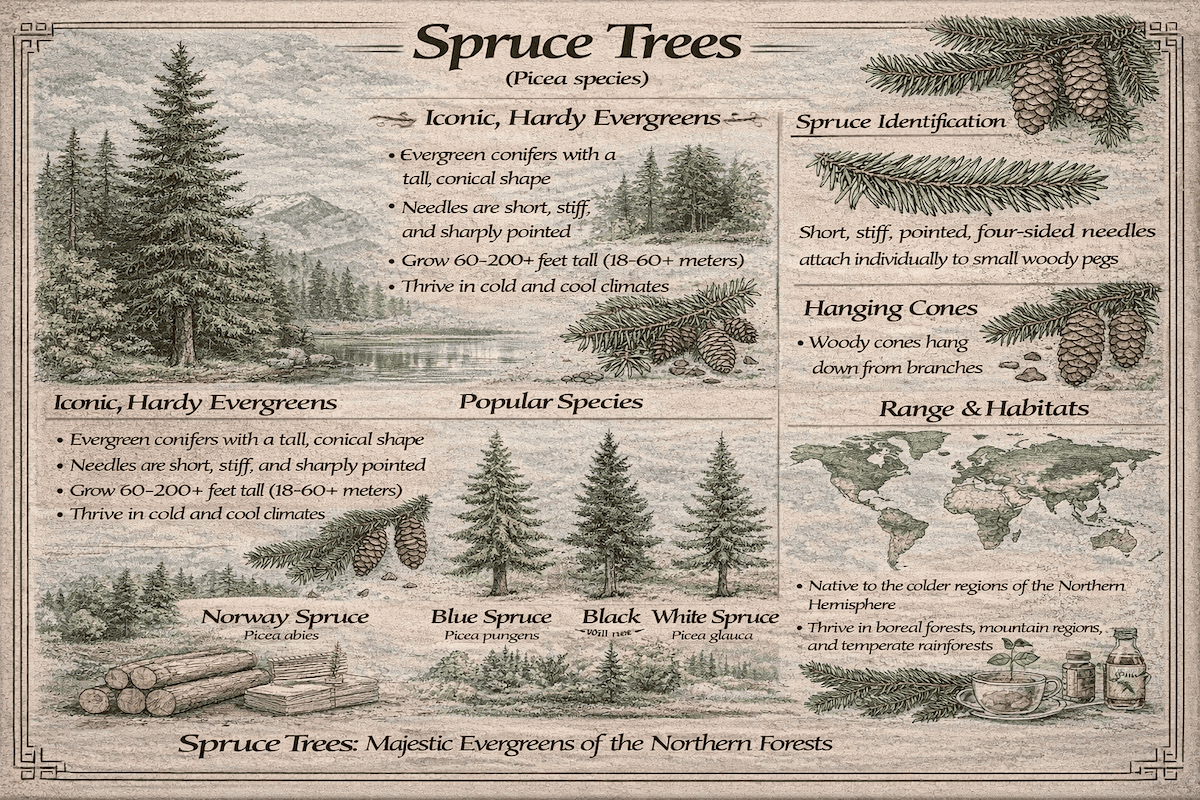
Spruce trees come in a variety of species, each with distinct features, growing ranges, and uses. Below are some of the most notable types of spruce trees grown for timber, landscaping, and reforestation:
Although spruce trees share common features like evergreen needles and conical shapes, their specific traits and applications vary. Some, such as Norway and Colorado Blue Spruce, are better suited for ornamental purposes and windbreaks, while others like Black and White Spruce are primarily grown for timber, pulp, and reforestation.
Beyond their industrial uses, spruce trees hold medicinal and cultural value. In traditional medicine, spruce needles have been used to make vitamin C-rich teas that help boost the immune system and alleviate colds, flu, and respiratory issues. Spruce resins and pitch have also been used historically for salves, mastics, and natural adhesives. Their ecological, commercial, and cultural versatility makes spruce trees an integral part of northern forests and managed woodlands.
Black Spruce thrives in colder climates, primarily in USDA growing zones 1 through 5. These regions encompass northern Canada, much of Alaska, and the far northern United States. The tree’s resilience to harsh winters, short growing seasons, and its preference for moist, acidic soils make it a staple in boreal forests, bogs, and peatlands.
Black Spruce often grows on poorly drained, nutrient-poor sites where few other commercial tree species can thrive. Its shallow roots and tolerance for cold, wet ground allow it to colonize muskeg and lowland areas, providing habitat, stabilizing soil, and contributing to long-term carbon storage in peat soils.

Spruce wood is a highly valued material in the construction and woodworking industries, thanks to its unique features and versatility. Key characteristics of spruce lumber include:
Spruce wood’s combination of strength, workability, and aesthetic appeal has made it a staple in the construction and woodworking industries worldwide. Its widespread availability and eco-friendly sourcing further enhance its appeal, offering a sustainable option for builders, architects, and designers seeking reliable and versatile softwood materials.
Norway, Blue, Black, White, and Sitka Spruce trees play a critical role in the environment by sequestering significant amounts of carbon dioxide (CO2) from the atmosphere through photosynthesis. As they grow, these trees absorb CO2 and release oxygen, helping to combat climate change and improve air quality.
Beyond their carbon-sequestering abilities, spruce trees serve as a sustainable timber resource. With proper forestry management, harvested trees are replaced with new plantings, ensuring a renewable and eco-friendly supply of wood products for construction, paper, and engineered wood products. This makes spruce an important component of climate-smart forestry.
Spruce forests also create essential wildlife habitats and thriving ecosystems. Their dense branches offer shelter and nesting opportunities for birds, while trunks and bark provide cover and homes for small mammals and insects. These animals, in turn, contribute to seed dispersal and forest regeneration, further enhancing biodiversity and long-term forest health.
By planting and managing spruce trees, landowners can positively impact the environment by capturing carbon, providing renewable resources, restoring degraded land, and supporting rich and diverse forest ecosystems.
Modern spruce tree plantations are beginning to adopt innovative geometric and spiral planting patterns instead of traditional straight rows. These designs can improve light distribution, air flow, and access, and may encourage more uniform growth. Planting diverse species such as Norway and White Spruce together can enhance the resilience and productivity of spruce wood plantations, reducing the risk from pests, disease, and extreme weather.
Well-designed spruce plantations can function as multi-purpose forests—producing timber, enhancing wildlife habitat, stabilizing soil, and storing carbon. Thoughtful spacing, mixed-species design, and long rotation lengths all contribute to sustainable, high-value spruce assets.
Softwoods, the pioneer species of the temperate forest, grow quickly to leave their mark on the landscape for centuries. Species like spruce, pine, fir, and cedar form the backbone of many commercial timber and reforestation programs.
For a technology twist on tree-inspired design, explore our guide to solar trees and solar pine structures.
Partner with us in a land management project to repurpose agricultural lands into appreciating tree assets. We have partnered with Growing To Give , a 501(c)(3) nonprofit, to create tree-planting partnerships with land donors.
We have partnered with Growing To Give , a Washington State nonprofit, to create a land and tree partnership program that repurposes agricultural land into appreciating tree assets.
The program utilizes privately owned land to plant trees that benefit both the landowner and the environment. Spruce and other softwood species can be managed for timber, wildlife habitat, and long-term carbon storage.
If you have 100 acres or more of flat, fallow farmland and would like to plant trees, we would like to talk to you. There are no costs to enter the program. You own the land; you own the trees we plant for free, and there are no restrictions; you can sell or transfer the land with the trees anytime.
Spruce trees (Picea) are naturally adapted to cool, northern climates across North America, Europe, and Asia. Many ornamental spruces perform well in cool-temperate zones with cold winters and moderate summers, especially where soils stay moist but not waterlogged. Black Spruce is among the most cold-hardy, thriving in USDA Zones 1–5 and dominating vast areas of the North American boreal forest, peatlands, and bogs.
These popular spruce species share evergreen needles and conical forms but differ in size, natural range, and uses:
A fast-growing European species with dark green needles and gracefully drooping branches. Widely planted as a shelterbelt, reforestation tree, and Christmas tree, and used for construction lumber, pulpwood, and tonewood for instruments.
The largest spruce species, native to the Pacific Northwest. It has an exceptional strength-to-weight ratio and resonance, making it highly prized for aircraft frames, boat building, and musical instrument soundboards.
Known for its striking blue-green needles and symmetrical, pyramidal crown. Commonly planted as an ornamental, windbreak, and specimen tree in large landscapes and parks.
A key Canadian and Alaskan species with light green to bluish needles and an elegant conical form. Widely used for framing lumber, paper, and outdoor structures and in northern reforestation programs.
A boreal species with short, dark needles and a narrow crown. Highly tolerant of cold, wet, nutrient-poor soils, it dominates bogs, muskeg, and peatlands and is harvested for pulpwood, paper, and light construction.
Most spruce trees prefer moist, cool, well-drained soils with a slightly acidic to neutral pH. They perform best where roots can stay cool and evenly moist, and where rainfall or supplemental irrigation is consistent. Black Spruce is more tolerant of poorly drained, acidic, organic soils than many timber species and can colonize peat and boggy sites where other trees fail.
For planting on upland sites, avoid compacted or drought-prone soils if possible. A layer of organic mulch can help retain moisture, moderate soil temperature, and encourage fine root growth around young spruce seedlings.
Growth rates vary by species and site quality:
Mature spruce heights commonly range from 40–100+ feet (12–30+ m), with Sitka Spruce capable of far greater heights in old-growth coastal forests. Crown spread depends on spacing and competition—tighter spacing produces taller, narrower stems with fewer lower branches, ideal for timber.
Spacing depends on your goal—timber plantation, windbreak, or ornamental planting:
For any larger project, design spacing with both early growth and future maintenance in mind, leaving room for access, pruning, and eventual harvest if timber value is a goal.
Yes. Spruce is one of the most important softwood timber species in the world. Its key wood characteristics include:
Because spruce is widely available from sustainably managed forests, it remains a cost-effective and environmentally responsible choice for builders and woodworkers.
Spruce forests provide critical habitat for a wide range of species:
Multi-aged spruce stands with deadwood, downed logs, and understory diversity create especially rich habitats that support long-term biodiversity and forest resilience.
Like other conifers, spruce trees capture and store carbon dioxide (CO2) through photosynthesis, locking carbon in trunks, branches, roots, and forest soils. Large, long-lived spruce stands in boreal and mountain regions are major global carbon sinks.
For landowners and project developers, you can estimate how much carbon your spruce trees store using the tree carbon calculator. When combined with reforestation and climate-smart forestry practices, spruce plantations can become long-term carbon and timber assets.
Yes. If you know your spruce trees’ approximate height, diameter, and species, you can use the tree value calculator to generate an educational estimate of potential timber value. This tool helps landowners:
For any sale, thinning, or harvest decision, always consult a local forester or appraiser—site conditions, log grades, and local markets strongly influence final stumpage prices.
Some spruce species, especially Norway and Colorado Blue Spruce, can grow quite large and are better suited to larger lots, farms, and acreage, where their mature size and root systems won’t conflict with buildings, driveways, or power lines.
On smaller properties, choose compact cultivars or plant spruce where they have room to expand without shading vegetable gardens or crowding foundations. Always check expected mature height and spread before planting, and allow generous distance from structures, underground utilities, and property lines.
Proper establishment is critical for long-lived spruce:
For more detail on planting technique and tree care basics, visit Tree Seedlings & Planting Trees.
Yes. Modern spruce plantations increasingly use creative planting patterns and species mixes instead of monoculture rows. Spiral or radial layouts can improve light distribution, airflow, access, and visual appeal. Mixing species such as Norway, White Spruce, and other softwoods can enhance resilience to pests, disease, and extreme weather.
When combined with tools like the tree spacing calculator and tree carbon calculator, spruce plantations can be designed as multi-purpose forests that deliver timber, carbon storage, wildlife habitat, and long-term landscape value.
Copyright © All rights reserved Tree Plantation






