


 INVEST
 PLANT
PLANT
 SOFTWOODS
 HARDWOODS
 CALCULATORS
 RESOURCES
 PROGRAMS

Softwoods
Learn More
FAST-GROWING • TIMBER • BIOMASS
Wondering how fast eucalyptus trees grow or how many years until harvest? Eucalyptus is one of the fastest-growing tree genera in the world, widely used for timber, pulp, biomass, essential oils, and carbon-focused plantations.
🌿 Quick answer: Many eucalyptus species can reach harvest size in 5–15 years, depending on climate, water, and management—making them ideal for fast-rotation, high-yield plantation systems.
Examples: Eucalyptus is commonly grown for sawlogs, pulpwood, firewood, biomass pellets, essential oils, and carbon sequestration projects.
This guide helps you compare common eucalyptus species, understand typical rotation goals (timber vs pulp vs biomass), and choose practical next steps for plantation planning.
Some eucalyptus plantations can produce multiple harvests from a single planting through coppicing, where new shoots regrow from the stump after harvest—reducing replanting costs and accelerating future rotations.
Start here: pick your end-use, review the species notes below, then follow the planning funnel to check spacing, estimate value, and compare pellet/biomass options.
Jump to: species guide • planning funnel • FAQs
Tip: If you’re comparing eucalyptus vs other fast-rotation trees, scroll to the hub below for quick jumping between species pages.
Key insight: Eucalyptus success depends less on maximum growth rate and more on matching species to climate, water availability, and end-market demand.
Estimate biomass yield, harvest cycles, coppicing performance, and per-acre profitability across multiple tree species and climate regions. Compare dry vs green tons and model short-rotation biomass systems with confidence.
Feel free to share this eucalyptus trees infographic on your website or blog. Please include a link back to this page as the source.
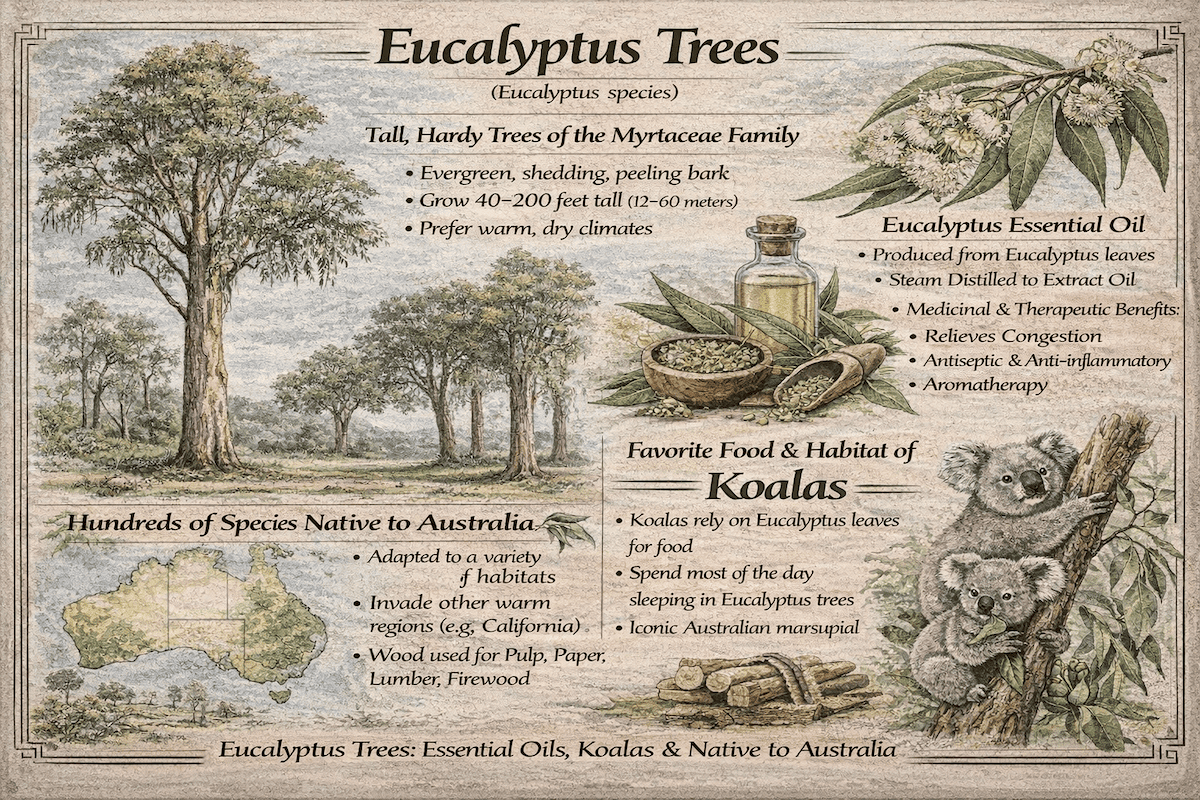
Large eucalyptus plantations are established across Australia, South America (especially Brazil and Argentina), South Africa, India, China, and southern Europe, supplying timber, pulp, renewable energy, and specialty products.
Eucalyptus is not a single wood but a large group of species, each with its own density, color, and performance. Below is an overview of some of the most commonly grown eucalyptus hardwoods, including their typical Janka hardness, grain, and commercial uses.
Blue Gum (Eucalyptus globulus): Blue Gum Eucalyptus is a dense, durable hardwood with a Janka hardness of roughly 2,700–3,000 pounds-force. It usually shows a straight grain and uniform texture, with colors ranging from pale cream to light brown with occasional pinkish or reddish tones. Blue Gum is widely used for flooring, decking, structural framing, outdoor furniture, and veneer.
Jarrah (Eucalyptus marginata): Native to Western Australia, Jarrah is prized as a premium red hardwood. It has a Janka hardness of about 1,800–2,000 pounds-force, a coarse texture, and often interlocked grain. Its rich red, pink, and orange hues make it a favorite for high-end flooring, furniture, joinery, decking, and exterior construction.
Blackbutt (Eucalyptus pilularis): Blackbutt is a strong, versatile hardwood native to eastern Australia. With a Janka hardness around 1,900–2,000 pounds-force, it ranges in color from pale brown to light yellow with occasional subtle streaking. A generally straight grain and even texture make Blackbutt suitable for engineered flooring, decking, stair parts, cladding, and outdoor furniture.
Ironbark (Eucalyptus sideroxylon): Ironbark ranks among the hardest commercial hardwoods, with Janka hardness commonly reported in the 3,000–3,800 pounds-force range depending on species and region. It is deep red to dark brown with darker streaks, a moderately coarse texture, and an interlocked grain. Because of its exceptional strength and durability, Ironbark is used for heavy-duty decking, bridge timbers, wharf and marine work, structural beams, and outdoor furniture.
Spotted Gum (Corymbia maculata): Spotted Gum is known for its distinctive mottled or “spotted” appearance and excellent strength. With a Janka hardness around 2,200–2,500 pounds-force, it ranges from light brown and grey-brown to richer chocolate tones, sometimes with green or yellow highlights. It is popular for solid and engineered flooring, decking, cladding, stair components, and heavy outdoor structures.
Tasmanian Oak (Eucalyptus regnans and related species): “Tasmanian Oak” is a trade name for several pale eucalyptus species; it typically has a Janka hardness around 1,300–1,500 pounds-force. Color is creamy-light, sometimes with pink or red tinges, and the grain is generally straight. Its workability and appearance make it ideal for interior flooring, furniture, cabinetry, doors, and moldings.
Rainbow Eucalyptus (Eucalyptus deglupta): Famous for its multi-colored bark that peels to reveal vibrant green, blue, purple, orange, and maroon strips, Rainbow Eucalyptus is often grown as an ornamental. The wood itself has a moderate density (roughly 1,000–1,200 pounds-force on the Janka scale) and a smooth texture, but it can be prone to warping and checking. As a result, it is used mainly for decorative projects, small woodworking items, turning blanks, veneers, and art pieces rather than heavy structural work.
For tree owners or investors, a good next step is to estimate economic returns from timber. Try the Tree Plantation value calculator to explore potential eucalyptus tree value per acre under different growth and price scenarios.
As a group, Eucalyptus species are remarkable not only for their wood and oil, but also for their ecological and cultural roles. Here are some key facts that make eucalyptus such a unique genus in the tree world:


Eucalyptus oil is an essential oil distilled from the aromatic leaves of certain eucalyptus species, especially Eucalyptus globulus and related trees. Rich in 1,8-cineole (eucalyptol), it has become a staple in medicine cabinets, cleaning cupboards, and aromatherapy kits around the world.
Indigenous Australians have used eucalyptus leaves and smoke for generations as part of their traditional medicine and ceremonial practices. In the late 18th and 19th centuries, European botanists and pharmacists began distilling eucalyptus oil, which quickly gained popularity as an ingredient in liniments, cough syrups, ointments, and disinfectants.
Today, eucalyptus oil is used in many ways, including:
Note: Essential oils are highly concentrated and should be used with care. They are not a substitute for professional medical treatment.
Depending on species and distillation method, eucalyptus oil is generally clear to pale yellow. Chemically, it may be dominated by 1,8-cineole or contain more complex blends of monoterpenes and sesquiterpenes, which influence aroma and best-use applications (pharmaceutical, therapeutic, or perfumery grade).
Eucalyptus oil appears in:
Commercial eucalyptus oil is produced via steam distillation:
Indigenous Australians traditionally used eucalyptus leaves in poultices, steams, and smoke treatments for respiratory discomfort, skin issues, and wound care, and incorporated them in cleansing and spiritual ceremonies. These traditional uses helped inform many of today’s commercial applications.
Prices vary with species, purity, and certification (organic vs conventional), but high-quality pharmaceutical-grade eucalyptus oil often retails in the range of $50–$100 per litre or more in bulk, with smaller retail bottles priced higher on a per-unit basis.

Fast growth, high wood density, and strong coppicing ability make eucalyptus plantations excellent candidates for biomass energy. In short-rotation systems, eucalyptus can supply fuelwood, chips, pellets, and fibre for biorefineries while also sequestering large amounts of carbon.
Some eucalyptus species have become standards in the biomass and pulp sectors thanks to their rapid growth and adaptability:
Under good management, eucalyptus biomass plantations typically produce around 10–30 tons of dry matter per acre per year. Yield depends on:
Eucalyptus for biomass is commonly harvested on 5–7 year rotations. Two main approaches:
Well-managed coppice systems can support multiple harvests from a single planting, making eucalyptus one of the most cost-effective biomass crops available.
Eucalyptus biomass feeds several key industries:
Properly designed eucalyptus biomass projects can deliver renewable energy, carbon credits, and rural employment, while supporting long-term landscape restoration and erosion control.

Eucalyptus plantations are now established on millions of hectares worldwide. Their rapid growth, high yield per acre, and ability to coppice make them a cornerstone of modern timber, pulp, and biomass industries.
Originally native to Australia, eucalyptus has been introduced to:
Eucalyptus thrives in climates ranging from warm temperate to tropical and can succeed on many soil types when matched with the right species, irrigation, and management.
Under favorable conditions, many species can grow 6–10 feet (2–3 m) per year in height, with some reaching commercial size in under a decade. Timber rotations of 7–10 years are common for pulpwood; sawlog rotations may be longer where larger diameters are required.
Plantations typically follow one of two main harvest strategies:
Traditional plantations are planted in rectangular grids, with spacing commonly in the 8–20 ft (2.5–6 m) range depending on product goals (pulpwood vs sawlogs vs biomass).
On drier sites, drip irrigation and fertigation systems improve early survival, shorten rotations, and stabilize yield. Soil preparation, ripping, and the addition of organic matter improve rooting depth and resistance to windthrow.
Beyond conventional rows, Tree Plantation LLC pioneered Archimedean spiral plantation layouts in Florida. In these designs, irrigation lines follow a spiral pattern, and:
Field results have shown that spiral layouts can deliver up to 20% faster growth in some cases, while also improving access, aesthetics, and ecological value. Use the tree calculators below to model different eucalyptus plantation spacing patterns.
Eucalyptus can be propagated either from seed or from vegetative cuttings. Seed propagation supports genetic diversity and is widely used in forestry; cutting-grown planting stock is favored where uniform clonal plantations are desired.
With suitable ground temperatures (around 20°C / 68°F), eucalyptus seeds typically germinate within 4–6 weeks. Cold stratification can improve germination rates:
Many hybrid and selected eucalyptus clones are propagated from cuttings to maintain uniform traits:
For large-scale commercial plantations, seed orchards, clonal hedges, and nursery systems are often combined to deliver robust, uniform planting stock tailored to the desired eucalyptus product (pulp, sawlog, biomass, or oil).
Recent research has shown that tiny amounts of gold can be found in eucalyptus leaves when trees grow over auriferous deposits. As deep roots tap groundwater passing through mineralised zones, trace particles of gold are transported upward and eventually deposited in leaves and twigs.
While the gold concentration is far too low to harvest commercially, leaf analysis can help geologists identify hidden gold deposits without drilling as many exploratory holes. In parts of Australia, eucalyptus stands are now considered a useful tool in surface geochemical exploration.
This is one of the first well-documented examples of a tree drawing measurable quantities of a precious metal into its tissues, highlighting a remarkable connection between forest ecosystems and underlying geology.
Because eucalyptus combines fast growth, high yield, and broad site adaptability, it has become a key species in global timber, pulp, biomass, and carbon projects.
In the United States, eucalyptus is increasingly recognised for its potential in biomass production and carbon sequestration. As part of the “30×30” goal to replace 30% of U.S. petroleum consumption with biofuels by 2030, short-rotation woody crops such as eucalyptus were projected in the original “Billion Ton Report” (USDA / DOE, 2005) to contribute hundreds of millions of dry tons of biomass.
In Brazil, industrial eucalyptus plantations are among the most productive in the world. Under optimal conditions, trees can be harvested for pulpwood in as little as 6–8 years, reaching heights of 30–35 metres. Yields per acre are roughly double those of many conifer plantations, providing a major competitive advantage for the Brazilian pulp, paper, and biomass sectors.
On the Iberian Peninsula, eucalyptus covers about 1.2 million hectares, supplying key feedstock for pulp mills in Portugal and Spain. After recent wildfire seasons, large-scale replanting and improved plantation design aim to rebuild commercial eucalyptus resources while integrating better fire-resilient management.
In its native Australia, eucalyptus remains central to both natural forests and plantations. Improved genetics, clonal forestry, and biotechnology are driving gains in growth rate, wood density, and fibre quality. Short rotations, high productivity, and superior pulp properties make eucalyptus a leading species for Australia’s future pulpwood and biomass industries.
China has planted extensive eucalyptus forests to help reverse deforestation, combat desertification, and supply wood to fast-growing industries. These plantations provide pulp, panels, biomass, and rural employment, while also playing a role in large-scale reforestation and land restoration programs.
Establishment costs commonly range between $1,000 and $3,000 per acre depending on:
Seedlings or rooted clones can cost roughly $25–$100 per thousand depending on genetics and volume. Proximity to sawmills, pulp mills, biomass plants, or export ports is critical for profitability.
Depending on product, rotation length, and market conditions, plantation revenue may range from $5,000 to $10,000 per acre or more over a full cycle, especially where high-value poles, sawlogs, and biomass can be marketed together.
Modern eucalyptus plantations increasingly rely on clonal hybrids—crosses between species such as E. grandis, E. urophylla, and E. camaldulensis selected for:
Clonal material is propagated from live cuttings and planted in the field, allowing plantation managers to roll out proven “elite” genetics across large areas. Over time, the best-performing clones are further refined, raising both productivity and profitability of eucalyptus plantations.
From maple to oak to eucalyptus, hardwoods store decades of growth in every board, providing premium timber and fine furniture wood for generations.
Partner with us in a land management and reforestation project to repurpose agricultural lands into appreciating tree assets. We have partnered with growingtogive.org , a 501(c)(3) nonprofit, to create tree-planting partnerships with land donors.
We have partnered with growingtogive.org , a Washington State nonprofit, to create a land and tree partnership program that repurposes agricultural land into long-term tree assets.
The program utilizes privately owned land to plant trees that benefit both the landowner and the environment— sequestering carbon, improving soil, and generating future timber or biomass revenue.
If you have 100 acres or more of flat, fallow farmland and would like to plant trees, we’d like to talk to you. There are no upfront costs to enter the program. You own the land; you own the trees we plant for free. You may sell or transfer the land with the trees at any time, without restrictions.
Copyright © All rights reserved Tree Plantation