


 INVEST
 PLANT
PLANT
 SOFTWOODS
 HARDWOODS
 CALCULATORS
 RESOURCES
 PROGRAMS

Softwoods
Learn More
MAPLE • HARDWOOD • SYRUP & TIMBER
Wondering what maple trees are used for and why they are so important? Maple trees (genus Acer) are among the most valuable temperate hardwoods, known for maple syrup production, high-quality lumber, landscape beauty, and ecological benefits. They are especially important in North America, where species such as sugar maple, red maple, and silver maple support both forest ecosystems and commercial industries.
🍁 Quick answer: Maple trees are prized for syrup, hardwood timber, shade, fall color, and wildlife value, making them one of the most useful and recognizable tree groups in temperate regions.
Examples: Sugar maple is valued for maple syrup, flooring, furniture, cabinetry, and musical instruments, while red and silver maple are often planted for shade, fast growth, and ornamental landscape use.
Maple trees, often associated with Canadian forests and northern hardwood ecosystems, belong to the genus Acer. With around 128 species worldwide—many native to North America—they combine economic value, cultural meaning, and environmental importance in a way few tree groups can match.
A single mature sugar maple can produce sap for decades while also generating high-value hardwood logs— making maple one of the few trees that offers both annual yield (sap and syrup) and long-term timber value.
Maple trees play a major role in both natural ecosystems and human economies. In forests and urban landscapes, they provide habitat and food for wildlife, including squirrels, birds, and beneficial insects. Their broad canopies help regulate temperature, shade streams and soils, and improve the stability of surrounding landscapes.
Maple trees are also effective carbon sinks, storing carbon in trunks, branches, and roots, contributing to climate stability and long-term forest health. Their root systems help reduce erosion and improve soil structure, especially in mature mixed hardwood forests.
Economically, maple trees are best known for producing hard maple lumber, a premium hardwood used in furniture, flooring, cabinetry, butcher blocks, and specialty products. High-grade sugar maple is especially prized for its strength, wear resistance, and fine, attractive grain.
Maple trees hold immense cultural significance, especially in North America. The maple leaf is a national symbol of Canada and is widely associated with resilience, beauty, and northern forest identity.
Indigenous communities long valued maple for food, medicine, tools, and materials, while later settler traditions expanded maple into furniture making, flooring, and syrup production. Together, these uses helped establish maple as one of the defining trees of North American history and culture.
Maple Sap: Harvested and boiled into syrup and sugar long before commercial production.
Maple Bark: Used for baskets, tools, and containers.
Maple Leaves: Used for teas, poultices, and natural dyes.
Maple Wood: Used for tools, bows, and structural materials because of its strength.
European settlers adopted Indigenous sap-harvesting techniques and expanded maple uses into furniture, flooring, cabinetry, and fine woodworking industries.
Furniture: Durable hardwood for tables, cabinets, and fine woodworking.
Flooring: Popular for high-traffic interiors because of its wear resistance.
Musical Instruments: Used in violins, guitars, drum shells, and other instruments for tonal quality.
Key insight: Maple trees are one of the few species that combine annual production (sap and syrup) with long-term timber value, making them uniquely important for both short-term and long-term returns.
Feel free to share this maple trees infographic on your website or blog. Please include a link back to this page as the source.
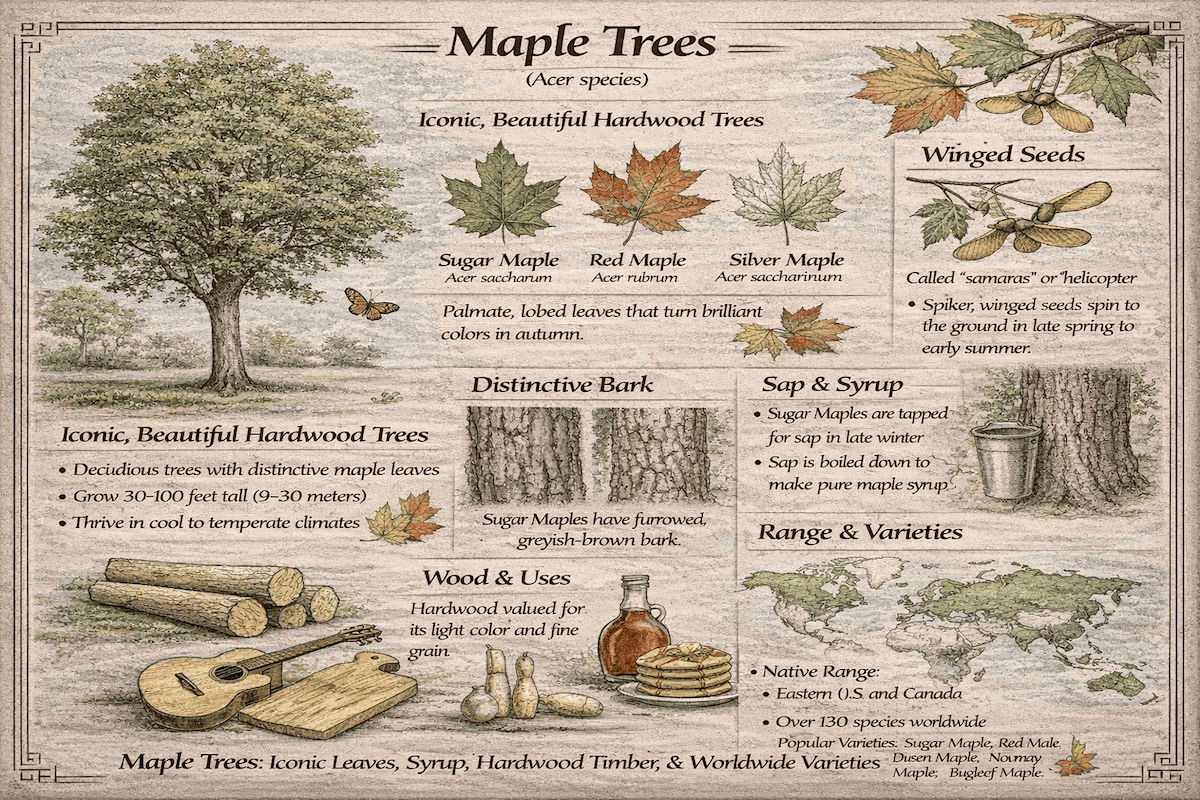

Maple trees include a broad and highly valuable group of species used for timber, syrup production, shade, landscaping, wildlife habitat, and urban forestry. From the dense wood of hard maples to the brilliant foliage of ornamental selections, maples are among the most versatile and recognizable trees in North America and beyond. Some are prized for lumber and veneer, some for sap and syrup, and others for their beauty in parks, streetscapes, and residential landscapes.
The maple group includes both large forest trees and smaller ornamental species, each adapted to different climates and uses. In commercial forestry, maples are important hardwood trees that contribute to flooring, furniture, cabinetry, and specialty wood products. In managed landscapes, they are often planted for shade, seasonal color, and structure. Because of this diversity, maples remain one of the most important tree groups in both natural forests and designed environments.
Although people often refer to “maple trees” as if they were one type, the group includes many species with very different characteristics. Some excel in syrup production, some grow rapidly and provide broad shade, and others are favored for compact form, colorful bark, or dramatic fall foliage. Understanding these distinctions is important for anyone planting, managing, or investing in maple trees.
Hard Maple Trees: The term hard maple usually refers to dense, durable maple species such as sugar maple and black maple. These trees produce wood known for its hardness, wear resistance, and fine grain, making it highly desirable for flooring, furniture, butcher blocks, cabinets, instruments, and specialty millwork. Hard maple lumber is also valued for its light color and clean appearance, which allows it to fit a wide range of interior styles and woodworking applications.
By comparison, species such as red maple and silver maple are often grouped as soft maples. While their wood is generally lighter and less dense than hard maple, it is still commercially useful for furniture parts, veneer, pallets, millwork, and general woodworking. Soft maples can also offer faster growth and broader adaptability, making them important in both urban forestry and regional timber systems.
Sugar Maple Trees (Acer saccharum): Sugar maple is the most famous maple species in North America and is especially valued for its sweet sap, which is used to make maple syrup. It is also one of the premier hardwood timber trees, producing strong, attractive wood with excellent commercial value. Sugar maples are known for their classic five-lobed leaves, rounded crowns, and spectacular orange, red, and yellow fall color. In landscapes, they are widely planted in parks, campuses, and larger residential properties where they can mature into impressive long-lived shade trees.
Canadian Maple Trees: The phrase Canadian maple is often used in a cultural or symbolic sense, especially because the maple leaf appears on the Canadian flag and maple syrup is closely associated with Canada. In practical forestry terms, however, it usually refers to the maple species that dominate parts of eastern Canadian forests, especially sugar maple, along with species such as black maple, red maple, and silver maple in certain regions. These trees play a major role in both the maple syrup industry and the hardwood timber economy, while also shaping the visual identity of Canadian autumn landscapes.
Landscape Maple Trees: Many maple species and cultivars are planted primarily for their ornamental value. These include Japanese maple (Acer palmatum), paperbark maple, hedge maple, and selected forms of red maple and Norway maple. Ornamental maples are popular because of their elegant branching, colorful foliage, attractive bark, and manageable size. In landscape design, they are frequently used as specimen trees, accent trees, courtyard trees, and focal points in gardens or streetscapes.
Other Maple Varieties: Beyond the best-known types, there are many other useful maple species, including bigleaf maple, boxelder, vine maple, and additional regional species adapted to different soils and climates. In western North America, for example, bigleaf maple and vine maple contribute to forest diversity, wildlife habitat, and local wood use. Across broader land-management plans, maple species can provide shade, erosion control, habitat value, and timber potential, making them an important component of mixed-species planting strategies and long-term woodland stewardship.
One of the most important cultural and economic contributions of maple trees is maple syrup production. Syrup is made by collecting sap from maple trees—especially sugar maples—during late winter and early spring, then boiling or evaporating off excess water until the sugars become concentrated. The result is a rich natural sweetener used on pancakes, waffles, desserts, glazes, baked goods, and specialty foods around the world.
Sap flow depends on a specific seasonal pattern: nights below freezing and days above freezing create pressure changes within the tree that move sap upward. Producers drill a small tap hole into the trunk, insert a spout, and collect the sap using traditional buckets or modern tubing and vacuum systems. Because large volumes of sap are required to make finished syrup, productive maple stands are extremely valuable and depend on healthy, vigorous trees.
Maple syrup production also supports rural economies and family operations across major syrup-producing regions. In addition to syrup itself, producers may market maple sugar, maple cream, maple candy, and value-added specialty products. Well-managed maple stands therefore offer multiple layers of return, including annual syrup income, long-term timber value, wildlife habitat, watershed protection, and aesthetic appeal.
Modern syrup grading systems also help producers market syrup by flavor, color, and quality. Lighter syrups are often associated with earlier runs, while darker syrups may have stronger flavor and are often preferred for cooking or specialty uses. These differences add market depth and reinforce the commercial importance of properly managed sugar maple forests.
Despite their value, sugar maple trees face a range of threats that can affect both syrup production and timber quality. Invasive insects, air pollution, acid deposition, drought stress, warming temperatures, and shifting seasonal patterns all place pressure on maple forests. When sugar maples are weakened, sap yields may decline, growth can slow, and wood quality may suffer.
One of the most serious biological threats has been the Asian longhorned beetle, an invasive insect capable of killing maples and other hardwood species. Infestations can cause extensive damage in affected areas and create long-term concern for both forest health and urban tree canopies. Other environmental stresses, including compacted soils, nutrient depletion, and repeated drought, can further reduce vigor and make trees more vulnerable to secondary pests and disease.
Concerns about sugar maple decline have been discussed for decades by foresters, botanists, and syrup producers. Reports from major production regions have pointed to reduced sap output, slower growth, and the cumulative effects of pollution-related stress and acidified soils. Because sugar maples are relatively sensitive compared with some other hardwoods, their performance can decline noticeably when soil calcium and magnesium are depleted or when environmental conditions become less stable.
These challenges have real economic consequences. Reduced sap flow lowers annual syrup yields, while stress-related defects can diminish timber value. High-quality maple lumber is most desirable when it comes from healthy, well-formed trees with straight grain, good color, and minimal defects. For that reason, long-term success in maple production depends not only on species selection, but also on site quality, soil health, forest management, and protection from environmental stress.
Looking ahead, sustaining maple resources will require thoughtful stewardship, including careful planting, monitoring for pests, soil management, and adaptive forestry practices. Whether the goal is syrup production, timber, landscape beauty, or habitat improvement, protecting maple trees means protecting one of North America’s most important and recognizable hardwood groups.

Across the northeastern United States and eastern Canada, sugar maple forests are facing increasing environmental stress driven by a combination of climate change, air pollution, and soil degradation. These trees, which form the backbone of many northern hardwood ecosystems, are particularly sensitive to subtle shifts in temperature, moisture, and soil chemistry—making them a useful indicator species for forest health.
One of the most significant pressures is rising temperatures and changing seasonal patterns. Sugar maples depend on a precise cycle of freezing nights and thawing days in late winter to produce sap. As winters become warmer and more erratic, with irregular freeze–thaw cycles, the timing and duration of sap flow are increasingly unpredictable. Shorter tapping seasons and abrupt sap shutdowns have already impacted syrup yields in many regions, forcing producers to rely on vacuum tubing systems and advanced collection technologies to maintain production.
Changes in precipitation patterns also play a major role. Periods of summer drought stress can weaken trees, reduce growth rates, and make them more vulnerable to pests and disease. Conversely, excessive rainfall and poorly drained soils can limit root oxygen availability, further stressing the tree. Over time, these compounding stresses reduce overall forest resilience and long-term productivity.
In addition to climate-related pressures, air pollution and acid rain continue to impact sugar maple health. Acid deposition can leach essential nutrients such as calcium and magnesium from the soil while mobilizing harmful aluminum, which interferes with root function. Because sugar maples have relatively high nutrient demands compared to many other species, they are especially vulnerable to soil acidification and nutrient imbalance.
These environmental stresses have direct economic implications. Reduced sap flow and altered sugar content can affect both the yield and flavor profile of maple syrup, while slower growth and increased defects may lower the value of maple timber. High-quality maple wood—used in flooring, furniture, and specialty products—requires straight grain, minimal defects, and healthy growth conditions, all of which are influenced by environmental stability.
As a result, site selection and long-term forest management are becoming more critical than ever. Growers and landowners are increasingly prioritizing locations with stable soils, adequate moisture, and lower pollution exposure, while also adopting practices such as soil amendment, selective thinning, and mixed-species planting to improve resilience. In some cases, interest is growing in expanding maple cultivation into new regions with more favorable conditions as part of broader climate adaptation strategies.
Looking ahead, protecting sugar maple forests will require a combination of environmental stewardship, adaptive management, and strategic planting. By addressing pollution impacts, improving soil health, and planning for changing climate conditions, it is possible to sustain both the ecological importance and economic value of these iconic trees for future generations.
Although sugar maple trees are most strongly associated with the Great Lakes, New England, and eastern Canadian forests, they can also perform well in select western U.S. and western Canada microclimates where temperature, soil moisture, elevation, and seasonal dormancy closely resemble parts of their native range. In the right setting, these iconic maple trees can be grown for ornamental value, long-term hardwood potential, and in some cases even future maple syrup production.
Successful western planting depends on choosing protected sites with cool winters, moderate summer heat, reliable soil moisture, and well-drained, fertile soils. North-facing slopes, irrigated valleys, sheltered mountain communities, and other buffered landscapes may provide the type of microclimate sugar maples need to establish and mature. In hotter or drier western regions, site selection becomes especially important, since prolonged heat stress, drought, and poor soils can reduce vigor and slow growth.
Establishing sugar maple plantations or specialty hardwood plantings in suitable western microclimates may offer several long-term advantages. It can help broaden the geographic range of cultivation, support genetic diversity, and create a reserve of valuable trees outside their traditional concentration. For landowners, growers, and conservation-minded investors, this approach may also provide an opportunity to develop attractive, high-value hardwood stands that contribute to shade, habitat, carbon storage, and long-term land stewardship.
In the decades ahead, carefully managed western maple plantings could play an important role in sustainability strategies tied to climate resilience, diversified hardwood production, and future specialty crop systems. Whether grown as part of a landscape plan, an agroforestry model, or a long-rotation timber project, sugar maples represent a tree with both ecological and economic promise when matched to the right western microclimate.

Several microclimate locations along the western corridor of North America have been identified as ideal for growing sugar maple. These include areas in British Columbia, Canada, as well as Washington, Oregon, and California in the United States.
In Canada, the interior regions of British Columbia—such as the Okanagan Valley and Revelstoke—boast seasonal climates similar to the Great Lakes, making them excellent for sugar maple cultivation. Lower mainland areas like Abbotsford and Chilliwack are also promising candidates, especially for mixed woodlots and agroforestry.
In the United States, areas east of the Cascades such as Spokane and Ellensburg in Washington, the Willamette Valley around Salem and Eugene in Oregon, and select regions in Northern California provide suitable temperature and moisture patterns for sugar maple growth. These microclimates offer the potential to support sustainable maple plantations far from the environmental threats facing sugar maples in the east.
Sugar maple wood—also known as hard maple or rock maple—is renowned for its incredible hardness and durability. Historically, it was the preferred material for bowling lanes and pins before the advent of acrylics and carbon fiber. Its heartwood ranges from light reddish-brown to tan, while the sapwood is creamy white, creating a striking contrast that finishers love.
Maple wood combines physical strength with aesthetic appeal. It is hard, tough, and dimensionally stable, with a fine, uniform texture and generally straight grain. These qualities make it easy to machine and finish, and its resistance to wear and abrasion makes it ideal for high-traffic flooring and commercial interiors. Highly figured maple—such as “bird’s-eye,” “curly,” and “quilted” maple—is considered a premium specialty wood.
Below are comments collected from a national wood products discussion forum about using sugar maple wood for flooring and fine woodworking.
Unlike many hardwoods, the sapwood of sugar maple is often preferred over its darker heartwood. The sapwood ranges from nearly white to off-white cream, often with a reddish or golden hue, making it highly desirable for hardwood flooring. In contrast, maple heartwood is a warmer reddish-brown color. Birdseye maple—a unique, eye-like grain pattern—is most commonly found in sugar maple, though it occasionally appears in black maple as well.
“I was tasked with supplying maple hardwood flooring for a custom home. The client requested wide plank maple flooring at least 12 inches wide, but I couldn’t find any available, even after contacting Canadian suppliers. If available, it would cost a small fortune—likely around $10 per linear foot. I’m now searching local farm woodlots for standing wide-trunk sugar maple to fulfill the request.”
“Maple is a beautiful hardwood but challenging to work with. You need extremely sharp tools for precise woodworking. However, with the right tools and enough time, it’s worth the effort. I have a stunning piece of Birdseye maple that I want to use, and I’m considering buying a tabletop CNC machine to handle the hard work so I can focus on finishing it.”
Maple syrup is produced by boiling down the sap of sugar maple trees. This process is limited to hardwood forests in Québec and New England, along with select regions of Ontario, New Brunswick, and the northern United States. Sap is collected through tubes or pails tapped directly from the trees when internal tree pressure exceeds external air pressure during the freeze–thaw cycle.
The collected sap is boiled to remove water and concentrate the sugars, creating rich, flavorful syrup. Maple syrup is a pure, natural sweetener that also contains essential trace minerals such as potassium, magnesium, phosphorus, manganese, iron, zinc, copper, and calcium.
Maple syrup is graded based on federal standards that evaluate color, flavor, and density. The four categories of “Grade A” syrups are: golden color with delicate taste, amber color with rich taste, dark color with robust taste, and very dark color with strong taste—each suited to different culinary uses.
In terms of value per gallon, maple syrup is often worth eight times the price of gasoline, twenty times the cost of bottled water, and thirty times the price of common cooking oils—underlining the economic importance of healthy maple forests.
Modern hard maple plantations are beginning to adopt innovative spiral crop circle designs instead of traditional parallel rows. These geometric formations improve light distribution, airflow, and access for equipment, while also creating visually striking landscapes that can be marketed as eco-tourism or educational sites.
The circular layout helps buffer trees from extreme wind and temperature swings. While wind can easily channel down straight rows in conventional plantations, it is diffused in circular designs. This can reduce mechanical damage, minimize edge stress, and help maintain more even moisture and temperature conditions around the trees. In the long term, these advantages can translate into higher survival rates, better growth, and increased yields of high-value hard maple timber.
From maple to oak, hardwoods whisper of centuries past, their slow growth a testament to patience, durability, and long-term value.
Partner with us in a land management project to repurpose agricultural lands into appreciating tree assets. We have partnered with growingtogive.org , a 501(c)(3) nonprofit, to create tree-planting partnerships with land donors.
We have partnered with growingtogive.org , a Washington State nonprofit, to create a land and tree partnership program that repurposes agricultural land into appreciating tree assets.
The program utilizes privately owned land to plant trees that benefit both the landowner and the environment through long-term carbon storage, wildlife habitat, and timber value.
If you have 100 acres or more of flat, fallow farmland and would like to plant trees, we would like to talk to you. There are no costs to enter the program. You own the land; you own the trees we plant for free, and there are no restrictions—you can sell or transfer the land with the trees anytime.
The easiest way to tell sugar maple (Acer saccharum) and red maple (Acer rubrum) apart is by their leaves, habitat, and primary uses. Sugar maple leaves usually have five well-defined lobes with smooth, U-shaped sinuses between them, while red maple leaves have three to five lobes, more jagged margins, and V-shaped sinuses.
Sugar maple prefers cool, well-drained, fertile soils and is the main species tapped for maple syrup thanks to its high sap sugar content. Red maple is more adaptable and grows in wetter, lower-quality sites, making it a common shade and street tree. In fall, sugar maples glow with orange and golden yellow tones, while red maples tend toward vivid scarlet foliage. For premium hard maple lumber, sugar maple is the benchmark species.
Most syrup producers wait until a sugar maple is at least 10–12 inches (25–30 cm) in diameter at breast height before placing a single tap. At that size, a healthy tree might be 30–40 years old, depending on site quality and competition. Larger trees can sometimes support two taps, but responsible producers avoid over-tapping to protect long-term tree health.
Under good conditions, a mature sugar maple can yield 10–20 gallons of sap per season. Since it takes about 40 gallons of sap to make one gallon of syrup, that works out to roughly a quart or two of finished syrup per tree per year. A well-managed maple stand can therefore provide both timber and a recurring syrup income over many decades.
No, not all maples are equally suitable for syrup production. Sugar maple has the highest average sap sugar content and is the preferred species in commercial sugarbushes. Black maple (Acer nigrum) is closely related and also used.
Other species like red maple and silver maple can be tapped, but their sap is usually less sweet and more variable, which means more boiling for each gallon of syrup. Ornamental maples—such as Japanese maples and Norway maples—are generally planted for landscaping, not syrup, and are rarely tapped on purpose.
Most commercial maple forests are found in the northeastern United States and eastern Canada, where cold winters and reliable freeze–thaw cycles create ideal sap-flow conditions. Sugar maples prefer deep, well-drained, slightly acidic soils and a cool, moist climate.
However, suitable western microclimates exist in British Columbia and the U.S. Pacific Northwest, where seasonal temperature swings and adequate moisture can support sugar maple plantations. These sites are often cleaner, with fewer pollution and acid-rain issues than legacy sugarbushes in the east, making them attractive for long-term timber and syrup projects.
“Hard maple” usually refers to lumber from sugar maple and black maple. It is one of the densest, toughest North American hardwoods, with excellent wear resistance and a fine, uniform texture. Hard maple lumber is prized for:
Because maple is both strong and stable, it competes directly with oak and black walnut as a cornerstone hardwood in furniture and architectural millwork.
Birdseye maple is a rare figure mostly found in sugar maple, where tiny, round “eyes” appear scattered across the board. Curly, flamed, or quilted maple shows wavy, three-dimensional grain that shimmers when finished. These figures occur naturally and unpredictably, making them highly sought after by luthiers, furniture makers, and wood turners.
Because only a small fraction of maple logs exhibit strong figure, highly figured boards can command prices many times higher than standard hard maple. They are commonly reserved for guitar tops, violin backs, decorative panels, and premium one-of-a-kind projects.
Maple forests—especially sugar maple stands in eastern North America—are under pressure from several overlapping threats:
Careful reforestation, pest monitoring, and climate-smart management can help keep maple forests healthy for syrup and timber production.
The value of an individual maple tree depends on its species, size, form, and local markets. A straight, knot-free sugar maple sawlog can be significantly more valuable than a crooked, branchy yard tree of the same diameter. Premium veneer or highly figured logs can bring especially high prices.
To get a rough estimate for a particular tree or stand, you can use the Tree Value Calculator and input diameter, log quality, and local board-foot prices. For a fuller picture of long-term climate benefits, pairing that with the Tree Carbon Calculator shows how much carbon a maple tree or sugarbush can store over its lifetime.
Like other long-lived hardwoods, maple trees act as effective carbon sinks. They capture carbon dioxide and store it in trunks, branches, roots, and forest soils. When maple wood is turned into long-lasting products—such as floors, furniture, or musical instruments—that carbon remains locked away for decades.
Managing maple stands for both timber and syrup—rather than short-rotation clearcuts—supports stable, mixed-age forests that provide shade, wildlife habitat, watershed protection, and ongoing carbon storage. You can quantify this benefit for your own trees using the Tree Carbon Calculator.
Yes—many maple species make excellent street and yard trees when matched to the right site. Red maples, some sugar maple cultivars, and compact Japanese maples are popular for their fall color and manageable size. However, large, fast-growing maples can create issues under power lines or in tiny planting strips, and some species (like Norway maple) are invasive in certain regions.
When planting maples in cities, choose drought-tolerant, non-invasive cultivars, provide adequate rooting space, and avoid heavily compacted soils. Mixing maples with other canopy species improves biodiversity and reduces the risk that a single pest or disease will devastate the entire streetscape.
Traditional maple plantations are planted on straight grids. A spiral or crop-circle layout arranges trees in flowing arcs or spirals, inspired by natural forest patterns. This approach can:
Spiral maple plantings can be combined with agroforestry systems, understory crops, and climate-smart management to produce high-value hard maple timber and syrup while enhancing biodiversity and long-term forest resilience.
Copyright © All rights reserved Tree Plantation