


 INVEST
 PLANT
PLANT
 SOFTWOODS
 HARDWOODS
 CALCULATORS
 RESOURCES
 PROGRAMS

Softwoods
Learn More
PALM TREES • DESERTS • AGRICULTURE
Wondering why palm trees grow so well in deserts and how they have supported human life? Palm trees are uniquely adapted to hot, dry environments, providing food, shade, fiber, and building materials that have sustained civilizations for thousands of years.
🌴 Quick answer: Palm trees thrive in deserts because they tolerate heat, drought, and poor soils, while producing valuable resources like dates, oils, and fibers that support agriculture and trade.
With approximately 2,800 species worldwide, palms are iconic plants of tropical, subtropical, and frost-free regions. They anchor ecosystems, support biodiversity, and remain essential in both traditional and modern landscapes.
Palm trees have a fossil history of over 60 million years. Species like the date palm helped early civilizations survive desert environments by providing food, shade, and materials—making them one of the most important plants in human history.
Date palms were central to early desert agriculture, especially across the Middle East and North Africa. They supported caravan trade routes and allowed settlements to thrive in arid landscapes by creating shaded microclimates where other crops could grow.
Palm trees are neither hardwood nor softwood. Botanically, they are giant monocot plants, more closely related to grasses like bamboo and corn.
Instead of growth rings and solid wood, palms consist of fibrous vascular bundles. While this structure limits traditional lumber use, modern processing techniques can compress palm material into dense, wood-like products suitable for construction and design.
Key insight: Palm trees are not just ornamental—they are foundational survival plants that have shaped agriculture, trade, and human settlement in arid regions.
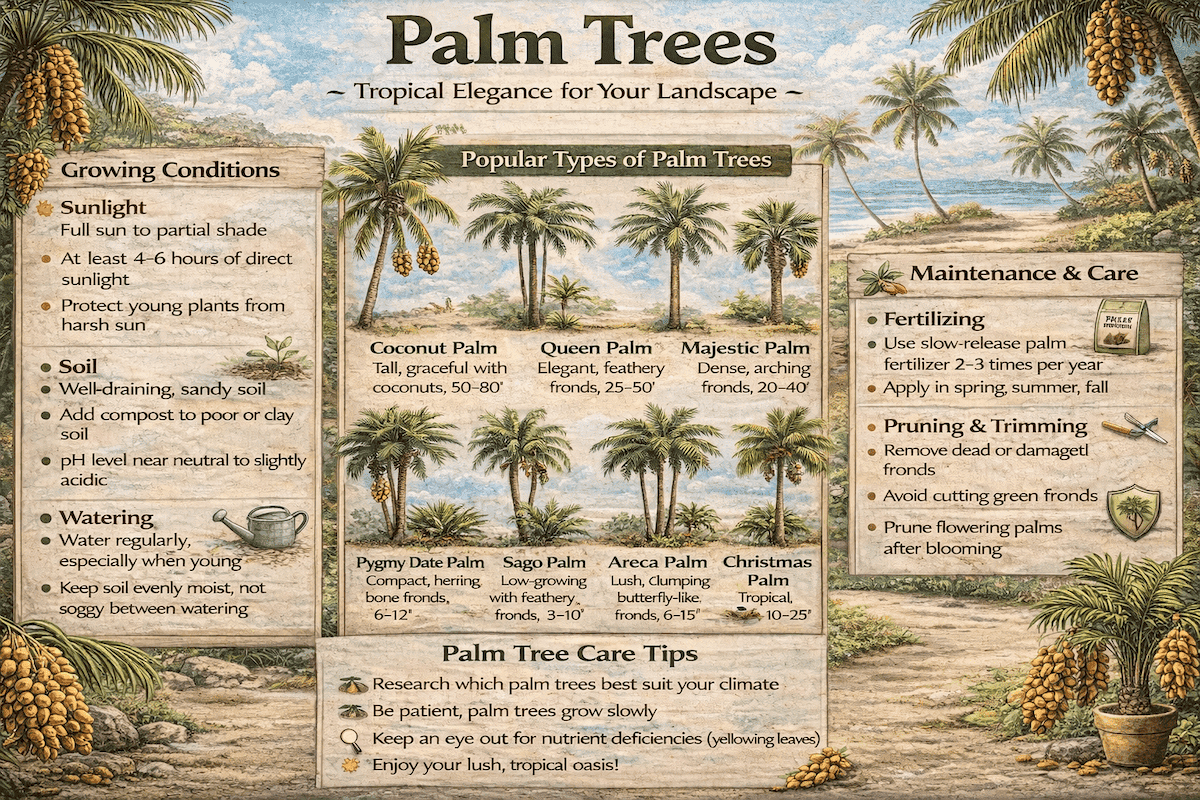
Feel free to share this palm trees infographic on your website or blog. Please include a link back to this page as the source.
Although palm trees are not true hardwoods or softwoods, their trunks can be processed into a dense, highly distinctive material often referred to as palm wood. Because palms are monocots, they do not form traditional growth rings or uniform grain. Instead, the trunk is made of tough, fibrous vascular bundles embedded in softer tissue. When this material is cut, stabilized, and compressed under high pressure, it can be transformed into durable blocks and boards suitable for specialty applications.
The level of compression affects both the appearance and performance of the finished product. In general, the more compression applied, the darker, denser, and harder the material becomes. For example, Red Palm is typically lighter in color and less dense, while Black Palm is heavily compressed, darker, and significantly harder. This gives designers and craftspeople a range of visual and functional options.
While engineered palm wood is not usually chosen for major structural beams or heavy framing, it is highly valued for furniture, flooring, wall paneling, cabinetry accents, bowls, cups, utensils, carvings, and decorative finishes. Its bold flecked texture and exotic appearance make it especially attractive in projects that emphasize natural materials and organic design.
Palm wood also offers an important sustainability advantage. When old palms are removed from urban landscapes, orchards, or plantation systems, the trunks can be repurposed rather than discarded or burned. This creates an additional income stream for growers and communities while reducing waste and extending the economic value of palms beyond fruit and oil production.
Palm trunks are made of dense fibers rather than normal tree rings, which is why palm wood has a unique speckled texture and must be processed differently than traditional lumber.
Across the world, governments and land managers are working to slow or reverse desertification—the gradual degradation of fertile land into dry, unproductive terrain. This process reduces crop yields, increases erosion, weakens rural economies, and threatens the food security of hundreds of millions of people.
One proven strategy is the establishment of tree belts, windbreaks, and green corridors that stabilize soil and reduce the movement of sand. In China, large-scale tree planting projects have been used to slow desert expansion in arid northern regions. In Africa, the Great Green Wall initiative aims to restore degraded land across the Sahel by planting trees and vegetation that can survive in harsh climates while improving soil, biodiversity, and local livelihoods.
In the Middle East, countries such as the UAE are also investing in green barriers and climate-resilient tree systems to protect vulnerable land from wind erosion and advancing sand. These projects rely on hardy species capable of withstanding heat, drought, and poor soils.
Palm trees, especially date palms, can play an important role in these systems. Their deep-rooting habit, tolerance for heat, and ability to create shaded microclimates make them valuable in desert farming, oasis agriculture, and land restoration. Palm belts can help reduce wind velocity, trap blowing sand, protect understory crops, and improve conditions for long-term agricultural recovery.
When integrated into broader desertification control and agroforestry systems, palm trees become more than ornamental plants—they serve as food-producing, soil-protecting, climate-resilient survival trees that help reclaim degraded landscapes and support communities living on the edge of the desert.

In many cases, history shows that it can. During the 1930s, prolonged drought, poor land management, and relentless wind erosion turned large parts of the U.S. southern plains into the Dust Bowl. Millions of acres of topsoil were stripped away, and enormous dust storms carried fertile soil across the country. In response, the U.S. government launched the Shelterbelt Project, planting long bands of native trees from Canada to Texas to reduce wind speed, protect farmland, and stabilize vulnerable soils.
These living windbreaks became one of the clearest examples of how trees can slow land degradation and help combat early-stage desertification. By interrupting wind flow, anchoring soil with roots, and creating more stable microclimates, tree belts can protect crops, reduce evaporation, and make surrounding land more productive.
Today, similar strategies are being used around the world with climate-resilient trees, improved irrigation systems, and better propagation methods. Wide belts of hardy trees and shrubs can trap blowing sand, reduce erosion, protect roads and farms, and create the cooler, less hostile conditions needed for long-term restoration.
A well-designed belt of trees does more than block wind. It can stabilize soil, reduce heat stress, trap sand, improve moisture retention, and create better growing conditions for crops and communities on the desert edge.
Palm trees—especially date palms—are among the most effective species for reclaiming desert margins. They tolerate intense heat, drying winds, saline conditions, and prolonged drought while still producing valuable food crops and creating shade. In many arid regions, palms fit naturally into oasis-style agroforestry systems, where tall upper canopies protect lower crops from sun and wind while helping create a cooler, more humid environment near the soil surface.
In dryland farming systems, date palms are often planted alongside other long-lived crops such as olive trees, producing diversified food and income systems that can survive where conventional farming struggles. Carefully managed palm groves can also support broader restoration goals by reducing erosion, rebuilding degraded soils, and improving habitat for beneficial species.
Mature palm groves can also contribute to carbon sequestration, microclimate improvement, and long-term landscape resilience. This combination of food production, shade, soil protection, and climate adaptation is one reason palms remain central to sustainable agriculture in desert and semi-arid regions.
How Palm Trees Capture and Store Carbon:
Date palms are often called the “tree of life” because of their deep cultural, spiritual, and practical importance. They are among the oldest cultivated fruit-bearing plants on Earth and have supported desert civilizations for thousands of years.
Food: Date palms produce highly nutritious fruit, while their tree seeds, sap, and other byproducts have also been used in traditional food systems across arid regions.
Shelter & materials: Leaves, midribs, and trunks are used for thatch, mats, baskets, fencing, fuel, and simple structures.
Medicine & wellness: Traditional systems have used palm oils, sap, pollen, and fruit in a variety of remedies and health-supporting preparations.
Spiritual significance: Palms appear in religious texts and ceremonies across Judaism, Christianity, and Islam, where they symbolize peace, abundance, resilience, and eternal life.
Economic value: Date production, palm fiber products, palm-derived oils, and related goods continue to support local economies throughout dryland regions.
While most palms are associated with tropical and subtropical landscapes, several species are surprisingly cold hardy and can grow in temperate climates when planted in the right location. These hardy palms can tolerate freezing temperatures, occasional snow, and cool winters, especially when established from healthy tree seedlings and protected during their early years.
In marginal climates, success depends on careful siting, reflected heat, wind protection, excellent drainage, and winter protection during the establishment phase. With the right strategy, palms can serve not only as striking ornamentals but also as functional plants in climate-resilient landscape design.
Spread across islands, deserts, tropical forests, and mountain valleys, palm trees have evolved into some of the most remarkable plants on Earth. Their diversity is extraordinary: some palms produce the largest seeds in the plant kingdom, while others tower above surrounding forests as the tallest palms in the world. This range of form, size, and adaptation helps explain why palms have captured human imagination for thousands of years.
One of the most famous is the legendary Coco de mer of the Seychelles, a rare palm that produces the largest seed in the plant kingdom. Its enormous double-lobed seeds can grow up to 20 inches across and weigh more than 40 pounds, making them one of the most distinctive botanical wonders in the world.
At the other end of the spectrum is the wax palm (Ceroxylon quindiuense), Colombia’s national tree and the tallest palm in the world. Under ideal conditions, wax palms can soar to heights of more than 300 feet, rising above cloud forests in dramatic, column-like forms. These giant palms show that palms are not limited to beaches and deserts—they can also dominate cool, misty mountain landscapes.
Palm trees include some of the largest seeds, tallest trunks, and most climate-adapted food-producing plants on Earth, thriving in habitats that range from tropical islands to harsh desert margins.
More than 2,000 years ago, dense groves of Judean date palms flourished along the Jordan River Valley and around the Dead Sea. These palms were famous in the ancient world for their sweet fruit, medicinal reputation, and economic value. Greek and Roman writers described the dates of Judea as among the finest in the Mediterranean, and the trees became an important symbol of abundance and prosperity in the region.
Over time, however, war, environmental change, shifting trade routes, and changing land use contributed to the disappearance of these once-celebrated groves. For centuries, the Judean date palm was thought to be extinct, remembered only through ancient texts, coins, and archaeological evidence.
That story changed with an extraordinary discovery at the ancient fortress of Masada, overlooking the Dead Sea. Archaeologists uncovered a cache of ancient date seeds preserved in clay jars for nearly two millennia. In one of the most remarkable feats of botanical science ever recorded, several of these ancient seeds were successfully germinated, producing living palms from a long-lost historical variety.
These revived “Masada palms” are now recognized as one of the most remarkable examples of ancient seed recovery and living plant revival ever achieved. They have become an iconic modern example of de-extinction of ancient trees, demonstrating the extraordinary resilience of plant life across vast spans of time.
As these palms mature and, in some cases, begin to produce fruit, researchers are studying their genetics, growth habits, disease resistance, and agricultural potential. Their revival offers a rare opportunity to recover lost genetic diversity and better understand the characteristics of an ancient crop that once played a central role in regional agriculture.
Much like discoveries preserved in petrified forests, the Judean date palm connects the modern world to deep botanical history. It provides a living window into ancient agriculture, plant resilience, and the long relationship between people and palms—showing that even after thousands of years, nature can still surprise us.

Palm oil is one of the most widely used and productive vegetable oils in the world. Derived from the fruit of the oil palm (Elaeis guineensis), it has been valued for centuries in both culinary traditions and natural medicine. Red palm oil, in particular, is naturally rich in vitamin E (tocotrienols), carotenoids, and antioxidants, giving it its distinctive color and nutritional profile.
In traditional uses, palm oil extracts have been associated with anti-inflammatory properties and are sometimes used to support immune health or soothe minor respiratory irritation. In parallel, date palms—often grown within the same oasis and agroforestry systems—produce highly nutritious fruit rich in vitamins B-complex, A, and C, along with essential minerals such as potassium, magnesium, calcium, and iron. Fresh or dried dates provide a dense, natural energy source and have supported desert populations for thousands of years.
From an agricultural perspective, oil palms are exceptionally efficient. They can yield significantly more oil per acre than crops such as soybean, sunflower, or rapeseed, making palm oil one of the most land-efficient sources of vegetable oil. This high productivity has driven its widespread use in food products, cosmetics, soaps, detergents, and biofuels across global markets.
Palm oil produces more oil per acre than any major oilseed crop—meaning sustainable production can reduce pressure on land if it avoids deforestation and prioritizes degraded or previously cleared areas.
However, the rapid expansion of palm oil plantations has also raised serious environmental concerns. In some regions, large-scale development has been linked to deforestation, biodiversity loss, and peatland drainage, contributing to carbon emissions and ecosystem disruption. These challenges have made palm oil one of the most debated crops in global agriculture.
The future of palm oil depends on responsible sourcing, certified production systems, and regenerative land management. Initiatives such as sustainable certification programs, improved supply chain transparency, and replanting on degraded land are helping shift the industry toward more environmentally sound practices. When managed correctly, palm oil can remain a highly efficient crop while reducing its ecological footprint.
Innovative desert agriculture concepts are now reimagining how palm trees can anchor large-scale regenerative systems in arid environments. One such vision proposes transforming sections of the Oman desert into a self-sustaining “green dot”—a circular oasis powered by thousands of date palms and integrated water systems.
In this model, date palms form the upper canopy, providing shade, reducing soil temperatures, and protecting crops from wind and evaporation. Beneath this canopy, diverse food systems can thrive in conditions that would otherwise be too harsh for agriculture.
A protective, three-mile-long covered structure shields the system from blowing sand while enclosing a multi-layered agricultural design:
Projects like this demonstrate how palm trees can function as climate infrastructure—stabilizing soil, reducing heat stress, improving water retention, and supporting continuous food production. By combining traditional oasis principles with modern engineering, these systems offer a blueprint for climate-smart agriculture in desert and semi-arid regions.
At scale, palm-based systems have the potential to transform degraded landscapes into productive ecosystems—showing that even in the harshest climates, food security, carbon capture, and ecological restoration can work together.
Botanically, palm trees are neither hardwood nor softwood. They are giant monocot grasses, more closely related to sugarcane and bamboo than to true trees. Instead of annual growth rings and solid heartwood, palm “trunks” are made of fibrous vascular bundles embedded in softer tissue.
Because of this structure, palms don’t yield conventional lumber. However, when the fibrous stems are compressed under high pressure, they can be turned into dense, engineered “palm wood” that mills and finishes much like hardwood and works well for bowls, utensils, furniture and paneling.
Palm trees, especially date palms, are powerful tools for slowing desertification. Planted in belts or shelterbelts, palms slow the wind, trap blowing sand, shade the soil and create cooler, moister microclimates at the desert’s edge. This protects cropland, villages and infrastructure from creeping sand.
Historic projects like the Dust Bowl-era shelterbelts in the United States, and modern “green wall” initiatives in Africa, the Middle East and China, show how long walls of trees can reduce erosion and help reclaim degraded land when combined with good land management.
Like all green plants, palms capture carbon dioxide through photosynthesis and lock it away in their trunks, fronds and roots. As palms grow, this living biomass becomes an expanding carbon store. An acre of date palms can sequester carbon at rates comparable to many temperate hardwood stands.
Over time, falling fronds, root turnover and organic litter build carbon-rich soils beneath palm groves. This below-ground carbon store improves soil structure, boosts fertility and increases water-holding capacity—key advantages for oasis agriculture and desert-margin farms.
Used correctly, yes. A wide, dense wall of palms and other hardy trees can function as a living barrier that slows wind speeds and reduces the amount of sand carried across the landscape. Deep, well-developed root systems help anchor soil, while the shaded microclimate reduces evaporation.
When integrated into larger agroforestry systems with shrubs, groundcovers and crops, palm shelterbelts can turn bare sand into productive “green dots” that support food production, livestock and local communities along the desert fringe.
Most palms are native to tropical or subtropical regions, but several hardy palm species cope well with freezing temperatures and even occasional snow. Examples include European fan palm (Chamaerops humilis), windmill palm (Trachycarpus fortunei), needle palm (Rhapidophyllum hystrix) and dwarf palmetto (Sabal minor).
Success in temperate gardens depends on choosing cold-tolerant species, providing fast-draining soil, and using heat-reflecting walls, windbreaks and winter protection during the coldest snaps. In favorable coastal or urban microclimates, hardy palms can give landscapes a distinctly “subtropical” feel far from the tropics.
The Judean date palm is an ancient date variety that once formed dense groves in the Jordan River Valley. It was famous in historical and religious texts for its fruit quality and symbolic value, but it disappeared centuries ago due to war, overuse and land-use change.
In a remarkable feat of conservation, seeds recovered from 2,000-year-old storage sites such as Masada were recently germinated, bringing this “extinct” palm back as living trees. The Judean date palm now stands as a symbol of biological resilience, cultural heritage and the potential to revive lost genetic resources for future agriculture.
Engineered palm wood, created by compressing the fibrous trunk, is best suited to small, high-value projects rather than heavy structural beams. Its striking grain and color variations work well for bowls, cups, utensils, tabletops, furniture accents, wall paneling and decorative elements in eco-resorts and homes.
Because many palms are removed from urban streets, old plantations or storm-damaged sites, turning stalks into palm wood products can add value to what would otherwise be waste, supporting circular, low-waste uses of palms beyond fruit and oil production.
In traditional oasis agriculture, date palms form the upper canopy, casting dappled shade over citrus, pomegranates, figs and other fruit trees, with vegetables and forage crops grown underneath. This multi-layer system makes efficient use of limited water and land while buffering crops from extreme heat and wind.
Modern “green dot” projects expand on this idea, combining date palms with protected irrigation canals, fish ponds and vegetable beds to create regenerative hubs of food production, jobs and carbon storage at the edge of expanding deserts.
Palm oil itself is highly productive per acre and has long been used for food, medicine and soap. Problems arise when new plantations replace high-biodiversity rainforests or peatlands. In those cases, the climate and wildlife costs can outweigh the benefits of the oil.
More responsible models prioritize growing oil palms on already-cleared or degraded land, protecting remaining native forests, and improving yields on existing plantations. As a consumer, looking for palm-containing products that reference certified or sustainable sourcing is one way to support better practices.
You can support palm-centered restoration by backing initiatives that use date palms and other resilient species to reclaim deserts, stabilize coastlines and improve food security. Programs that integrate palms into reforestation and climate-smart agriculture, or that help smallholders plant diversified palm-based agroforestry systems, provide both ecological and economic wins.
Learning more about tree-based carbon sequestration, choosing products that respect forests, and sharing the story of palms as “trees of life” in drylands all help build momentum for projects that use palm trees to cool the planet while feeding people.
Copyright © All rights reserved Tree Plantation