INVEST
 PLANT
PLANT
 SOFTWOODS
 HARDWOODS
 CALCULATORS
 RESOURCES
 PROGRAMS

Softwoods
Learn More




Learn fruit tree spacing, compare trees per acre, choose the right orchard layout, and explore how Crop Circle Orchards can increase yield, improve airflow, and support water-smart fruit production.
ORCHARD • SPACING • HIGH-DENSITY
Wondering what a Crop Circle orchard is? A Crop Circle Orchard is a high-density fruit tree planting system that arranges trees in mirrored spiral patterns instead of traditional straight rows.
🍎 Quick answer: Crop Circle orchards use spiral layouts to increase planting density, improve airflow, reduce wind exposure, and maximize yield per acre while maintaining access for irrigation, pruning, and harvest.
Examples: These systems can be used for apples, citrus, stone fruit, nut trees, and mixed-species orchards, especially where space efficiency and microclimate control are important.
Unlike long linear rows, the spiral layout creates a more compact and wind-buffered planting system, helping protect young trees while improving light distribution and canopy structure across the orchard.
Crop Circle orchard layouts can support significantly more trees per acre than traditional row systems, while still maintaining access lanes and airflow—making them a powerful approach for high-yield, space-efficient fruit production.
The goal is to combine the best parts of modern orchard design—tight spacing, drip irrigation, strong airflow, organized harvest lanes, and high yield per acre—within a system that also enhances resilience, efficiency, and long-term productivity.
Key advantage: Crop Circle orchards are designed to maximize output per acre while improving growing conditions—not just increase tree count.
Whether you are planting a traditional orchard or exploring a spiral layout, the same fundamentals still matter: matching the right fruit tree to your climate, choosing the right rootstock, giving every tree enough light and airflow, and building an irrigation plan that supports healthy roots and consistent fruit set.
Fruit tree success comes down to spacing, sunlight, pollination, pruning, irrigation, and long-term canopy control. Crop Circle Orchards apply those same orchard fundamentals in a spiral layout designed for high productivity and strong resource efficiency.
Fruit tree spacing depends on mature canopy size, rootstock vigor, training system, equipment access, and how intensively you want to manage the orchard. Standard trees need far more room than dwarf or semi-dwarf trees, while high-density orchards require regular pruning to keep trees narrow, productive, and easy to harvest.
If you want a quick estimate, use the on-page Fruit Tree Planting Calculator or jump to the interactive orchard planner below.
Use this fruit tree spacing chart as a practical starting point. Final spacing should always reflect your rootstock, training system, soil fertility, irrigation strategy, and harvest equipment.
| Fruit Tree Type | Typical Tree Spacing | Typical Row Spacing | General Trees Per Acre Range |
|---|---|---|---|
| Dwarf apples / pears | 6-10 ft | 10-14 ft | 300-700+ |
| Peaches / plums / apricots | 10-16 ft | 14-20 ft | 130-300 |
| Cherries | 8-18 ft | 14-20 ft | 120-380 |
| Citrus | 10-15 ft | 14-20 ft | 145-310 |
| Standard mixed fruit orchard | 15-25 ft | 18-25 ft | 70-160 |
Tighter spacing can increase early yield, but only if you manage canopy size, renewal pruning, and irrigation. Overcrowded orchards lose light, airflow, fruit quality, and long-term productivity.
Traditional orchards are usually planted in straight, parallel rows. Crop Circle Orchards use spiral geometry to organize trees, irrigation, and access lanes in a more compact pattern. Both systems can be productive, but the spiral model is designed to push density, airflow, and water efficiency farther.
| Feature | Crop Circle Orchard | Traditional Row Orchard |
|---|---|---|
| Tree density | Higher potential density | Moderate to high, depending on system |
| Wind buffering | Strong due to curved rows and reduced edge exposure | More exposed in open blocks |
| Drip irrigation layout | Integrated along spiral planting lines | Straight lateral lines |
| Equipment access | Requires planned loop spacing and turnarounds | Simple row access |
| Visual / educational value | High | Low to moderate |
| Organic potential | Strong when airflow, mulch, sanitation, and IPM are managed well | Strong when orchard spacing and sanitation are well managed |
The best fruit trees for a spiral or high-density orchard are the ones that fit your climate, rootstock, labor budget, and market. In general, growers often begin with species that respond well to pruning, produce on manageable canopies, and have reliable local demand.
A standard Crop Circle Orchard concept uses two mirrored spirals laid out side by side. In the current page model, a minimum of 4 acres of relatively flat land is recommended, with spiral rows spaced about 12 feet apart and planting intervals as tight as 4 feet along the drip line. This can push the design toward very high tree counts while still preserving airflow and equipment movement.
A few trees at the center of each spiral are intentionally omitted to create efficient turnarounds for mowers, carts, and harvest equipment. This reduced center congestion helps maintain practical orchard access.
Drip irrigation is one of the most important performance drivers in any fruit orchard. In spiral orchards, irrigation lines also define the planting path itself, helping growers organize loops, maintain even spacing, and support fertigation with precision. Pair irrigation with mulch such as wood chips or pine straw to conserve moisture and protect root-zone biology.
Jump to the interactive Crop Circle Orchard Planner to estimate trees, spacing, and long-term orchard value for apples, pears, peaches, and more.
Feel free to share this crop circle orchards infographic on your website or blog. Please include a link back to this page as the source.
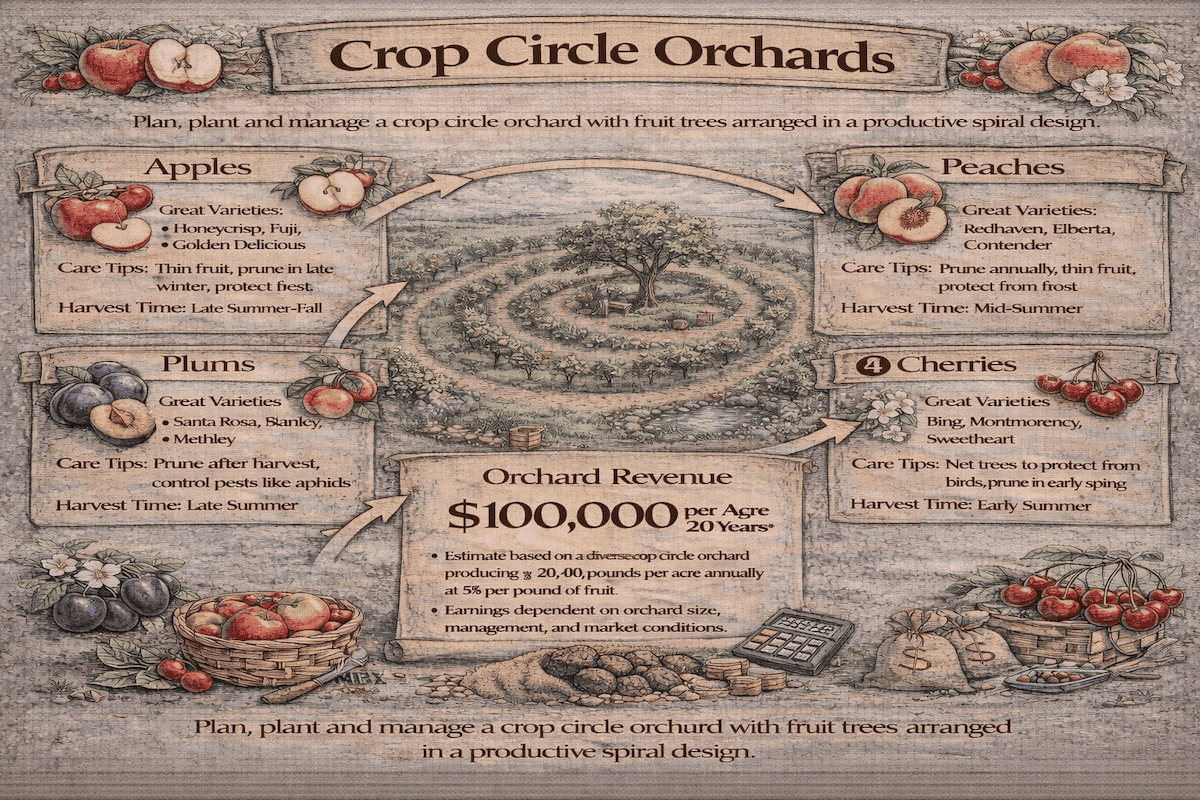
Pruning fruit trees is essential in both traditional and spiral orchards. The tighter your spacing, the more important pruning becomes. The goal is to keep each tree narrow, fruitful, well lit, and easy to harvest without letting canopies crowd neighboring rows or loops.
Estimate how many fruit trees you can plant per acre based on your row spacing and in-row tree spacing.
Conventional orchards typically grow fruit trees in either low-density or high-density planting patterns. Crop Circle Orchards adapt the advantages of both systems into a spiral layout that captures more trees per acre while preserving equipment access and light.
In low-density orchards, trees are planted 10–15 feet apart in parallel rows spaced about 20 feet apart to allow the passage of spraying, pruning, and harvest equipment. Trees are allowed to “fill in” at the top, producing a broad canopy with many fruiting branches. This traditional system has been used for hundreds of years and remains common for standard-size fruit trees.
High-density orchards emerged when enterprising orchardists realized they could plant many more trees per acre, often with support from government programs that rewarded tree counts. While some growers initially struggled to manage vigor and fruit quality in tightly spaced trees, refined pruning, training, and rootstock selection eventually enabled these systems to out-yield low-density orchards, sometimes by 2:1.
In many high-density systems, fruit trees are planted as close as 2 feet apart and trained into slender hedgerows only 2–3 feet wide in full leaf. Rows spaced about 10 feet apart allow equipment to move through. Crop Circle Orchards take these high-density concepts and organize them into circular or spiral rows, further improving wind protection, pollinator movement, and workflow.
Crop Circle Orchards support a full range of temperate climate fruit trees, including pears, apples, cherries, plums, peaches, and apricots. The spiral layout and drip irrigation system adapt well to many commercial varieties and specialty cultivars grown for fresh market, processing, or value-added products.
A 4-acre Crop Circle Orchard with approximately 2,500 pear trees can produce around 200,000 pears per season. Pear varieties well suited to this system include Bartlett pears for preserving and canning, Anjou pears for juicing, and Asian pears for fresh retail sales and farm stands.
There are many pear varieties, each with its own fruit size, shape, color, flavor, and growth habit. Below are some widely planted cultivars:
Other pear varieties include Seckel, Forelle, and Conference pears, each adapted to specific climates and markets. When selecting pear trees for a Crop Circle pear orchard, consider chill hours, disease resistance, and rootstock vigor.

Traditional apple orchards with 20–30 foot spacing produce between 20,000 and 30,000 apples per acre. Modern high-density plantings of roughly 500 trees per acre can double production. Crop Circle Orchards, using spiral high-density systems, can potentially double that again to well over 100,000 apples per acre, depending on variety, rootstock, and management.
Nearly all temperate apple varieties adapt well to Crop Circle designs, including Granny Smith, McIntosh, Gala, Red Delicious, Golden Delicious, Honeycrisp, Nicola, and Spartan apples.
Below are some popular commercial apple cultivars:
Other apple varieties commonly used in Crop Circle apple orchards include Fuji, Braeburn, Jonathan, and McIntosh, each offering different ripening times and flavor profiles.

A conventional cherry orchard typically produces about 80,000 cherries per acre from roughly 80 trees. High-yield management can increase that by about 50%. Crop Circle Orchards, using spiral high-density planting, can potentially triple cherry yields per acre.
Almost all sweet and tart cherries respond well to the Crop Circle system, including Bing, Rainier, Montmorency, and Van cherries. These systems are especially advantageous where wind protection and frost mitigation are critical.
Common cherry varieties include:
Other cherry varieties suitable for Crop Circle cherry orchards include Stella, Lapins, and Sweetheart, which add self-fertility and different harvest windows.

Experimental high-density plum orchards in straight rows have been challenging, but Crop Circle plum orchards have shown promise. Conventional plum production averages about 85,000 plums per acre, whereas Crop Circle Orchards can boost this to more than 180,000 plums per acre under good management.
Both blue and yellow plum types are suitable for spiral systems. Varieties that benefit from this innovative propagation include Methley plums, Blue plums, Yellow plums, and Italian plums typically dried as prunes.
Additional popular plum varieties include:
Other plum tree varieties used in high-density spiral plum orchards include Black Ruby, Shiro, and Damson plums, each suited to specific climates and markets.

Peach trees typically produce fewer fruit per tree than many other orchard crops—around 300 peaches per tree on average. A conventional row orchard with trees spaced 25 feet apart yields about 16,000 peaches per acre. Traditional high-density systems have been difficult to manage for peaches, but spiraled high-density Crop Circle peach orchards have proven successful.
Peach varieties that perform well in Crop Circle systems include Red Haven, Contender, Sweet Bagel, Elberta, and classic Georgia peaches.
Additional peach tree varieties include:
Other peach varieties grown in Crop Circle peach orchards include August Lady, Dixie Red, and Redskin peaches—each with its own ripening window, flavor, and handling characteristics.

In traditional row systems, apricot trees spaced 25 feet apart yield around 500 apricots per tree and 40,000 apricots per acre. Some high-density training systems, such as X-trellis designs, have been tested with mixed results. A proven way to increase apricot yield is to plant apricot trees in Crop Circle Orchards, where spiral spacing and drip irrigation support strong, productive canopies.
All common apricot varieties adapt well to this system, including Golden apricots, Castlebrite, and Pixie-cot, along with many commercial cultivars.
Here are a few widely grown apricot varieties:
Other apricot varieties suitable for high-density spiral apricot orchards include Apache, Harglow, and Perfection apricots, offering different ripening times and disease resistance profiles.

Use this planner to visualize a spiral (crop circle) orchard and understand how spacing, tree count, and production changes over time. One click can plant a full loop (for example, 20 trees) so visitors immediately see the orchard pattern come to life.
Black walnut is typically established using directly sown seed, 2-year bare-root seedlings, or 3-year plug/seedling transplants. In this planner scenario, 220 black walnut trees are planted within a 3.5-acre spiral layout, spaced 25 feet apart.
White oak is typically established using 2-year bare-root seedlings or 3-year plug transplants. In this planner scenario, 300 white oak trees are planted within a 3.5-acre spiral layout, spaced 20 feet apart.
Black cherry is typically established using 3-year seedling transplants, which offer strong survival rates when properly sited and maintained. In this planner scenario, 400 black cherry trees are planted within a 3.5-acre spiral layout, spaced 18 feet apart with 18 feet between spiral rows, allowing each tree adequate spacing for long-term crown development, root expansion, and soil health.
Hard maple (sugar maple) is typically established using 3-year seedling transplants, which offer strong survival rates when properly sited and maintained. In this planner scenario, 280 sugar maple trees are planted within a 3.5-acre spiral layout, spaced 22 feet apart with 22 feet between spiral rows, allowing each tree adequate spacing for long-term crown development, root expansion, and soil health.
Yellow birch is typically established using 3-year transplants, which offer strong survival rates when properly sited and maintained. In this planner scenario, 300 yellow birch trees are planted within a 3.5-acre spiral layout, spaced 20 feet apart with 20 feet between spiral rows, allowing each tree adequate spacing for long-term crown development, root expansion, and soil health.
American chestnut is typically established using 3-year hybrid transplants, which provide strong survival rates when properly sited and maintained. In this planner scenario, 220 American chestnut trees are planted within a 3.5-acre spiral layout, spaced 25 feet apart with 25 feet between spiral rows. This configuration ensures ample room for long-term canopy development.
Mahogany is typically established using nursery-grown transplants, often 2–3 years old, which offer reliable survival when properly sited and managed. In this planner scenario, 220 mahogany trees are planted within a 3.5-acre spiral layout, spaced 25 feet apart with 25 feet between spiral rows. This spacing supports long-term crown development, deep root expansion, and healthy airflow.
Teak plantings are commonly established with well-hardened nursery seedlings or clonal stock that are 2–3 years old, selected for uniform growth and durability. In this planner example, a total of 220 teak trees are arranged across a 3.5-acre spiral planting pattern. Trees are set on 25-foot centers, with equal spacing between spiral rows, creating an open structure that encourages strong trunk formation.
Rosewood is typically established using carefully raised nursery transplants, often 2–3 years old, to ensure strong early growth and successful establishment. In this planner scenario, 220 rosewood trees are integrated into a 3.5-acre spiral planting design. The trees are spaced at 25-foot intervals, with 25 feet between spiral rows, providing sufficient room for mature canopy spread and deep root development.
White pine is commonly established using 2–3 year nursery-grown plug transplants, which provide reliable survival when properly sited and cared for. In this planner scenario, 300 white pine trees are arranged within a 3.5-acre spiral planting pattern, spaced 20 feet apart with 20 feet between spiral rows. This layout balances efficient land use with sufficient room for mature canopy formation.
Western red cedar is typically established using 2–3 year nursery-grown seedlings, valued for their resilience and strong establishment when properly sited and maintained. In this planner scenario, 400 western red cedar trees are planted within a 3.5-acre spiral layout, spaced 18 feet apart with 18 feet between spiral rows. This spacing provides each tree with adequate room for vertical growth.
Hybrid poplar is commonly established using fast-growing nursery transplants or cuttings, selected for rapid early growth and high establishment success. In this planner scenario, 480 hybrid poplar trees are planted within a 3.5-acre spiral configuration, spaced 16 feet apart with 16 feet between spiral rows. This tighter, uniform spacing supports straight trunk formation and efficient canopy development.
Orchard apples are typically established using 8-foot spear transplants chosen for their quick establishment and vigorous early growth. In this planner scenario, 2,000 apple trees are integrated into a 3.5-acre spiral planting design, with trees spaced 6 feet apart and 10 feet between spiral rows. This high-density arrangement promotes manageable tree structure and controlled canopy development.
Orchard pears are typically established using 7-foot spear transplants chosen for their quick establishment and vigorous early growth. In this planner scenario, 2,000 pear trees are integrated into a 3.5-acre spiral planting design, with trees spaced 6 feet apart and 10 feet between spiral rows. This high-density arrangement promotes manageable tree structure and controlled canopy development.
Orchard peaches are typically established using 6-foot spear transplants chosen for their quick establishment and vigorous early growth. In this planner scenario, 2,000 peach trees are integrated into a 3.5-acre spiral planting design, with trees spaced 6 feet apart and 10 feet between spiral rows. This high-density arrangement promotes manageable tree structure and controlled canopy development.
Use the buttons to advance or reverse the future tree value
Your spacing depends on rootstock and training system. Dwarf and semi-dwarf trees can be planted closer and kept productive with annual pruning, while standard trees need more room and longer-term planning.
Many apples, pears, and some plums need compatible pollinizers. Plan variety groupings so bloom times overlap, and include pollinator-friendly plants between loops for better fruit set.
Drip irrigation (or micro-sprays where appropriate) paired with mulch protects soil moisture and reduces weeds. Keep organic matter cycling in the alleys and maintain a clear, mulched ring around each trunk.
Build in at least one continuous access path so you can move a cart, mower, or small tractor. The spiral layout makes circulation intuitive—just make sure your “between-loop” distance supports your equipment.
A Crop Circle Orchard is a high-density orchard system that plants fruit, nut, or citrus trees in spiral rows instead of straight rows. The layout is designed to improve orchard organization, protect trees from wind, support drip irrigation, and increase production potential per acre.
Trees per acre depends on row spacing, tree spacing, rootstock vigor, pruning intensity, and equipment access. Standard orchards may carry well under 200 trees per acre, while high-density systems can support several hundred or more. Use the Fruit Tree Planting Calculator and the interactive orchard planner to compare layouts.
Dwarf trees are commonly planted more tightly than semi-dwarf or standard trees. A practical starting point is to match spacing to the mature canopy size of the tree and then reserve enough room for sunlight, airflow, mowing, spraying, harvesting, and annual pruning.
Apples, pears, peaches, plums, cherries, apricots, and citrus can all work in tighter orchard systems when variety, rootstock, and pruning are chosen correctly. The best species for your site will depend on climate, chill hours, disease pressure, market demand, and labor availability.
Pruning controls canopy width, improves light penetration, reduces disease pressure, and keeps fruit trees productive over time. In tighter orchard systems, pruning is one of the biggest factors separating a productive planting from an overcrowded one.
Yes. Organic management becomes more realistic when you combine good spacing, strong airflow, careful sanitation, drip irrigation, mulch, and integrated pest management. The spiral layout can support those goals when orchard access and pruning are kept consistent.
Before planting, map your irrigation, pollination groups, equipment lanes, slopes, frost pockets, soil drainage, and mulch strategy. Also decide whether your orchard is intended for home use, U-pick, wholesale fruit, nursery stock, or value-added processing.
Copyright © All rights reserved Tree Plantation