

tree logo Follow Us On Facebook Talk About Us On X See Us On Instagram

The best time to grow nut trees was 20 years ago.
The second best time is now.

Crop Circle Nut Groves

Crop Circle Nut Groves: An Introduction to High-Yield Nut Farming

Designing and laying out a commercial nut grove is part science, part art. It requires careful attention to the nut tree species you select, your local climate and soil conditions, and the way you organize space, water, and sunshine across the site. A well-designed orchard or Crop Circle Nut Grove can dramatically increase yield per acre while reducing water and fertilizer inputs.

Traditional nut orchards are usually planted in straight rows. In contrast, a Crop Circle layout uses Archimedean or Fibonacci spirals to create a more efficient nut farming pattern. These spiraled planting systems open the canopy, improve air flow and light penetration, and naturally shelter trees from prevailing winds. Whether you are growing walnut, pecan, almond, macadamia, hazelnut or lychee trees, the right layout directly affects nut quality, yield, and long-term tree health.

  • Choose the right nut trees: Select nut trees that are adapted to your USDA hardiness zone, rainfall pattern, and soil type. Consider mature tree size, chilling requirements, pollination needs, and cross-pollinizer varieties. Look for high-yielding, disease-resistant cultivars and, whenever possible, certified nursery stock.
  • Plan the layout: Begin with a scaled sketch of your proposed nut grove, marking slopes, low spots, access roads, and existing trees or structures. In a conventional orchard, trees are planted in straight or offset rows. In a Crop Circle Nut Grove, trees follow curved, spiraling rows that provide better edge light, improved air circulation, and more efficient equipment access while maintaining high planting density.
  • Consider the soil and irrigation requirements: Most commercial nut trees prefer deep, well-drained loam soils with good structure and organic matter. Poor drainage and waterlogging can lead to root diseases and reduced nut set. Plan for buffer strips, grassed alleys, or cover crops to protect soil structure, reduce erosion, and build soil carbon. Design your irrigation system first, then fit tree placement around its mainlines and sub-mains.
  • Choose the right spacing: Spacing depends on species, rootstock, and the training system you use. As a general guide, many warm-climate nut trees require 20–30 feet between trees and 25–30 feet between rows in conventional layouts. In a Crop Circle system, spiraled rows are often placed 10–14 feet apart with closer in-row spacing, then selectively thinned or pruned as the grove matures to maintain light capture and airflow.
  • Consider the orientation of your orchard: The orientation of your grove can influence temperature, light and frost risk. A north–south orientation is commonly recommended so both sides of the tree receive balanced sun through the day. On sloped land, align rows with contour or gentle diagonal patterns to slow runoff and improve water infiltration.
  • Plan for maintenance: Leave enough space for tractors, harvest equipment and sprayers to safely navigate between spiraled rows. Ensure there is room for pruning, fertilizing, mulching and pest management. In tightly planted high-density systems, a clear equipment turnaround at the center of the Crop Circle prevents soil compaction and trunk damage.

By combining smart layout with water-smart irrigation, soil-building practices and variety selection, you can design a nut grove that is efficient, productive and easier to manage over decades of production.

Soil and Irrigation Considerations for Productive Nut Tree Groves

Long-lived nut trees like walnuts, pecans and almonds may occupy the same ground for 40–60 years, so getting soil health and irrigation design right from the beginning is crucial. Healthy soil and consistent water are the foundation of high-yield nut farming, whether in a conventional layout or a Crop Circle Nut Grove.

Start with a comprehensive soil test to understand pH, organic matter, texture, and nutrient levels. Many nut species prefer slightly acidic to neutral soil (pH 6.0–7.0). Amendments like lime, gypsum, compost, or rock minerals can be incorporated pre-plant to build a long-term fertility base. Once trees are in the ground, surface amendments, mulching and cover crops take over the job of maintaining fertility and soil structure.

Irrigation is essential for consistent nut set, kernel fill and tree health—especially in arid, semi-arid or drought-prone regions. Here are the main irrigation systems for nut orchards and Crop Circle groves:

  • Drip irrigation: Drip lines or emitters deliver water directly to each tree’s root zone, minimizing waste and limiting leaf wetness (which can encourage disease). In a Crop Circle grove, ring or spoke layouts of drip tubing can be placed beneath the canopy. Drip also pairs well with fertigation, allowing growers to apply nutrients through the irrigation water at precise growth stages.
  • Sprinkler irrigation: Overhead or under-tree sprinklers distribute water over a wider soil area. This is useful for mature nut trees with extensive root systems, and in sandy soils that dry quickly. Under-tree micro-sprinklers give more control than large impact sprinklers and help keep canopies drier.
  • Flood irrigation: Surface or basin flooding can work for established, deep-rooted groves on suitable soils and gentle slopes. While simple, it can cause waterlogging, salinity issues and erosion if not carefully managed. Many growers now shift from flood to drip or micro-sprinklers for better water-use efficiency.
  • Micro-sprinkler irrigation: Micro-sprinklers combine some benefits of drip and sprinkler. They gently wet a circular area beneath the tree, encouraging roots to explore a larger soil volume while keeping water application targeted and efficient. They are ideal for newly planted nut trees that need a moist but not saturated root zone.
  • Subsurface irrigation: Buried drip lines or subsurface pipes deliver water below the soil surface. This greatly reduces evaporation and keeps orchard floors drier for equipment and weed control. In hot, windy climates, subsurface systems can dramatically cut water use and stabilize yields.
  • Combination irrigation: Many advanced nut orchards and Crop Circle groves use a hybrid approach—for example, drip or subsurface irrigation for daily or weekly maintenance watering, backed up by periodic micro-sprinkler use to leach salts, cool the orchard or boost soil moisture before flowering.

The best system for your nut grove depends on tree age, soil type, water quality, climate and budget. Water-smart systems like Crop Circle Irrigators can reduce water and fertilizer consumption by up to 80%, making regenerative nut farming possible even in water-scarce regions.

Regenerative Nut Farming: Sustainability Combined with Increased Production

A Crop Circle Nut Grove is more than a novel layout—it is a regenerative nut farming system that increases yield per acre while improving soil health, biodiversity and water efficiency. Nut trees like cashew, lychee, macadamia, pecan, walnut, almond and hazelnut are planted in Archimedean or Fibonacci spirals on minimum 5-acre blocks. The spiral geometry creates a living “wind fence” that shelters individual trees, reduces evapotranspiration and enhances radiation from the sun into the orchard interior.

Ideally, trees are irrigated under the canopy using a drip emitter system. Paired with proprietary Crop Circle Irrigators, this approach can reduce water and fertilizer use by as much as 80% compared with conventional rowed orchards. The result is a water-smart nut grove that remains productive in regions facing chronic drought, changing rainfall patterns or irrigation restrictions. Spiral layouts also create natural biodiversity corridors for pollinators, insect predators and understory plants that help support a resilient system.

The circular form opens more of the orchard floor to angled sunlight at dawn and dusk, improving flower initiation, nut fill and wood ripening. Instead of long, shaded alleys between uniform rows, trees at the edge of each spiral capture extra light and share some of that advantage with interior trees through better air movement and reflected light. Growers can use either open orchard spacing or more intensive “hanging wall” training systems depending on their labor, mechanization and market strategy.

The Open Orchard Method


With the open orchard method, trees are spaced generously so each can develop a wide, spreading canopy and strong scaffold structure. This works well for large nut species such as pecans and walnuts, especially when integrated with livestock or cover crops beneath the canopy in a silvopasture-style system. Trees may be topped or left untopped depending on the production philosophy of the grower.

Early Department of Agriculture trials compared production from topped and untopped nut trees. The assumption was that topping would force branching and increase “nutting wood.” Instead, forced topping cut production in half in many groves. Heavy topping removed too much photosynthetic area and created weakly attached water sprouts. The lesson for Crop Circle growers is clear: focus on gentle structural pruning, leader selection and light canopy thinning rather than aggressive heading cuts.

The Hanging Wall System


In the Hanging Wall system, an enterprising nut farmer experimented with close-in planting that grouped trees as little as 4 feet apart within a row. Using an espalier-style training system, he created parallel hedges of nut trees along a clipped, two-dimensional plane—essentially turning each row into a living nut wall.

Over time, production per acre increased until the orchard produced roughly twice the yield of an open grove. The trade-off was labor. Precision pruning and branch training required each spring was estimated at three times the cost of an open orchard. For growers with access to skilled labor—or those willing to mechanize hedge trimming—the Hanging Wall offers a high-density option that combines Crop Circle geometry with intensive, high-yield training.

Nut Tree Planting Calculator

  • If you have
  • between rows, and
  • between trees,

You will need approximately nut trees per acre.

Nut Trees

Fruit Trees, Citrus Trees


FRUIT TREES – Learn how to maximize production and increase fruit size of pear, apple, cherry, plum, peach and apricot fruit trees
CITRUS TREES - Learn how Crop Circle Citrus Orchards improve production, quality and taste of lemon, lime, orange and grapefruit citrus fruit

Nut Tree Growth and Production: Understanding Leader and Branch Pruning

Nut production also depends on several other factors including stem length, straightness and well-balanced branching. A straight nut tree stem produces more nuts; as many as three times the overall production of a twisted or crooked stem. To encourage the development of straight nut tree stems, a defined leader should be selected to be nut bearing. Defined leaders are stems that are not only straight but display fast, vigorous growth. They also should be the longest of all the stems growing from the main trunk and secondary branches of the tree.

Properly pruned nut trees grow several well-balanced branches that will become big producers season to season. Well balanced branches feature secondary branching grow parallel and level to one from the main stem of the tree. This is particularly important for an improved growing system; Crop Circles®.

Planning Your Nut Orchard Layout for Maximum Sunlight and Air Circulation

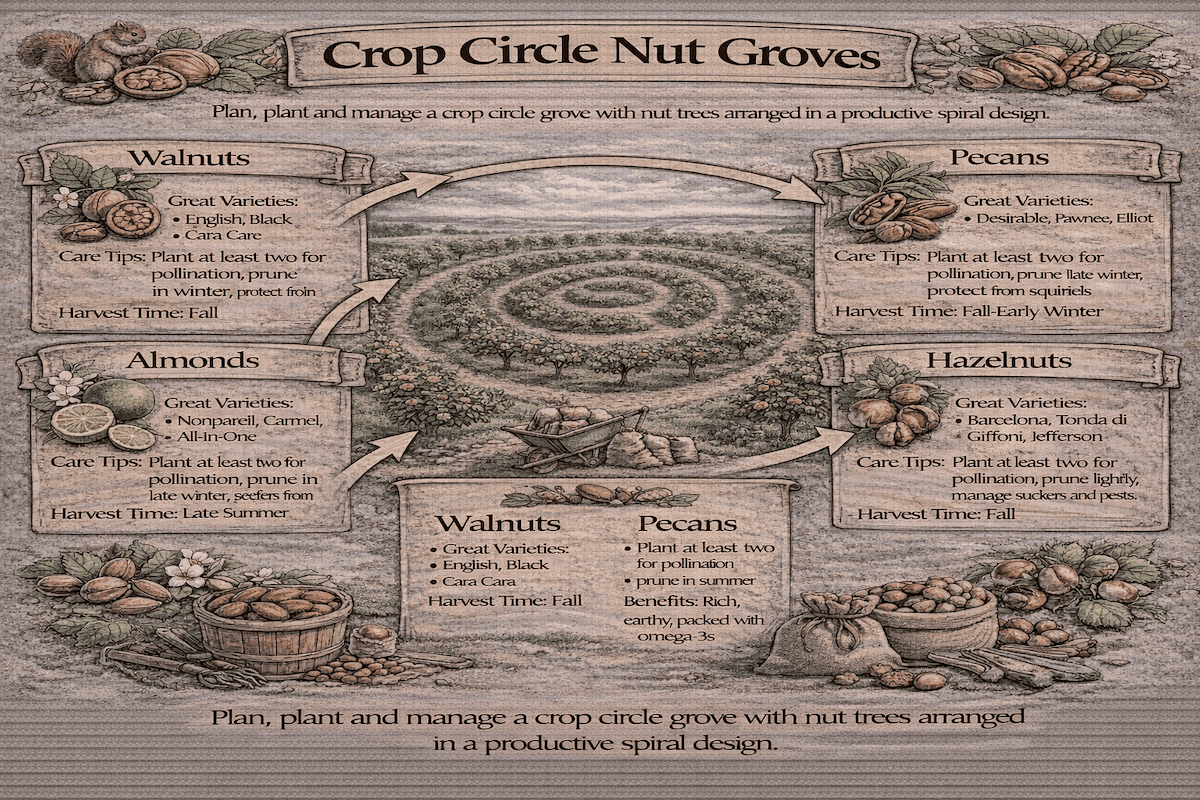
A Crop Circle Nut Grove features a 4-acre double spiral where 2,500 nut trees are spaced along the length of the spiral (5,000 feet) in 4-foot increments to create a high yield planting pattern. Spiraled tree rows spaced 12 feet apart provide equipment access. A few tree spaces at the center of each spiral are not planted to create a turnaround for the equipment.

It’s important that branches are trained properly to get the most out of the trees. A post and wire system is erected along the length of the double spiral so tree branches can be tied in place. A cross or t-shaped post shape allows for several support wires to be threaded between each tree.

The shape of a Crop Circle grove protects trees and nuts from the wind preventing loss of nuts from excessive wind blow. The Crop Circle also protects trees and nuts from insects (nuts can be grown organically without the need for chemical protection), which saves and makes money at the retail end when the nuts are sold. A Crop Circle nut grove also offers a level of protection for blossoms from frost. Nuts are also of very high quality.

Nut Tree Varieties

Types of nut trees that benefit from Crop Circle grove growing include Walnut, Hazelnut, Almond, Macadamia, Pecan, Pistachio, Lychee, Cashew and Chestnut trees.

Pecan Trees: Stuart, Elliott

The Pecan tree is a Texas tree. Texas dominates Pecan production in the United States although the tree is also grown in California and Arizona to some extent. In a typical Pecan grove, about 80 Pecan trees are planted per acre. Given the right climate and sufficient water, an acre can produce about 5,000 pounds of Pecans. Like most areas of the Southwest, these States are suffering from years of drought, which has had an impact on Pecan production - down 50% from just 10 years ago. A Crop Circle Pecan Grove is an intensive farming technique that grows more pecans per acre foot using less water. All varieties of Pecan tree is suitable for this system including Stuart pecans, Moreland pecans, Desirable pecans, Elliot pecans, Cape Fear pecans and Candy Pecans. Crop Circle Pecan Groves increase production 10 times that of a rowed Pecan grove.

There are many types of pecan trees, each with its unique characteristics in terms of nut size, shell thickness, and tree growth habits. Here are some common pecan tree varieties:

  • Stuart Pecan: This is the most common and widely grown pecan variety, known for its large, oval-shaped nuts with a thin shell and a sweet, rich flavor. The tree is a large, deciduous tree with an upright growth habit.
  • Desirable Pecan: A large, oval-shaped nut with a thin shell and a sweet, buttery flavor. It's commonly used for baking and snacking. The tree is a large, deciduous tree with a spreading growth habit.
  • Elliott Pecan: A small to medium-sized nut with a thick shell and a rich, flavorful meat. It's commonly used for baking and snacking. The tree is a medium to large-sized, deciduous tree with an upright growth habit.
  • Candy Pecan: A small to medium-sized nut with a thin shell and a sweet, rich flavor. It's commonly used for snacking and baking. The tree is a medium to large-sized, deciduous tree with a spreading growth habit.

Other pecan tree varieties include the Pawnee, Cape Fear, and Kiowa pecans. Each variety has its own unique characteristics and is suited to different growing conditions and climates. When selecting a pecan tree variety, it's important to consider factors such as climate, soil type, and disease resistance to ensure the best possible growing conditions for the tree.

Almond Trees: Carmel, Mission

Almond growers have been utilizing intensive growing techniques the past 50 years. The problem isn’t maximized production per acre, it's the lack of water, especially in California and Australia where thousands of acres have been lost from water shortages caused by drought. As a result, nearly half of all California Almond producers have left the market. Those that remain can save their orchards with the implementation of water saving Crop Circles that use proprietary irrigators to water each Almond tree. A Crop Circle Almond orchard uses significantly less water than a conventional rowed orchard. It takes approximately 1 gallon of water to produce 1 almond, which in California is more than 600 billion gallons of water each year. That can be cut down by as much as 90% using Crop Circle Irrigators. Any type of Almond tree is suitable for this water saving growing system including California almonds, Spanish almonds and Nonpaeil almonds.

There are several varieties of almond trees:

  • Nonpareil Almond: This is the most popular almond variety, known for its large, plump, and smooth nuts with a thin shell and a mild, sweet flavor. The tree is a medium to large-sized, deciduous tree with an upright growth habit.
  • Carmel Almond: A medium-sized, elongated almond with a hard shell and a rich, nutty flavor. It's commonly used for snacking and baking. The tree is a medium to large-sized, deciduous tree with an upright growth habit.
  • Mission Almond: A small, round almond with a hard shell and a sweet, slightly bitter flavor. It's commonly used for making marzipan and other confections. The tree is a medium to large-sized, deciduous tree with a spreading growth habit.
  • Texas Almond: A medium-sized, elongated almond with a thin, soft shell and a sweet, mild flavor. It's commonly used for snacking and baking. The tree is a medium to large-sized, deciduous tree with an upright growth habit.

Other almond tree varieties include the Butte, Peerless, and Price almonds.

Walnut Trees: English and Black Walnut

Walnuts are grown in just about every country in the Northern hemisphere including the United States, Canada, China, the UK and parts of continental Europe. Walnut trees require “cold dormancy” for a period of 90 days or more, to re-leaf and produce walnuts each year. Walnut tree groves typically feature large, canopied trees spaced 50 feet apart, which plants about 20 trees per acre. Each tree can produce up to 5,000 walnuts so 100,000 walnuts per acre is not uncommon. Crop Circle walnut production is significantly higher, about 5 times that of a typical walnut grove because trees are planted a little closer together in a winding Any type of walnut tree would benefit from this growing system including Black Walnut, English Walnut, and White Walnut, also known as Butternut.

There are several varieties of walnut trees:

  • English Walnut: This is the most popular walnut variety, known for its large, round nuts with a mild, buttery flavor and a thin shell that's easy to crack. The tree is a large, deciduous tree with an upright growth habit.
  • Black Walnut: A smaller, oval-shaped nut with a hard, thick shell and a bold, rich flavor. It's commonly used for baking and snacking. The tree is a medium to large-sized, deciduous tree with an upright growth habit.
  • Hartley Walnut: A medium to large-sized nut with a thin shell and a sweet, mild flavor. It's commonly used for baking and snacking. The tree is a medium to large-sized, deciduous tree with a spreading growth habit.
  • Chandler Walnut: A large, round nut with a thin shell and a sweet, mild flavor. It's commonly used for baking and snacking. The tree is a medium to large-sized, deciduous tree with an upright growth habit.

Other walnut tree varieties include the Franquette, Serr, and Tulare walnuts.

Hazelnut Trees: Jefferson, Eta

Hazelnut grows as far north as Canada and as far south as Texas. A Hazelnut tree requires a cold dormancy period for at least 60 days to stimulate regenerative production year to year. Hazel nut groves typically have 40 trees planted per acre, with each tree producing 500 hazelnuts on average. A small grove will produce about 20,000 hazelnuts per acre. Production, however, can be improved; at least twice that of a conventional orchard by using Crop Circle propagation methods. Hazelnuts typically produce more nuts when trees are planted close together so a Crop Circle hazelnut grove can be exceedingly productive. Hazelnut trees tend to send out suckers from near the base of the tree, which will reduce nutting so it is advisable to snip these off every spring as soon as they appear. Any type of hazelnut tree benefits from Crop Circle propagation including, American hazelnuts, European hazelnuts and Round hazelnuts.

There are several types of hazelnut trees:

  • Barcelona Hazelnut: This is the most popular hazelnut variety, known for its large, round nuts with a sweet, nutty flavor and a thin shell. The tree is a medium to large-sized, deciduous tree with a spreading growth habit.
  • Jefferson Hazelnut: A medium-sized, elongated nut with a sweet, buttery flavor and a thin shell. It's commonly used for snacking and baking. The tree is a medium to large-sized, deciduous tree with an upright growth habit.
  • Eta Hazelnut: A medium to large-sized nut with a thin shell and a sweet, nutty flavor. It's commonly used for snacking and baking. The tree is a medium to large-sized, deciduous tree with a spreading growth habit.
  • Tonda di Giffoni Hazelnut: A small to medium-sized nut with a sweet, nutty flavor and a thick shell. It's commonly used for making chocolate and other confections. The tree is a medium to large-sized, deciduous tree with an upright growth habit.

Other hazelnut tree varieties include the Yamhill, Delta, and Wepster hazelnuts.

Macadamia Trees: Beaumont, A4 and 344

Macadamia, a tropical/sub-tropical tree is grown in many areas of the world, but California has the lion's share of the market. 80 trees per acre is the standard plant density for a conventional Macadamia orchard. Higher density plantings have been tried without success however, a new system plants trees close together in looping spirals with great success. Macadamia trees thrive in spiraled Crop Circles where as many as 160 trees are planted per acre, which effectively doubles production. There are two types of Macadamia trees; tetraphylla, which prefers cooler climates and integrifolia, which prefers warmer climates. Both will produce abundantly in a Crop Circle Macadamia Nut Grove.

There are several varieties and types of macadamia trees, each with unique characteristics in terms of nut size, flavor, shell hardness, and tree growth habits. Here are some common macadamia tree varieties:

  • Beaumont Macadamia: This is the most popular macadamia variety, known for its large, round nuts with a buttery flavor and a hard, thick shell. The tree is a medium to large-sized, evergreen tree with an upright growth habit.
  • Maroochy Macadamia: A medium-sized, oval-shaped nut with a thin shell and a rich, nutty flavor. It's commonly used for snacking and baking. The tree is a medium-sized, evergreen tree with a spreading growth habit.
  • A4 Macadamia: A large, round nut with a thin shell and a sweet, buttery flavor. It's commonly used for snacking and baking. The tree is a medium to large-sized, evergreen tree with an upright growth habit.
  • 344 Macadamia: A medium to large-sized nut with a thin shell and a sweet, nutty flavor. It's commonly used for snacking and baking. The tree is a medium-sized, evergreen tree with a spreading growth habit.

Other macadamia tree varieties include the Hinde, 741, and 816 macadamias.

Lychee Trees: Emperor, Brewster

It takes about 20 years for a Lychee tree to reach full production; about 600 Lychee nuts per tree. In a conventional orchard, approximately 60 trees spaced 30 feet apart produce 18,000 Lychee nuts per acre. High density plantings have been tried unsuccessfully; however a Crop Circle Lychee farm may increase yields with close-in planting. Any type of Lychee tree can be grown using this system including Bengal, Ohia, Sweet Cliff, Ha-Kip and Emperor. Lychees are extensively grown in China, Vietnam and the rest of tropical Southeast Asia, the Indian Subcontinent, and more recently in South Africa, Brazil, the Caribbean, Australia, Southern California and Florida.

There are several types and varieties of lychee trees:

  • Emperor Lychee: This is the most popular lychee variety, known for its large, juicy fruit with a reddish-pink skin and a sweet, floral flavor. The fruit is commonly eaten fresh or used in desserts and beverages. The tree is a medium to large-sized, evergreen tree with an upright growth habit.
  • Brewster Lychee: A medium-sized lychee with a pinkish-red skin and a sweet, musky flavor. The fruit is commonly eaten fresh or used in desserts and beverages. The tree is a medium-sized, evergreen tree with a spreading growth habit.
  • Mauritius Lychee: A small to medium-sized lychee with a reddish-pink skin and a sweet, fragrant flavor. The fruit is commonly eaten fresh or used in desserts and beverages. The tree is a medium-sized, evergreen tree with a spreading growth habit.
  • Sweetheart Lychee: A small to medium-sized lychee with a pinkish-red skin and a sweet, delicate flavor. The fruit is commonly eaten fresh or used in desserts and beverages. The tree is a medium-sized, evergreen tree with a spreading growth habit.

Other lychee tree varieties include the Wai Chee, Hak Ip, and Tai So lychees.

Tree Plantation

Hardwoods

The Woodworking Tree

From maple to oak, hardwoods whisper of centuries past, their slow growth a testament to patience and value over time.

Tree Species

Donate Land

Partner with us in a land management project to repurpose agricultural lands into appreciating tree assets. We have partnered with growingtogive.org , a 501(c)(3) nonprofit, to create tree-planting partnerships with land donors.


Hire Us as a Consultant


  • to design and plant a tree plantation on your land;
  • to vend your trees into a carbon credit program;
  • to build a fast-growing tree nursery;

Your Land: Our Trees

We have partnered with growingtogive.org , a Washington State nonprofit, to create a land and tree partnership program that repurposes agricultural land into appreciating tree assets.

The program utilizes privately owned land to plant trees that benefit both the landowner and the environment.

If you have 100 acres or more of flat, fallow farmland and would like to plant trees, we would like to talk to you. There are no costs to enter the program. You own the land; you own the trees we plant for free, and there are no restrictions—you can sell or transfer the land with the trees anytime.


Contact Us

Nut Tree FAQs

What’s the difference between walnuts and hazelnuts?

Walnuts and hazelnuts are both nutritious tree nuts, but they look, taste, and grow quite differently. Walnuts are larger, with a wrinkled, two-lobed kernel inside a hard shell. They have a rich, slightly bitter flavor due to their high omega-3 content and are excellent in salads, baked goods, and as a heart-healthy snack. Hazelnuts are smaller, rounder nuts with a smooth shell and a sweet, creamy flavor that shines in chocolate spreads, pralines, and roasted snack mixes.

From a nutritional perspective, walnuts tend to be higher in polyunsaturated fats and antioxidants, while hazelnuts offer more vitamin E and monounsaturated fats. Both can be grown in Crop Circle Nut Groves, with walnuts suited to cooler climates that provide enough winter chill, and hazelnuts doing well in temperate regions with good drainage and wind protection.

Are cashew nuts poisonous?

The cashew nut you buy at the store is safe, but the raw cashew straight from the tree is not. Cashews grow attached to a cashew apple in a hard shell that contains urushiol, the same irritant found in poison ivy and poison oak. For this reason, commercial cashews are always steamed or roasted to remove and neutralize the toxic compounds before the nut is shelled and packaged.

If you are planting cashew trees in a Crop Circle Nut Grove, always handle the raw nuts and shells with gloves and follow safe processing guidelines. For eating, stick with properly processed nuts from reputable suppliers. Never attempt to roast and shell “wild” cashews without understanding the safety procedures involved.

How can I increase the yield of my nut trees?

Higher yields start with the right cultivar in the right place. Choose nut tree varieties adapted to your climate, chilling hours, and soil type—whether that’s high-yield almonds, walnuts, pecans, hazelnuts, macadamias, or lychees. Plant in a layout that maximizes light interception and air flow, such as mirrored spirals in a Crop Circle Nut Grove, and maintain consistent spacing so trees don’t compete excessively as they mature.

Next, build healthy, living soil with organic matter, balanced N-P-K fertility, and cover crops that fix nitrogen, support mycorrhizae, and suppress weeds. Use water-smart fertigation or drip irrigation to support nut fill during key growth stages while minimizing water waste. Regular, thoughtful pruning improves canopy structure, light penetration, and fruiting wood; remove dead, diseased, or crossing branches and maintain strong scaffold limbs rather than letting trees become crowded and shaded.

Finally, implement an integrated pest management (IPM) program: monitor insects and diseases, encourage beneficial predators, and use organic controls where possible instead of broad-spectrum sprays. Good pollination—either through compatible pollinizer varieties or strong wild/managed bee populations—is critical for many nut species. Together, these practices can dramatically increase yield per acre and improve nut quality in both conventional orchards and Crop Circle Nut Groves.