 INVEST
 PLANT
PLANT
 SOFTWOODS
 HARDWOODS
 CALCULATORS
 RESOURCES
 PROGRAMS

Softwoods
Learn More




Discover why Western Red Cedar (Thuja plicata) is one of the most versatile and naturally durable woods—ideal for decking, siding, landscaping, and long-term outdoor performance
CEDAR • REDWOOD • TIMBER VALUE
Wondering what Western red cedar is and how it compares to redwood? Western red cedar (Thuja plicata) is a highly valued softwood known for natural rot resistance, stability, and long-lasting outdoor performance.
🌲 Quick answer: Western red cedar and redwood are both premium exterior woods, but cedar is typically more lightweight and widely available, while redwood is often denser and associated with high-end architectural applications.
Examples: Both species are used for siding, decking, fencing, shingles, pergolas, and outdoor structures, where resistance to decay and weather exposure is critical.
Western Red Cedar and California Redwood are among the most valuable softwood timber trees in North America. Their ability to produce clear, durable lumber makes them ideal for long-term building and landscape applications.
Cedar terminology can be confusing. Many species are called “cedar,” but Western Red Cedar is distinct from Eastern red cedar (a juniper) and true cedars (Cedrus spp.). Understanding these differences helps landowners, builders, and investors choose the right species.
Key insight: Western red cedar offers one of the best combinations of durability, workability, and natural weather resistance among softwoods.
Feel free to share this western red cedar infographic on your website or blog. Please include a link back to this page as the source.
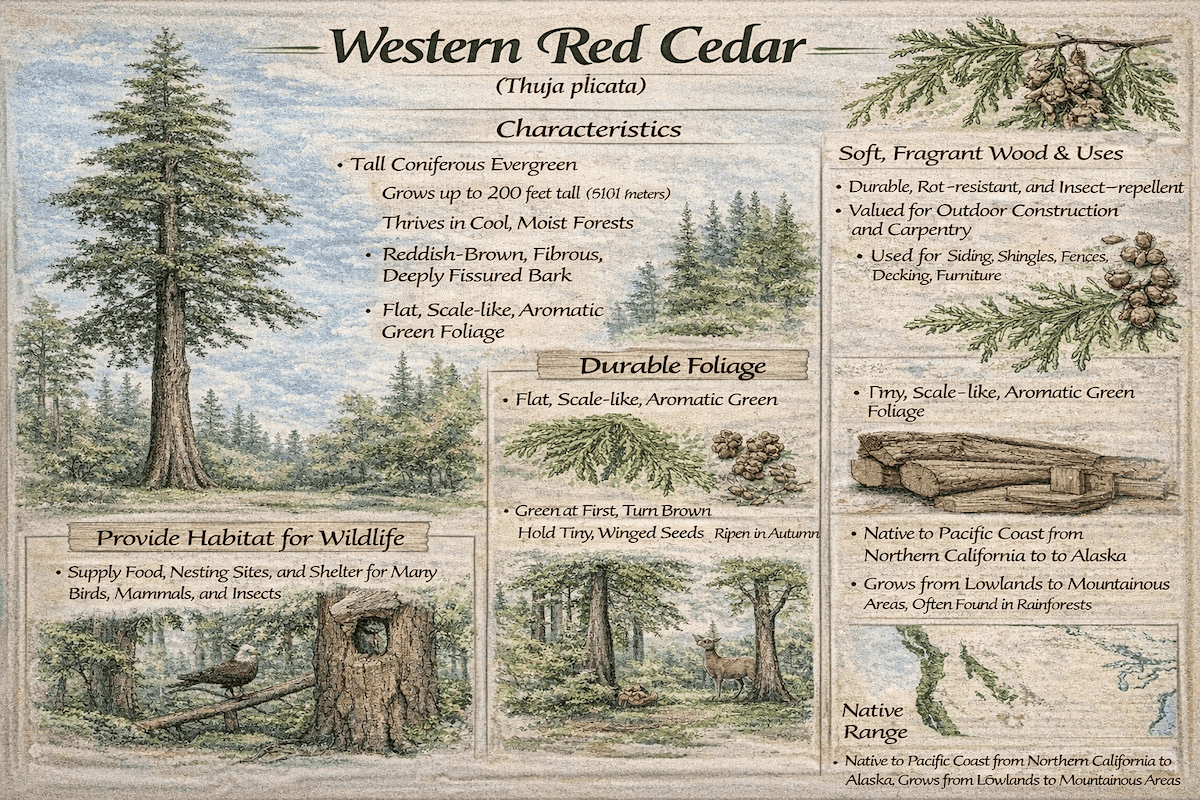
Western Red Cedar is sometimes called the “North Coast Redwood” because of its towering height, long life, and valuable knot-free heartwood. In native forests it can reach 200–230 feet tall with diameters up to 10–13 feet, forming majestic stands along rivers, wetlands, and coastal valleys.
Because of these traits, Western Red Cedar is the go-to species for exterior cladding, shingles and shakes, pergolas, and high-end decking in cool, wet climates.
Coastal Redwood (Sequoia sempervirens), sometimes referred to as California Redwood, is native to the foggy coastal belt of northern California and southern Oregon. It is one of the fastest-growing and tallest trees on Earth, making it an outstanding candidate for long-board lumber and plantation timber where climate allows.
California Redwood plays an important ecological role in the Pacific coastal ecosystem while also supplying highly prized lumber for premium decking, siding, outdoor structures, and select softwood furniture.
Clear, wide planks of Western Red Cedar and California Redwood—24 inches or more in width and many feet in length—are now rare in the marketplace. Old-growth forests that supplied these boards for more than 200 years have largely been logged, and remaining giants are increasingly protected in parks, conservancies, and reserves.
This scarcity drives demand for clear, vertical-grain cedar and redwood. Premium-grade clear cedar can bring $5 or more per board foot at the retail level, with top-quality redwood often commanding similar or higher prices. For landowners, the opportunity lies in producing specialty lumber grades rather than commodity, knotty boards.
High-density plantation spacing encourages natural self-pruning. As crowns compete for light, shaded lower branches die and fall away, leaving long, knot-free stems. With careful thinning and pruning, a plantation can yield 30-foot cedar sawlogs averaging 12 inches in diameter that mill out into high percentages of clear lumber. In many models, timber investment groups can earn $500 or more per tree within 30–40 years, depending on site quality, growth rate, and market conditions.
In natural forests, Western Red Cedar often occupies moist microsites—stream edges, wet flats, and toe slopes—where it can access abundant water even during summer droughts. Seedlings tolerate shade, allowing cedar to regenerate beneath taller conifers such as Douglas Fir and Sitka spruce. These same traits make Western Red Cedar an excellent candidate for managed timber plantations on lowland ground that may be too wet for conventional crops or grazing.
On high-quality sites, well-managed cedar plantations can produce tall, straight stems with small, well-healed knots. High-density planting early on promotes rapid height growth and natural pruning. Strategic thinning then shifts growth into diameter, building volume and value in the best trees. Properly timed harvest can yield long, clear sawlogs ideal for siding, shingles, cladding, and timbers.

Cedar plantations are particularly well suited to wet lowlands and marginal ground that may not be ideal for row cropping or livestock. Western Red Cedar tolerates periodic flooding, helps stabilize saturated soils, and builds long-term timber value on land that might otherwise be underutilized.
In wetlands and floodplains, pure stands of Western Red Cedar often outperform mixed-species plantings, as associated conifers like Douglas fir may suffer root rot in saturated soils. On slightly drier sites, cedar can be integrated with complementary species, including spruce or alder, to diversify risk and take advantage of different growth rates and canopy layers.
At Tree Plantation, we often move beyond traditional rectangular row layouts. Geometric spiral and crop-circle planting patterns can increase light capture, improve airflow, and create visually striking plantations that double as demonstration forests or eco-tourism sites. These patterns encourage trees to grow tall and straight, while also making access lanes and thinning corridors easier to plan and maintain.
Interplanting Pacific Yew (Taxus brevifolia) among Western Red Cedar rows can increase biodiversity and add another income stream. Yew trees occupy partial shade beneath cedar crowns, making efficient use of light and space that might otherwise be underutilized.
Pacific Yew is thus both an ecologically important understory tree and a commercially valuable species. Responsible management focuses on plantation culture, sustainable bark harvesting, and supporting synthetic or semi-synthetic Taxol production to reduce pressure on wild populations.

Western Red Cedar is often described as the most valuable of the commercial softwoods. Its fine, straight grain, rich color, flexibility, and strength-to-weight ratio make it ideal for high-end exterior applications. Just as important is the wood’s high impermeability to liquid water and its natural phenolic preservatives, which dramatically slow decay and insect attack.
In coastal Pacific Northwest climates, untreated cedar can perform for decades as roofing, siding, and trim. In hot, humid climates it still lasts much longer than many other softwoods, though its surface weathers to a silver-grey in just a few years if not stained or finished. Cedar shakes and shingles have been a signature roofing material for more than 200 years—lightweight, strong, water-resistant, and naturally beautiful. The same properties make Western Red Cedar ideal for exterior cladding, decks, fencing, and landscape structures.
Western Red Cedar has very low thermal conductivity, providing roughly R-1 of insulation per inch of thickness. This helps moderate temperature swings in structures clad with cedar and explains why Indigenous longhouses and early settler cabins along the West Coast were frequently built with thick cedar logs and planks. Walls and roofs made from cedar helped keep interiors warmer in winter and cooler in summer while shedding heavy coastal rains.
The following comments from a national wood products discussion forum highlight how wood enthusiasts feel about cedar and yew:
“This wood is my absolute favorite of favorites. Quite simply, it has a richness that speaks to my senses like a fine cognac long aged in French oak barrels, or perhaps your preference is Grand Marnier. My kitchen cabinets are made from Pacific Yew, as are many of our doors here at West Wind Hardwood, and upon returning from time away, I am always struck by how extraordinary this richly colored, unique wood is.”
“I love Western Red Cedar; my all-time fave in softwoods – got a big pile of it stacked. I mainly use it for flutes and frame-drums but also scroll feather designs on the scroll saw and recently started making half-turned cedar log lamps on my lathe as well as other turned pieces, candle sticks and votive/tea-light holders.”
“I inherited a farm property in Campbell River, B.C., on Vancouver Island. We hadn’t been up there since I was a kid. The house was nice, the property even better, but what surprised us most was what was stored in one of the outbuildings; it was chock full of 30-inch-wide, 2-inch-thick cedar timber stacked high to the rafters. Some of the planks were over 40 feet long. We ended up selling the whole lot for a stunning amount of money – in fact we had a bit of a bidding war on our hands as word of this spectacular find spread throughout the town.”
These stories echo the core message of this page: premium Western Red Cedar and California Redwood are long-term wealth trees. Managed wisely, they can turn wet, marginal, or underused land into an appreciating timber asset while providing habitat, carbon storage, and beautiful wood for generations.
Have questions about Western Red Cedar, how it compares to redwood, and which one to choose for decks, siding, fences, and plantations? Start with these practical answers for builders, landscapers, and tree growers.
Yes. Western Red Cedar heartwood contains natural extractives that resist decay and insects, which is why it is one of the most trusted softwoods for exterior use. It performs especially well in siding, shingles, fencing, pergolas, outdoor furniture, planters, and trim.
Keep in mind that sapwood is less durable than heartwood. For long-lasting results, specify heartwood for ground-proximate or highly exposed applications, and use smart detailing:
In favorable coastal or moist inland sites, young Western Red Cedar can add 1–2 feet of height per year. Growth slows as the tree matures, but it continues to put on volume and high-value clear wood.
In landscapes, trees commonly reach 50–120 feet tall, while in native forests they can grow much taller. For planting:
It doesn’t need a finish to survive. Left unfinished, Western Red Cedar weathers to a soft silver-gray patina that many people love. The wood’s natural durability still provides good service life.
If you want to maintain color or deepen the tone, use:
Avoid heavy, non-breathable finishes that can peel. Detail assemblies to shed water—sloped surfaces, drip edges, and good ventilation—then seal end grain and keep boards out of direct soil contact.
No. SPF is a grouping of framing softwoods (spruce, pine, fir) used primarily for structural studs, joists, and rafters. Western Red Cedar is a separate species, Thuja plicata, with a different performance profile.
Compared to SPF, Western Red Cedar offers:
That’s why cedar is favored for siding, shingles, fencing, soffits, and outdoor structures rather than hidden structural framing.
Some people are sensitive to cedar dust. When cutting, sanding, or milling Western Red Cedar, use dust collection, a quality respirator, and eye protection—especially in enclosed shops.
Cedar’s natural acids can also corrode bare iron or mild steel fasteners and cause black staining. For exterior projects, always use:
This protects both the wood and hardware, and keeps finished surfaces clean and stain-free over time.
Both Western Red Cedar and redwood are premium exterior woods with excellent durability and appearance. In many cases, you can build a long-lasting deck, fence, or pergola with either species, but there are practical differences:
For most projects, the “best” choice comes down to your budget, local availability, and preferred color. From a performance standpoint, properly detailed heartwood cedar or redwood will both do excellent service outdoors.
Softwoods, the pioneer species of the temperate forest, grow quickly to leave their mark on the landscape for centuries. Many of the world’s most valuable plantation trees—from cedar and redwood to pine and spruce—belong to this group.
Visit each species page to compare growth rates, site requirements, and projected yields before designing your own mixed-species tree plantation.
Partner with us in a land management project to repurpose agricultural lands into appreciating tree assets. We have partnered with Growing To Give , a 501(c)(3) nonprofit, to create tree-planting partnerships with land donors focused on climate resilience, habitat creation, and long-term timber value.
We have partnered with Growing To Give , a Washington State nonprofit, to create a land and tree partnership program that repurposes agricultural land into appreciating tree assets.
The program uses privately owned land to plant trees that benefit both the landowner and the environment. Together, we design plantations for timber, wildlife, and climate benefits, including high-value species such as Western Red Cedar, Douglas Fir, and select hardwoods.
If you have 100 acres or more of flat, fallow farmland and would like to plant trees, we’d like to hear from you. There are no upfront costs to enter the program. You own the land; you own the trees we plant for free, and there are no restrictions—you can sell or transfer the land with the trees at any time.
Copyright © All rights reserved Tree Plantation