 INVEST
 PLANT
PLANT
 SOFTWOODS
 HARDWOODS
 CALCULATORS
 RESOURCES
 PROGRAMS

Softwoods
Learn More




From forest giant to near extinction—discover how the American chestnut is being restored and why it may become one of the most valuable trees for reforestation, timber, and agroforestry
CHESTNUT • RESTORATION • FOREST LEGACY
Wondering what happened to the American chestnut tree? The American chestnut (Castanea dentata) was once one of the most dominant and valuable hardwood trees in eastern North America—until a devastating disease nearly wiped it out.
🌳 Quick answer: The American chestnut was a fast-growing, rot-resistant hardwood that supported ecosystems and economies, but was nearly eliminated by chestnut blight. Today, restoration efforts aim to bring it back.
Examples: Historically, chestnut trees were used for timber, fence posts, construction, furniture, and nut production, while also feeding wildlife and rural communities.
Chestnut trees were once among the most valuable and admired hardwoods in North America, known for their rapid growth, edible nuts, rot-resistant wood, and major ecological role in eastern forests.
The arrival of chestnut blight devastated the American chestnut and transformed Appalachian ecosystems, eliminating a tree that had supported both wildlife and rural economies for generations.
Today, restoration efforts—including blight-resistant breeding, genetic research, and reforestation programs— are opening a new chapter. The American chestnut may once again become a powerful tree for ecosystem restoration, conservation, and long-term planting value.
The story of the American chestnut is one of both loss and opportunity. While the original forest giants are largely gone, new generations of trees are being developed to restore this species to its former ecological and economic importance.
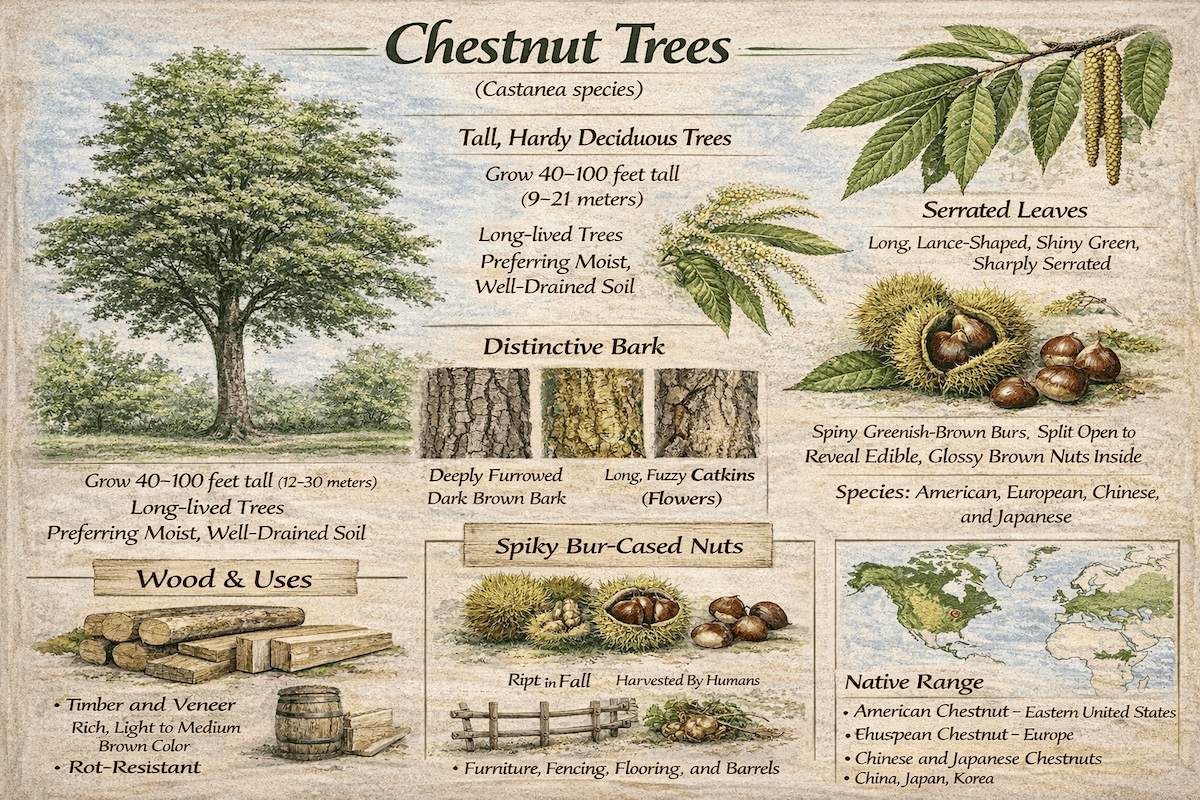
Chestnut trees (Castanea species) are large, fast-growing deciduous hardwoods native to temperate regions of the Northern Hemisphere. These long-lived trees can reach heights of 40–100 feet (12–30 meters), forming broad, spreading canopies with distinctive deeply furrowed bark and elegant, serrated leaves.
One of their most defining features is their spiny bur-covered fruit, which splits open in fall to reveal glossy brown edible nuts. Known for their sweet, rich flavor, chestnuts have been a staple food source for centuries and are widely used roasted, boiled, or incorporated into stuffing, soups, and desserts.
Beyond their culinary value, chestnut trees have long been prized for their durable, rot-resistant timber, making them ideal for furniture, fencing, flooring, and construction . Historically, they were among the most important multipurpose trees in both forest ecosystems and rural economies. However, chestnut populations have been severely impacted by chestnut blight, a fungal disease that dramatically reduced native stands in North America and Europe. Today, restoration efforts are focused on developing blight-resistant chestnut trees through advanced breeding and biotechnology.
The American chestnut (Castanea dentata) was once a dominant species throughout the eastern United States, often referred to as the “redwood of the East.” It grew rapidly, reached impressive heights, and produced abundant nut crops that supported wildlife, livestock, and rural communities.
The two most important chestnut species for growers and restoration projects are the American chestnut (Castanea dentata) and the Chinese chestnut (Castanea mollissima). While they share similarities in growth habit and nut production, they differ significantly in disease resistance, form, and commercial use.
Understanding these differences is essential when selecting the right species for reforestation, agroforestry systems, or commercial chestnut orchards.
| Feature | American Chestnut | Chinese Chestnut |
|---|---|---|
| Scientific Name | Castanea dentata | Castanea mollissima |
| Native Range | Eastern United States | China & East Asia |
| Tree Size | Tall (80–100+ ft), straight trunk | Shorter (40–60 ft), spreading form |
| Growth Habit | Forest canopy tree | Orchard-style, wider canopy |
| Blight Resistance | Highly susceptible | Naturally resistant |
| Nut Size & Flavor | Smaller, very sweet | Larger, slightly less sweet |
| Primary Use | Timber, restoration | Nut production, orchards |
The best choice depends on your goals:
Modern breeding programs are combining the best traits of both species, creating blight-resistant hybrid chestnut trees that retain the height, timber quality, and ecological value of the American chestnut while incorporating the disease resistance of the Chinese chestnut.
These hybrids are expected to play a major role in reforestation, agroforestry, and future commercial chestnut plantations, making them one of the most important developments in modern forestry.
In the early 1900s, chestnut blight—a fungal pathogen introduced from Asia—spread rapidly across eastern forests , killing an estimated 4 billion American chestnut trees. This catastrophic event reshaped entire ecosystems, eliminated a critical food source for wildlife, and removed one of the most valuable hardwood species from the American landscape.
Today, scientists, foresters, and conservation groups are working to restore the American chestnut using a combination of innovative approaches:
With continued advances in breeding, biotechnology, and sustainable forestry, chestnut trees are poised for a powerful comeback. Their return represents more than restoration—it signals a new opportunity for reforestation, regenerative agriculture, and long-term plantation value across suitable growing regions.
Feel free to share this chestnut tree infographic on your website or blog. Please include a link back to this page as the source.

What Is Chestnut Blight?
Chestnut blight is a destructive fungal disease caused by Cryphonectria parasitica, one of the most impactful plant pathogens in North American history. Native to East Asia, the fungus co-evolved with Asian chestnut species such as Chinese and Japanese chestnuts, which developed natural resistance over time.
The disease was accidentally introduced to the United States in the early 1900s through imported nursery stock. First identified in New York City, it spread rapidly through eastern forests, encountering a highly susceptible host in the American chestnut (Castanea dentata)—a tree with no natural defenses against the fungus.
The fungus infects trees through cracks or wounds in the bark, where it forms sunken, orange-brown cankers. As these cankers expand, they girdle branches and trunks, cutting off the flow of water and nutrients. While the root system may survive and send up new shoots, these sprouts are typically reinfected before reaching maturity.
Blight spores are easily dispersed by wind, rain splash, birds, and insects, allowing the disease to spread quickly across vast forest regions. The fungus can also persist in infected bark and dead wood, making eradication nearly impossible once established.
Prior to the blight, the American chestnut was a keystone species throughout the Appalachian region, often comprising up to 25% of the forest canopy. It was valued for its rapid growth, straight form, abundant nut production, and highly durable, rot-resistant wood.
Within just a few decades, the blight eliminated an estimated 4 billion trees, effectively removing the species from the forest canopy by the 1950s. Today, American chestnuts persist mainly as small understory sprouts, rarely surviving long enough to reproduce before succumbing to reinfection.
Despite the scale of devastation, efforts to restore the American chestnut are gaining momentum through science, conservation, and advanced forestry practices:
The story of chestnut blight is one of both loss and resilience. With continued advances in genetics, breeding, and sustainable forestry, the American chestnut is increasingly viewed as a restoration-ready species with the potential to return to forests, farms, and commercial landscapes.
Its revival would not only restore a critical ecological role but also unlock new opportunities in carbon sequestration, agroforestry systems, wildlife habitat restoration, and long-term timber and nut production. The return of the chestnut stands as one of the most important and hopeful reforestation efforts of our time.
Despite the near-total destruction caused by chestnut blight, the American chestnut (Castanea dentata) has never completely disappeared. Millions of trees continue to resprout each year from ancient root systems—some over a century old—demonstrating the species’ remarkable resilience.
Because the blight fungus primarily attacks the above-ground portions of the tree, the root systems remain alive and capable of producing new shoots. However, once these sprouts reach a small diameter—typically within 3–5 years—they become vulnerable to infection. The fungus forms lethal cankers that girdle the young stems, preventing them from reaching maturity and producing seed.
To overcome this cycle, researchers are developing blight-resistant American chestnut trees using both advanced breeding and biotechnology. These efforts aim to preserve the tree’s native characteristics—its fast growth, straight form, and high-value wood—while introducing durable resistance to the fungus.
The long-term goal is to produce millions of blight-resistant seedlings capable of restoring chestnut populations across their native range while also supporting future commercial orchards and timber plantations.
Authentic American chestnut wood is now one of the rarest hardwoods in North America. Known for its warm light-to-medium brown tones, straight grain, and exceptional workability, it was once a preferred material for barns, homes, fencing, flooring, and fine furniture.
Today, most available chestnut lumber comes from reclaimed sources, including dismantled historic structures or salvaged logs. True chestnut wood is typically clean-grained and free of insect damage, while the more commonly marketed “wormy chestnut” features small holes created by insect activity after the tree’s decline.
Due to its scarcity, reclaimed chestnut often commands premium pricing, frequently exceeding the value of other domestic hardwoods such as oak, maple, and even walnut.
A unique source of chestnut lumber comes from river-recovered logs. During the 1800s and early 1900s, vast quantities of timber were transported by floating logs downstream to sawmills. Many logs sank along the way and remained preserved underwater for decades.
These submerged logs, often referred to as “deadhead logs,” were later recovered through specialized salvage operations, providing a rare supply of old-growth chestnut wood.
River salvage operations played an important role in early American industry by recovering valuable timber resources and creating regional jobs. However, these activities also disrupted river ecosystems, altered sediment patterns, and impacted aquatic habitats.
Today, salvage operations are limited and more carefully regulated, with greater emphasis on environmental restoration and sustainable forestry practices. Recovered chestnut wood remains highly desirable, offering a tangible connection to pre-blight forests and early American craftsmanship.
The restoration of the American chestnut represents one of the most ambitious ecological recovery efforts in modern forestry. Beyond simply returning a lost species, it opens the door to new opportunities in reforestation, agroforestry systems, carbon sequestration, and high-value timber production.
As blight-resistant trees become commercially viable, chestnut has the potential to re-emerge as a cornerstone species—supporting biodiversity, strengthening rural economies, and playing a meaningful role in climate-smart land management strategies.
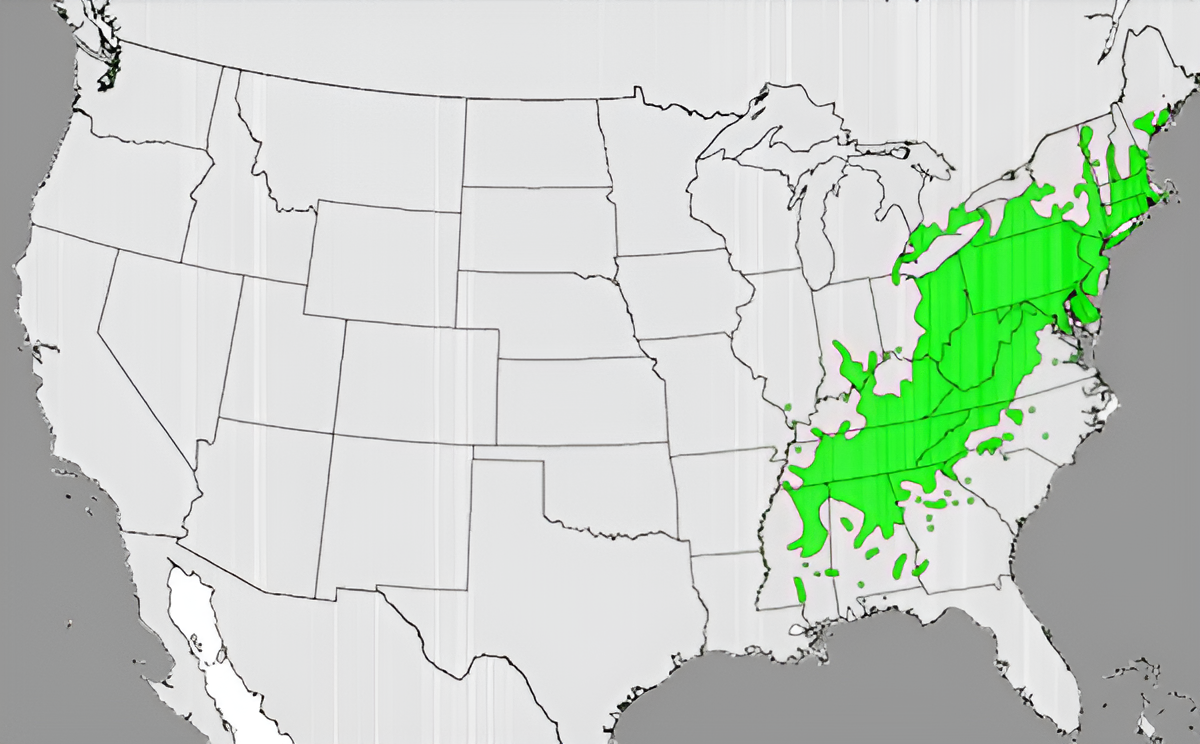
The American chestnut (Castanea dentata) is native to the Appalachian Mountain region and was once one of the most dominant tree species in eastern North America. Its historic range extended from southern Maine and Ontario south through the Appalachian Mountains to northern Georgia, Alabama, Tennessee, and Kentucky, and westward into parts of Ohio and Pennsylvania.
Today, American chestnut trees are best suited for USDA growing zones 4 through 8, where they thrive in regions with moderate rainfall, well-drained soils, and full sun exposure. They perform particularly well in upland areas with slightly acidic soils, commonly found throughout the Appalachian corridor.
The Appalachian region remains the most suitable area for restoration and planting, including states such as Pennsylvania, West Virginia, Virginia, North Carolina, Tennessee, and Kentucky. With the development of blight-resistant varieties, planting is expanding into additional areas within the species’ historic range.
In managed landscapes, chestnut trees are increasingly being used in agroforestry systems, reforestation projects, and commercial nut orchards, where proper spacing, sunlight, and soil preparation can significantly improve long-term performance and yields.
For best results, chestnut trees should be planted with adequate spacing to allow for canopy development and airflow, reducing disease pressure and supporting healthy growth. They are not shade-tolerant and should be established in open areas with minimal competition.
As restoration efforts continue, the American chestnut is once again becoming a viable species for long-term forest regeneration, wildlife habitat, and high-value tree planting systems across the eastern United States.
Chestnut trees (Castanea species) are among the most compelling hardwoods for modern plantation systems, offering a rare combination of fast growth, high-value timber, and annual nut production. This dual-income capability positions chestnut as one of the most versatile and scalable species for investors, landowners, and agroforestry developers.
With the emergence of blight-resistant American chestnut varieties and improved orchard management practices, chestnut plantations are gaining renewed attention as a high-yield, climate-smart investment capable of producing both short-term and long-term returns.
Chestnut plantations offer multiple income pathways that can be layered over time:
This staggered revenue model allows growers to generate cash flow during the growth cycle while building long-term timber value—an advantage rarely found in single-output forestry systems.
Advanced plantation layouts—such as precision spacing, circular planting systems, and spiral-based designs—can significantly improve light distribution, airflow, and overall tree performance.
The development of blight-resistant American chestnut trees has the potential to reshape the hardwood industry. With its historic reputation for strength, workability, and rot resistance, American chestnut is positioned to re-enter the market as a premium timber species.
Chestnut plantations also align with carbon-smart and ESG investment strategies. Their rapid biomass accumulation supports meaningful carbon sequestration, while diversified production systems contribute to regenerative land use.
Commercial chestnut plantations represent a powerful convergence of agriculture, forestry, and environmental restoration. With the integration of improved genetics, advanced planting systems, and data-driven management tools, chestnut is emerging as a next-generation tree crop with both economic and ecological upside.
In summary: Chestnut tree plantations offer a scalable, multi-revenue investment model that combines timber production, annual nut income, and long-term carbon value. For landowners and investors seeking resilient, high-performance tree systems, chestnut stands out as one of the most promising species for the decades ahead.

American chestnut wood (Castanea dentata) was once one of the most important and widely used hardwoods in North America. Known for its unique combination of lightweight strength, straight grain, and natural rot resistance, it became a cornerstone material in early American construction, craftsmanship, and rural infrastructure.
Its fine, uniform texture and warm light-to-medium brown tones made it both highly functional and visually appealing. Easy to work with hand tools and machinery, chestnut quickly became a preferred wood for builders, carpenters, and furniture makers alike.
In the late 1800s and early 1900s, chestnut was considered a “go-to” building material across the eastern United States due to its abundance, durability, and versatility.
Following the chestnut blight, the supply of American chestnut wood collapsed, transforming it from a common material into one of the rarest and most sought-after reclaimed woods in North America.
Today, most available chestnut lumber is sourced from:
Due to its scarcity and historical significance, reclaimed chestnut often commands premium pricing, frequently exceeding oak, maple, and even walnut in specialty markets. It is especially prized for high-end furniture, architectural features, and restoration projects.
Authentic American chestnut wood is typically clean and straight-grained. In contrast, “wormy chestnut” refers to chestnut that developed insect holes after the tree declined from blight. While wormy chestnut has become popular for its rustic appearance, clear chestnut lumber is rarer and often more valuable.
With the development of blight-resistant American chestnut trees, there is growing potential for chestnut to re-emerge as a viable commercial timber species. Plantation-grown chestnut could once again supply:
The return of chestnut wood production aligns with modern sustainable forestry and climate-smart land use strategies. Fast growth rates combined with long-term durability make chestnut an ideal species for regenerative planting systems.
The restoration of the American chestnut represents more than the return of a lost species—it signals the revival of a high-performance hardwood with strong market demand and long-term economic potential.
As blight-resistant varieties become widely available, chestnut is poised to reclaim its place as a premium timber resource, supporting reforestation, sustainable building materials, and next-generation forestry investments.
From maple to oak, hardwoods whisper of centuries past, their slow growth a testament to patience and value over time.
Partner with us in a land management project to repurpose agricultural lands into appreciating tree assets. We have partnered with growingtogive.org , a 501(c)(3) nonprofit, to create tree-planting partnerships with land donors.
We have partnered with growingtogive.org , a Washington State nonprofit, to create a land and tree partnership program that repurposes agricultural land into appreciating tree assets.
The program utilizes privately owned land to plant trees that benefit both the landowner and the environment.
If you have 100 acres or more of flat, fallow farmland and would like to plant trees, we would like to talk to you. There are no costs to enter the program. You own the land; you own the trees we plant for free, and there are no restrictions—you can sell or transfer the land with the trees at any time.
American chestnut (Castanea dentata) once formed towering, straight-trunked forest trees that could reach 100 feet or more, producing very sweet nuts and valuable, rot-resistant timber. Chinese chestnut (Castanea mollissima) is typically shorter and more spreading with stronger natural resistance to chestnut blight. Its nuts are larger and easier to peel, which makes Chinese and hybrid chestnuts the main choice for modern orchards, while American chestnut is the focus of forest restoration and conservation work.
Yes, but with important caveats. In most of its native range, pure American chestnut still dies back from chestnut blight once stems reach 1–2 inches in diameter. Landowners interested in restoration typically plant carefully sourced seedlings from breeding or conservation programs, monitor them for blight cankers, and accept that many will resprout from the roots rather than grow into full canopy trees. For nut or timber production, most growers choose blight-resistant Chinese, European–Japanese, or American–Chinese hybrid chestnuts instead.
Historically, American chestnut dominated Appalachian forests from Maine and southern Ontario through the mid-Atlantic and into Tennessee and Kentucky, thriving on well-drained, slightly acidic soils on ridges and upper slopes. Today, surviving sprouts and test plantings are still concentrated across this region, especially in sites with full sun, good air movement, and no standing water. If your land falls within this historic range and appropriate USDA zones, it may be a good candidate for restoration planting.
Chestnut blight is caused by the fungus Cryphonectria parasitica. The pathogen enters through small wounds in the bark, forming orange-brown cankers that eventually girdle and kill the stem above the infection. Introduced from Asia in the early 1900s, it spread rapidly through eastern North America, killing an estimated four billion American chestnut trees within a few decades and transforming Appalachian forests. The fungus attacks the above-ground tree, while the roots usually survive and keep sending up new sprouts that also succumb once they thicken.
Several options now exist. Chinese chestnut and many of its hybrids show strong natural resistance and are widely planted for nuts and timber. Long-term breeding programs have produced American–Chinese hybrids that look and grow much like American chestnut but carry improved blight tolerance. In parallel, genetic-engineering projects have developed American chestnut lines that express a single resistance gene while remaining almost entirely native in their genetics. Availability of these lines depends on regulatory approvals and program policies, so always purchase planting stock from reputable nurseries or recognized restoration partners.
“Wormy chestnut” usually refers to salvaged chestnut boards with numerous small insect or beetle holes, often recovered from old barns, buildings, or forest-salvage logs. The species is American chestnut, but the worm holes and weathering give it a very rustic character that’s popular in paneling and flooring. By contrast, historic, clear American chestnut lumber was mostly knot-free, straight-grained, and uniform in color—extremely rare and highly valued today. Both are genuine chestnut, but “wormy” stock typically commands different prices and is used for different design aesthetics.
Yes—especially when you focus on blight-resistant Chinese and hybrid chestnut orchards or carefully planned timber plantations. Chestnut offers two strong revenue streams: high-value, naturally durable wood and sweet, storable nuts for fresh markets, roasting, or value-added products. With good site selection, pruning for straight stems, and thoughtful spacing (often in rows or spiral patterns for efficient light capture), growers can develop sawlog quality trees while harvesting annual nut crops. Chestnut also fits well into mixed agroforestry systems and reforestation projects, where carbon sequestration and habitat restoration add long-term value.
Chestnut value depends on diameter, height, log quality (knot-free, straight stems bring the highest veneer prices), and local markets for specialty hardwoods and reclaimed “wormy” lumber. To get a quick sense of potential value on your land, you can use tools like the Tree Value Calculator on TreePlantation.com, then compare results with current local prices for specialty hardwood logs, lumber, or nuts. For significant stands, a consultation with a professional forester or wood-products buyer is highly recommended.
Copyright © All rights reserved Tree Plantation