


 INVEST
 PLANT
PLANT
 SOFTWOODS
 HARDWOODS
 CALCULATORS
 RESOURCES
 PROGRAMS

Softwoods
Learn More
PELLETS • HEAT • YIELD
Wondering how many 40 lb bags of wood pellets a single tree can produce? This estimator uses your tree’s diameter at breast height (DBH) to generate a fast planning estimate—useful for comparing trees in a woodlot, planning pellet-based heating fuel, or sanity-checking how much material could be pelletized after thinning.
🔥 1 ton of wood pellets = ~16–18 million BTUs — roughly equal to 120–150 gallons of heating oil.
Start by choosing a DBH below to see estimated pellet bags, then scroll to compare pellet grades and understand how processing choices affect real-world yield.
A single mature tree can produce dozens to hundreds of 40 lb bags of wood pellets depending on its diameter, species, and how much of the branches and tops are utilized. When properly dried and compressed, wood pellets can deliver up to 2–3x more usable heat per unit volume than traditional firewood—making them one of the most efficient biomass fuels available.
Note: This is a planning estimator. Real pellet yield depends on species density, taper, bark/ash content, moisture control, and how much of the branches/tops you include.
Feel free to share this wood pellet calculator infographic on your website or blog. Please include a link back to this page as the source.
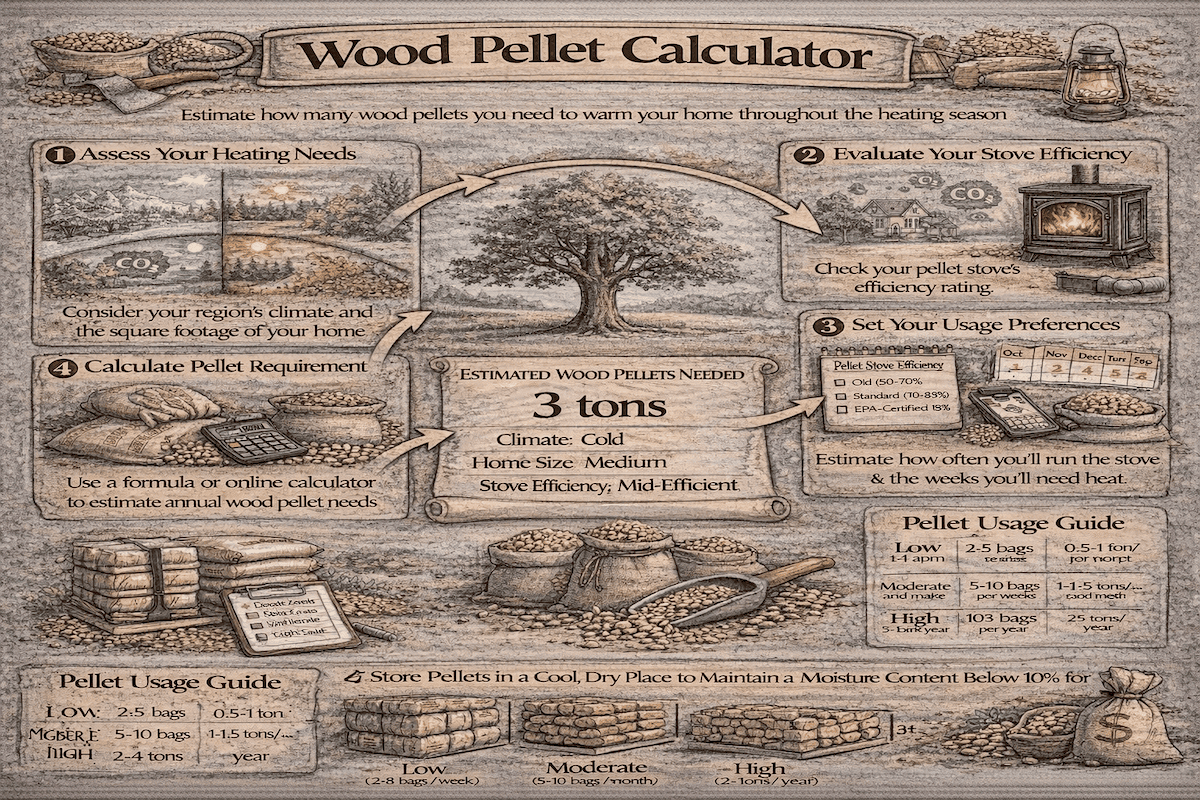
Use this wood pellet estimator together with our other free tools to plan your forest, woodlot, or homestead fuel supply.
The table below gives a quick reference for how many 40 lb bags of wood pellets a single tree may produce based on diameter at breast height (DBH). These figures are planning estimates based on the same bag values used in the calculator.
| Tree DBH | Estimated 40 lb Bags |
|---|---|
| 5 in. | 3 bags |
| 10 in. | 16.5 bags |
| 15 in. | 48 bags |
| 20 in. | 84 bags |
| 24 in. | 125 bags |
Note: Actual pellet yield varies by species, moisture content, bark content, taper, and how much of the tops and branches are included.
Use the yield table above as a baseline—then consider the real-world factors that influence actual pellet output.
In real-world woodlot and plantation operations, pellet yield can vary significantly depending on species, moisture content, and processing efficiency. Dense hardwoods such as oak and hickory typically produce more pellets per cubic foot due to their higher energy content, while softwoods like pine may produce slightly fewer pellets but offer advantages in drying speed and natural resin content for binding. Professional pellet producers also account for bark, branch material, and processing losses when estimating total yield.
The estimates provided by this calculator assume clean, dry wood and efficient pelletization. Actual results may vary based on:
For planning purposes, many landowners use conservative estimates and treat pellet output as a range rather than a fixed number. This approach supports more accurate fuel planning, better cost projections, and more sustainable long-term woodlot management.
Every tree planted is a metric waiting to be measured by a tree calculator. Use these tools together to plan tree spacing, estimate timber value, and track carbon storage across your forest, farm, or woodlot.
Together, these calculators create a decision toolkit for owners who want to manage trees as both an ecological asset and a long-term financial investment.
When using a wood pellet estimator or planning your fuel supply, understanding the difference between hardwood and softwood pellets is critical. Each type offers unique advantages in heat output, burn characteristics, ash production, and availability.
| Feature | Hardwood Pellets | Softwood Pellets |
|---|---|---|
| Wood Source | Oak, maple, hickory, ash | Pine, spruce, fir |
| Density | Higher density | Lower density but resin-rich |
| BTU Output | High and steady heat | Often hotter burn due to resins |
| Burn Rate | Slower, longer-lasting | Faster, more intense burn |
| Ash Production | Typically low | Very low (premium softwoods) |
| Flame Characteristics | Stable, consistent flame | Brighter, more active flame |
| Availability | Widely available | Region-dependent (more common in northern forests) |
| Best Use Case | Consistent home heating | High heat demand / cold climates |
Premium wood pellets are manufactured from clean, debarked sawdust—most often sourced from large lumber mills. Historically, this sawdust was treated as waste and stockpiled in massive quantities, sometimes requiring costly disposal. Today, pellet production transforms that byproduct into a high-value, renewable heating fuel, improving both efficiency and sustainability across the timber industry.
Premium pellets are engineered for performance. They typically feature:
These characteristics make premium pellets ideal for residential heating systems, pellet stoves, and high-efficiency boilers.
At the other end of the spectrum, utility wood pellets are produced from mixed or lower-grade materials, often including bark, forest residues, or recycled wood. While more affordable, they tend to have:
Standard pellets fall between premium and utility grades, offering a balance of cost and performance. They are often suitable for users willing to trade slightly higher maintenance for lower fuel costs.
Note: Compared to traditional firewood, wood pellets are a more energy-dense and efficient fuel source. Because pellets are dried and compressed, they typically contain half the moisture of seasoned firewood. Lower moisture means more energy goes into producing heat rather than evaporating water.
In practical terms, pellets can deliver more consistent heat output, cleaner combustion, and higher overall efficiency than cordwood. Hardwood pellets generally provide higher BTU values (see BTU chart), while some softwood pellets burn hotter due to natural resins.
Wood pellets aren’t just for heating—they’ve transformed outdoor cooking. The rise of pellet grills has created strong demand for flavored wood pellets, which infuse food with distinct smoke profiles.
Popular varieties include:
Blending pellet types allows cooks to customize flavor profiles for everything from brisket and ribs to vegetables and pizza.
A well-managed tree plantation or woodlot provides an ideal foundation for sustainable pellet production. Unlike one-time harvest systems, managed forests generate a continuous supply of usable biomass through:
Even during timber harvest, valuable pellet feedstock is created. Sawlogs can be milled into lumber, while slabs, offcuts, and tops are repurposed into pellet fuel, maximizing total tree value.
Using tools like the wood pellet estimator, firewood calculator, and tree carbon calculator, you can quantify:
Use the wood pellet estimator to identify high-yield trees and plan your own renewable fuel supply—or even launch a small-scale pellet operation from your land.
Wood pellets are produced by compressing finely ground wood fibers into small, dense cylinders. The process is highly efficient and typically includes four key stages:
During pelletizing, natural lignin in the wood acts as a binding agent, eliminating the need for chemical additives.
Commercial pellet plants use large-scale equipment and can produce tons of pellets per hour. However, small-scale and portable pellet mills are increasingly popular for farms, homesteads, and micro-enterprises.
While pellet systems require upfront investment, they enable landowners to convert low-value wood waste into a clean, renewable energy source.
Walking your woodlot with the wood pellet estimator in hand—seeing how many 40 lb bags each tree can produce—often reveals a powerful opportunity: turning your land into a self-sustaining energy system.
A typical small-scale pellet setup includes:
These systems can run on electricity, gas engines, or PTO-driven equipment, making them adaptable for rural and off-grid applications.
With the right setup, your woodlot can produce:
In essence, wood pellets represent a shift from waste-based thinking to resource optimization—where every part of the tree contributes to value, efficiency, and sustainability.

The result is a dense, energy-rich pellet that is easy to handle, store, and burn efficiently. Portable pellet mills are highly versatile and can be powered by electric motors, PTO (tractor-driven systems), or small gas/diesel engines, making them suitable for homesteads, farms, and small-scale commercial operations.
Most mills can be configured for different pellet diameters (typically 6mm–10mm) and production rates, allowing you to tailor output for residential heating, pellet stoves, or specialty uses like BBQ pellets.
With proper setup, a small pellet system can convert low-value wood waste into a consistent, high-performance fuel source, turning pruning debris, thinning material, and sawmill byproducts into usable energy.
To make your own wood pellets, follow these key steps:
Pro Tip: Consistency is everything. Uniform particle size and stable moisture levels dramatically improve pellet quality, reduce machine wear, and increase overall production efficiency.
Pellet yield depends primarily on tree diameter (DBH), species density, and how much usable material is processed. Larger, denser trees can produce significantly more pellets than smaller or lower-density species.
This estimator provides a fast planning estimate in 40 lb bags per tree, but real-world output will vary based on:
For the most accurate projections, combine this tool with on-site woodlot measurements and actual milling data.
The estimator uses diameter at breast height (DBH) to approximate trunk volume and includes a realistic allowance for additional usable biomass such as upper stem sections and branching material.
It is designed as a planning tool, not a precision measurement. Actual yield will vary based on taper, species density, processing methods, and pellet mill efficiency.
Yes—branches and tops can significantly increase total pelletable material, especially in thinning or pruning operations. However, they often contain more bark, which can increase ash content and require additional processing.
For best results, many operators separate cleaner trunk material from higher-bark residues to maintain pellet quality.
Optimal moisture content for pelletizing is typically 8–12%. Maintaining this range is critical for producing dense, durable pellets with good combustion characteristics.
Consistent drying is one of the most important factors in successful pellet production.
Premium pellets are made from clean, debarked wood and have lower ash content, resulting in cleaner burns and less maintenance. Standard pellets may include more bark or mixed materials, leading to slightly higher ash and more frequent cleaning.
Choosing the right pellet grade depends on your appliance, usage frequency, and tolerance for maintenance.
Yes, but success depends on proper preparation and realistic expectations. Small pellet mills can produce high-quality fuel, but they require:
For homeowners, pellet production can offset heating costs. For small operators, it can become a micro-enterprise opportunity— converting wood waste into a marketable, renewable fuel.
Copyright © All rights reserved Tree Plantation