 INVEST
 PLANT
PLANT
 SOFTWOODS
 HARDWOODS
 CALCULATORS
 RESOURCES
 PROGRAMS

Softwoods
Learn More




Iconic shade trees known for their vase-shaped canopy, resilient wood, and historic role in American landscapes—now making a comeback through disease-resistant cultivars and modern forestry practices.
Elm trees were once the most popular street trees in North America, forming breathtaking “cathedral canopies” over entire towns. Before Dutch elm disease, millions of American elms lined city streets—some living over 100 years and reaching massive sizes with trunks over 20 feet across. Today, disease-resistant cultivars are helping bring back this iconic shade tree to urban landscapes and reforestation projects. :contentReference[oaicite:0]{index=0}
Elm trees are believed to have originated in Asia several million years ago as the planet transitioned from a hot, tropical climate to cooler, temperate zones. As elm trees spread into Europe, North America, and beyond, they adapted to diverse growing conditions and were selectively bred into dozens of regional cultivars. In their prime, mature elms formed cathedral-like avenues over city streets and farm lanes.
Some elm forests became truly magnificent, with trees reaching heights of over 200 feet. Historical records show that certain American elms in Ohio measured up to 20 feet across at breast height. Because elm wood resists splitting and holds together under constant wetting and drying, it was historically used anywhere a “nearly waterproof wood” was needed—water pipes, dock pilings, bridge timbers, and boat frames. Today, elm remains an important hardwood for specialty timber, outdoor structures, and high-BTU firewood.
Different elm species and cultivars have evolved to perform in specific soils, climates, and landscape roles. Below are some notable elm cultivars and how they are commonly used:
Many of these species and hybrids are now being reconsidered for reforestation projects, riparian buffers, and farm woodlots where rot-resistant elm wood can add long-term value.
The American Elm once thrived as both a timber and landscape tree, widely planted along the streets of New England towns and cities and throughout the Great Lakes region. Its arching limbs formed a high, vase-shaped canopy that shaded farmhouses, town squares, and rural roads.
That all changed with Dutch Elm Disease in the 20th century. Introduced by a beetle through the St. Lawrence, the disease devastated elm populations across the Great Lakes states and provinces. Within two decades, nearly every mature American elm in Eastern North America had been killed.
As a landscape tree, the American Elm provided ample summer shade with its broad canopy. Its majestic form made it a popular subject in historical paintings, often depicted with ivy climbing its towering trunks. Old-growth American elms were highly valued for their straight, branch-free trunks, producing premium clear wood timber. Field elms, often grown in open spaces, provided dense wood ideal for firewood, burning efficiently through the night with a high BTU rating (see our wood BTU chart).
Thanks to decades of selective breeding and backcrossing, several American Elm cultivars now show good resistance to Dutch Elm Disease and are suitable for street trees, parks, and timber plantations:
These improved cultivars are key to climate-resilient urban forestry, bringing back the classic elm canopy while reducing disease risk.
Feel free to share this elm trees infographic on your website or blog. Please include a link back to this page as the source.
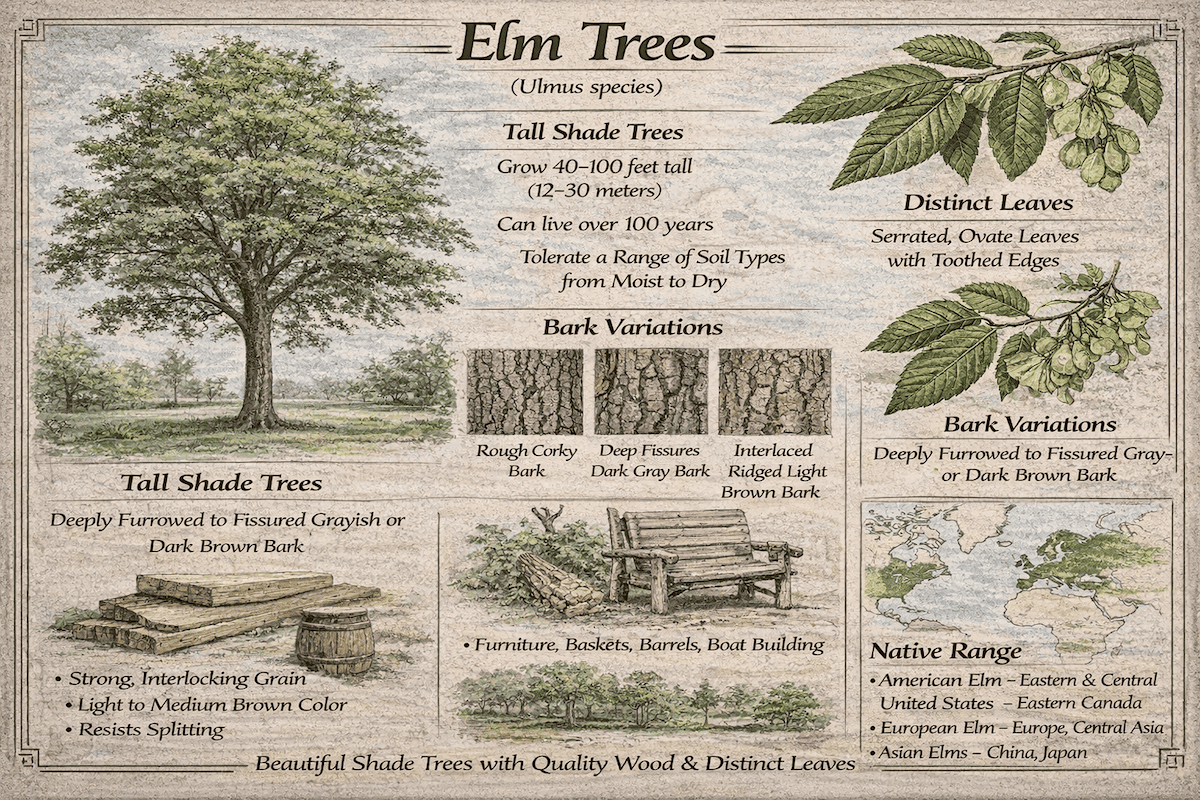

Thanks to advancements in tree breeding, disease-resistant elm varieties were introduced in the 1980s. Today, there is a dedicated effort to restore elm trees as a valuable commercial timber resource for urban, farm, and plantation settings.
High-density planting techniques encourage elm trees to grow tall and straight by reducing their natural tendency to spread laterally. Limiting branch spread promotes the development of clear trunk wood, which is the most valuable sawlog grade for milling into long, defect-free boards.
On productive sites, elms can be managed similarly to other high-value hardwoods like oak and maple:
Utilizing a looping spiral planting design can further enhance growth by boosting nutrient and water absorption through the root systems of each tree. In a spiral pattern, individual trees are staggered along an imaginary line, creating more even competition for light and soil resources. This pattern also leaves natural lanes for equipment access and future thinnings.
Some growers use spiral or circular layouts borrowed from agroforestry and permaculture design to:
By year 10, a seedling nursery can be established beneath the plantation canopy. These young seedlings will grow straight and branch-free as they compete for filtered light that penetrates the mature canopy above, providing continuous planting stock for future tree seedling programs.
The map below illustrates the North American growing zones suitable for American elm cultivation and can help landowners evaluate where elm plantations and restoration plantings are likely to succeed.

In today’s environmentally conscious world, elm wood stands out as a sustainable and natural alternative for numerous structural and decorative applications. Its ability to be used in-ground or in wet locations—often without harmful chemical preservatives—makes it an ideal material for eco-friendly wood products. Historically, elm was used for everything from wagon hubs to underground water pipes and boat planking.
Because elm resists splitting and holds fasteners well, it is still used or considered for:
Elm wood is valued for its dense, durable, and visually appealing properties. Below are its key characteristics:
For builders and woodworkers seeking a strong, attractive hardwood with exceptional performance in wet environments, elm is an excellent alternative to species like black locust and western red cedar.
The English Elm (Ulmus procera) is a majestic deciduous tree native to Europe and western Asia, renowned for its towering height, elegant arching branches, and iconic fan-shaped canopy. While native to Europe, it has been widely cultivated and naturalized in parts of North America where climate and soils are suitable.
Mature English elms can grow up to 100 feet tall, with a canopy spanning 50 to 60 feet, often displaying a vase-like structure. Its rugged, grayish-brown bark is deeply furrowed, while the dark green, serrated oval leaves turn a stunning golden yellow in autumn, adding seasonal charm.
A defining trait of the English elm is its remarkable ability to regenerate from roots, even after being felled. This resilience makes it a popular choice for hedgerows, windbreaks, and erosion control, particularly in agricultural landscapes and along streams.
The wood of the English elm is celebrated for its beautiful grain, strength, and resistance to splitting. Historically, it has been used in crafting furniture, flooring, boats, and machine parts. Before the industrial revolution, its durability made it the material of choice for axles, gears, pulleys, and water infrastructure. Its natural resistance to water led to its use in water pipes, river craft hulls, and canal systems, where elm wood has proven its longevity over centuries.
In North America, English elm performs best in:
Despite its strengths, the English elm has faced dramatic population declines due to Dutch elm disease, which decimated elms across Europe and North America. In response, ongoing breeding efforts aim to develop disease-resistant cultivars, ensuring the species' survival and continued utility in both urban and rural landscapes.
Today, English elm remains highly valued for its durability and exceptional finish, making it a preferred choice for premium furniture and flooring where it is still available and legally harvested.

The Chinese Elm (Ulmus parvifolia) is a versatile and resilient deciduous tree native to China, Korea, and Japan. Renowned for its elegant, arching branches, small serrated leaves, and distinctive exfoliating bark, this tree is a favorite for landscaping worldwide and is often called the “lacebark elm.”
Chinese elms can reach heights of up to 60 feet, with a canopy spread of 50 to 70 feet, forming a broad, vase-like shape. Its bark is uniquely mottled and exfoliates in patches, revealing colors that range from tan to gray-green. The tree’s small, oval leaves with serrated edges contribute to its delicate appearance. As a semi-evergreen species, the Chinese elm may retain some foliage during mild winters, adding year-round visual appeal.
One of the standout attributes of the Chinese elm is its adaptability to diverse soil types and environmental conditions. Its natural resistance to Dutch elm disease and other ailments that have devastated many elm species makes it an excellent choice for urban landscapes and tough planting sites.
Chinese elm wood is dense, hard, and valued for its straight grain and fine texture. It is exceptionally durable and resistant to splitting, making it ideal for applications such as furniture, flooring, and carving. Additionally, woodturners prize Chinese elm for crafting decorative items like bowls and vases due to its beautiful finish and workability.
In smaller form, Chinese elm is also widely used in bonsai culture, where its small leaves and fine branching make it an ideal training species.

Firewood elm, as the name suggests, is known as the “firewood tree” in Japan, where it originates. This Japanese elm grows profusely in many parts of the United States and, if planted in large numbers, could become a major tree supply for high-BTU fuel sources like cordwood and wood pellets.
Firewood elm adapts to most soils, including low-lying wetlands, making it an excellent tree choice to reclaim marginal land that would be too wet for many other hardwoods. Curing this wood for one and a half seasons (beginning of summer year 1 to end of summer year 2) will significantly increase its heat quotient value and make it easier to handle.
With proper curing and handling, firewood elm can help landowners turn low-value, wet ground into a reliable, renewable heat source for homesteads, farms, and rural communities.

From maple to oak and elm, hardwoods whisper of centuries past, their slow growth a testament to patience, strength, and long-term value.
Partner with us in a land management project to repurpose agricultural lands into appreciating tree assets. We have partnered with growingtogive.org , a 501(c)(3) nonprofit, to create tree-planting partnerships with land donors.
Elm, oak, black locust, and other long-lived hardwoods can transform underused acres into productive forests that store carbon, generate quality timber and firewood, and support local wildlife.
We have partnered with growingtogive.org , a Washington State nonprofit, to create a land and tree partnership program that repurposes agricultural land into appreciating tree assets.
The program utilizes privately owned land to plant trees that benefit both the landowner and the environment— storing carbon, improving soil, and providing long-term timber and firewood value.
If you have 100 acres or more of flat, fallow farmland and would like to plant trees, we would like to talk to you. There are no costs to enter the program. You own the land; you own the trees we plant for free, and there are no restrictions—you can sell or transfer the land with the trees at any time.
Copyright © All rights reserved Tree Plantation






