



 INVEST
 PLANT
PLANT
 SOFTWOODS
 HARDWOODS
 CALCULATORS
 RESOURCES
 PROGRAMS

Softwoods
Learn More
TREE VALUE • QUICK ANSWER • CALCULATOR
Quick answer: A tree’s value is estimated using its diameter (DBH), height, species, and wood quality. Larger, straighter trees of high-value species like walnut and oak are typically worth more because they produce more usable timber and command higher market prices.
Tree Value ≈ DBH² × Height × Species Factor × Quality Adjustment
This simplified formula is commonly used for planning estimates and educational comparisons.
👉 Use the calculator below to estimate what your tree may be worth instantly.
Used by landowners, foresters, and plantation managers for planning and comparison.
On this page: How To Use The Caluclator • Value factors • Calculator • Value factors • Measure DBH • Tree vs Timber Value • Yard Tree vs Forest Tree • Tree Value FAQs • Related Calculators • Value Growing Trees • Donate Land
This tree value calculator helps estimate potential value using practical field inputs such as diameter at breast height (DBH), while also accounting for species, timber quality, defects, and market conditions. It is useful for comparing trees, planning a harvest, and understanding long-term growth decisions.
| Value Factor | Why It Matters |
|---|---|
| DBH | Larger diameter usually means more usable wood volume. |
| Species | Some species command much higher sawlog or veneer prices. |
| Quality | Straight stems, fewer knots, and low defects increase value. |
| Market | Regional demand and timing can raise or lower pricing. |
Example: A straight, high-quality hardwood tree with a larger DBH can be worth several times more than a smaller tree of the same species because usable volume increases faster than diameter alone suggests.
Tree value is influenced by size, species, quality, and market demand. Even trees with the same diameter can vary significantly in value depending on these factors.
To calculate tree value, measure the diameter (DBH) and height, then apply a species value factor and quality adjustment.
Result: A planning-level estimate that helps compare trees and guide management decisions.
Tree value increases faster than diameter because wood volume grows exponentially as trees get larger.
As DBH increases, the amount of usable wood expands significantly, especially in the higher-quality portions of the trunk. This means a tree that is twice the diameter can be worth several times more, particularly for high-value species.
Start by entering a tree diameter below to see an estimated value, then explore how species, form, defect level, and market conditions can increase or decrease real-world pricing.
A high-quality hardwood tree with good form and minimal defects can be worth several times more than a similar-sized tree with bends, knots, rot, or poor log form. In many cases, tree quality matters almost as much as size when determining market value.
The value of a tree depends on more than size alone. Species, form, condition, and market demand all influence how much a tree may be worth for timber, appraisal, or long-term management purposes.
| Factor | Effect on Value |
|---|---|
| DBH | Larger diameter usually increases value because the tree yields more usable wood volume. |
| Species | High-demand species such as walnut, oak, and maple can often be worth more than lower-value species. |
| Stem Quality | Straighter stems with long, clear sections of wood often sell for more and are easier to mill. |
| Defects | Rot, forks, scars, cracks, and insect damage can significantly reduce tree value. |
Because of these differences, two trees of similar size can have very different values depending on species, condition, and wood quality.
Compare spacing and carbon tools to better plan tree placement, improve long-term growth, and estimate environmental benefits.
Estimate planting distance, compare row spacing, and calculate how many trees can fit per acre.
Use the calculator →Estimate how much carbon a tree can store and better understand the climate value of planting and preserving trees.
Explore the calculator →Feel free to share this tree value calculator infographic on your website or blog. Please include a link back to this page as the source.
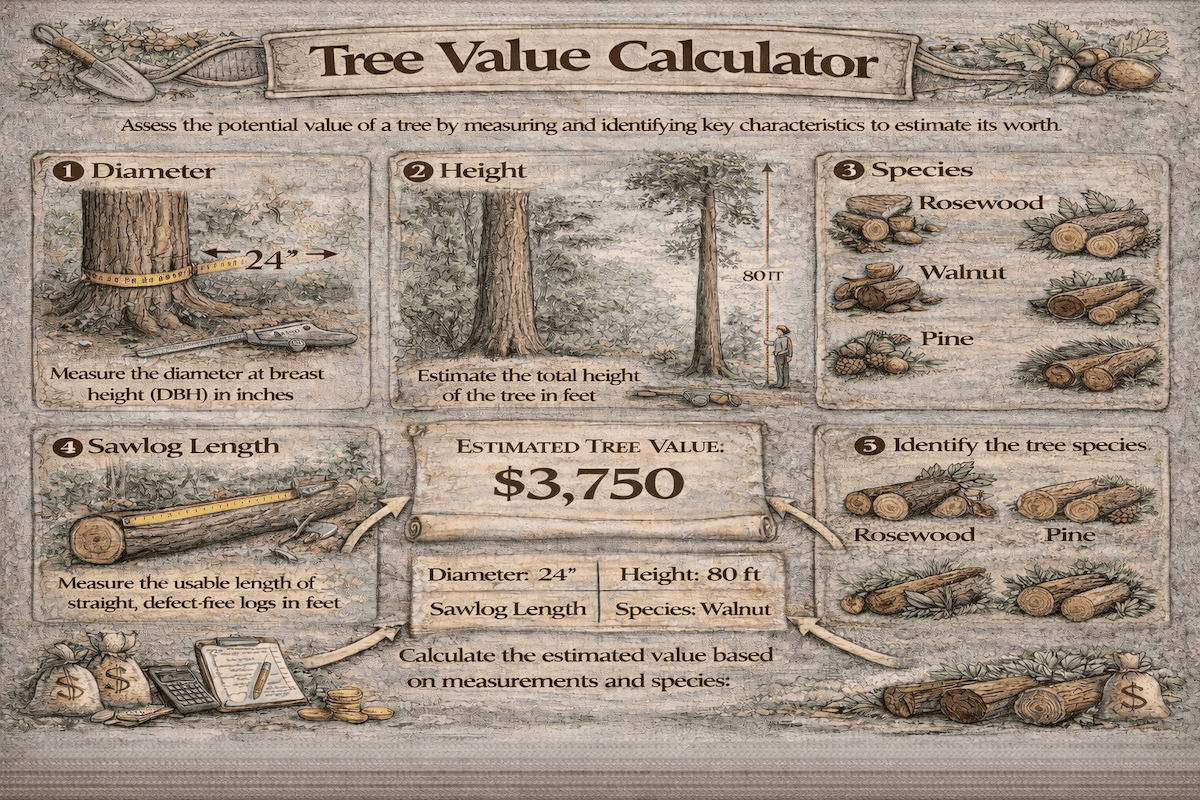
<a href="https://treeplantation.com/tree-value-calculator" target="_blank" rel="noopener">
  <img src="https://treeplantation.com/images/TP-tree-value-calculator-infographic.png" alt="Tree value calculator infographic showing how diameter at breast height, tree height, species, sawlog length, and log quality affect estimated tree value." width="1200" height="800" />
</a>
<div style="font-size:14px; margin-top:6px;">Source: TreePlantation.com</div>
A single mature tree can absorb 48 pounds (22 kg) of carbon dioxide per year and store roughly one ton of carbon dioxide over a 40-year lifespan. Forests therefore play a critical role in slowing climate change by removing carbon from the atmosphere and storing it in wood, roots, and soil.
Tools like the Tree Carbon Calculator help estimate how much carbon individual trees or entire plantings may capture over time, providing a practical way to measure the environmental value of tree planting and forest restoration projects.
Every tree planted is a metric waiting to be measured by a tree calculator. Use these tools together to plan tree spacing, estimate timber value, and track carbon storage across your forest, farm, or woodlot.
Together, these calculators create a decision toolkit for owners who want to manage trees as both an ecological asset and a long-term financial investment.
The calculator gives a planning estimate. Real-world value usually moves up or down based on the four things below. Use this list as a checklist before you assume a tree is “worth a lot.”
If you’re estimating a whole stand, pair this calculator with a simple tree count by diameter class, then verify pricing locally.
DBH means diameter at breast height. It’s the most common field measurement used in forestry because it’s fast, repeatable, and correlates well with volume.
People often use these terms interchangeably, but they are not always the same. Tree value is a broad planning idea that can include size, species, wood quality, future growth, location, and even non-timber considerations. Timber value is narrower and usually refers to what the merchantable wood could be worth in a real market.
A high-quality tree in a managed stand may have strong timber value because buyers can harvest and transport it efficiently. A yard tree, by contrast, may look impressive and add major landscape value to a property, yet have limited timber value if it has sweep, embedded metal, low limbs, or poor access for harvest equipment.
For that reason, this tool works best as a planning baseline. It helps you compare trees and estimate potential value, but real timber sales still depend on grade, access, market conditions, and local buyer requirements.
A tree growing in a backyard, along a driveway, or near a structure may have a very different value profile than a tree growing in a woodlot. Forest and plantation trees are often evaluated for merchantable height, log quality, and harvesting efficiency. Landscape trees are more often valued for shade, beauty, privacy, habitat, and how they contribute to overall property appeal.
This is why a large tree can be highly valuable to a homeowner even when its timber value is modest. On the other hand, a straight, accessible tree in a stand of similar trees may have stronger commercial value because it can be harvested and marketed with less cost.
Use a certified forester or qualified appraiser when you need a number for insurance, estate planning, legal disputes, tax reporting, major timber sales, or any situation where local grade rules and market pricing must be documented.
A tree’s value depends on its diameter (DBH), height, species, and wood quality. Larger, straighter trees of high-value species like walnut or oak can be worth significantly more due to greater usable timber volume and stronger market demand.
It estimates a planning-range tree value based on size and typical market assumptions. It is designed for comparison and education, not as a certified timber appraisal.
Tree value is typically calculated using DBH, height, species value, and quality factors. A simplified formula is: Tree Value ≈ DBH² × Height × Species Factor × Quality Adjustment.
Measure the trunk at about 4.5 feet above the ground. If the trunk is irregular or swollen, measure just above the irregularity for a more accurate diameter.
Tree quality and species differences can dramatically affect value. A straight, defect-free tree can be worth several times more than a crooked or damaged tree of the same diameter.
High-value species include black walnut, oak, cherry, and maple. These species are in strong demand for lumber, veneer, and specialty wood products, which increases their market price.
Yes—species and log quality are major value drivers. Higher-grade logs with fewer knots and defects produce more usable wood and command higher prices.
No—this is a planning tool, not a certified appraisal. For selling timber or insurance purposes, consult a professional forester or appraiser.
Focus on growth, spacing, and stem quality. Reduce competition, protect trees from damage, and favor straight, healthy stems through thinning and proper management.
Tip: For the most accurate pricing, combine this calculator with local stumpage data and a professional tree assessment.
The value of growing trees extends far beyond simple timber production. Some tree benefits are easy to recognize, such as lumber, veneer logs, firewood, poles, biomass, and pulpwood. Other benefits are less visible but still highly valuable, including carbon capture, erosion control, watershed protection, wildlife habitat, shade, wind protection, and long-term land restoration. A smart tree-growing strategy considers both financial returns and ecosystem services.
For landowners, investors, and forest managers, trees can function as a long-term natural asset. Depending on the species, spacing, site quality, and market conditions, the same acre of land may be managed for short-rotation biomass, pole wood, sawtimber, or high-value veneer hardwoods. The Tree Value Calculator helps estimate what individual trees may be worth and provides a practical starting point for larger plantation, woodlot, and forest planning decisions.
Managed tree plantations often provide the highest and most predictable financial return because they are designed around spacing, species selection, thinning schedules, and harvest timing. Softwood plantations, biomass plantations, and hybrid tree systems are especially attractive to investors because they can produce marketable yields in relatively short cycles—often between 5 and 20 years—compared with long-rotation hardwood systems that may take several decades to fully mature.
By contrast, hardwood plantations are typically a longer-term investment. However, they may also offer some of the highest per-tree returns when managed for clear sawlogs, veneer logs, and specialty wood. Species such as walnut, cherry, maple, and oak can become extremely valuable when trees are grown straight, protected from defects, and allowed to reach large diameters. For investors willing to wait, veneer-quality hardwood production may far exceed the short-cycle returns of lower-value plantation wood.
This is where a tree value calculator becomes especially useful. Instead of viewing a plantation only as an acre-level investment, you can also estimate the value of individual trees by species, diameter, and merchantable height. That makes it easier to compare management strategies, thinning decisions, and the potential value difference between ordinary timber and premium sawlogs.
In many softwood plantations, especially pine plantations, a large portion of the economic return comes not only from the final harvest but also from intermediate thinnings. These thinning stages generate early cash flow while improving spacing and growth conditions for the best remaining trees.
A common plantation model may include:
This phased harvest model helps explain why tree plantations can be highly profitable. Instead of waiting until the end of the rotation for all income, landowners may generate returns at multiple points while simultaneously improving stand quality. The Tree Value Calculator can help estimate the value of trees at each stage of this process, especially for plantation softwoods such as white pine and loblolly pine.
Growing trees for biomass usually involves the shortest crop rotations. In many systems, coppicing species can be harvested in roughly 5-year cycles, then regrow from the stump for repeated harvests. Biomass plantations may supply wood chips, pellets, pulp feedstock, or fuel for renewable energy systems.
Because biomass crops emphasize volume and repeatability more than premium log quality, they can create predictable short-run revenue streams for landowners who want faster turnover. The Woodlot Estimator can be used alongside local biomass pricing to model stand-level returns from repeated harvest cycles.
Growing trees to rebuild ecosystems may not always look profitable at first glance, but the economics of restoration are changing rapidly. Governments, conservation organizations, watershed districts, and private partners increasingly pay landowners to reclaim land damaged by fire, flood, erosion, mining, or poor agricultural practices.
In many regions, income can come from:
In these cases, the value of a tree is not limited to what it could be cut for. The value may also come from what the tree does while standing—protecting soil, filtering water, stabilizing slopes, shading streams, and rebuilding ecological function across a damaged landscape.
One of the fastest-growing areas of tree-based value is carbon sequestration. Trees remove carbon dioxide from the atmosphere and store that carbon in wood, roots, litter, and soil. As concerns about climate change increase, this stored carbon has become financially important through carbon markets, sustainability programs, and climate-focused land investment strategies.
Carbon-related tree value is especially attractive because it may create revenue without requiring the trees to be harvested. In some cases, landowners can generate ongoing returns simply by maintaining healthy growing forests. Use the Tree Carbon Calculator to estimate how much carbon a tree may capture and to better understand the climate value of keeping trees in the ground.
The Tree Value Calculator can also function as a practical timber value calculator for forest owners and woodlot managers. To estimate approximate timber value per acre, begin by identifying the number of harvestable trees growing on one acre and grouping them by species.
For example, if you estimate that one acre contains 35 harvestable black cherry trees, you can enter the average diameter and merchantable height of a representative tree into the calculator. Multiply the estimated per-tree value by 35 to generate a rough value for the black cherry timber growing on that acre.
Repeat this process for other species on the same acre—such as maple, oak, pine, or walnut—and then combine the totals to estimate the overall timber value of that acre. This method is especially useful for comparing species mixes, thinning strategies, and the potential difference between current harvest value and future value after additional years of growth.
For a broader stand-level estimate, combine tree-by-tree calculations with the Woodlot Estimator. Together, these tools can help landowners evaluate different management scenarios, including thinning plans, delayed harvests, and long-term stand improvement.
The Tree Value Calculator can also be used as a black walnut tree value calculator. Black walnut is one of the most valuable hardwood species in North America because of its dark color, strong demand, and potential to produce premium veneer logs.
To estimate walnut tree value, choose Black Walnut from the species list and enter the diameter and height of the merchantable stem. For a more refined estimate, divide the usable trunk into 10-foot sections and evaluate each section separately. This method helps distinguish high-value lower veneer logs from upper sections that may only qualify as standard lumber or blocking.
The calculator can also be used as an oak tree value calculator. Oak value depends heavily on species, diameter, straightness, and the length of defect-free log sections. White oak and red oak are both commercially important, but individual tree value can vary greatly depending on quality.
To estimate oak tree value, divide the trunk into 10-foot sections wherever the diameter is large enough to produce a merchantable log. Enter the diameter and height for each section, select the correct oak species, and add the values together. This method more closely mirrors how buyers evaluate and scale logs.
The calculator also works as a pine tree value calculator for species such as loblolly pine and white pine. Pine is commonly sold as pole wood, sawtimber, pulpwood, or plantation softwood, depending on size, quality, and market demand.
To estimate pine tree value, select the appropriate pine species, then measure the diameter and height of the usable pole or sawlog section. Because pine plantations are often managed across entire stands, repeating this process for several representative trees can help landowners estimate the value of a plantation block or polewood stand more accurately.
Whether trees are grown for timber, poles, veneer, biomass, restoration, or carbon value, understanding what each tree may be worth helps landowners make better long-term decisions. The Tree Value Calculator is most powerful when used not just as a curiosity tool, but as part of a broader strategy for forestry, plantation design, stand management, and land stewardship.
Partner with us in a land management project to repurpose agricultural lands into appreciating tree assets. We have partnered with growingtogive.org, a 501(c)(3) nonprofit, to create tree planting partnerships with land donors that benefit local communities and global climate goals.
We have partnered with growingtogive.org, a Washington State nonprofit, to create a land and tree partnership program that turns flat, fallow farmland into appreciating tree assets.
The program utilizes privately owned land to plant trees that benefit both the landowner and the environment. Long-lived trees can provide future timber, carbon income, and habitat value while improving soil health and water retention.
If you have 100 acres or more of suitable land and would like to plant trees, we would like to talk to you. There are no costs to enter the program. You own the land; you own the trees we plant for free, and there are no restrictions—you can sell or transfer the land with the trees at any time. The Tree Value Calculator gives you a glimpse of what those trees might be worth in the decades ahead.
Copyright © All rights reserved Tree Plantation



