


 INVEST
 PLANT
PLANT
 SOFTWOODS
 HARDWOODS
 CALCULATORS
 RESOURCES
 PROGRAMS

Softwoods
Learn More
SOLAR TREES • RENEWABLE ENERGY • SMART DESIGN
Wondering what solar trees are and how they work? Solar trees are innovative renewable energy systems designed to mimic the structure of a tree, using solar panels arranged like branches and leaves to capture sunlight efficiently while minimizing ground space.
☀️ Quick answer: Solar trees generate electricity by using elevated, multi-directional solar panels that capture sunlight throughout the day, offering a space-efficient, visually appealing alternative to traditional solar arrays.
Examples: Solar trees are used in urban parks, campuses, parking areas, commercial developments, and smart cities, where they provide power generation, shade, lighting, and charging stations.
As demand for renewable energy grows, solar trees represent a fusion of technology, design, and sustainability. They are engineered not only to produce energy, but also to enhance public spaces and demonstrate how clean energy can be integrated into everyday environments.
Unlike traditional ground-mounted panels, solar trees stack panels vertically, allowing them to generate power while using significantly less land area— making them ideal for dense urban environments.
As the world increasingly seeks renewable energy sources, innovative solar technologies are emerging as practical solutions for homes, businesses, and cities. Among these developments, solar trees stand out as both aesthetically pleasing and highly functional tools to harvest the sun's energy.
Solar trees come in a variety of designs and configurations, each offering different power outputs, panel arrangements, and installation footprints. From compact decorative units to large-scale installations, they can be tailored to meet both energy production goals and architectural design needs.
In this guide, we explore the different types of solar trees, how they work, and how they can contribute to a more sustainable, energy-efficient future in both urban and rural environments.
Estimate solar-tree power output (kWh/day + kWh/year), battery runtime, EV charging capacity, and CO₂e avoided. Compare compact 2–4 kW units versus 10–25+ kW canopy systems using region presets, shading, and performance losses.
Feel free to share this solar tree calculator infographic on your website or blog. Please include a link back to this page as the source.
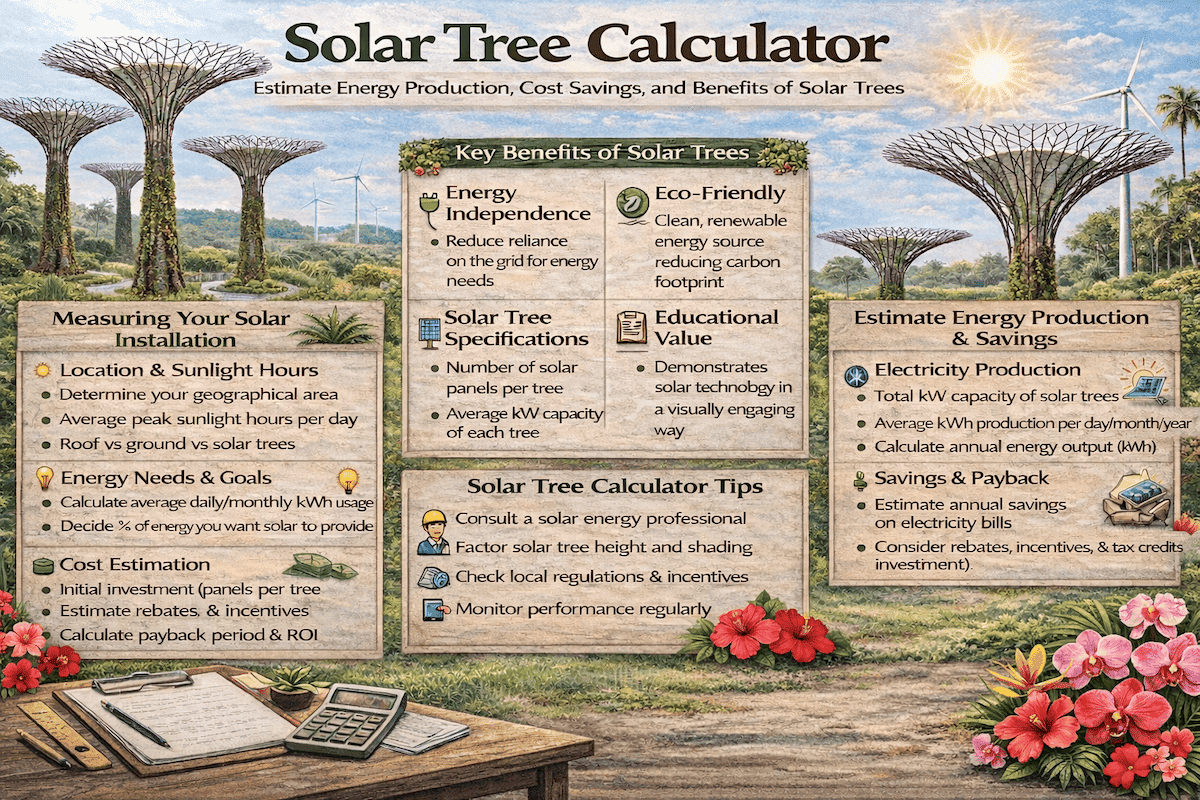
A solar tree is a structure designed to resemble a tree, with solar panels taking the place of leaves on its branches. These “leaves” capture sunlight and convert it into usable electricity through photovoltaic (PV) technology. Solar trees offer an attractive alternative to traditional rooftop or ground-mounted solar panel installations, blending into urban streetscapes, parks, campuses, and commercial properties while generating clean energy.
For city planners and landscape architects, solar trees support sustainable urban planning by:
A solar panel tree is a tree-shaped structure that supports multiple solar modules on branching arms. By stacking panels vertically and at optimized angles, solar panel trees can:
Solar panel trees demonstrate the potential for creative design and the integration of renewable energy into everyday life. By incorporating numerous solar panels on their branches, they optimize energy capture while minimizing the space required for installation. This unique design opens up opportunities for installations in dense urban areas, corporate campuses, schools, and public parks.
A real-world example of solar panel trees is the “eTree” developed by the Israeli company Sologic. The eTree is a solar-powered structure that provides shade, free Wi-Fi, charging stations for electronic devices, and even a water trough for animals. Metal branches hold solar panels, and its energy production is sufficient to power these amenities. eTrees have been installed in several locations around the world, including public parks and university campuses. One notable installation can be found in the French city of Nevers, where the eTree not only generates clean energy but also serves as a social hub, encouraging community engagement and interaction.
Another example of solar panel trees comes from Spotlight Solar, a company that develops “solar sculptures” for commercial properties. These elegant structures are designed to capture the attention of passersby while generating clean energy for the property. With installations at various corporate campuses and commercial sites, Spotlight Solar’s solar panel trees demonstrate the potential for renewable energy solutions to be both functional and visually appealing, contributing to a more sustainable and aesthetically pleasing environment.
Pine tree solar designs are particularly valuable in preserving the natural aesthetics of an area while harnessing solar energy. By integrating solar panels into an artificial pine or spruce tree structure, the installation becomes nearly indistinguishable from surrounding forest or landscaped areas. This approach is especially useful where residents or visitors are sensitive to visual impacts, yet onsite renewable power is needed.
Pine tree solar systems have been installed in remote forested locations, highway corridors, and suburban neighborhoods. In each case, they help maintain the scenic quality of the landscape while still promoting the use of clean, low-carbon energy. For golf courses, resorts, trailheads, and nature parks, pine tree solar designs can power lighting, signage, irrigation systems, and small buildings without adding industrial-looking infrastructure.

One real-world example of pine tree solar is the "Pine Solar Project" developed by Valmont Industries. This project has implemented pine tree solar installations at multiple sites, including a golf course in Colorado. The artificial pine trees, standing around 30 feet tall, blend seamlessly into the natural environment while hosting solar panels on their branches. These installations generate clean energy for the golf course and help maintain the scenic beauty of the landscape, demonstrating that renewable energy solutions can be both effective and visually unobtrusive.
Another example of pine tree solar technology appears in the telecommunications industry. Cell phone towers are often disguised as pine trees or other natural structures to reduce their visual impact on the surrounding environment. By incorporating solar panels into these artificial structures, companies can power their telecommunications equipment using renewable energy while maintaining the aesthetic harmony of the area. This innovative approach showcases the potential for pine tree solar designs to provide versatile, environmentally friendly solutions across multiple industries, from telecom infrastructure to transportation and recreation.
Solar palm trees are an innovative approach to renewable energy that combines functionality with visual appeal, particularly in tropical and coastal regions. These structures, designed to resemble palm trees, incorporate solar panels into their fronds, allowing them to capture sunlight and generate clean electricity. Solar palm trees are not only eco-friendly but also add an artistic touch to their surroundings, making them an attractive alternative to traditional solar panel installations on flat roofs or carports.
In tourist destinations and waterfront cities, solar palm trees can:

One real-world example of solar palm trees can be found in Dubai, where the city’s energy and water authority (DEWA) has installed several "Smart Palm" structures in public spaces. These solar palm trees not only generate clean energy but also offer a range of additional amenities, including free Wi-Fi, charging stations for electronic devices, and digital screens that display useful information for tourists and residents. The solar palm trees also provide shade and seating areas, making them a valuable addition to parks and recreational spaces.
In Scottsdale, Arizona, another example of solar palm trees can be seen in the form of a solar parking canopy at the city’s Desert Botanical Garden. This installation, consisting of several solar palm tree structures, provides shade for parked cars while generating electricity to power the garden’s facilities. The solar palm trees serve a practical purpose and enhance the visual appeal of the parking area, blending seamlessly with the surrounding desert landscape. The integration of solar palm trees into various settings demonstrates their potential as an attractive, space-efficient, and sustainable solution for renewable energy generation in urban environments.
Solar willow trees represent a fusion of natural beauty and cutting-edge renewable energy technology. By mimicking the graceful form of willow trees, these installations capture the essence of their natural counterparts while generating clean energy. Flexible branches, adorned with solar panels, can sway gently in the wind, creating a mesmerizing visual effect that adds an artistic dimension to their surroundings. Solar willow trees show that renewable energy solutions can be both functional and visually engaging, contributing to a more sustainable and aesthetically pleasing environment.

A real-world example of solar willow trees is the "Solar SunFlower" installation created by the Swiss designer and artist duo Harries and Héder. The Solar SunFlowers are a series of solar-powered sculptures that resemble willow trees with their long, slender branches and solar panel "leaves." Installed at the University of Massachusetts at Lowell, the Solar SunFlowers not only generate clean energy for the campus but also serve as a public art exhibit, encouraging students and visitors to engage with renewable energy technology in a more personal and interactive manner.
Another willow-inspired solar concept is the "Solar Ivy" project developed by the Brooklyn-based design firm SMIT (Sustainably Minded Interactive Technology). This system consists of flexible, leaf-like solar panels that can be attached to the exterior of buildings, creating the appearance of ivy or willow branches cascading down the structure. Solar Ivy generates clean energy while adding a striking visual element to the building’s facade, demonstrating the potential for solar willow tree-inspired designs to be integrated into various architectural settings. These examples showcase the versatility and creativity of solar willow tree installations, proving that art and renewable energy can work in harmony to create a more sustainable world.
Solar power trees, renewable energy trees, and artificial energy trees are umbrella terms for a growing family of tree-shaped technologies designed to capture sunlight (or wind) and convert it into usable electricity. These structures often feature a tree-like design with multiple branches supporting solar panels or micro-turbines. By combining functionality with visual appeal, solar power trees can be integrated into a variety of settings, including urban landscapes, residential neighborhoods, and commercial properties, offering an attractive alternative to conventional solar installations.

One real-world example of a solar power tree is the "Energy Tree" located in Bristol, United Kingdom. Designed by artist John Packer and engineer Pete Licence, the Energy Tree is a 5-meter tall steel structure with 36 solar panels integrated into its branches. Installed in Millennium Square, a public space in the heart of the city, the Energy Tree not only generates clean electricity but also serves as an interactive educational exhibit. Visitors can use the electricity produced by the tree to charge their mobile devices or interact with LED lighting that responds to their presence. The Energy Tree showcases the potential for solar power trees to engage the public with renewable energy technology while providing practical benefits.
Another example of an artificial energy tree is the "Wind Tree", developed by the French company New Wind. Although not a solar power tree, the Wind Tree is worth mentioning due to its unique approach to harnessing renewable energy. Standing at 11 meters tall, the Wind Tree is equipped with 63 miniature wind turbines mounted on its branches, capturing energy from even the slightest breeze. This innovative design allows the Wind Tree to generate electricity in urban environments where conventional wind turbines might be impractical. Together, the Energy Tree and the Wind Tree exemplify how solar power trees, renewable energy trees, and artificial energy trees can contribute to a more sustainable future by creatively integrating clean energy solutions into our everyday lives.
Compared to flat rooftop or ground-mounted systems, solar trees offer several distinct advantages:
Traditional solar arrays may provide lower cost per watt on large, open sites, but solar trees excel where space, visibility, and multi-use design are priorities.
Solar trees have numerous practical applications, including:
Beyond generating electricity, solar tree installations can be designed for additional functions, such as:
By incorporating these extra features, solar trees provide even more value to communities and promote public engagement with renewable energy technologies.
In short, solar trees represent a creative, flexible, and visually compelling approach to harnessing solar energy. By blending into the landscape and providing a multitude of uses, they offer an attractive solution for sustainable energy generation in cities, suburbs, and natural settings. As renewable energy technologies continue to evolve, solar trees and other artificial energy trees will likely play a crucial role in our transition toward a greener future.
For more on the natural trees that inspire these designs, explore our guides to willow trees, palm trees, and spruce trees.
Copyright © All rights reserved Tree Plantation