


 INVEST
 PLANT
PLANT
 SOFTWOODS
 HARDWOODS
 CALCULATORS
 RESOURCES
 PROGRAMS

Softwoods
Learn More
WHITE PINE • TIMBER • LONG-TERM VALUE
Wondering how valuable white pine trees can become and how to grow them successfully? Eastern white pine (Pinus strobus) is a fast-growing softwood capable of producing high-value timber when properly spaced, pruned, and managed over time.
🌲 Quick answer: White pine trees can reach high value through straight growth, proper spacing, and long-term management, with premium logs used for lumber, millwork, and specialty wood products.
Examples: White pine is commonly used for construction lumber, trim, paneling, furniture, and plantation forestry systems, where fast growth and workable wood are key advantages.
As one of the most historically important trees in North America, white pine has long been valued for its tall, straight trunks and consistent wood quality. Today, it remains a top choice for growers seeking a balance between timber production, land improvement, and long-term investment.
Eastern white pine has been prized for centuries for its tall straight trunks, lightweight workable wood, and broad commercial usefulness. Today, it remains one of the most attractive softwood species for growers seeking a balance of timber income, plantation performance, and land improvement.
When managed with proper spacing, pruning, and seedling selection, white pine can produce better form, cleaner stems, and stronger returns over time. It also delivers ecological benefits through carbon capture, wildlife habitat, and shelterbelt value.
Explore this guide to see why white pine continues to be a standout species for tree plantations, mixed forestry systems, and long-range land investment.
White pine performs especially well in managed plantation systems, where spacing and thinning strategies are used to optimize both growth rate and final timber quality.
Key insight: The highest-value white pine trees are produced not just by growth rate, but by form control, spacing strategy, and long-term planning.
White pine (Pinus strobus) offers one of the most compelling opportunities in modern softwood forestry. With the right planting strategy, spacing, and early pruning, landowners can transform underutilized acreage into a long-term asset capable of producing high-value, clear-grain timber—with premium trees potentially exceeding $1,000+ per tree in today’s specialty wood markets.
Native to eastern North America, white pine is a fast-growing, long-lived conifer known for its straight form, soft workable wood, and strong demand across construction, millwork, and fine woodworking industries. Below are the key characteristics that make this species both ecologically important and commercially attractive:
Today, high-quality old-growth white pine is extremely scarce—creating a powerful opportunity for growers to reintroduce this iconic species through sustainable plantation systems that prioritize both yield and environmental impact.
Several important “white pine” species share similar needle structure (bundles of five) and timber characteristics. Each offers unique advantages depending on climate, elevation, and plantation goals:
Historically, vast old growth white pine forests produced massive, branch-free trunks that were considered some of the most valuable timber in North America. Today, those old-growth stands are largely gone—making clear, knot-free white pine lumber increasingly rare and valuable.
This scarcity creates a strategic opportunity for landowners to grow white pine using modern plantation techniques, including precision spacing, early pruning, and structured planting systems such as crop circle or spiral layouts. These approaches improve light distribution, airflow, and tree form—helping produce straighter trunks and higher-quality logs.
With the right management plan, white pine can deliver a powerful combination of timber income, land appreciation, carbon value, and ecological restoration—making it a cornerstone species for sustainable forestry and long-term land investment strategies.
Feel free to share this white pine tree infographic on your website or blog. Please include a link back to this page as the source.
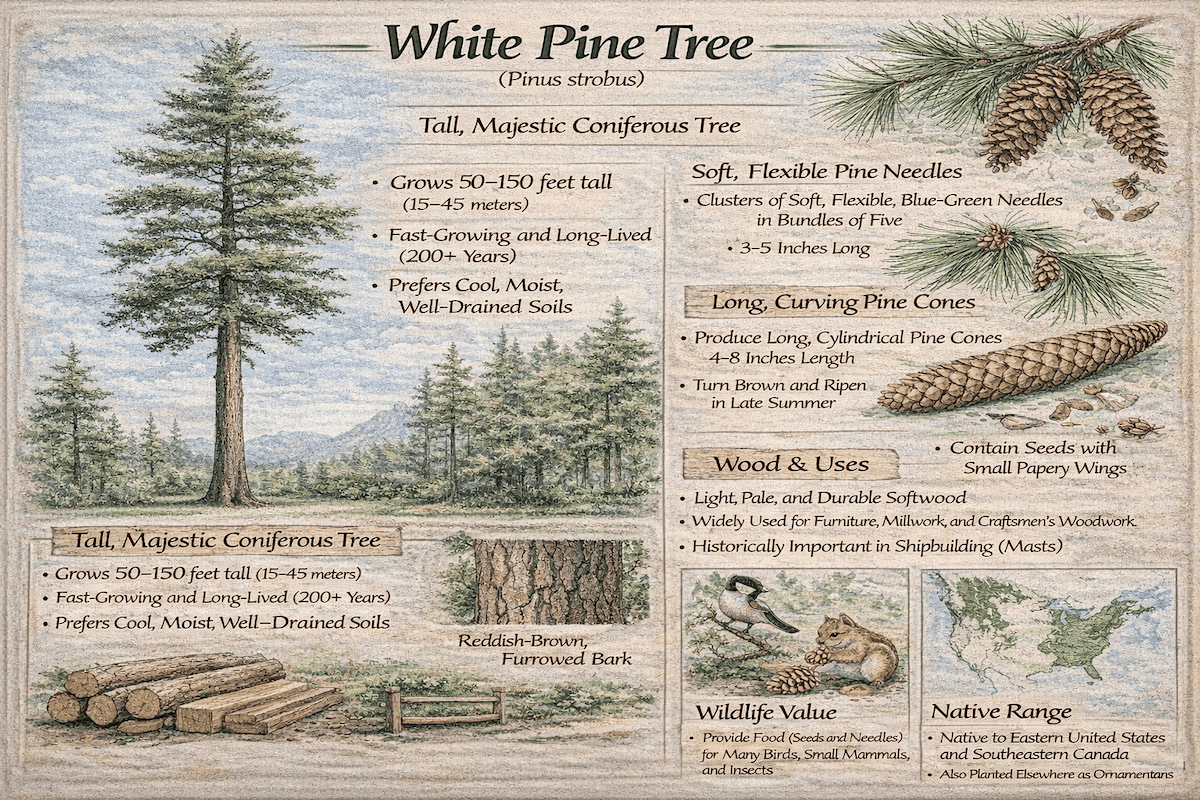
White pine remains one of the most attractive softwood species for tree plantations because it combines commercial versatility, fast early growth, strong market demand, and long-term sustainability. In many North American plantation systems, white pine is grown alongside red pine to create a diversified conifer stand that can serve multiple timber markets while improving plantation resilience.
In conventional plantations, both white pine and red pine are often managed for pole wood, fencing, pulpwood, posts, and utility uses. When trees are planted closely and left unpruned, they tend to develop branches along much of the trunk. Each branch eventually forms a knot in the finished wood, which lowers the grade for premium clear-lumber markets but still produces highly usable material for a broad range of commercial products.
This is why older plantation-grown white pines are frequently sawn into dimensional lumber and the well-known decorative material called “knotty pine”. Knotty pine has long been valued for its warm color, visible knots, and rustic character, making it popular for paneling, flooring, furniture, ceilings, cabinetry, and interior trim. Its continued appeal in cabins, cottages, lodges, and farmhouse-style homes gives white pine an enduring place in both structural and decorative wood markets.
What makes white pine especially important in sustainable timber production is that it can be managed for different value tiers depending on the landowner’s goals. A lower-input plantation may produce knotty pine, posts, and general-use lumber, while a more intensively managed stand—with proper spacing, selective thinning, and early pruning—can begin moving toward higher-grade, clearer wood suitable for millwork, specialty trim, and premium lumber applications.
White pine also supports sustainability beyond timber alone. It contributes to carbon storage, soil protection, wind moderation, wildlife shelter, and long-term land improvement. As a long-lived native conifer, it fits well into plantation systems designed to balance economic return with ecological stewardship. For growers looking to build value over time while producing a useful and marketable wood product, white pine stands out as one of the best all-around choices in temperate forestry.
One of the most important factors in determining the value of a white pine tree is the presence—or absence—of knots. In traditional plantations, trees are often left unpruned, allowing branches to persist along the trunk for decades. While this approach produces usable lumber, it typically results in knotty wood, which is significantly less valuable than clear, knot-free timber used in premium applications.
To produce higher-grade logs, growers implement systematic pruning programs during the early years of growth. By removing lower branches while they are still small, trees can develop clean, straight boles capable of producing clear lumber and, in some cases, veneer-quality material. Pruning is usually carried out in stages, gradually lifting the live crown to heights of 16–18 feet or more, depending on management goals.
Without pruning, it can take 80–100+ years for white pine to naturally shed enough branches to produce clear wood. With proper intervention, this timeline can be dramatically reduced—making pruning one of the highest-return practices in a managed plantation system.
A complementary strategy is to establish plantations using high-density spacing, which encourages trees to grow upward in competition for light. This natural competition promotes self-pruning, straighter trunks, and reduced branch size. As the stand matures, selective thinning removes competing trees, allowing the best-formed individuals to expand and increase in diameter.
In addition to field management, advances in nursery practices are helping accelerate plantation performance. Using advanced propagation techniques, growers can produce larger, more vigorous seedlings that establish quickly and begin vertical growth sooner than traditional stock. Some systems focus on developing taller, well-formed seedlings prior to transplanting, improving early survival and reducing the time needed to achieve commercial size.
Specialized container systems—such as deep or structured root tubes, can further enhance early performance by promoting strong, well-distributed root systems. These roots adapt more efficiently after planting, improving water uptake, stability, and long-term growth consistency.
By combining early pruning, optimized spacing, improved seedlings, and selective thinning, growers can significantly shorten the path to harvest while producing higher-quality timber—resulting in stronger economic returns and more efficient land use.
Traditional tree plantations are typically laid out in straight rows, which can limit light distribution, airflow, and overall growing efficiency. In contrast, Crop Circle Tree Plantations use spiral-based planting patterns designed to optimize spacing, sunlight exposure, and environmental interaction across the entire planting area.
In a spiral configuration, trees are positioned along curved pathways rather than rigid lines. This layout can improve light penetration, air circulation, and root-zone balance, creating a more dynamic growing environment. For species like white pine, which respond well to consistent light and reduced competition stress, this can translate into more uniform growth and improved tree form.
Field observations and early-stage implementations suggest that spiral-based systems may support enhanced growth rates—often in the range of 10% or more compared to conventional row planting, depending on site conditions and management practices. Importantly, this increased growth does not compromise wood density, strength, or visual quality, making it a promising approach for high-value timber production.
Spiral plantations also integrate well with mixed-species designs, selective thinning strategies, and precision spacing tools, allowing growers to fine-tune plantation performance over time. The result is a system that not only improves yield potential but also supports resilience, biodiversity, and long-term sustainability.
For landowners seeking to combine innovation with profitability, spiral plantation design represents a forward-thinking approach to cultivating white pine—maximizing both growth efficiency and timber quality within a modern forestry framework.
White pine performs especially well in mixed-species plantations, where it can be paired with other commercially valuable conifers to improve both resilience and long-term profitability. One effective approach is to alternate white pine with red pine throughout each loop of a spiral or crop circle plantation layout. This type of species diversity helps reduce uniformity across the stand, creating a healthier and more adaptable planting system.
Mixed plantations are often better able to withstand pest pressure, disease outbreaks, and weather stress than single-species blocks. Because white pine and red pine differ in growth habit, crown structure, and site response, planting them together can improve air movement, distribute risk, and add visual and ecological diversity to the plantation. For landowners seeking a balance of timber production, landscape beauty, and sustainable forestry, this can be a highly effective strategy.
A relatively high-density planting pattern, such as trees spaced about 8 feet apart, can be used in the early years to encourage straighter growth and more natural competition. This tighter spacing helps promote upward growth, improves trunk form, and can reduce excessive branching on future crop trees. As the plantation matures, a program of selective thinning can remove every second red pine or white pine tree, depending on form, vigor, and spacing needs.
This thinning stage can create an early revenue opportunity through pulpwood, posts, small poles, biomass, or lower-grade saw material, while at the same time giving the remaining trees more light, root space, and crown room to develop into larger, higher-value stems. Over time, this management system supports the production of better-quality logs suited for dimensional lumber, specialty wood products, and potentially veneer-grade material where site quality and pruning programs are favorable.
In well-managed mixed plantations, white pine can become a cornerstone species for long-term value creation. Its straight form, soft workable wood, and broad market appeal make it a strong candidate for growers who want to combine forestry income, carbon storage, habitat value, and land improvement within a single planting design.
Eastern white pine (Pinus strobus) is native to a broad area of eastern Canada and the northeastern to north-central United States. Its historic range is strongly associated with the Great Lakes region, New England, the Appalachian uplands, and the St. Lawrence River corridor, where cool winters, moderate summer moisture, and well-drained soils support vigorous growth.
In cultivation, white pine is generally well suited to USDA growing zones 3 through 8, making it adaptable across a wide band of North America. It grows best on fertile, slightly acidic, well-drained soils and performs especially well in regions with reliable rainfall and good air circulation. Although it is most strongly identified with the eastern half of the continent, white pine can also be grown successfully in selected microclimates outside its main native range.
In parts of the western United States and Canada, white pine may perform well in cooler interior valleys, mountain foothills, and protected coastal-influenced zones where summer heat is moderated and soil moisture is sufficient. In places such as portions of British Columbia, Washington State, and other favorable northern or elevated sites, growers may be able to establish white pine successfully when local climate and soil conditions are matched carefully to the species’ needs.
For plantation planning, the best results usually come from choosing sites with good drainage, adequate moisture, room for airflow, and minimal long-term heat stress. When matched to the right site and managed with proper spacing, pruning, and thinning, white pine can serve as both a beautiful landscape tree and a highly useful long-term forestry species.

Eastern white pine (Pinus strobus) was introduced to Europe in the early 1600s, traditionally credited to English explorer George Weymouth. In the United Kingdom, it became widely known as Weymouth Pine and was initially planted as an ornamental tree in estates, botanical gardens, and landscaped parks due to its elegant form and soft, blue-green foliage.
Over time, white pine proved to be far more than ornamental. Its fast growth, straight trunk, and adaptable nature led to broader adoption across continental Europe, particularly in Germany, France, Poland, and parts of Central and Northern Europe. Foresters began recognizing its potential as a productive timber species capable of performing well on a range of sites.
In northern Bavaria, Germany, white pine—locally referred to as “Strobe”—has become a well-established forest species. Germany alone maintains thousands of acres of white pine stands, including mature forests exceeding 100–120 years in age. These plantations serve as both a reliable seed source and a living demonstration of the species’ long-term performance under European growing conditions.
One of white pine’s key advantages in Europe is its ability to grow on moderately poor or sandy soils where other commercial species may struggle. Its needle litter contributes organic matter to the forest floor, gradually improving soil structure and nutrient cycling. This process can enhance soil fertility, microbial activity, and biodiversity, making white pine a valuable component in mixed and restorative forestry systems.
Today, white pine is used in Europe not only for timber production but also in reforestation, mixed-species forestry, and climate-adaptive planting strategies, where its resilience and growth characteristics help stabilize landscapes and diversify forest composition.
White pine is classified as a lightweight softwood with a fine, straight grain and uniform texture. Its color typically ranges from creamy white to pale yellow, sometimes accented by subtle orange or brown streaks. These characteristics make it one of the most versatile and user-friendly woods for both structural and decorative applications.
One of its most recognized uses is in knotty pine paneling, where natural knots create a warm, rustic aesthetic popular in cabins, homes, and interior feature walls. At the higher end of the market, properly managed and pruned trees can produce clear, knot-free lumber suitable for fine millwork, trim, cabinetry, and specialty woodworking.
Common applications include interior trim, window sashes, door frames, molding, shelving, and detailed carpentry. Its dimensional stability and ease of machining also make it a preferred material for millwork and custom fabrication.
Beyond interior uses, white pine is widely utilized for wood siding, as well as for boxes, crates, coffins, boats, woodenware, and specialty products. Its lightweight nature and workability make it especially useful where ease of handling and shaping are important.
White pine also plays a major role in the Christmas tree industry, where its soft needles, symmetrical form, and pleasant appearance make it a popular choice for seasonal markets. This adds an additional revenue stream for growers and highlights the tree’s versatility across both short-term and long-term production cycles.
From rustic paneling to high-end clear lumber, white pine continues to deliver a unique combination of workability, beauty, and commercial value—making it one of the most enduring and adaptable softwood species in both North American and European forestry.
Knotty pine refers to pine lumber that features visible knots—natural remnants of branches embedded within the wood grain. These knots create a warm, rustic appearance that has made knotty pine a timeless favorite in interior design. Most commonly, knotty pine boards are milled with tongue-and-groove (T&G) joints, allowing them to interlock seamlessly for use in walls, ceilings, and flooring.
Knotty pine gained widespread popularity in 1950s and 1960s home design, especially in kitchens, cabins, and family rooms, where its natural texture and golden tones created a cozy, inviting feel. Today, it is experiencing a strong resurgence as designers blend rustic materials with modern finishes, bringing character and warmth into contemporary spaces.
While knotty pine is valued for its visual appeal, it also represents an important distinction in forestry: knotty wood vs. clear wood. Trees that are not pruned develop branches along the trunk, resulting in knotty lumber. In contrast, carefully managed and pruned white pine plantations can produce clear, knot-free boards that command significantly higher prices in premium markets.
The balance between producing knotty pine for decorative uses and clear wood for high-end applications is a key consideration for growers and landowners managing white pine plantations.
The following insights reflect practical experience from forestry professionals, sawmill operators, and wood product specialists working with white pine across North America:
White pine consistently ranks among the highest-value softwoods in eastern North America. Whether sold as stumpage, logs, or finished lumber, it often commands premium pricing compared to other regional species. Select and shop grades of white pine can rival—or even exceed—the value of traditional hardwoods like red oak in certain applications. Even lower-grade material tends to outperform many other eastern softwoods such as red pine, jack pine, spruce, and balsam fir.
One of the biggest challenges in establishing white pine plantations is deer browsing. Young seedlings are highly susceptible, with deer often consuming the terminal leader or entire plant. Damage to the leader can cause forking and poor form, significantly reducing future timber value. In some regions, losses of newly planted seedlings can be substantial without protection.
Effective strategies include tree shelters, fencing, repellents, and planting larger or more established seedlings that can grow beyond browsing height more quickly. Proper early protection is critical to maintaining stand quality and long-term economic return.
Tree size and wood quality are the primary drivers of value in white pine. One of the most important management practices is early limb pruning, which helps produce clear, knot-free trunks (boles). Pruning is typically carried out in stages, often up to 16–18 feet, depending on the intended end product.
Without pruning, white pine may take 80–100+ years to naturally develop clear wood through self-pruning. By contrast, managed plantations can significantly shorten this timeline and produce higher-grade lumber, veneer logs, and specialty wood products.
The difference in value between knotty wood and clear wood can be substantial—making pruning one of the highest-return investments in a white pine plantation system. In addition to improving wood quality, pruning can also help reduce disease risk, including issues such as blister rust.
Together, these real-world insights highlight the importance of active management, protection, and early intervention in maximizing the full economic and ecological potential of white pine.
Softwoods, the pioneer species of the temperate forest, grow quickly to leave their mark on the landscape for centuries.
Partner with us in a land management project to repurpose agricultural lands into appreciating tree assets. We have partnered with growingtogive.org , a 501(c)(3) nonprofit, to create tree-planting partnerships with land donors.
We have partnered with growingtogive.org , a Washington State nonprofit, to create a land and tree partnership program that repurposes agricultural land into appreciating tree assets.
The program utilizes privately owned land to plant trees that would benefit both the landowner and the environment.
If you have 100 acres or more of flat, fallow farmland and would like to plant trees, we would like to talk to you. There are no costs to enter the program. You own the land; you own the trees we plant for free, and there are no restrictions—you can sell or transfer the land with the trees anytime.
Eastern white pine (Pinus strobus) is considered a fast-growing softwood, especially in its early years. On a good site with proper moisture, spacing, and weed control, young trees can put on strong annual height growth and develop into tall, straight-stemmed plantation trees. Over time, white pine can reach 80 to 150+ feet in managed stands, making it one of the most important long-term timber species in eastern North America.
White pine can be highly valuable because it serves both structural lumber markets and premium specialty wood markets. Lower-grade logs may be sold for dimensional lumber, paneling, or knotty pine products, while properly managed trees with straighter trunks and clearer wood can produce much higher-value boards, specialty lumber, and even veneer-quality logs. Tree size, straightness, knot reduction, and final wood grade are the biggest drivers of value.
The best spacing depends on your end goal. If you want faster crown closure, early competition, and a more traditional plantation feel, trees are often planted at relatively close spacing. If your goal is high-value timber production, spacing should allow for airflow, crown development, equipment access, and future pruning. Many growers use spacing that encourages straight trunk form early, then rely on thinning or structured layouts to improve growing conditions as the stand matures.
Pruning is one of the most important management steps in a white pine plantation because branches create knots in the finished wood. By removing lower limbs early and in stages, growers can encourage the tree to form a longer section of clear, knot-free bole. This improves lumber grade and can make a major difference in long-term tree value. Without pruning, white pine often produces more knotty lumber and may take many decades to naturally develop clear wood.
Knotty pine is pine lumber that contains visible knots where branches once grew from the trunk. It is especially popular in rustic interiors, cabins, ceilings, paneling, and decorative millwork because of its warm color and natural character. In white pine forestry, knotty pine represents the difference between trees that were left unpruned and trees that were carefully managed for clear wood production.
White pine wood is widely used for trim, molding, paneling, shelving, millwork, cabinetry, doors, window parts, siding, boxes, crates, boats, and specialty wood products. It is lightweight, stable, easy to machine, and attractive in both painted and natural finishes. White pine is also important in the Christmas tree industry, giving growers additional revenue opportunities beyond long-term timber.
Copyright © All rights reserved Tree Plantation