


 INVEST
 PLANT
PLANT
 SOFTWOODS
 HARDWOODS
 CALCULATORS
 RESOURCES
 PROGRAMS

Softwoods
Learn More
TREE FROGS • ARBOREAL AMPHIBIANS • CANOPY WILDLIFE
Wondering what tree frogs are and how they survive high above the ground? Tree frogs are arboreal amphibians adapted to life in rainforests, wetlands, woodlands, and garden ecosystems, where they climb and hunt among branches, trunks, and leaves.
🐸 Quick answer: Tree frogs are special because they have adhesive toe pads, agile bodies, and strong climbing ability, allowing them to live in trees, shrubs, and dense vegetation while feeding on insects and avoiding predators.
Examples: Tree frogs can be found in tropical rainforests, swamp edges, woodland ponds, and even backyard gardens, where they help control insects and support healthy ecosystems.
Although many species are small and easy to miss, tree frogs play an important ecological role as both predators of insects and prey for birds, snakes, and other wildlife. Their variety of colors, camouflage patterns, and behaviors makes them one of the most fascinating amphibian groups in the world.
Many tree frogs can cling to smooth leaves and branches thanks to microscopic structures on their toe pads that create strong surface contact, helping them move through the canopy with ease.
Tree frogs are among the most fascinating amphibians on Earth, living in habitats that range from tropical rainforests to wetlands, woodlands, and garden ecosystems. Although many species are small and easily overlooked, tree frogs play an important ecological role as both predators of insects and prey for birds, snakes, and other wildlife.
The term tree frog covers a wide variety of species, each with its own appearance, behavior, and habitat preferences. Some are brilliantly colored warning specialists, while others rely on camouflage to blend into bark, moss, or foliage.
RAINFOREST TREE FROGS • TROPICAL AMPHIBIANS • CANOPY SPECIES
Wondering which rainforest tree frogs are the best known? Tropical rainforests are home to some of the world’s most iconic tree frog species, thanks to their warm temperatures, abundant moisture, and layered vegetation.
🌿 Quick answer: Some of the most famous rainforest tree frogs include the red-eyed tree frog, glass frog, and Amazon milk frog, each known for its distinctive appearance, canopy lifestyle, and adaptation to humid forest habitats.
Examples: Red-eyed tree frogs are known for their vivid colors, glass frogs for their translucent undersides, and Amazon milk frogs for their pale patterned skin and bark-like camouflage.
These frogs highlight the extraordinary diversity of arboreal amphibians and show how different species have adapted to life in the rainforest canopy, near streams, and among dense tropical foliage.
Species such as glass frogs often lay eggs on leaves above streams, so when the eggs hatch, the tadpoles drop directly into the water below.
Tropical rainforests are home to some of the world’s most iconic tree frogs. Warm temperatures, abundant moisture, and layered vegetation create ideal conditions for arboreal amphibians to thrive.
1. Red-Eyed Tree Frog – Found in the tropical rainforests of Central and South America, the Red-Eyed Tree Frog is one of the most recognizable amphibians in the world. Its vivid green body, blue-striped flanks, and brilliant red eyes make it a visual symbol of rainforest biodiversity.
2. Glass Frog – Glass Frogs, native to the rainforests of Central and South America, are famous for their translucent undersides, which can reveal their internal organs. Most glass frogs spend their lives in the forest canopy near streams and rivers, where they lay eggs on the undersides of leaves.
3. Amazon Milk Frog – Native to the Amazon Rainforest, the Amazon Milk Frog is known for its pale gray to milky-white skin marked with brown or black bands. This striking pattern helps it blend into tree bark and shaded branches.

The forests, wetlands, and mountain landscapes of the Pacific Northwest provide ideal habitats for several fascinating amphibians. Cool temperatures, abundant rainfall, and dense vegetation support a remarkable diversity of frog species that play an important role in regional ecosystems.
Many frogs in the Pacific Northwest are considered indicator species. Because amphibians absorb water through their skin, changes in water quality, pollution levels, and habitat health often affect frogs before other animals. Scientists frequently monitor frog populations to assess the health of forest and wetland ecosystems.
From coastal rainforests to alpine lakes, these amphibians thrive in a wide range of environments. Three notable species highlight the region’s unique amphibian diversity.
1. Pacific Tree Frog (Pacific Chorus Frog) – The Pacific Tree Frog is one of the most recognizable amphibians in the Pacific Northwest. Despite its small size, it is famous for its remarkable color variation. Individuals may appear bright green, tan, brown, reddish, gray, or nearly black, allowing them to blend seamlessly with leaves, bark, and forest debris.
A distinctive dark stripe or “mask” runs from the frog’s nose across the eye and back toward the shoulder. This identifying feature helps distinguish the species from other regional frogs. Pacific Tree Frogs are excellent climbers and are commonly heard before they are seen—their loud chorus calls often echo through wetlands, ponds, and forest edges during the breeding season.
2. Northern Red-Legged Frog – Although not strictly arboreal, the Northern Red-Legged Frog thrives in moist forest environments throughout the Pacific Northwest. These frogs prefer shaded woodlands, wetlands, and slow-moving streams where dense vegetation provides cover, often in forests dominated by towering conifers such as the Douglas fir tree.
Their name comes from the distinct reddish coloration visible on the underside of their legs and abdomen. This bright underside contrasts with their more subdued brown or olive upper coloration, creating a striking but often hidden visual feature. Their preference for cool forest habitats makes them a common resident of coastal forests and riparian ecosystems.
3. Cascades Frog – The Cascades Frog inhabits the mountainous landscapes of the Pacific Northwest, particularly within high-elevation lakes, streams, and wetlands. These frogs are commonly found in alpine and subalpine environments where open water and forest cover meet.
Their habitat often includes mountain lakes surrounded by conifer forests such as western red cedar groves. The combination of cold mountain waters, abundant insects, and forest shelter provides ideal conditions for feeding, breeding, and protection from predators.
Together, these species illustrate the rich amphibian diversity of the Pacific Northwest. From wetlands and forests to alpine lakes, tree frogs and their relatives contribute to the ecological balance of these landscapes by controlling insect populations and serving as an important link in the regional food web.
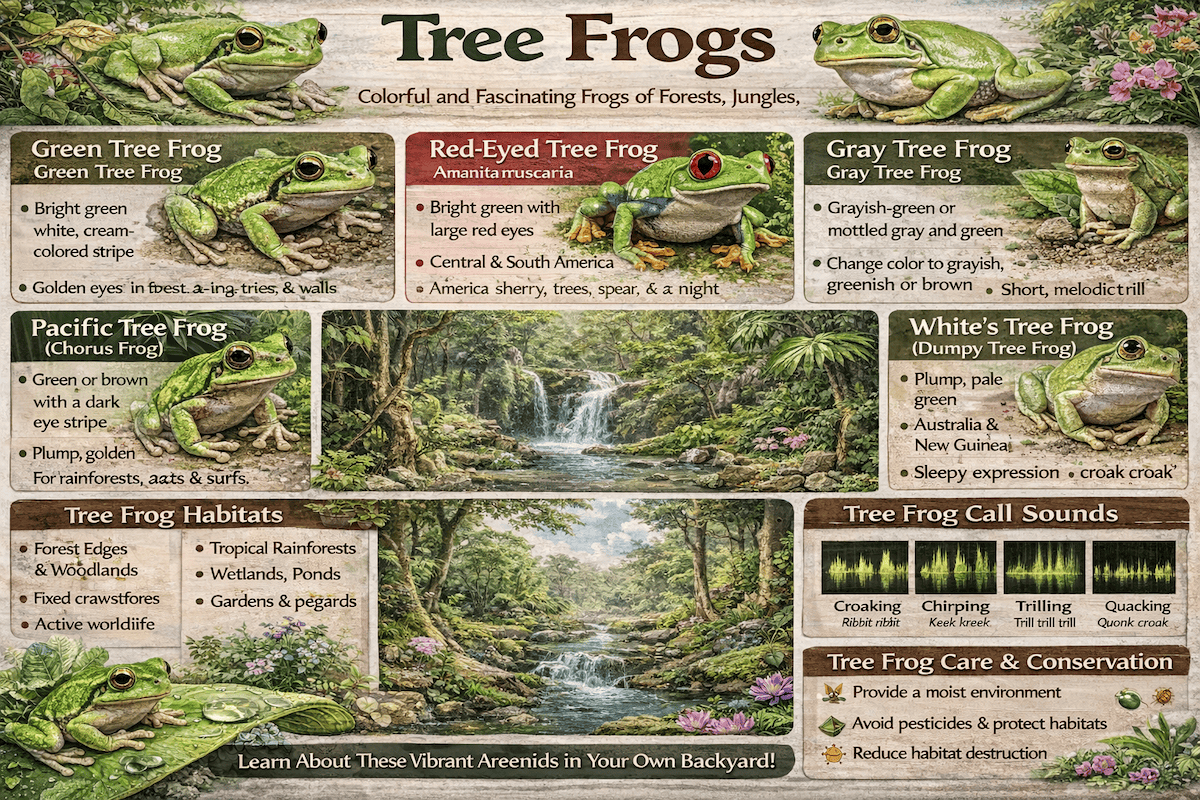
Feel free to share this tree frogs infographic on your website or blog. Please include a link back to this page as the source.

Europe is home to several species of tree frogs that thrive in wetlands, forest edges, and Mediterranean landscapes. Although many European frogs are small, their bright coloration, distinctive calls, and climbing ability make them some of the most recognizable amphibians in the region.
Many European tree frogs can slightly change their skin color depending on temperature, humidity, and surrounding vegetation. This subtle color shift helps them blend into leaves, bark, and moss while resting during the day.
These amphibians often inhabit landscapes where forests, wetlands, and agricultural areas meet. Three notable species highlight the diversity of tree frogs found across Europe and the Mediterranean region.
1. Common European Tree Frog (Hyla arborea) – Widespread across much of Europe, the Common European Tree Frog is easily recognized by its bright green coloration and slender body. These frogs can adjust their skin tone from vibrant green to shades of gray or brown depending on their surroundings, allowing them to camouflage among leaves and branches.
A defining feature is the dark stripe or “mask” that runs from the nostrils across the eye and toward the eardrum. This contrast against their green body gives them a distinctive appearance. They are often found in forest edges, wetlands, and habitats near trees such as beech trees, where they climb vegetation and hunt insects during the evening hours.
2. Italian Tree Frog (Hyla intermedia) – Native to Italy and surrounding Mediterranean regions, the Italian Tree Frog is known for its smooth green skin that ranges from bright leaf-green to deeper olive tones. A white underside contrasts with the frog’s dorsal coloration, while subtle dark markings along the sides add pattern and texture.
These frogs are commonly found in wetlands, ponds, and vegetated areas near water. Their climbing ability allows them to rest among reeds, shrubs, and low branches during the day before becoming active at night to feed on insects.
3. Stripeless Tree Frog (Hyla meridionalis) – The Stripeless Tree Frog, native to Mediterranean regions of southern Europe, is known for its smooth light-green to yellow-green coloration. Its pale underside and clean body pattern give the frog a soft, almost pastel appearance that blends easily with sunlit vegetation and woodland habitats, including areas where Mediterranean species such as cork trees grow.
One of the most notable characteristics of this species is its surprisingly loud call. During the breeding season, males produce resonant calls that carry across wetlands and coastal habitats, making them easier to hear than to see. Their vocal presence is a familiar sound of Mediterranean evenings near ponds and marshes.
Together, these species illustrate the diversity of amphibian life across Europe. From temperate forests to Mediterranean wetlands, tree frogs contribute to healthy ecosystems by controlling insect populations and serving as important indicators of environmental health.

Around the world, many tree frog species are facing serious threats from habitat loss, climate change, pollution, and emerging wildlife diseases. Amphibians are particularly vulnerable because their permeable skin absorbs environmental toxins and changes in water quality quickly affect their survival.
Amphibians are considered some of the most threatened vertebrates on Earth. Scientists estimate that more than 40% of amphibian species worldwide are currently experiencing population declines due to disease, climate change, and habitat destruction.
Several remarkable species highlight both the diversity of tree frogs and the urgent need for conservation efforts. These frogs serve as important reminders of how fragile ecosystems can be.
1. Lemur Leaf Frog (Agalychnis lemur) – Native to the tropical forests of Central America, the Lemur Leaf Frog is a critically endangered species known for its unusual ability to change color during its daily cycle. At night, the frog typically displays a vivid green coloration that helps it blend with rainforest foliage. During the daytime, it often shifts to darker brown tones that resemble tree bark and leaf litter.
This color change provides valuable camouflage against predators and reflects the species’ remarkable evolutionary adaptation to life in dense rainforest environments. Unfortunately, habitat loss and disease have significantly reduced wild populations.
2. Mountain Chicken Frog (Leptodactylus fallax) – Despite its unusual name, the Mountain Chicken is not a bird but one of the largest frog species in the Caribbean. It is native to the islands of Montserrat and Dominica, where it once played an important role in local ecosystems.
Today this species is classified as critically endangered, largely due to the spread of chytridiomycosis, a fungal disease that has devastated amphibian populations worldwide. Conservation programs are now working to protect the remaining populations and restore the species in the wild.
3. Golden Toad (Incilius periglenes) – Once found only in the misty cloud forests of Costa Rica, the Golden Toad was famous for its brilliant golden-orange coloration. This striking amphibian became a symbol of the region’s rich biodiversity, which also includes valuable forest resources such as Costa Rica timber species found within these unique tropical ecosystems.
Tragically, the Golden Toad has not been observed since 1989 and is widely believed to be extinct. Scientists suspect that a combination of climate change and disease contributed to its disappearance. The loss of the Golden Toad serves as a powerful reminder of the fragile balance within natural ecosystems and the importance of protecting habitats before species vanish.
Protecting endangered amphibians requires coordinated global conservation efforts, including habitat preservation, disease research, and sustainable environmental practices. Tree frogs and other amphibians remain vital indicators of ecosystem health, making their survival closely linked to the health of forests, wetlands, and freshwater systems worldwide.

While many tree frogs are small and delicate, some species grow surprisingly large. These amphibians demonstrate the impressive range of sizes found within the tree frog family. From tropical rainforests to Caribbean islands, large tree frogs occupy diverse habitats and play important roles in controlling insect populations.
The White-Lipped Tree Frog is considered the largest tree frog species in the world. Some individuals grow longer than 13 cm (over 5 inches), making them giants compared to many other tree frogs that measure only a few centimeters in length.
1. White-Lipped Tree Frog (Litoria infrafrenata) – Native to the tropical regions of Australia and New Guinea, the White-Lipped Tree Frog holds the distinction of being the largest known tree frog species. Adults can reach lengths of about 13.5 cm (5.3 inches).
This species is easily recognized by the pale or white stripe that runs along the lower lip and extends toward the flank, giving the frog its common name. Its large size and vibrant green coloration make it one of the most striking amphibians found in the rainforests of northern Australia and Papua New Guinea.
2. Giant Monkey Frog (Phyllomedusa bicolor) – Found in the dense forests of the Amazon rainforest, the Giant Monkey Frog is another large and distinctive tree frog species. Adults commonly grow to about 11.5 cm (4.5 inches) in length.
The species earns its name from its slow, deliberate climbing style, which resembles the movements of monkeys navigating branches. Its bright green body, contrasting markings, and arboreal lifestyle make it a remarkable resident of the Amazon’s forest canopy.
3. Cuban Tree Frog (Osteopilus septentrionalis) – Native to Cuba, the Bahamas, and the Cayman Islands, the Cuban Tree Frog is one of the largest tree frogs in the Caribbean. Individuals can reach lengths of around 14 cm (5.5 inches).
This species is highly adaptable and can thrive in both natural habitats and human-modified environments. Cuban Tree Frogs display a wide range of coloration, often shifting between shades of gray, green, or brown depending on their surroundings. Their size, adaptability, and striking appearance make them one of the most recognizable amphibians of the Caribbean region.
These large tree frog species demonstrate the remarkable diversity within the amphibian world, highlighting how evolution has shaped frogs to occupy different ecological niches across forests, wetlands, and tropical ecosystems.

Some of the most striking amphibians in the world are also among the most dangerous. Poison dart frogs are known for their brilliant colors and powerful skin toxins. These frogs use bright coloration as a warning signal to predators—a survival strategy known as aposematic coloration.
The Golden Poison Dart Frog is considered one of the most toxic animals on Earth. Scientists estimate that a single frog may carry enough toxin to kill several humans if handled improperly.
These frogs live primarily in the tropical rainforests of Central and South America, where humidity, dense vegetation, and abundant insect life provide ideal habitat. Three notable species illustrate the remarkable diversity and defensive adaptations of poisonous tree frogs.
1. Golden Poison Dart Frog (Phyllobates terribilis) – Native to the Pacific coastal rainforests of Colombia, the Golden Poison Dart Frog is widely considered the most toxic frog species in the world. Despite its small size, this frog carries extremely potent skin toxins that serve as a powerful defense against predators.
Indigenous communities in the region historically used these toxins to coat blow darts for hunting, giving rise to the common name “poison dart frog.” The bright yellow or golden coloration of this species acts as a warning signal that helps predators recognize and avoid it.
2. Blue Poison Dart Frog (Dendrobates tinctorius) – Found in parts of Suriname and northern Brazil, the Blue Poison Dart Frog is famous for its brilliant blue skin covered with black spots or patterns. This vivid coloration makes it one of the most recognizable amphibians in tropical rainforests.
The bright colors are not just for display—they warn predators that the frog carries toxic skin secretions. This combination of beauty and defense makes the species an iconic example of how evolution shapes survival strategies in the wild.
3. Black-Legged Dart Frog (Phyllobates bicolor) – Native to western regions of Colombia, the Black-Legged Dart Frog is considered one of the most toxic species of poison dart frog, second only to the Golden Poison Dart Frog in potency.
Although small in size, these frogs produce powerful skin toxins that effectively deter predators. Their bold coloration signals danger to animals that might otherwise mistake them for prey, illustrating one of nature’s most effective defense strategies.
Poison dart frogs demonstrate how striking colors and chemical defenses can work together to protect animals in complex rainforest ecosystems. Their presence also highlights the incredible biodiversity found within tropical forests and the importance of conserving these fragile habitats.
Discover more about water-loving plants, tropical ecosystems, and the beauty of garden spaces that support biodiversity.
Explore one of the world’s most remarkable aquatic plants, known for its giant floating leaves and tropical habitat.
Read the guide →Discover how tree gardens create layered habitats that support wildlife, shade-loving plants, and healthy landscapes.
Explore the guide →
Some tree frog species have evolved remarkable adaptations that allow them to glide through the forest canopy. Although these frogs cannot truly fly, they are able to control their descent by spreading the large webbing between their toes, effectively creating a parachute-like surface that slows their fall and allows them to glide between branches.
Some gliding tree frogs can control their descent over distances of more than 10–15 meters (30–50 feet) by spreading the webbing between their toes and flattening their bodies to increase surface area while in the air.
These adaptations allow flying tree frogs to move efficiently through dense forests, escape predators, and travel between trees without descending to the ground. Several species in Southeast Asia have evolved this extraordinary ability.
1. Wallace's Flying Frog (Rhacophorus nigropalmatus) – Named after the famous British naturalist Alfred Russel Wallace, this species is one of the most well-known gliding frogs. Native to the tropical forests of Borneo and Malaysia, Wallace's Flying Frog has large, fully webbed feet that allow it to glide gracefully between trees.
By spreading its toes wide while leaping from branches, the frog increases its surface area and slows its descent, enabling controlled glides through the forest canopy. This remarkable adaptation allows the frog to travel efficiently through its arboreal habitat.
2. Japanese Tree Frog (Hyla japonica) – Found throughout Japan, the Japanese Tree Frog is a small but agile species capable of impressive leaps and short gliding descents. Its webbed feet and lightweight body allow it to move easily among branches and vegetation, including garden landscapes and forest areas where ornamental trees such as Japanese maples are commonly found.
While not a true gliding specialist like Wallace's Flying Frog, the Japanese Tree Frog can extend its limbs and webbing during long jumps, helping it control its movement between branches and navigate forested environments more efficiently.
3. Chinese Gliding Frog (Rhacophorus dennysi) – Native to southern China and Vietnam, the Chinese Gliding Frog is another impressive arboreal amphibian capable of gliding between trees. Like other flying frogs, it possesses extensive webbing between its toes.
When the frog leaps from high branches, this webbing spreads out and acts as a natural airfoil, allowing the frog to glide toward lower branches or nearby trees. This unique ability highlights the remarkable diversity of adaptations that have evolved among amphibians living in forest canopies.
Flying tree frogs demonstrate how evolution can produce extraordinary solutions for life in complex forest environments. Their gliding ability allows them to move efficiently through dense vegetation while reducing the risk of ground predators, making them one of the most fascinating groups of arboreal amphibians.

Tree frogs are a diverse and intriguing group, characterized by their remarkable adaptations to their environments. The examples provided give a glimpse into the world of tree frogs, a world filled with color, sound, and unique behaviors. Their varying states of conservation also serve as a reminder of our role in preserving these remarkable species for future generations to marvel at and learn from.
Copyright © All rights reserved Tree Plantation