


 INVEST
 PLANT
PLANT
 SOFTWOODS
 HARDWOODS
 CALCULATORS
 RESOURCES
 PROGRAMS

Softwoods
Learn More
TREE SPACING • ACRES • PLANTING DENSITY
To calculate trees per acre, divide 43,560 by the product of row spacing and tree spacing in feet.
Wondering how many trees per acre you can plant at a specific spacing? This tree spacing calculator helps you quickly estimate trees per acre and total planting capacity for your acreage based on the distance between rows and the spacing between trees. It is useful for planning timber plantations, orchards, shelterbelts, windbreaks, privacy screens, reforestation projects, and agroforestry systems.
🌲 Quick answer: Trees per acre = 43,560 ÷ (row spacing in feet × tree spacing in feet).
Closer spacing gives you more trees per acre, while wider spacing gives each tree more room for sunlight, airflow, root expansion, crown development, equipment access, and long-term growth.
Start by entering your spacing below to calculate planting density, then use the guide further down the page to compare orchard layouts, timber stand spacing, windbreak rows, spiral planting ideas, and wider-access planting designs.
Even a small spacing adjustment can change planting density dramatically. For example, shifting from 10 ft × 10 ft spacing to 12 ft × 12 ft spacing reduces the number of trees you can plant per acre by hundreds. That is why spacing is one of the most important early decisions in orchard design, timber planting, reforestation, and privacy screening.
Note: This is a planning calculator. Actual planting layouts may vary depending on species, mature canopy width, irrigation design, row access, slope, equipment clearance, soil conditions, and whether you plan to thin the stand later.
ROW SPACING • SPIRAL SPACING • PROJECT GOALS
Wondering why tree spacing matters so much? The spacing you choose affects more than just the number of trees per acre. It also influences tree size, canopy spread, airflow, sunlight exposure, root competition, harvest access, irrigation layout, and future thinning needs.
📏 Quick answer: Narrow spacing increases planting density, while wider spacing usually improves access, crown development, and long-term growing room.
The best spacing depends on your goal — whether you are planting in straight rows for easy mowing and equipment access or exploring spiral tree layouts for unique planting patterns, visual impact, and intensive land use planning.
A dense planting plan may look efficient at first, but trees that are spaced too closely can compete for light, water, and nutrients as they mature. On the other hand, spacing trees too far apart may reduce planting density, delay canopy closure, and leave unused ground for years.
That is why the best planting plans begin with both a spacing calculation and a clear understanding of the final objective. A timber grower, orchard owner, landowner creating a privacy screen, and someone planning reforestation may all use the same calculator but arrive at very different spacing choices. Some projects are best laid out in traditional rows, while others may benefit from circular or spiral-based designs that change how trees are arranged across the site.
Want to compare a non-row layout? Jump down to the spiral planner to explore an alternative planting pattern.
Planting trees in spirals or circular patterns can create a very different growing layout than straight rows. Spiral planting is sometimes used for permaculture gardens, educational landscapes, specialty orchards, and visual demonstration plantings, especially where design, access paths, or pattern-based growing systems are part of the goal.
Feel free to share this tree spacing calculator infographic on your website or blog. Please include a link back to this page as the source.
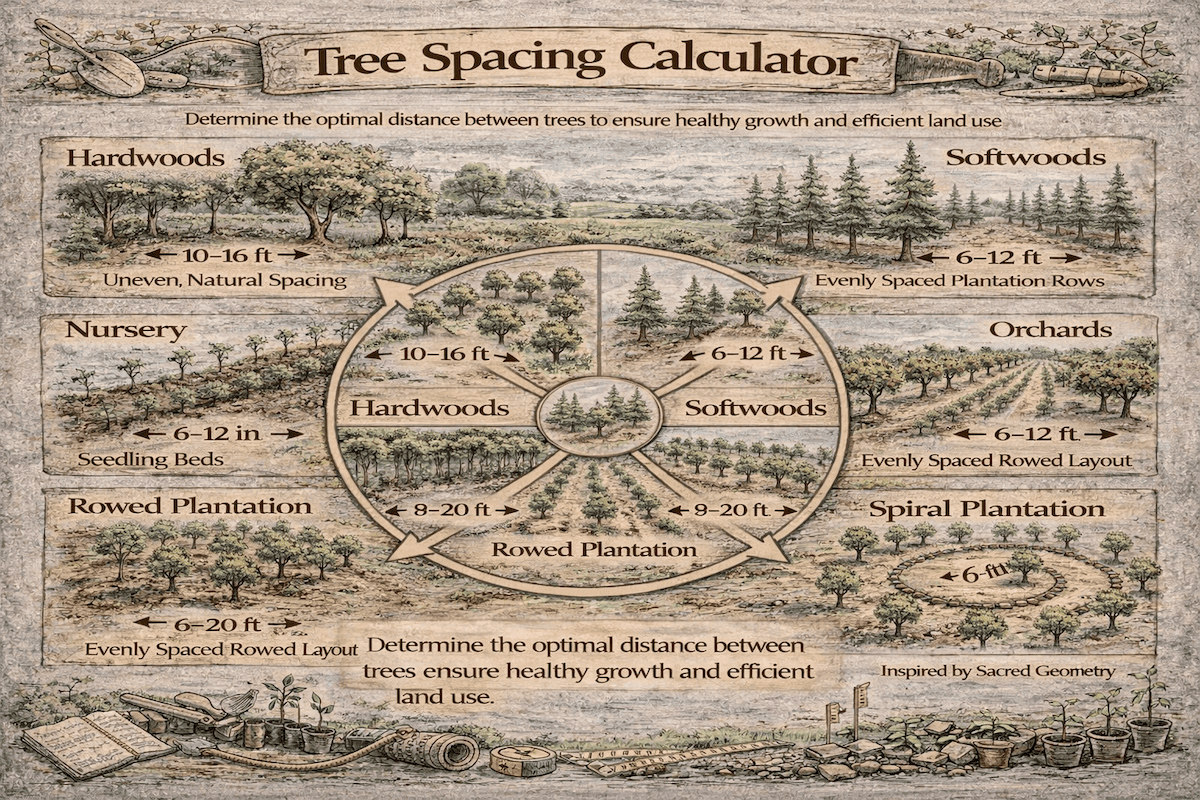
This calculator quickly tells you how many trees you can plant per acre based on the distance between rows and the distance between trees in each row.
Tip: Use wider row spacing when you need access for tractors, harvesters, or pruning equipment, and tighter in-row spacing when you want a denser stand, orchard, or windbreak.
A 12 ft × 12 ft hardwood spacing allows approximately 302 trees per acre. If each hardwood tree reaches an average value of $1,000 per tree, that represents a potential value of $302,000 per acre — showing how spacing decisions can directly influence long-term hardwood returns.
A 10 ft × 10 ft softwood spacing allows approximately 435 trees per acre. If each softwood tree reaches an average value of $350 per tree, that represents a potential value of $152,250 per acre — showing how spacing decisions can directly affect long-term softwood returns.
“Right” spacing depends on your goal: timber, windbreak, orchard, agroforestry alleys, or a fast-rotation biomass crop. Spacing is really a tradeoff between tree count, access, and future canopy closure.
If you’re planning value, pair spacing with tree value and carbon estimates to see how density changes long-term outcomes.
SPIRAL PLANTING • LAYOUT DESIGN • INTERACTIVE MODEL
Wondering how to design a spiral tree planting layout instead of using traditional rows? This interactive spiral tree planner helps you visualize how trees can be arranged in circular and spiral patterns, while estimating spacing, planting totals, and long-term growth potential.
🌀 Quick answer: A spiral tree layout arranges trees in a circular pattern around a center point, allowing you to explore alternative planting designs that can be used for permaculture systems, crop-circle orchards, demonstration gardens, and specialty landscape projects.
Use this planner to move beyond rows — test spacing, visualize growth patterns, and see how a spiral planting design may evolve over time as trees mature.
Whether you are designing a reforestation project, orchard, educational garden, or permaculture system, this planner helps turn a concept into a more practical layout by combining spacing, structure, and long-term thinking.
Reforestation works best when it’s planned. Survival rates, long-term carbon storage, and habitat value all improve when you match species to site conditions, give seedlings the right spacing, and commit to multi-year care. This interactive planner is designed to make those decisions easier—and more engaging.
The model below lets visitors plant a 300-tree spiral in batches of 20 trees per click, then explore how the forest “ages” over time. It’s a simple way to visualize spacing, canopy development, and the cumulative impact of planting projects—whether you’re restoring a backyard, a woodlot, or a larger tract.
Choose a tree type and click to plant 20 trees at a time along the spiral until you reach 300 total. The right panel updates totals like trees planted, estimated value, and carbon.
Black walnut is typically established using directly sown seed, 2-year bare-root seedlings, or 3-year plug/seedling transplants. In this planner scenario, 220 black walnut trees are planted within a 3.5-acre spiral layout, spaced 25 feet apart.
White oak is typically established using 2-year bare-root seedlings or 3-year plug transplants. In this planner scenario, 300 white oak trees are planted within a 3.5-acre spiral layout, spaced 20 feet apart.
Black cherry is typically established using 3-year seedling transplants, which offer strong survival rates when properly sited and maintained. In this planner scenario, 400 black cherry trees are planted within a 3.5-acre spiral layout, spaced 18 feet apart with 18 feet between spiral rows, allowing each tree adequate spacing for long-term crown development, root expansion, and soil health.
Hard maple (sugar maple) is typically established using 3-year seedling transplants, which offer strong survival rates when properly sited and maintained. In this planner scenario, 280 sugar maple trees are planted within a 3.5-acre spiral layout, spaced 22 feet apart with 22 feet between spiral rows, allowing each tree adequate spacing for long-term crown development, root expansion, and soil health.
Yellow birch is typically established using 3-year transplants, which offer strong survival rates when properly sited and maintained. In this planner scenario, 300 yellow birch trees are planted within a 3.5-acre spiral layout, spaced 20 feet apart with 20 feet between spiral rows, allowing each tree adequate spacing for long-term crown development, root expansion, and soil health.
American chestnut is typically established using 3-year hybrid transplants, which provide strong survival rates when properly sited and maintained. In this planner scenario, 220 American chestnut trees are planted within a 3.5-acre spiral layout, spaced 25 feet apart with 25 feet between spiral rows. This configuration ensures ample room for long-term canopy development.
Mahogany is typically established using nursery-grown transplants, often 2–3 years old, which offer reliable survival when properly sited and managed. In this planner scenario, 220 mahogany trees are planted within a 3.5-acre spiral layout, spaced 25 feet apart with 25 feet between spiral rows. This spacing supports long-term crown development, deep root expansion, and healthy airflow.
Teak plantings are commonly established with well-hardened nursery seedlings or clonal stock that are 2–3 years old, selected for uniform growth and durability. In this planner example, a total of 220 teak trees are arranged across a 3.5-acre spiral planting pattern. Trees are set on 25-foot centers, with equal spacing between spiral rows, creating an open structure that encourages strong trunk formation.
Rosewood is typically established using carefully raised nursery transplants, often 2–3 years old, to ensure strong early growth and successful establishment. In this planner scenario, 220 rosewood trees are integrated into a 3.5-acre spiral planting design. The trees are spaced at 25-foot intervals, with 25 feet between spiral rows, providing sufficient room for mature canopy spread and deep root development.
White pine is commonly established using 2–3 year nursery-grown plug transplants, which provide reliable survival when properly sited and cared for. In this planner scenario, 300 white pine trees are arranged within a 3.5-acre spiral planting pattern, spaced 20 feet apart with 20 feet between spiral rows. This layout balances efficient land use with sufficient room for mature canopy formation.
Western red cedar is typically established using 2–3 year nursery-grown seedlings, valued for their resilience and strong establishment when properly sited and maintained. In this planner scenario, 400 western red cedar trees are planted within a 3.5-acre spiral layout, spaced 18 feet apart with 18 feet between spiral rows. This spacing provides each tree with adequate room for vertical growth.
Hybrid poplar is commonly established using fast-growing nursery transplants or cuttings, selected for rapid early growth and high establishment success. In this planner scenario, 480 hybrid poplar trees are planted within a 3.5-acre spiral configuration, spaced 16 feet apart with 16 feet between spiral rows. This tighter, uniform spacing supports straight trunk formation and efficient canopy development.
Orchard apples are typically established using 8-foot spear transplants chosen for their quick establishment and vigorous early growth. In this planner scenario, 2,000 apple trees are integrated into a 3.5-acre spiral planting design, with trees spaced 6 feet apart and 10 feet between spiral rows. This high-density arrangement promotes manageable tree structure and controlled canopy development.
Orchard pears are typically established using 7-foot spear transplants chosen for their quick establishment and vigorous early growth. In this planner scenario, 2,000 pear trees are integrated into a 3.5-acre spiral planting design, with trees spaced 6 feet apart and 10 feet between spiral rows. This high-density arrangement promotes manageable tree structure and controlled canopy development.
Orchard peaches are typically established using 6-foot spear transplants chosen for their quick establishment and vigorous early growth. In this planner scenario, 2,000 peach trees are integrated into a 3.5-acre spiral planting design, with trees spaced 6 feet apart and 10 feet between spiral rows. This high-density arrangement promotes manageable tree structure and controlled canopy development.
Use the buttons to advance or reverse the future tree value
Build a tight internal-link cluster so visitors can move from standard row spacing to spiral layouts, crop-circle orchards, agroforestry systems, species pages, and carbon tools. This improves user flow, increases time-on-page, and strengthens topical relevance around tree planning and alternative planting design.
If you want a spiral planting or crop-circle style tree layout that survives and increases in value over time, plan beyond planting day. The highest-leverage work often happens before the first tree goes in the ground and during the first 2–3 years after establishment.
SPIRAL LAYOUTS • WIND PROTECTION • BETTER WOOD
Wondering why spiral tree planting may be better than rowed planting? A spiral plantation can create a more protected and self-supporting growing environment than a standard plantation laid out in parallel rows. While rowed plantations are often easier to survey and mechanize, they can also leave trees more exposed to wind, moisture loss, and uneven growing conditions over time.
🌀 Quick answer: Spiral tree planting can provide better wind buffering, improved moisture retention, faster growth, better wood quality, and a more stable internal growing environment than conventional row planting.
The curve matters. Unlike straight rows, a spiral planting pattern creates a circular structure that can soften wind flow, reduce exposure, and help create a calmer, more humid microclimate within the plantation.
In a rowed plantation, trees are planted in straight, exposed lines that can channel wind through the stand. During storms and high wind gusts, this exposure can increase the risk of damage, including broken limbs and, in some cases, crowns being snapped off entirely. A spiral plantation, by contrast, uses curvature as part of the planting design, helping to break up wind movement and reduce the force that reaches individual trees.
Spiral plantations can also create a more stable internal environment. Because of the way the planting pattern slows airflow and holds humidity, the interior of the plantation may retain moisture better than a rowed system. That can benefit not only the trees themselves, but also companion plants, soil biology, and wildlife using the site. In dry and drought-prone regions, this kind of moisture-holding microclimate may become especially valuable.
Another advantage often associated with spiral planting is faster growth. Trees grown in spiral systems may grow more quickly than trees planted in parallel rows, while also producing wood with fewer branches, fewer knots, and fewer visible imperfections. That creates stronger opportunities for higher-value products, including veneer-quality wood and other premium timber uses.
Spiral plantations may also improve long-term regeneration potential. With trees arranged in a more enclosed and sheltered pattern, the likelihood of maintaining productive mother seed trees within the plantation can increase, supporting future seed drop, natural recruitment, and stand continuity over time.
Supporters of spiral plantations argue that the planting pattern does more than change appearance. By reshaping how wind, shade, and moisture move through the site, a spiral layout can influence tree growth rate, wood quality, drought resilience, wildlife value, and long-term plantation stability.
In most timber plantations, hardwood trees are spaced farther apart than softwood trees—often by a factor of 1.5–2×—to give their broad crowns and deep roots room to develop. For example:
Wider spacing allows hardwoods to reach diameter at breast height (DBH) and clear log lengths suitable for veneer and sawlogs, while closer spacing in softwoods produces straighter poles and more tonnage per acre on shorter rotations.
These distances are typical final spacing for hardwood plantations grown for timber. Some growers start closer and thin, but most hardwoods are not heavily thinned like softwoods.
Softwoods are often planted closer together, especially where trees will be thinned for pulp, poles, or biomass before final timber harvest.
In traditional row plantations, softwoods are often double-spaced: planted at 6–8 feet apart initially with the expectation of thinning every second tree for pulp or pole wood. Hardwoods grown for timber are usually planted wider—between 15 and 25 feet apart—and may not be thinned as aggressively.
Row plantations leave ample space for mechanical harvesters, skidders, and log trucks. Row spacing typically ranges from 20 to 30 feet, depending on tree species and equipment size. Softwood plantations require less spacing than hardwoods, which need room for wide-branched crowns (oaks, maples, etc.) to fall safely during harvest.
For long-term forest health and diversified income, it is often recommended to alternate tree species by rows—for example, a row of maples next to a row of oaks, or conifer rows alternating with deciduous rows. This diversifies ROI, spreads risk, and improves overall stand resilience. While the number of trees per acre in a row plantation can be higher than in a spiral plantation, growth rates are often slower than in optimized spiral patterns.
Although fewer trees are planted per acre in a spiral plantation, the geometric layout of a Crop Circle tree plantation can increase growth rates by as much as 20%. Faster growth means that harvest and return on investment occur sooner than in a conventional row plantation, more than making up for the lower trees-per-acre count.
Spacing between trees in a spiral layout is similar to a rowed plantation, but spacing between “rows” (spiral arms) is typically set at 25 feet for both softwoods and hardwoods. Mixing species along the spiral—such as planting a white pine, then a sugar maple, then a red oak and repeating—achieves both investment diversification and improved plantation health.
Timber is usually hand harvested and trucked out of the plantation, preserving veneer sawlog quality and supporting secondary revenue activities such as branch-trimming for pellet production and periodic pole-log harvesting.
In agroforestry systems, tree spacing is designed to balance tree growth, crop production, livestock movement, and long-term land value. Unlike conventional plantations that often rely on uniform grids, agroforestry layouts may use wider rows, staggered patterns, or integrated planting systems that combine trees with crops, pasture, and conservation goals.
The goal is to create a planting design where trees provide benefits such as wind protection, shade, soil improvement, carbon capture, habitat value, and long-term timber or fruit production, while still allowing productive use of the land between rows. Thoughtful planting trees strategies help ensure that spacing works not only at establishment, but also as the trees mature.
| Agroforestry System | Typical Tree Spacing | Purpose |
|---|---|---|
| Alley Cropping | Tree rows spaced 30–80 ft apart | Wide alleys allow crops, vegetables, or cover crops to grow between tree rows while trees improve soil, reduce erosion, and add long-term value. |
| Silvopasture | 20–40 ft between trees | Trees provide shade, shelter, and forage support for livestock while preserving enough sunlight for healthy pasture grasses below. |
| Windbreak Rows | 8–16 ft between trees with multiple staggered rows | Windbreaks reduce wind speed, protect crops and soil, improve moisture retention, and create better growing conditions across adjacent fields. |
| Spiral Plantations | Variable spacing along spiral rows | Spiral planting systems can improve access, maximize edge productivity, and create diverse microclimates for mixed-species plantings and regenerative land design. |
In many agroforestry systems, trees are intentionally planted at wider spacings than dense timber plantations so crops, livestock, pollinator habitat, or additional tree layers can share the same acreage more efficiently.
When planning tree spacing for agroforestry or mixed-use plantations, consider:
Well-designed systems for planting trees in agroforestry landscapes can support multiple yields from the same land—including timber, fruit, nuts, livestock shelter, soil-building benefits, and long-term ecological resilience.
ORCHARD LAYOUTS • FRUIT TREES • NUT TREES
Wondering how far apart orchard trees should be planted? Proper orchard spacing helps determine how many trees you can plant per acre while also shaping sunlight exposure, airflow, root competition, equipment access, harvest efficiency, and long-term tree health.
🍎 Quick answer: Orchard spacing depends on the type of tree, rootstock, mature canopy width, irrigation method, and management style. High-density orchards use closer spacing for more trees per acre, while traditional orchards use wider spacing to give each tree more room to develop.
The right orchard layout balances productivity and practicality — enough trees to make the land productive, but enough space for light, airflow, pruning, spraying, mowing, and harvest access.
Orchard spacing is not one-size-fits-all. A compact high-density apple planting will be very different from a traditional walnut orchard, and a citrus grove may follow different spacing rules than a mixed fruit planting. Soil fertility, climate, slope, irrigation design, and machinery access all influence the final layout.
Before locking in your orchard design, think beyond the sapling stage. Trees that look small and manageable at planting can become crowded within a few seasons if spacing is too tight for their mature size. Wider spacing may reduce the initial tree count, but it can improve airflow, reduce disease pressure, and make long-term maintenance easier.
Always base spacing on the tree’s mature width and management plan, not just its size at planting. Pruning style, rootstock choice, and harvest method can all change the amount of room an orchard really needs.
For more orchard-specific planting ideas, see our guides to fruit trees, citrus trees, and nut trees.
WINDBREAKS • SHELTERBELTS • TREE SPACING
Wondering how far apart trees should be planted in a windbreak? Proper windbreak spacing helps determine how quickly the planting fills in, how much protection it provides, and how well it performs over the long term against wind, drifting snow, soil erosion, dust, and exposure.
🌬️ Quick answer: Windbreak trees are usually spaced closely enough to form a protective barrier, but not so tightly that they compete excessively for light, water, and nutrients. The best spacing depends on the tree species, the number of rows, and the level of protection you want.
The goal is balance — enough density to slow wind effectively, but enough room for healthy root systems, crown development, and long-term stand stability.
Windbreak spacing is different from standard orchard or plantation spacing because the purpose is not just growing trees, but creating a functional barrier that changes how wind moves across the site. Trees that are spaced too far apart may leave gaps that reduce protection, while trees that are planted too tightly may struggle as they mature.
Species choice matters too. Fast-growing conifers, dense evergreens, and mixed shelterbelt plantings all respond differently to spacing. In many cases, a layered or staggered design can provide better protection than a single straight row with uniform gaps.
The most effective windbreaks are designed for the mature size and density of the trees, not just for how quickly they fill in during the first few years.
For a more detailed planning tool, use our windbreak calculator to compare layouts, estimate planting needs, and plan a shelterbelt that fits your site.
If you have 100 acres or more of suitable flat or fallow farmland, you may qualify for a land and tree partnership program created with Growing to Give. You provide the land, and we help with the tree plantation design, planting strategy, and management plan. The goal is to convert agricultural land into appreciating forest, timber, and carbon assets with no upfront cost to enter the program.
Once spacing is set, you can estimate downstream impacts like carbon, value, and wood volume with these calculators.
Start by choosing your planting pattern: square, rectangular, or triangular. For most timber and orchard layouts,
you’ll use a square or rectangular grid. Set the row spacing (X) and the
in-row spacing (Y), then plug those into the Tree Spacing Calculator to see trees per acre.
For diagonal distance between trees in a square or rectangular grid, use the Pythagorean theorem
(a² + b² = c²) to calculate corner-to-corner spacing. Always adjust for mature canopy width,
equipment access, and the critical root zone.
Convert your spacing to feet, then multiply row spacing by in-row spacing to get the square feet per tree. Divide 43,560 (square feet in one acre) by that result. Example: 10 ft × 12 ft = 120 sq ft per tree; 43,560 ÷ 120 ≈ 363 trees per acre. The calculator on this page does this math for you in one click.
Orchard spacing depends on species, rootstock, and training system. Dwarf fruit trees on high-density systems may be planted much closer than full-size trees. Use square or rectangular spacing that gives good light and airflow around each canopy, and follow cultivar-specific guidelines from your nursery or extension service. Once you pick your row and in-row spacing, enter them in the Tree Spacing Calculator to see trees per acre for that layout.
For yard and street trees, use the mature canopy spread as your guide. A simple rule of thumb is to space trees at least half the mature canopy width apart (for example, a 30-foot canopy suggests about 15 feet minimum spacing). Give extra clearance from buildings, driveways, and overhead lines. Unlike plantations, landscape trees don’t need formal rows, but you can still use the calculator to test different spacing distances and compare how many trees would fit per acre.
Yes. Windbreaks often use closer in-row spacing and multiple staggered rows to create a dense barrier. Closer spacing blocks wind faster but can require earlier thinning. Choose distances based on species, desired density, and equipment access, then run several spacing combinations through the calculator to compare trees per acre and total planting stock required.
Absolutely. When you mix species (for example, alternating hardwoods and softwoods or combining timber and wildlife trees), base your layout on the largest mature canopy and root zone in the mix. Enter a conservative spacing into the calculator to estimate trees per acre, then adjust your species pattern within that framework for biodiversity, staggered harvests, and better overall forest health.
Copyright © All rights reserved Tree Plantation