


 INVEST
 PLANT
PLANT
 SOFTWOODS
 HARDWOODS
 CALCULATORS
 RESOURCES
 PROGRAMS

Softwoods
Learn More
CLIMATE • CARBON • SOLUTIONS
Wondering what “zero carbon” means? Reaching zero carbon means balancing the amount of greenhouse gases we emit with the amount we remove or offset through natural and technological solutions.
🌍 Quick answer: The path to zero carbon requires both reducing emissions (energy, transport, industry) and increasing carbon removal through forests, soil, and regenerative systems.
Examples: Key strategies include renewable energy, energy efficiency, reforestation, carbon-smart agriculture, and scalable tree-based systems that capture and store carbon over time.
Climate change is no longer a distant concept—it is a measurable shift in global weather patterns, temperatures, and ecosystems already impacting how we live, grow food, and manage land.
At its core, climate change is driven by the rapid accumulation of greenhouse gases in the atmosphere, primarily from human activities such as burning fossil fuels, deforestation, and industrial-scale agriculture.
One of the clearest signals of this shift is global warming—the steady rise in the Earth’s average temperature. Since the pre-industrial era, global temperatures have increased by approximately 1°C, with accelerating trends tied directly to rising carbon emissions.
The primary driver behind this change is our dependence on fossil fuels—coal, oil, and natural gas— which release large volumes of carbon dioxide (CO₂) when burned. At the same time, deforestation removes one of the planet’s most important natural carbon sinks, further accelerating the imbalance between emissions and absorption.
Reducing emissions is critical—but equally important is increasing our ability to remove and store carbon at scale.
This is where trees and biomass systems become essential. Through photosynthesis, trees naturally capture carbon, store it in wood, roots, and soil, and help restore ecological balance.
The path to zero carbon is not just about reducing what we emit—it’s about maximizing what we can grow, restore, and regenerate.
Feel free to share this climate change infographic on your website or blog. Please include a link back to this page as the source.
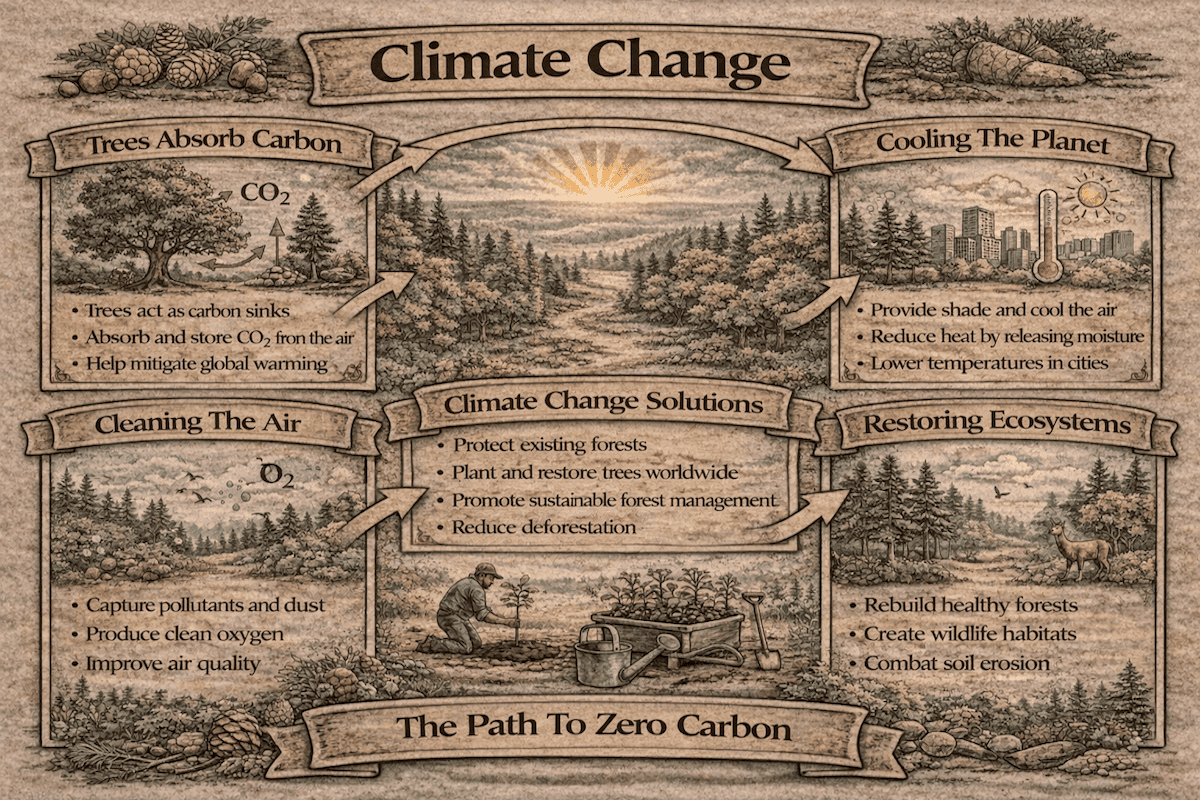
Move from awareness to measurable action. Quantify how changes in energy use, food systems, waste reduction, and land stewardship reduce environmental impact— then generate a clear, shareable sustainability plan.
Climate change is no longer a distant threat—it is a present-day reality reshaping ecosystems, economies, food systems, and daily life across the globe. Rising temperatures, changing rainfall patterns, melting ice, worsening droughts, and more frequent natural disasters all point to the same conclusion: the planet is under increasing stress, and human activity is the primary driver.
Glaciers are melting at unprecedented rates, contributing to rising sea levels that threaten coastal communities, low-lying nations, and freshwater systems that depend on glacial runoff. Forests are also under pressure, with longer wildfire seasons, shifting weather patterns, and pest outbreaks leaving once-thriving ecosystems weakened and vulnerable. These are not isolated events—they are part of a wider pattern of climate disruption that is now affecting nearly every region of the world.
Agriculture sits at the center of this challenge. Industrial food production systems built around monoculture farming, heavy tillage, synthetic inputs, and large-scale land clearing have helped drive soil degradation, biodiversity loss, and rising emissions. Likewise, highly mechanized agriculture often depends on diesel-powered equipment, energy-intensive infrastructure, and long supply chains that increase the carbon footprint of the food we grow and distribute.
The deep connection between climate change and energy use cannot be ignored. Our dependence on fossil fuels continues to release large volumes of carbon dioxide and other greenhouse gases into the atmosphere, intensifying global warming and destabilizing natural systems. As temperatures rise, water cycles shift, crop reliability declines, and ecosystems become less resilient.
At the same time, there is a path forward. Regenerative and sustainable agriculture systems offer a way to grow food while rebuilding soil, storing carbon, improving water retention, and restoring ecological balance. Tree-based systems, climate-smart planting, and diversified land design can help reverse some of the damage caused by extractive farming models while supporting long-term productivity.
The effects of climate change are interconnected and cumulative, amplifying one another through dangerous feedback loops. But the solutions can be interconnected too. By reducing emissions, moving away from fossil fuel dependence, restoring forests, and redesigning agriculture around resilience and regeneration, we can begin building a healthier and more stable future.
The burning of fossil fuels remains one of the most significant drivers of climate change. Coal, oil, and natural gas release enormous quantities of carbon dioxide (CO₂) and other greenhouse gases into the atmosphere, where they trap heat and accelerate global warming. These emissions affect not only temperature, but also rainfall patterns, ocean chemistry, air quality, and the long-term health of both human and natural systems.
One of the lesser-known consequences of fossil fuel emissions is ocean acidification. As oceans absorb excess CO₂, their chemistry changes, making it harder for corals, shellfish, and many marine organisms to survive. At the same time, air pollution from fossil fuel combustion contributes to respiratory disease, cardiovascular stress, and degraded environmental quality in communities around the world.
The environmental toll extends beyond combustion. Extraction, refining, and transport damage landscapes, fragment habitats, pollute waterways, and place additional pressure on already stressed ecosystems. Reducing our dependence on fossil fuels is essential—not only for cutting emissions, but for protecting water, soil, forests, wildlife, and public health.
Transitioning to cleaner energy and more regenerative land-use systems is one of the most practical ways to respond. Trees, perennial systems, diversified farms, and low-input land design can all play a role in reducing emissions while increasing resilience.
Climate change is driven largely by rising greenhouse gas concentrations—especially carbon dioxide (CO₂). Trees help counter this by pulling CO₂ from the atmosphere, storing carbon in wood, roots, and soil, cooling landscapes, supporting biodiversity, and improving water cycles. When integrated into productive land systems, they become more than a symbol of climate action—they become working infrastructure for restoration.
This page includes an interactive Tree Spiral Planner so visitors can visualize how tree planting systems scale over time. Whether you are a landowner, grower, educator, or restoration group, the planner can help connect the idea of climate action to real planting patterns, long-term growth, and measurable impact.
The path to climate resilience will require more than awareness. It will require better systems—systems that reduce dependence on fossil fuels, move beyond monocultures, and support a more regenerative relationship with land. Trees, diversified farms, and climate-smart design can help lead that transition.
Estimate your carbon footprint and explore practical ways to reduce and offset emissions using trees, farms, plantations, and biomass systems. Switch between project types, compare scenarios, and see what it takes to reach net-zero.
Tip: Use this alongside the Tree Spiral Planner below to visualize how planting scales over time.
Spiral plantings can be space-efficient, visually compelling, and easy to replicate. They’re also a strong educational tool—helping people see compounding benefits like canopy coverage, habitat creation, and long-term carbon storage.
Click to plant 20 trees sequentially in the spiral. The white icon stays visible while the spiral is being filled. Use the right panel to add years (growth) and compare outcomes.
Black walnut is typically established using directly sown seed, 2-year bare-root seedlings, or 3-year plug/seedling transplants. In this planner scenario, 220 black walnut trees are planted within a 3.5-acre spiral layout, spaced 25 feet apart.
White oak is typically established using 2-year bare-root seedlings or 3-year plug transplants. In this planner scenario, 300 white oak trees are planted within a 3.5-acre spiral layout, spaced 20 feet apart.
Black cherry is typically established using 3-year seedling transplants, which offer strong survival rates when properly sited and maintained. In this planner scenario, 400 black cherry trees are planted within a 3.5-acre spiral layout, spaced 18 feet apart with 18 feet between spiral rows, allowing each tree adequate spacing for long-term crown development, root expansion, and soil health.
Hard maple (sugar maple) is typically established using 3-year seedling transplants, which offer strong survival rates when properly sited and maintained. In this planner scenario, 280 sugar maple trees are planted within a 3.5-acre spiral layout, spaced 22 feet apart with 22 feet between spiral rows, allowing each tree adequate spacing for long-term crown development, root expansion, and soil health.
Yellow birch is typically established using 3-year transplants, which offer strong survival rates when properly sited and maintained. In this planner scenario, 300 yellow birch trees are planted within a 3.5-acre spiral layout, spaced 20 feet apart with 20 feet between spiral rows, allowing each tree adequate spacing for long-term crown development, root expansion, and soil health.
American chestnut is typically established using 3-year hybrid transplants, which provide strong survival rates when properly sited and maintained. In this planner scenario, 220 American chestnut trees are planted within a 3.5-acre spiral layout, spaced 25 feet apart with 25 feet between spiral rows. This configuration ensures ample room for long-term canopy development.
Mahogany is typically established using nursery-grown transplants, often 2–3 years old, which offer reliable survival when properly sited and managed. In this planner scenario, 220 mahogany trees are planted within a 3.5-acre spiral layout, spaced 25 feet apart with 25 feet between spiral rows. This spacing supports long-term crown development, deep root expansion, and healthy airflow.
Teak plantings are commonly established with well-hardened nursery seedlings or clonal stock that are 2–3 years old, selected for uniform growth and durability. In this planner example, a total of 220 teak trees are arranged across a 3.5-acre spiral planting pattern. Trees are set on 25-foot centers, with equal spacing between spiral rows, creating an open structure that encourages strong trunk formation.
Rosewood is typically established using carefully raised nursery transplants, often 2–3 years old, to ensure strong early growth and successful establishment. In this planner scenario, 220 rosewood trees are integrated into a 3.5-acre spiral planting design. The trees are spaced at 25-foot intervals, with 25 feet between spiral rows, providing sufficient room for mature canopy spread and deep root development.
White pine is commonly established using 2–3 year nursery-grown plug transplants, which provide reliable survival when properly sited and cared for. In this planner scenario, 300 white pine trees are arranged within a 3.5-acre spiral planting pattern, spaced 20 feet apart with 20 feet between spiral rows. This layout balances efficient land use with sufficient room for mature canopy formation.
Western red cedar is typically established using 2–3 year nursery-grown seedlings, valued for their resilience and strong establishment when properly sited and maintained. In this planner scenario, 400 western red cedar trees are planted within a 3.5-acre spiral layout, spaced 18 feet apart with 18 feet between spiral rows. This spacing provides each tree with adequate room for vertical growth.
Hybrid poplar is commonly established using fast-growing nursery transplants or cuttings, selected for rapid early growth and high establishment success. In this planner scenario, 480 hybrid poplar trees are planted within a 3.5-acre spiral configuration, spaced 16 feet apart with 16 feet between spiral rows. This tighter, uniform spacing supports straight trunk formation and efficient canopy development.
Orchard apples are typically established using 8-foot spear transplants chosen for their quick establishment and vigorous early growth. In this planner scenario, 2,000 apple trees are integrated into a 3.5-acre spiral planting design, with trees spaced 6 feet apart and 10 feet between spiral rows. This high-density arrangement promotes manageable tree structure and controlled canopy development.
Orchard pears are typically established using 7-foot spear transplants chosen for their quick establishment and vigorous early growth. In this planner scenario, 2,000 pear trees are integrated into a 3.5-acre spiral planting design, with trees spaced 6 feet apart and 10 feet between spiral rows. This high-density arrangement promotes manageable tree structure and controlled canopy development.
Orchard peaches are typically established using 6-foot spear transplants chosen for their quick establishment and vigorous early growth. In this planner scenario, 2,000 peach trees are integrated into a 3.5-acre spiral planting design, with trees spaced 6 feet apart and 10 feet between spiral rows. This high-density arrangement promotes manageable tree structure and controlled canopy development.
Use the buttons to advance or reverse the future tree value
Most people understand climate change in the abstract, but it’s harder to visualize how solutions scale. A lightweight, interactive planner helps bridge that gap—turning “plant more trees” into a clear, repeatable action with an easy-to-understand layout.
Forests are among the planet’s most important life-support systems—absorbing carbon dioxide, regulating climate, protecting water resources, and supporting biodiversity. From the vast Amazon Rainforest to smaller regional ecosystems and global biodiversity hotspots, forests play a critical role in maintaining ecological balance. They also provide habitat for countless species, including sensitive forest dwellers such as tree frogs, whose survival often depends on stable humidity, clean water, and intact canopy systems. Yet today, these ecosystems are under increasing pressure from climate change.
Rising temperatures, shifting weather patterns, and increasing environmental stress are triggering a chain reaction of impacts that weaken forests and reduce their ability to store carbon. These challenges are interconnected, often amplifying one another in ways that accelerate long-term ecosystem decline.
Warmer temperatures, prolonged droughts, and reduced humidity are turning forests into highly flammable landscapes. Forest wildfires are becoming more frequent, more intense, and more destructive, burning millions of acres and releasing massive amounts of stored carbon back into the atmosphere. As wildfire cycles intensify, recovery becomes slower and less certain.
Climate change is allowing destructive insects to survive and spread more easily. Species such as pine beetles and other forest insects are devastating millions of trees across North America and beyond. Warmer winters fail to control these populations, allowing infestations to expand into new regions and overwhelm forest defenses.
Changing climates also create opportunities for invasive tree species and plants to spread into new areas. These species can outcompete native vegetation, alter soil conditions, and disrupt entire ecosystems, making forests less resilient and more vulnerable to future stress.
Climate change is altering seasonal timing—affecting flowering, leaf cycles, and seed production. Some species are shifting toward cooler regions or higher elevations, while others struggle to adapt. Over time, this leads to changes in forest composition and can reduce biodiversity and ecosystem stability.
Changes in rainfall patterns, earlier snowmelt, and prolonged drought conditions are reducing water availability for forests. Trees under water stress grow more slowly, become more vulnerable to pests and disease, and are more likely to die during extreme heat events. Reduced moisture also increases fire risk and limits long-term carbon storage capacity.
Forests are one of the world’s most effective natural carbon sinks. However, when forests burn, degrade, or die back, they release stored carbon back into the atmosphere. This creates a dangerous feedback loop: climate change damages forests, and damaged forests accelerate climate change by storing less carbon.
Protecting and restoring forests is one of the most powerful strategies available to address climate change. From preserving critical ecosystems like the Amazon to restoring degraded landscapes and managing forests more sustainably, these efforts can help stabilize climate systems while supporting biodiversity and human communities.
Healthy forests are not just natural resources—they are essential climate infrastructure, and their future is directly tied to our own.
As climate change accelerates, traditional forestry and agricultural systems are often too slow, inefficient, or resource-intensive to respond at scale. Crop Circle Tree Plantations offer a new approach—combining regenerative design, high-density planting, and optimized spacing to maximize productivity, carbon capture, and ecosystem restoration on every acre.
A Crop Circle Tree Plantation is a structured planting system that arranges trees in circular, high-efficiency patterns rather than conventional rows. These systems are designed to improve light distribution, airflow, water use, and root expansion while increasing planting density and reducing wasted space.
By integrating principles from reforestation, advanced tree breeding, and regenerative land design, Crop Circle systems create highly productive, scalable landscapes that can be adapted for timber, biomass, food production, and ecological restoration.
By combining intelligent design with natural systems, Crop Circle Tree Plantations represent a scalable solution to one of the world’s biggest challenges. They don’t just grow trees—they grow carbon sinks, resilient ecosystems, and long-term environmental value.
In a world facing climate uncertainty, smarter planting systems may be one of the most powerful tools we have to restore balance.
Climate change refers to long-term shifts in global temperatures and weather patterns, primarily caused by human activities such as burning fossil fuels, deforestation, and industrial agriculture. These activities increase greenhouse gas concentrations, trapping heat in the atmosphere.
Trees absorb carbon dioxide (CO₂) through photosynthesis and store carbon in their trunks, roots, and soil. They also cool the environment, improve air quality, support biodiversity, and stabilize water cycles.
Forests act as major carbon sinks, regulate rainfall patterns, protect watersheds, and support biodiversity. Healthy forests help maintain climate balance, while degraded forests release stored carbon back into the atmosphere.
Carbon sequestration is the process of capturing and storing carbon dioxide from the atmosphere. Trees and soils are among the most effective natural systems for long-term carbon storage.
Deforestation releases stored carbon into the atmosphere and reduces the number of trees available to absorb CO₂. This accelerates global warming and disrupts ecosystems.
Biodiversity hotspots are regions with extremely high levels of species diversity that are also under threat. Protecting these areas helps preserve ecosystems, support wildlife, and maintain global ecological balance.
Climate change increases wildfire risk, pest outbreaks, drought stress, and species migration. These factors weaken forests and reduce their ability to store carbon and support ecosystems.
Sustainable and regenerative agriculture focuses on improving soil health, conserving water, reducing inputs, and increasing biodiversity. These practices help reduce emissions and restore natural systems.
Yes. Planting trees, supporting sustainable practices, reducing energy use, and using tools to measure carbon impact can collectively contribute to meaningful change.
A combination of reducing emissions and increasing carbon capture is most effective. Large-scale tree planting, reforestation, and regenerative land systems are among the fastest natural solutions available.
Partner with us in a land management project to repurpose agricultural lands into appreciating tree assets. We have partnered with growingtogive.org , a 501(c)(3) nonprofit, to create tree-planting partnerships with land donors.
We have partnered with growingtogive.org , a Washington State nonprofit, to create a land and tree partnership program that repurposes agricultural land into appreciating tree assets.
The program utilizes privately owned land to plant trees that benefit both the landowner and the environment.
If you have 100 acres or more of flat, fallow farmland and would like to plant trees, we would like to talk to you. There are no costs to enter the program. You own the land; you own the trees we plant for free, and there are no restrictions—you can sell or transfer the land with the trees at any time.
Copyright © All rights reserved Tree Plantation