


 INVEST
 PLANT
PLANT
 SOFTWOODS
 HARDWOODS
 CALCULATORS
 RESOURCES
 PROGRAMS

Softwoods
Learn More
DEFORESTATION GUIDE • CAUSES • IMPACTS • SOLUTIONS
Deforestation is one of the most important environmental issues facing the planet because it connects directly to climate change, biodiversity loss, food systems, soil erosion, water cycles, and rural livelihoods. Forests that once formed large, continuous ecosystems are now being cleared or fragmented for timber, cattle pasture, crop production, mining, roads, and urban expansion.
Healthy forests act as carbon sinks, rainfall regulators, soil protectors, and biodiversity reservoirs. When forests are removed, stored carbon is released, wildlife habitat disappears, soils become exposed, and entire landscapes become more vulnerable to drought, flooding, fire, and long-term degradation.
Deforestation is usually caused by a combination of economic demand, land-use pressure, weak enforcement, and short-term resource extraction. The biggest drivers include agriculture, logging, ranching, mining, infrastructure, and plantation development.
Fire-based land clearing removes forest cover quickly, releases carbon, and can leave soils depleted after repeated use.
Compare total forest removal with targeted timber harvesting and understand how each affects forest recovery.
Unregulated timber extraction accelerates forest loss, damages ecosystems, and undermines sustainable forestry.
Large-scale palm plantations can replace tropical forests, especially in regions where land conversion is poorly controlled.
Pasture expansion is one of the most visible drivers of forest clearing in parts of the Amazon and other tropical regions.
Roads, mines, and settlement expansion open forests to additional clearing, fragmentation, and long-term degradation.
The impacts of deforestation extend far beyond the loss of trees. Forest destruction affects climate systems, wildlife habitat, soil health, water quality, rainfall patterns, and the resilience of nearby communities.
Forest clearing releases stored carbon and reduces the planet’s ability to absorb future greenhouse gases.
Habitat destruction reduces species populations, weakens ecosystems, and disrupts natural food webs.
Many endangered plants and animals depend on intact forests for food, shelter, breeding, and migration.
Deforestation can be slowed, prevented, and reversed through better land-use planning, sustainable forestry, reforestation, agroforestry, restoration of degraded land, and climate-smart tree planting systems.
Responsible forest management protects ecosystems while allowing long-term timber and land value.
Well-designed plantations can restore degraded land, store carbon, and reduce pressure on natural forests.
Restoration in the Amazon helps rebuild habitat, stabilize rainfall cycles, and protect global biodiversity.
Damaged land can be rebuilt through soil regeneration, tree planting, water retention, and ecological recovery.
Measuring forest loss helps landowners, project planners, educators, and restoration teams understand carbon impact, land degradation risk, planting density, and the value of rebuilding tree cover.
Estimate forest loss impact, carbon emissions, restoration potential, and the value of replanting trees.
Plan protective tree rows that reduce wind erosion, protect soil, support farms, and help restore degraded landscapes.
Estimate how many trees are needed per acre or hectare for restoration, reforestation, timber, or climate-smart planting projects.
Use these related guides to explore the full deforestation topic cluster, from causes and impacts to solutions, restoration, and practical tools.
How fire-based clearing affects forests, soil, carbon, and long-term land productivity.
Understand the difference between total canopy removal and selective timber harvest.
Explore how unauthorized timber extraction damages forests and local economies.
How forest loss releases carbon and disrupts rainfall, temperature, and climate regulation.
Why forest clearing threatens species, habitats, genetic diversity, and ecosystem balance.
How habitat loss pushes forest-dependent species toward decline and extinction.
Forest management practices that protect ecosystems while supporting timber needs.
Tree planting systems designed for carbon storage, resilience, and long-term value.
Restoring one of the most important forest ecosystems on Earth.
Turn damaged landscapes back into productive, living ecosystems.
Estimate carbon loss, forest impact, and restoration potential.
Learn how tree loss can contribute to soil drying, erosion, and land degradation.
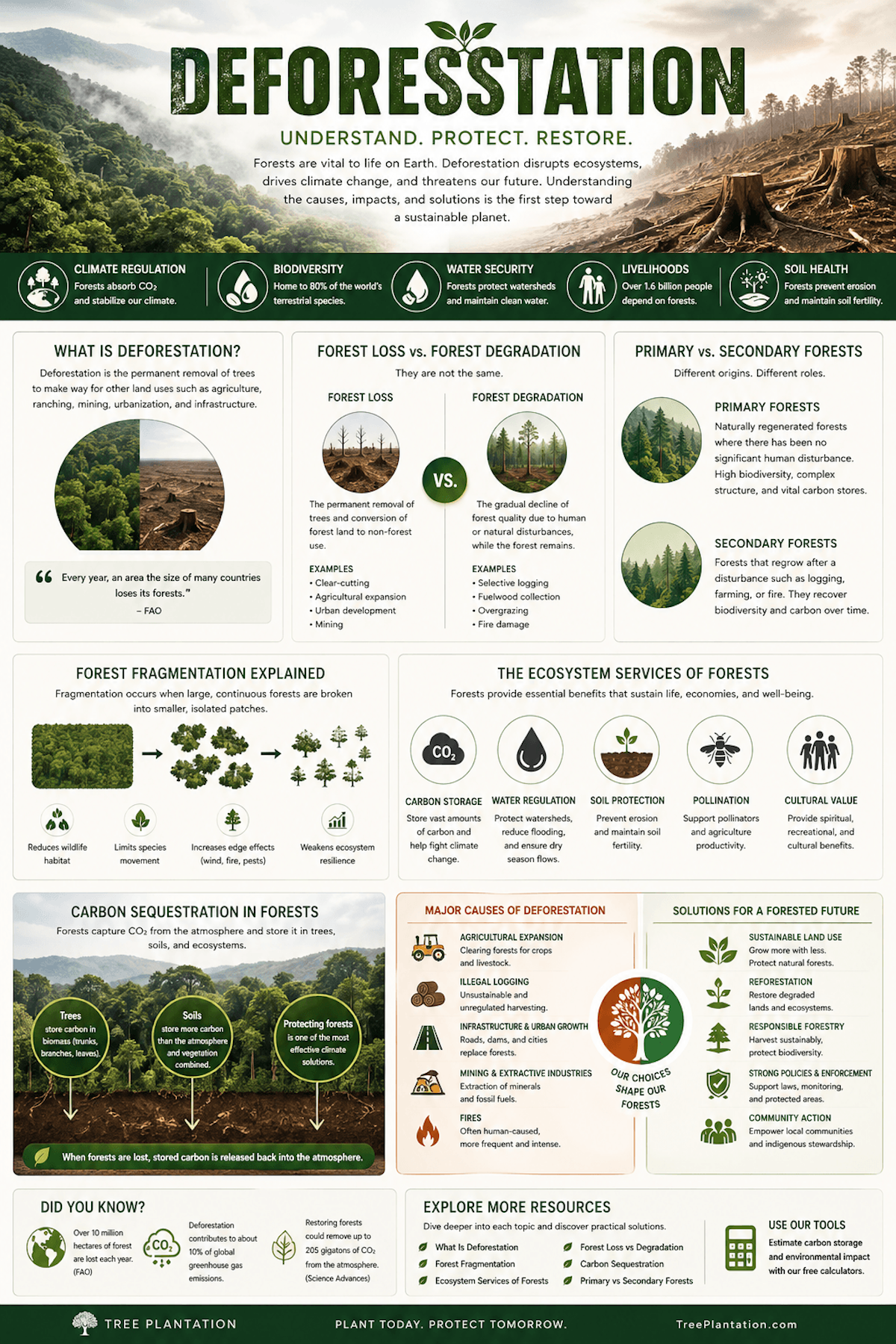
Feel free to share this deforestation infographic on your website or blog. Please include a link back to this page as the source.

Forest fragmentation occurs when large, continuous forest ecosystems are broken into smaller, isolated patches. This process is often driven by roads, agriculture, logging, urban expansion, and infrastructure development. While some trees may remain standing, the integrity of the ecosystem is disrupted—altering habitat structure, reducing connectivity, and weakening the overall resilience of the forest.
The loss of connectivity and core habitat is one of the most significant impacts of fragmentation. Many species rely on large, uninterrupted forest areas for migration, breeding, and access to food. When forests are divided into smaller patches, wildlife populations become isolated, genetic diversity declines, and species are more vulnerable to predation, disease, and local extinction.
Edge effects and environmental stress further accelerate ecosystem decline. Fragmented forests have more exposed edges, where conditions differ dramatically from the forest interior. Increased sunlight, wind, and temperature fluctuations can dry out soils, alter vegetation patterns, and make forests more susceptible to invasive species and fire. These edge zones often expand inward, reducing the amount of stable, interior habitat over time.
Forest fragmentation also disrupts ecological processes such as water cycles, carbon storage, and nutrient flow. As forest patches shrink and degrade, their ability to regulate climate, support biodiversity, and provide ecosystem services declines. However, strategies such as habitat corridors, reforestation, and landscape-level planning can reconnect fragmented areas, restore ecological balance, and strengthen long-term forest resilience.

Slash-and-burn agriculture is one of the oldest and most widespread drivers of deforestation, particularly in tropical regions such as the Amazon rainforest. This practice involves cutting down vegetation and burning it to quickly clear land for crops or grazing. While it can provide short-term fertility from nutrient-rich ash, the long-term impact is often forest loss, soil degradation, and repeated cycles of land clearing as productivity declines.
The relationship between slash-and-burn agriculture and deforestation is direct and cumulative. Each clearing removes forest cover, releases stored carbon, and fragments ecosystems. Initially, crops may grow well due to nutrients released from burned biomass, but these benefits are temporary. Without tree cover to protect and replenish the soil, nutrients are quickly depleted, and the land becomes less productive over time.
As soil fertility declines, farmers are often forced to clear additional forest areas to maintain yields. This creates a repeating cycle: forests are cut, burned, cultivated, and then abandoned once productivity drops. Over time, this cycle expands outward, increasing deforestation rates and leaving behind degraded landscapes that are more vulnerable to erosion, drought, and desertification.
The environmental consequences extend beyond tree loss. Burning releases significant amounts of carbon dioxide and other greenhouse gases into the atmosphere, contributing to climate change . At the same time, the removal of tree cover disrupts local rainfall patterns, reduces biodiversity, and increases the risk of wildfires spreading beyond controlled areas.
Repeated burning also damages soil structure, reduces organic matter, and exposes land to wind and water erosion. Without roots to anchor the soil and vegetation to provide cover, landscapes can rapidly transition from forest to degraded land, making natural regeneration increasingly difficult.
Reducing the impact of slash-and-burn agriculture requires a shift toward more sustainable land management practices. Agroforestry, improved soil management, and long-term cultivation systems can help maintain productivity without continuous forest clearing. By integrating trees into agricultural landscapes, it is possible to preserve soil health, support biodiversity, and reduce the pressure to expand into remaining forest areas.
When sustainable alternatives are adopted, the cycle of clearing and abandonment can be replaced with systems that support both livelihoods and forest conservation. This transition is essential for slowing deforestation, protecting ecosystems, and building more resilient landscapes over time.

Deforestation is a complex, global issue with far-reaching impacts on biodiversity, climate, and human well-being. From habitat loss and species extinction to the disruption of climate regulation and ecosystem services, the consequences are profound and alarming.
Addressing deforestation requires coordinated efforts at local, national, and international levels. This includes strengthening forest governance, supporting Indigenous rights, promoting sustainable land-use practices, and reducing global demand for commodities that drive deforestation.
It also involves raising awareness about the value of forests and the services they provide, fostering a deeper appreciation for nature among the public, and investing in reforestation, restoration, and climate-smart plantations that bring degraded land back into productive use without sacrificing remaining natural forests.
The leading cause of deforestation worldwide is the conversion of forests to agricultural land – especially cattle pasture, soybean fields, and palm oil plantations. In many regions, logging, mining, and infrastructure projects also clear large areas of forest and open remote areas to further land speculation.
Deforestation releases the carbon stored in trees and forest soils back into the atmosphere as carbon dioxide, a major greenhouse gas. It also removes forests’ ability to absorb future emissions, disrupts rainfall patterns, and makes landscapes more vulnerable to heat waves, droughts, and floods.
Effective solutions combine stronger forest protection with reforestation, agroforestry, and more sustainable production of food and timber. Restoring degraded land with well-planned plantations can produce wood, food, and income while taking pressure off remaining natural forests.
You can estimate the climate and financial impact of your trees using tools such as the Tree Carbon Calculator and Tree Value Calculator. These tools help you understand how much carbon your trees may store and what your standing timber could be worth over time.
Copyright © All rights reserved Tree Plantation