INVEST
 PLANT
PLANT
 SOFTWOODS
 HARDWOODS
 CALCULATORS
 RESOURCES
 PROGRAMS

Softwoods
Learn More
From the smooth silver-gray bark of American beech to the tall, premium timber form of European beech, beech trees are among the most distinctive hardwoods in temperate forests. They provide dense shade, valuable mast for wildlife, durable lumber for furniture and flooring, and lasting beauty in large landscapes.
Explore species differences, wood uses, habitat value, planting potential, and the role of beech in healthy forests, sustainable forestry, and long-term hardwood investment.
Beech trees (Fagus species) are stately, long-lived deciduous hardwoods in the Fagaceae family, admired for their smooth silver-gray bark, dense spreading crowns, and enduring presence in temperate forests. Native to North America, Europe, and Asia, beech trees are among the most recognizable woodland species, valued for their beauty, shade, wildlife food production, and strong, fine-grained wood.
In both natural forests and cultivated landscapes, beech trees stand out for their cathedral-like form, glossy foliage, and nutritious beechnuts. These elegant hardwoods play an important role in biodiversity, carbon storage, and sustainable forestry, while also serving as specimen trees in parks, estates, and large gardens.
Beech trees are valued for their beauty, ecological role, and dependable hardwood production:
Beech trees help shape some of the most important and biologically rich temperate forest systems in the world:
Beech trees perform best in deep, fertile, well-drained soils with reliable moisture and a cool to moderate temperate climate. Young trees are relatively shade-tolerant, which helps them establish beneath a partial canopy, but they need adequate space and long-term light access to develop into high-value timber trees.
Because beech is a slow-growing hardwood, it is best suited to landowners and growers with a long time horizon who value both timber quality and ecological return. Well-managed beech plantings can deliver premium hardwood, improved habitat, long-term carbon storage, and strong landscape value.
In carefully planned beech plantations—including innovative systems such as crop circle or spiral forestry layouts—growers can combine sustainable hardwood production with biodiversity enhancement, visual appeal, and long-term forest resilience.
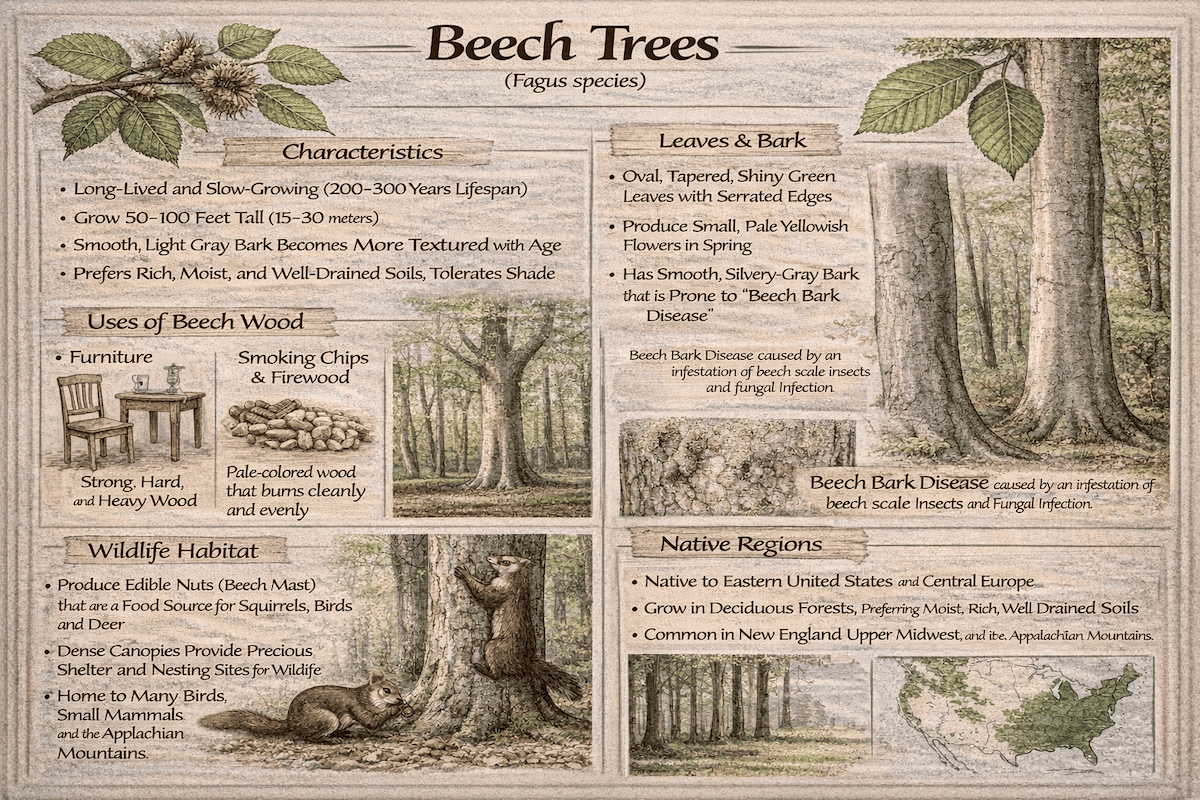
Feel free to share this beech trees infographic on your website or blog. Please include a link back to this page as the source.
The American beech (Fagus grandifolia) is one of the most iconic hardwoods in eastern North America, especially across the Great Lakes region, the Appalachians, and the rich mixed forests of the Northeast. Known for its smooth gray bark, dense canopy, and remarkable longevity, American beech has long been a defining species of mature woodland ecosystems. Historic beech-dominated forests once stretched from southern Canada to the Gulf states, creating cool, shaded forest interiors rich in wildlife, leaf litter, and mast production.
Some of the oldest American beech trees have survived for centuries, developing massive trunks and broad crowns that make them true forest monuments. Although extensive logging and land conversion greatly reduced many old-growth stands, American beech remains ecologically important in second-growth forests and mixed hardwood landscapes. Today, it is valued not only for its timber and wildlife benefits, but also for its role in soil health, biodiversity, and long-term carbon storage.
American beech is valued for its strength, uniform texture, and workability. While it may not always receive the same attention as oak or cherry, it remains an important hardwood in both traditional woodworking and modern forest management.
Beechnuts are one of the most valuable mast crops in eastern forests, especially in productive years when trees bear heavily. These small triangular nuts provide concentrated energy that helps wildlife survive fall, winter, and early spring.
Despite its strength and longevity, American beech faces several serious pressures that affect both natural stands and future regeneration:
Protecting and expanding American beech will require a combination of sound forestry, habitat restoration, and long-term planning. Foresters and landowners are increasingly recognizing the species not just for timber, but for its ecological and climate value.
As interest grows in resilient hardwood systems, American beech plantations, mixed-species reforestation projects, and innovative crop circle forestry layouts offer promising opportunities for landowners seeking a blend of timber value, habitat enhancement, and long-term environmental return.

Beechnuts are the small, triangular seeds produced by beech trees, and they have long served as an important resource in temperate forest ecosystems. Rich in natural oils, protein, and energy, beechnuts help sustain birds, mammals, and other woodland species during fall and winter. For centuries, they were also gathered by people as a seasonal food source and used in a range of traditional practices, from cooking and oil extraction to folk remedies and craft applications.
Although beechnuts are small, their ecological and cultural value is significant. In strong mast years, they can influence wildlife populations across entire forest regions, while historically they offered rural communities a dependable source of calories, lamp oil, and natural materials. Their importance helps explain why beech forests have long been valued not only for timber, but also for food security, biodiversity, and woodland resilience.
The European beech (Fagus sylvatica) is one of Europe’s most important native hardwoods and a defining species in many of the continent’s classic temperate forests. It thrives in deep, fertile soils and moderate climates, often forming tall, elegant stands with straight trunks and broad crowns. In mature forests, European beech creates a cool, shaded interior and a distinct woodland atmosphere that supports a wide range of plant and animal life.
Because of its form, wood quality, and ecological strength, European beech has long been prized in forestry, woodworking, and conservation. It is equally valued as a commercial hardwood, a wildlife tree, and a key species in old cultural landscapes.
European beech is widely respected as a versatile hardwood with both structural strength and refined appearance. It is used across a broad range of interior, commercial, and specialty applications.
Heavy crops of beechnuts, often called beech mast, are among the most important periodic food events in temperate forests. In productive mast years, the nut supply can support a wide range of species and shape wildlife behavior for months.
Across Europe and other temperate regions, beech forests have long been associated with permanence, wisdom, shelter, and woodland abundance. Their value extends far beyond timber production.
Because old-growth beech stands are now far less common in many regions, sustainable management is essential for protecting their long-term ecological and economic value. Selective harvesting, longer rotations, mixed-species planting, and rewilding strategies can help maintain forest structure while supporting regeneration and habitat quality.
For landowners, foresters, and conservation groups, beech offers a compelling balance of high-quality hardwood, wildlife support, carbon storage, and long-term woodland resilience. Well-managed beech forests and plantations can supply premium timber while also strengthening biodiversity and restoring healthier temperate forest systems.

The European beech (Fagus sylvatica) has been quietly growing across parts of the eastern United States and Canada for more than a century. Originally introduced as an ornamental tree for estates, parks, and botanical collections, it has demonstrated an impressive ability to adapt to North American climates—often achieving comparable height, form, and wood quality to its native European stands.
This presents a compelling and largely untapped opportunity: the development of European beech plantations as a premium hardwood resource in North America. With limited domestic supply and strong demand for high-quality hardwoods, European beech has the potential to occupy a valuable niche in both specialty wood markets and long-term forestry investments.
European beech is widely regarded as one of the most versatile and reliable hardwoods in commercial forestry. In managed forests, trees are often grown to large diameters, producing wide boards, uniform grain patterns, and high-quality veneer logs.
Its combination of strength, density, and fine texture makes it suitable for both structural and aesthetic applications, placing it alongside other premium hardwoods in value and performance.
As demand grows for sustainable, high-quality hardwoods, European beech is gaining attention as a long-term plantation species in North America. Its rarity in the local market, combined with proven performance, creates strong positioning for future value.
For landowners, investors, and regenerative forestry projects , European beech offers a rare combination of beauty, performance, and long-term economic potential. When integrated into thoughtfully designed plantation systems, it can serve as both a premium timber species and a cornerstone of sustainable forest development.

Asian beech trees include several important Fagus species native to East Asia and nearby temperate regions, where they form beautiful, high-canopy forests and support rich woodland ecosystems. Like their American and European relatives, these trees are valued for their smooth bark, shade tolerance, quality hardwood, and nutrient-rich beechnuts. They also hold longstanding importance in regional forestry, wildlife habitat, and traditional woodland culture.
Among the most recognized Asian beech species are:
These species share many of the defining characteristics of the beech genus: strong and workable wood, long life spans, seed crops that support wildlife, and a major role in stabilizing soils, regulating moisture, and building healthy forest systems.
Asian beech woods are respected for their strength, density, and fine, even texture. In many regions, they are used much like European beech—where appearance, durability, and machining quality all matter.
Like other beech species, Asian beech trees produce small triangular nuts that are rich in fats, protein, and energy. These nuts are an important seasonal mast crop in forest ecosystems and, in some regions, have also been gathered for human use.
In parts of East Asia, different parts of the beech tree have been used in traditional herbal and folk practices. While these uses vary by region and culture, bark, leaves, and related plant materials have historically been associated with everyday remedies and practical household applications.
Asian beech forests are ecologically rich and often form part of highly productive temperate mountain and mixed-hardwood ecosystems. Their long-lived canopy structure and seasonal nut production make them especially valuable for biodiversity.
Despite their resilience and long ecological history, Asian beech species face many of the same pressures affecting temperate forests worldwide:
Protecting Asian beech forests requires a combination of restoration, better forestry practices, and long-term landscape conservation:
As demand grows for premium hardwood and pressure increases on natural forests, managed beech plantations offer a practical and environmentally responsible path forward. Well-designed projects can combine timber production with restoration and long-term ecological value.
For growers, landowners, and reforestation planners, Asian beech species offer a strong combination of timber value, ecological resilience, and cultural significance. In the right climates and soils, they represent an attractive option for restoring temperate forests and building long-term hardwood assets.

From maple to oak to beech, hardwoods whisper of centuries past—their slow growth and dense grain a testament to patience, value, and long-lasting wood products.
Partner with us in a land management project to repurpose agricultural lands into appreciating tree assets. We have partnered with growingtogive.org, a 501(c)(3) nonprofit, to create tree-planting partnerships with land donors.
We have partnered with growingtogive.org, a Washington State nonprofit, to create a land-and-tree partnership program that repurposes agricultural land into appreciating tree assets.
The program utilizes privately owned land to plant trees that benefit both the landowner and the environment— increasing long-term land value while restoring soil, water, and wildlife habitat.
If you have 100 acres or more of flat, fallow farmland and would like to plant beech or other hardwood trees, we would like to talk to you. There are no costs to enter the program. You own the land; you own the trees we plant for free, and there are no restrictions—you can sell or transfer the land with the trees anytime.
Explore answers to common questions about American beech, European beech, Asian beech species, beechnuts, timber value, and sustainable beech forestry.
A beech tree is a long-lived deciduous hardwood in the Fagus genus, valued for its smooth gray bark, dense shade canopy, strong fine-grained wood, and nutritious beechnuts. Beech trees are native to temperate regions of North America, Europe, and Asia, where they play an important role in forest ecology, timber production, and landscape planting.
Beech trees are most easily identified by their smooth, pale gray bark, slender pointed buds, and simple oval leaves with a neat, slightly toothed margin. Mature trees often develop a broad, rounded crown and a stately, cathedral-like appearance in the forest. In fall, the foliage usually turns golden, bronze, or copper tones.
American beech is used for furniture, cabinetry, flooring, veneer, woodenware, tool handles, firewood, and charcoal. Its wood is hard, heavy, and close-grained, making it useful for interior wood products and durable utility items. It is also highly valued as a wildlife tree because of its mast production and habitat benefits.
Beechnuts can be eaten when properly prepared, and historically they were roasted, boiled, or ground into meal in some rural and traditional food systems. They are rich in oils and energy, which made them useful as a seasonal woodland food. Beechnuts have also been used in some regions for oil extraction and other household purposes.
Beechnuts are one of the most valuable mast crops in temperate forests. They provide concentrated food for deer, bears, wild boar, squirrels, chipmunks, birds, and other woodland wildlife during fall and winter. In productive mast years, beechnuts can influence wildlife survival, reproduction, and movement across entire forest ecosystems.
Beech bark disease is a damaging condition caused by a combination of scale insects and fungal pathogens. The insects weaken the bark, allowing fungi to invade and damage the tree. Over time, affected beech trees may develop bark deformities, reduced vigor, canopy decline, and increased mortality, making disease management a major concern in some regions.
European beech can be a promising plantation species in suitable temperate regions of North America. It offers excellent form, strong timber quality, premium market potential, and compatibility with diversified hardwood systems. For landowners with a long investment horizon, European beech may provide a valuable combination of specialty hardwood production, carbon storage, and landscape value.
Asian beech trees include species such as Japanese beech (Fagus crenata), Chinese beech (Fagus engleriana), and Oriental beech (Fagus orientalis). These trees are native to East Asia and nearby temperate regions and are valued for their quality hardwood, ecological importance, shade tolerance, and seasonal beechnut production.
Beech forests are important because they support biodiversity, store carbon, improve soil structure, protect watersheds, and provide habitat for birds, mammals, fungi, and understory plants. They also produce valuable hardwood and nutrient-rich mast while contributing to long-term forest resilience. In both natural forests and managed plantations, beech trees offer ecological, economic, and conservation value.
Copyright © All rights reserved Tree Plantation