


 INVEST
 PLANT
PLANT
 SOFTWOODS
 HARDWOODS
 CALCULATORS
 RESOURCES
 PROGRAMS

Softwoods
Learn More
Bonsai trees are miniature living works of art that capture the beauty of full-sized forests in a container. Through careful pruning, wiring, and long-term cultivation, bonsai artists shape ordinary trees into elegant miniature landscapes that can live for decades—or even centuries.
But bonsai is more than a gardening technique. It is a centuries-old horticultural tradition rooted in Japanese and Chinese culture, where patience, balance, and respect for nature guide every cut and branch placement. Today bonsai is practiced around the world by collectors, artists, and gardeners who appreciate the discipline and tranquility that comes from shaping a living tree over time.
On this page you’ll learn how bonsai trees are grown and cared for, explore famous bonsai specimens that have inspired generations of artists, discover some of the oldest bonsai trees in the world, and see how bonsai cultivation can even help preserve endangered tree species through seed collection and conservation programs.
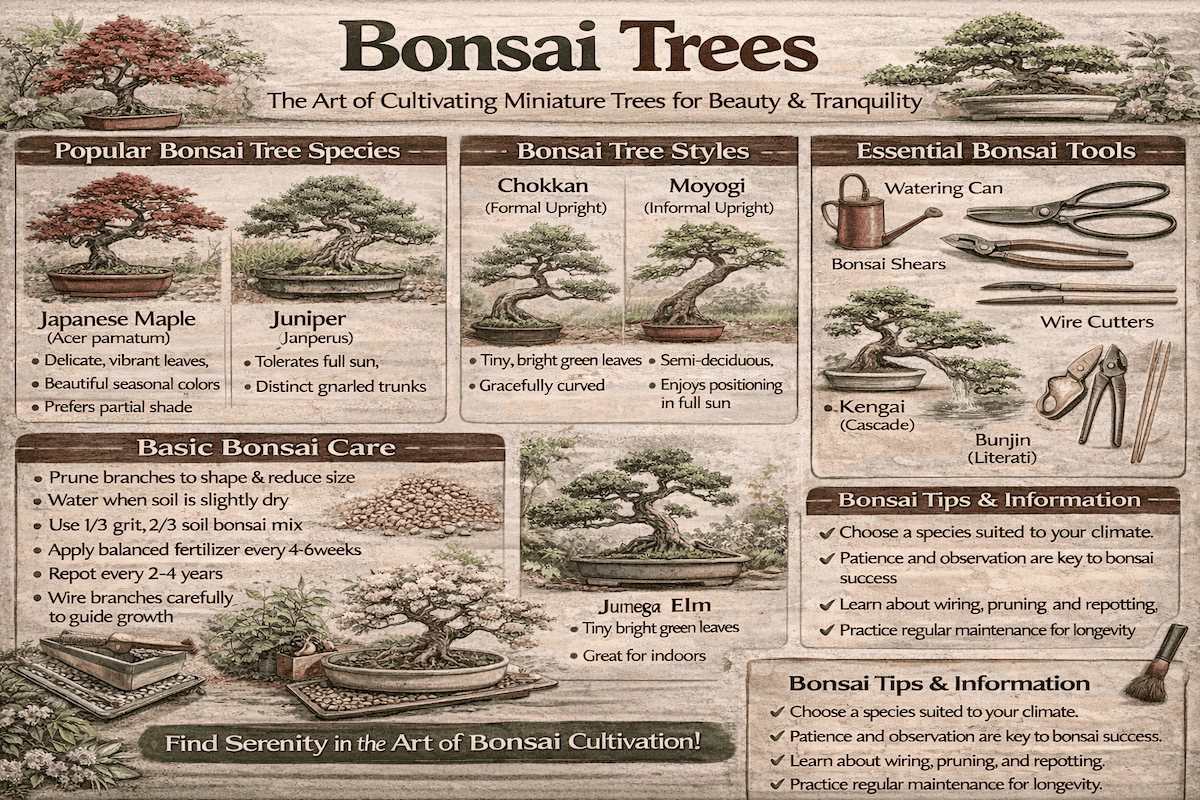
Feel free to share this bonsai trees infographic on your website or blog. Please include a link back to this page as the source.
Among the most extraordinary achievements in the art of bonsai are trees that have survived for centuries. Some of the oldest bonsai trees in the world are believed to be 400 to more than 1,000 years old, living witnesses to generations of care, pruning, and careful cultivation. These ancient specimens demonstrate the remarkable longevity of trees when they are grown in controlled environments and maintained with deep horticultural knowledge.
Unlike ordinary potted plants, a bonsai is never “finished.” It is a living collaboration between nature and the bonsai artist. Over decades and centuries, the tree continues to grow while successive caretakers refine its structure, guide its branches, and preserve its health. The result is a living sculpture that evolves slowly through time, often becoming more valuable and beautiful with each passing generation.
The extraordinary lifespan of bonsai trees is not accidental. Several factors contribute to their longevity. First, bonsai are grown in carefully controlled environments where water, nutrients, and soil conditions are closely managed. Second, regular pruning removes weak growth and encourages strong branch structure, allowing the tree to maintain balance and vigor over long periods.
Finally, bonsai receive constant attention from skilled caretakers who monitor pests, diseases, and environmental stress. This level of care means that a bonsai tree can often outlive trees growing freely in the wild. In fact, some bonsai are considered living heirlooms, passed from master to apprentice or from family to family for generations.
Today, these ancient bonsai serve as powerful reminders of the patience and dedication required in this remarkable horticultural tradition. They also highlight the enduring beauty of trees themselves—living organisms capable of spanning centuries when treated with respect and care.
Pruning is what turns a potted sapling into a true bonsai. Careful, regular pruning controls size, enhances taper, and builds the fine twigging that makes a tree look old in miniature. Whether you’re working with a young starter or a mature specimen, use these pruning steps to keep your bonsai tree healthy and in scale.
Pruning is not a one-time task but an ongoing dialogue with the tree. With each session you refine the form, strengthen the structure, and deepen the impression of age. It’s one reason growing bonsai trees has become a meditative practice for many people—equal parts horticulture, sculpture, and quiet time with a living companion.
Today, world-class bonsai—sometimes hundreds of years old—are sold, donated, or insured for hundreds of thousands of dollars. But even a modest starter tree can provide the same sense of focus and calm if you care for it with patience and intention.
Simply putting a tree seedling in a pot does not create a bonsai. Without training and root management, the tree will quickly become root-bound and decline. True bonsai requires a long-term plan, careful root pruning, and deliberate shaping of trunk and branches.
Most artists begin with young trees of suitable species—such as juniper, pine, maple, ficus, or elm—and then gradually refine them through:
Over time, this process creates the illusion of a full-sized, time-worn tree shrunken into a small, living sculpture—what many call “the smallest tree on earth.”
Not all bonsai are suitable for indoor life, but some tropical and subtropical species can thrive in the home or office when their needs are met. Popular indoor bonsai trees include Ficus, Chinese elm, Jade (Crassula), Schefflera, and certain dwarf citrus trees.
For successful indoor bonsai culture, focus on four essentials:
With the right species and routine, you can enjoy bonsai indoors year-round, bringing a tiny piece of forest into your living room, study, or meditation space.
Temperate species—such as pine, spruce, juniper, birch , birch, and many fruit trees—are best grown outdoors, where they can experience the changing seasons they evolved with.
Key points for outdoor bonsai success include:
Outdoor bonsai let you create small, natural landscapes—forest groupings, windswept pines, riverbank maples—that echo the larger ecosystems they come from. Many growers combine bonsai with agroforestry and reforestation interests, using miniature trees as both art and education.
Many bonsai are grown in special “air-root” pots with perforated sides. These allow air to prune the roots as they reach the pot edge, keeping them small and fibrous. Every second year, the tree is lifted, its root mass reduced, and fresh soil added. This root-pruning cycle lets a bonsai live in the same size pot for decades while remaining vigorous.
For many practitioners, bonsai is as much a spiritual practice as it is horticulture. The slow pace of growth, the need to observe carefully, and the rhythm of seasonal work all encourage mindfulness.
The act of sitting with a small tree—pruning, wiring, watering, or simply studying its silhouette—can function as a moving meditation. It focuses attention on the present moment and builds a quiet relationship between grower and tree.
Because bonsai are long-lived, they invite long-term thinking. Watching a tree respond to your choices over years and decades can be deeply grounding, reminding us that transformation in nature (and in life) rarely happens overnight.
In this way, bonsai can become a daily companion in cultivating patience, humility, and appreciation for the subtle changes that time brings.
Bonsai is not typically associated with commercial timber plantations, yet it can play a powerful role in tree conservation. Land-clearing agriculture, over-logging, and climate change have pushed many species toward threatened or endangered status. Some trees now survive only in small remnant stands or cultivated collections.
As sanctuary trees, bonsai offer a way to safeguard genetic lines of rare and valuable species on a small footprint. A single greenhouse or courtyard can hold dozens of endangered trees grown in miniature, each maintained long enough to flower, fruit, and set viable seed.
Around the world, thousands of tree species are under threat from deforestation, invasive pests, climate change, and habitat loss. Many rare trees disappear quietly—sometimes before scientists fully understand their ecological importance. Through our Bonsai Sanctuary, we are working to create a living safeguard for these vulnerable species by cultivating them in miniature form while preserving their genetic future.
The Bonsai Sanctuary functions as a miniature tree plantation for endangered and rare tree species. Seeds are collected from diverse regions and carefully grown into young trees. Rather than remaining ordinary nursery stock, these trees are trained using traditional bonsai techniques that encourage strong trunks, compact branching, and long-term vitality. While the trees remain small in size, they are allowed to mature biologically so they can flower, pollinate, and produce viable seed.
Those seeds become part of a growing tree seed bank dedicated to the long-term conservation of threatened species. When ecological restoration opportunities arise—whether through reforestation projects, conservation programs, or research partnerships—these seeds can be planted to grow into full-sized trees in their native environments. Even though the parent trees are cultivated as bonsai, their offspring develop normally once returned to soil and space in the wild.
This innovative approach connects several important conservation strategies at once: ex-situ conservation, seed preservation, and seedling production. It also creates a powerful educational platform. Visitors can see rare species up close, learn about their ecological roles, and understand how thoughtful cultivation can help protect biodiversity for future generations.
In essence, the Bonsai Sanctuary acts as a living archive of endangered trees. Every miniature tree represents the possibility of restoring forests, rebuilding ecosystems, and protecting species that might otherwise disappear.
You can directly support the protection of endangered and climate-threatened species through our $111 Adopt a Rare Tree Bonsai program. Each adoption helps fund the cultivation, care, labeling, seed collection, and long-term preservation of rare trees grown in our Bonsai Sanctuary.
Across the planet thousands of rare tree species face extinction due to habitat loss, climate change, pests, and disease. Through our Bonsai Sanctuary, we cultivate endangered trees in miniature form so they can produce seed, preserve genetic diversity, and support future forest restoration.
Your support helps maintain this living conservation collection and expand the seed bank that will one day help rebuild forests around the world.
$111
Adopt a rare bonsai tree and help support its care, cultivation, and seed preservation. Your contribution helps protect the genetic future of endangered tree species.
Adopt a Rare Bonsai$333
Sponsor multiple conservation bonsai and help expand the sanctuary’s living archive of rare and climate-threatened tree species.
Sponsor Rare Trees$1,111
Help fund a dedicated section of the Bonsai Sanctuary and support seed banking, education programs, and future forest restoration initiatives.
Become a Sanctuary StewardEvery tree preserved today increases the chances that future generations will inherit healthy forests, thriving wildlife habitat, and resilient ecosystems.
African blackwood—often referred to as black ebony and scientifically known as Dalbergia melanoxylon—is widely regarded as one of the most valuable and sought-after tonewoods on the planet. Native to regions of eastern, central, and southern Africa, particularly Tanzania and Mozambique, this remarkable species is part of the diverse group of African trees that thrive in the continent’s savanna and dry woodland ecosystems. Its extremely dense hardwood has long been prized for its deep black color, fine grain, and exceptional stability. These qualities make it ideal for precision-crafted musical instruments such as clarinets, oboes, and bagpipes, as well as for intricate carving and luxury woodwork.
Unfortunately, the same qualities that make African blackwood so desirable have also placed it under intense pressure in the wild. Slow growth rates, limited natural distribution, and decades of heavy harvesting for the global instrument trade have dramatically reduced the number of mature trees remaining in many regions. In some areas, old-growth specimens large enough for instrument-quality timber are now increasingly rare.
Today, conservationists, foresters, and instrument makers are working together to promote sustainable harvesting, plantation programs, and genetic preservation of this remarkable species. Efforts include community forestry projects across Africa, seed collection programs, and experimental cultivation in botanical gardens and specialty collections. By protecting remaining stands and growing new generations of trees, these initiatives aim to ensure that African blackwood—and the musical traditions that depend on it—can continue for centuries to come.
In bonsai form, ebony and other African trees can be preserved in miniature while still producing seed and educating viewers about their plight.

Pines are classic bonsai subjects, and several important pine species are now threatened in parts of their native range. Eastern white pine (Pinus strobus) in North America, for example, has been impacted by habitat loss, pests, and disease. Japanese black and Japanese white pines are likewise under pressure in some regions.

Several birch species—grey birch, dwarf birch, paper birch, red-leaf birch, and yellow birch—face threats from climate change, pests, and habitat loss. Their distinctive bark and delicate foliage make them striking subjects for bonsai and ideal candidates for sanctuary collections.

Ash trees are under severe pressure from the invasive emerald ash borer (EAB), which has devastated many ash populations across North America and beyond. Green ash, black ash, white ash, and European ash are all affected.
By cultivating ash trees in bonsai form and carefully preserving their seed, growers can play a small but meaningful role in protecting the future of this important forest species. Across North America and parts of Europe, ash populations have been devastated by pests such as the emerald ash borer, which has killed hundreds of millions of mature trees. Maintaining ash in bonsai collections allows horticulturists and enthusiasts to safeguard living specimens, observe their growth characteristics, and collect viable seed that may one day contribute to restoration programs.
In this way, ash bonsai serve not only as miniature works of living art but also as conservation tools. By keeping these trees alive in gardens, nurseries, and bonsai collections, growers help preserve valuable genetic diversity that could support the development of pest-resistant ash populations in the future. These small trees may ultimately play a role in helping scientists and foresters rebuild healthy ash forests once effective control methods and resistant varieties are widely available.

Maples are among the most beloved species in bonsai, prized for their fine ramification and spectacular autumn color. Several maple species—Bigleaf maple, Florida maple, Southern sugar maple, and Nikkō maple—face regional threats from habitat loss and changing climate.

Many flowering trees are under stress from habitat loss, shifting weather patterns, and disease. Bigleaf magnolia, cucumber tree, eastern redbud, Franklinia, and the Japanese katsura tree are a few notable examples. In bonsai form they can be preserved, studied, and enjoyed up close.

Start by slowly turning the tree and choosing the most attractive front view. Remove any dead, damaged, or obviously weak branches first so you can clearly see the living structure. Next, shorten over-long shoots back to a bud or side branch that points in the direction you want growth to continue. Eliminate crossing branches and congested clusters so that light and air reach the inner canopy. Use sharp bonsai shears and concave cutters to make clean cuts, and seal any larger wounds with bonsai paste. Pruning is gradual and ongoing—you refine the silhouette a little at a time rather than in one drastic session.
Yes—if you choose the right indoor bonsai species and give them enough light, humidity, and careful watering. Tropical and subtropical trees such as Ficus, Chinese elm, jade (Crassula), Schefflera, and some dwarf citrus trees adapt well to home or office conditions. Place them where they receive bright, indirect sun or under LED grow lights, use a free-draining bonsai soil mix, and water thoroughly whenever the top of the soil begins to dry. Humidity trays, light misting, and small humidifiers help offset dry indoor air. Feed lightly during the growing season with a balanced fertilizer formulated for bonsai.
Many of the classic bonsai tree species are actually outdoor trees and need real seasons to stay healthy. Pines, junipers, spruce, larch, maples, birches, and fruit trees all do best outside in climates where they are naturally hardy. Give them several hours of direct sun, protect shallow pots from extreme heat and hard freezes, and adjust watering with the seasons—more in summer, less when they are dormant. In very cold climates, pots can be sunk into mulch, kept in a cold frame, or overwintered in an unheated but frost-protected space so roots don’t freeze solid.
Bonsai can serve as living sanctuary trees for threatened and endangered species. Rare trees collected ethically from cultivation (not wild poaching) can be miniaturized and grown in a dedicated bonsai sanctuary, where they are protected, documented, and carefully pollinated. Even though the parent plants are small, the seeds they produce will grow into full-size trees when planted in the wild or in restoration projects. In this way, a collection of miniature trees can act as a genetic backup for species at risk from land clearing, over-logging, pests, or climate change, and can support broader reforestation and climate-resilience work.
Copyright © All rights reserved Tree Plantation