


 INVEST
 PLANT
PLANT
 SOFTWOODS
 HARDWOODS
 CALCULATORS
 RESOURCES
 PROGRAMS

Softwoods
Learn More
DESERTIFICATION GUIDE • CAUSES • IMPACTS • SOLUTIONS
Desertification is one of the most serious land and food security challenges facing arid, semi-arid, and dry sub-humid regions. It does not simply mean that deserts are spreading. It means productive land is losing the soil structure, vegetation cover, water retention, and biological life needed to support crops, grazing, wildlife, and communities.
Healthy drylands can be productive, biodiverse, and resilient. But when vegetation is removed, soils are overused, water systems are depleted, and climate stress increases, the land becomes more vulnerable to erosion, salinization, drought, heat stress, and long-term ecological decline.
The impacts of desertification extend far beyond dry soil. As land degrades, ecosystems lose vegetation, soil fertility declines, water becomes harder to retain, and communities become more vulnerable to food insecurity, dust storms, drought, and migration pressure.
Compare how wind and rainfall remove exposed topsoil and accelerate long-term land degradation.
Understand why losing the top layer of soil reduces fertility, crop yields, and ecosystem recovery potential.
Explore how nutrient depletion, low organic matter, and weakened soil biology reduce land productivity.
Learn how declining rainfall, runoff, groundwater depletion, and poor retention intensify desertification.
See how salt buildup damages roots, reduces crop growth, and makes degraded land harder to restore.
Understand how vegetation loss, erosion, drought, and biodiversity decline can push drylands past recovery thresholds.
Desertification can often be slowed, stopped, or reversed when land restoration addresses soil, water, vegetation, and long-term management together. Successful solutions usually combine trees, ground cover, water harvesting, grazing control, regenerative agriculture, and soil rebuilding.
Explore practical methods for restoring degraded land through vegetation, soil repair, and water retention.
Learn how compost, cover crops, mulch, reduced disturbance, and organic matter rebuild living soil.
See how degraded landscapes can recover through targeted planting, erosion control, and microclimate repair.
Support natural regrowth by protecting seedlings, managing grazing, and helping native vegetation return.
Build productive dryland systems using soil cover, water efficiency, biodiversity, and climate-smart practices.
Capture rainwater, slow runoff, recharge soil moisture, and improve restoration success in dry landscapes.
Planning restoration requires understanding planting density, wind protection, water availability, soil condition, and long-term recovery potential. These tools help landowners, educators, and restoration teams estimate practical next steps.
Plan protective tree rows that reduce wind erosion, conserve soil moisture, and improve dryland restoration success.
Estimate how many trees are needed per acre or hectare for restoration, windbreaks, shelterbelts, and degraded land recovery.
Estimate how much rainwater can be captured from roofs or surfaces to support gardens, trees, and restoration systems.
GLOBAL IMPACT • FOOD SECURITY • DRYLAND REGIONS
Desertification is not limited to remote deserts. It affects agricultural land, grazing regions, dry forests, savannas, and semi-arid landscapes around the world. The UNCCD has reported that up to 40% of the planet’s land is degraded, directly affecting nearly half of humanity. Drylands also cover roughly 40% of Earth’s land area excluding Antarctica, making desertification a global land-use, climate, and food security issue.
The most vulnerable regions include parts of Africa, Asia, the Middle East, Latin America, Australia, and the U.S. Southwest. In Africa, the Sahel is one of the best-known examples, where drought, overgrazing, population pressure, and climate stress combine to reduce vegetation and soil productivity. In Asia and the Middle East, groundwater depletion, salinization, heat stress, and poor irrigation practices are major concerns.
Desertification directly threatens food security because productive soil is the foundation of crops, grazing, and rural livelihoods. When topsoil is lost, soil fertility declines, and water becomes harder to retain, farmers and herders face lower yields, weaker pastures, livestock losses, and greater dependence on imported food or emergency support.
Restoring degraded land is therefore not only an environmental priority — it is also a food security, climate resilience, and community stability strategy. Practices such as soil regeneration, water harvesting, windbreaks, assisted natural regeneration, agroforestry, and climate-smart planting can help rebuild land productivity and reduce pressure on vulnerable dryland communities.
EXPLORE DESERTIFICATION TOPICS • FULL CLUSTER COVERAGE
How excessive grazing removes vegetation, compacts soil, and accelerates desertification.
Tree loss reduces moisture retention, soil stability, and ecosystem resilience.
Overcultivation, monocropping, and poor soil management degrade land over time.
Improper irrigation can leave salt behind, damaging soil structure and fertility.
Compacted soil reduces infiltration, root growth, and long-term productivity.
Prolonged drought accelerates vegetation loss, erosion, and land degradation.
Rising temperatures and shifting rainfall increase desertification risk.
Extreme heat increases evaporation and weakens soil-water balance.
Compare how wind and rainfall remove topsoil and accelerate degradation.
Losing topsoil reduces fertility, crop yields, and ecosystem recovery.
Declining nutrients and organic matter weaken long-term land productivity.
Reduced rainfall and groundwater increase desertification pressure.
Salt buildup damages roots, limits plant growth, and reduces yields.
How irrigation practices can unintentionally degrade soils over time.
Overuse of aquifers reduces long-term water availability in drylands.
When vegetation loss and erosion push ecosystems past recovery thresholds.
Invasive plants can outcompete native vegetation in stressed environments.
Trees reduce heat, conserve moisture, and stabilize degraded landscapes.
Wind-driven sand movement is a visible sign of advancing desertification.
Practical methods to rebuild soil, restore vegetation, and stabilize land.
Restore organic matter, improve structure, and rebuild living soil systems.
Transform degraded land into productive ecosystems through targeted interventions.
Support natural recovery by protecting vegetation and improving conditions.
Build productive systems that restore soil and conserve water.
Capture rainfall using swales, bunds, and landscape design techniques.
Africa’s large-scale effort to restore degraded land and combat desertification.
How land degradation threatens agriculture, livelihoods, and global food systems.
One of the most impacted regions, facing rapid land degradation.
Dryland expansion and soil degradation across major regions.
Water scarcity and heat stress shaping regional land degradation.
Local impacts of drought, heat, and land use in arid American landscapes.
Estimate erosion risk and soil loss under different land conditions.
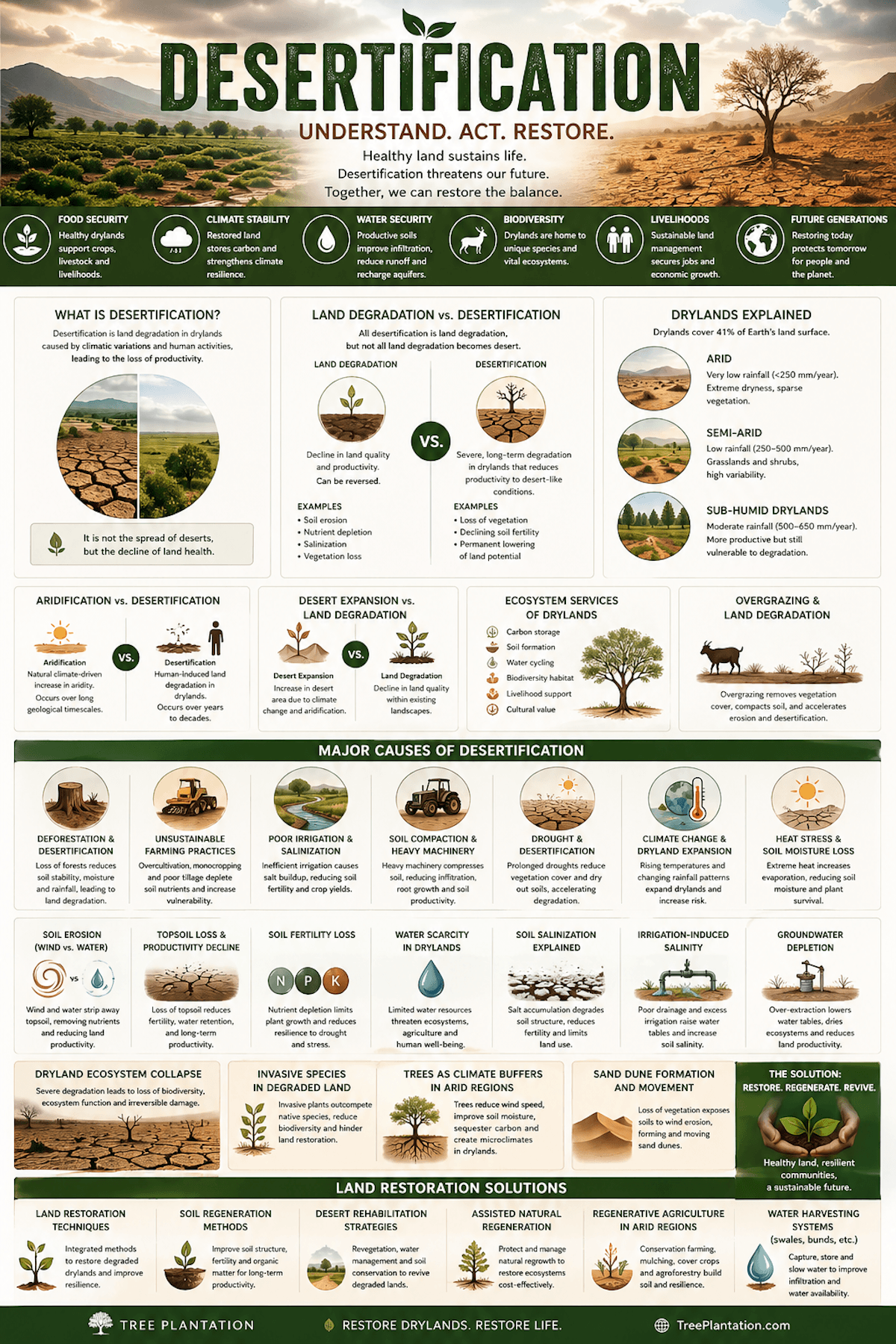
Feel free to share this desertification infographic on your website or blog. Please include a link back to this page as the source.

Topsoil degradation is one of the earliest and most critical stages of desertification. As vegetation cover is removed and soil structure weakens, the land begins to lose its ability to retain moisture, support plant growth, and sustain ecological balance. This process is often gradual at first, but once key thresholds are crossed, soil degradation can accelerate rapidly—transforming productive land into dry, unproductive, and increasingly desert-like conditions.
The loss of organic matter and soil structure plays a central role in this transition. Healthy topsoil contains nutrients, microorganisms, and carbon that help retain water and support plant life. When land is overworked, overgrazed, deforested, or exposed to extreme heat and poor water management, this organic layer begins to break down. As a result, soil becomes compacted, less fertile, and more vulnerable to erosion from wind and water.
Moisture loss and rainfall disruption further accelerate desertification. Without vegetation to provide shade, root stability, and water retention, rainfall is less effectively absorbed into the ground. Instead, it runs off quickly, carrying away valuable topsoil. Over time, this reduces groundwater recharge, increases drought stress, and contributes to long-term declines in land productivity.
The progression from healthy soil to degraded land is closely linked to broader environmental pressures, including deforestation, unsustainable farming practices, and climate change. As topsoil is lost, ecosystems weaken, biodiversity declines, and land becomes increasingly difficult to restore. However, with the right interventions—such as regenerative agriculture, reforestation, and soil restoration—this process can be slowed, halted, and even reversed.

As the number of planted trees increases over time, desert encroachment can begin to decline in a proportional and visible way. Trees stabilize loose soil, slow wind movement, increase shade, improve water infiltration, and help rebuild organic matter. In the early years, the change may be gradual, but as root systems expand and canopy cover increases, the land becomes more resistant to erosion, heat stress, and moisture loss.
Desert encroachment often advances when soil is exposed, vegetation is sparse, and wind removes valuable topsoil faster than the land can recover. Strategic tree planting reverses this process by creating living anchors in the landscape. Fast-growing species such as hybrid poplar and moisture-tolerant trees such as willow trees can help establish early structure, shade, and root stability in restoration zones where conditions allow.
As tree density increases, the surrounding microclimate begins to improve. Ground-level temperatures moderate, evaporation slows, rainfall is more likely to soak into the soil, and organic material from leaves, roots, and plant residues begins to rebuild degraded topsoil. This creates a positive feedback loop: better soil supports more vegetation, more vegetation protects more soil, and desert pressure begins to retreat.
Tree planting is most effective when it is organized into protective systems rather than scattered randomly across exposed land. Strategic windbreaks reduce wind speed, protect young trees, limit topsoil loss, and create sheltered recovery zones. A simple windbreak calculator can help estimate tree rows, spacing, protected distance, and layout options for restoration planning.
Windbreaks act as the first line of defense against desert expansion. Once wind pressure is reduced, grasses, shrubs, and young trees have a much better chance of survival. Deep-rooted grasses such as switchgrass biomass can also support restoration by covering exposed soil, slowing erosion, adding organic matter, and helping bridge the gap while trees mature.
When tree planting, windbreak design, and ground-cover species work together, restoration success improves dramatically. The land begins moving from exposed and vulnerable toward shaded, protected, and biologically active. Over time, desert encroachment declines as planted trees increase, wind erosion decreases, soil moisture improves, and vegetation spreads across the restored landscape.

Deforestation is a complex, global issue with far-reaching impacts on biodiversity, climate, and human well-being. From habitat loss and species extinction to the disruption of climate regulation and ecosystem services, the consequences are profound and alarming.
Addressing deforestation requires coordinated efforts at local, national, and international levels. This includes strengthening forest governance, supporting Indigenous rights, promoting sustainable land-use practices, and reducing global demand for commodities that drive deforestation.
It also involves raising awareness about the value of forests and the services they provide, fostering a deeper appreciation for nature among the public, and investing in reforestation, restoration, and climate-smart plantations that bring degraded land back into productive use without sacrificing remaining natural forests.
Copyright © All rights reserved Tree Plantation