


 INVEST
 PLANT
PLANT
 SOFTWOODS
 HARDWOODS
 CALCULATORS
 RESOURCES
 PROGRAMS

Softwoods
Learn More
🌸 Did you know? The “flowers” on dogwood trees aren’t actually flowers at all—they’re colorful bracts that surround tiny, true blossoms at the center. These showy bracts not only create the iconic spring display, but also help attract pollinators, making dogwoods both beautiful and ecologically important in your landscape.
The blossoming of dogwood trees is a spring spectacle that captivates gardeners, homeowners, and nature lovers alike. When dogwood trees wake up from winter, their branches become covered in clouds of white, pink, or occasionally red bracts that look like petals. These colorful bracts surround the tree’s tiny, true flowers at the center and create an enchanting display in yards, woodlands, and city parks.
Flowering dogwood (Cornus florida) is the classic eastern North American species, famous for its broad white or soft pink bracts. The Kousa dogwood (Cornus kousa), originally from Asia, carries star-shaped blooms that appear slightly later in spring, extending the dogwood season for several weeks. In the evening, dogwood blooms can seem to glow in low light, giving patios and garden paths a soft, almost lantern-like shimmer that feels both peaceful and magical.
Beyond their beauty, dogwood blossoms carry cultural symbolism around the world, often tied to purity, resilience, and rebirth. Artists, poets, and photographers return to dogwoods year after year as a favorite subject. In a home landscape, a dogwood tree becomes more than just another ornamental tree – it becomes a seasonal landmark and a living reminder of the changing year.
Whether you are designing a new landscape or adding one special specimen tree, dogwoods offer a rare combination of spring flowers, summer shade, brilliant fall color, and winter structure. They are truly one of nature’s masterpieces in tree form.
Feel free to share this dogwood infographic on your website or blog. Please include a link back to this page as the source.
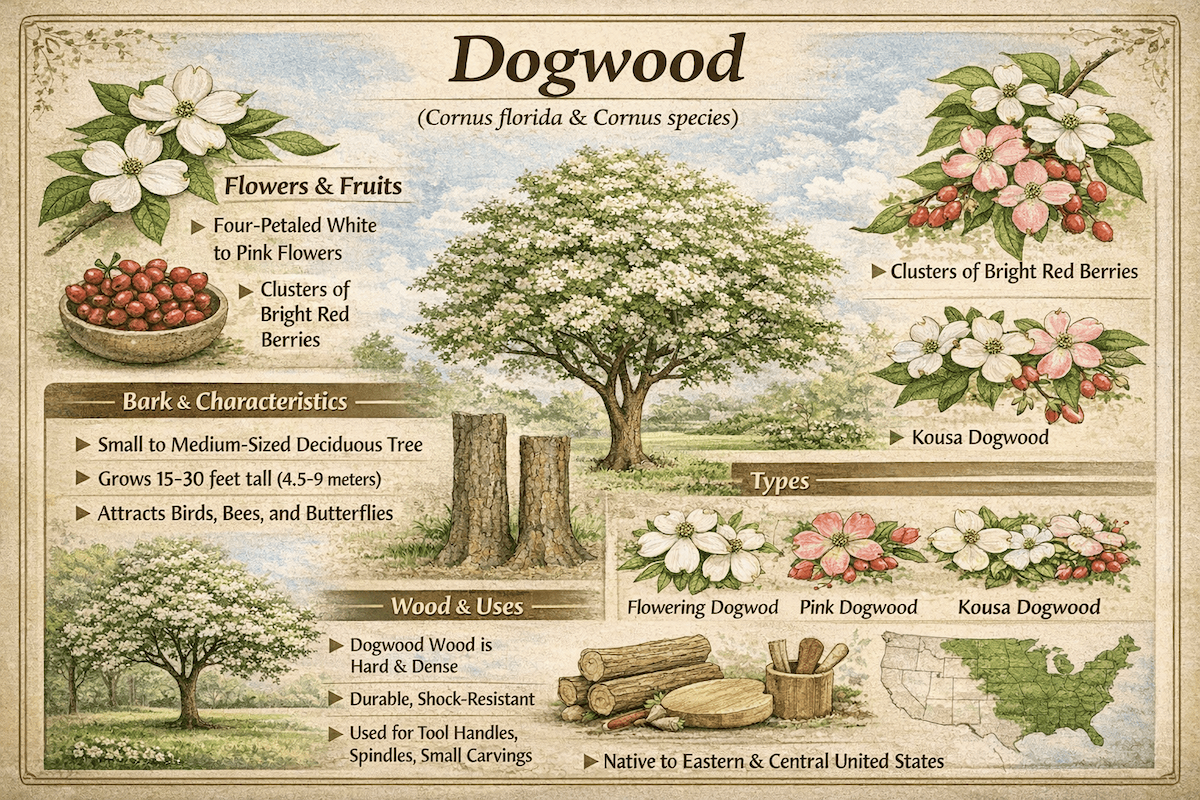

The dogwood family includes a surprising number of species and cultivars, each with its own character and preferred growing conditions. This makes dogwood trees highly adaptable—there is usually a dogwood suited to nearly every climate zone, from cool northern woodlands to mild coastal gardens.
The best-known species is the Flowering dogwood (Cornus florida), a North American native beloved for its four large white bracts that appear in early to mid-spring. Many cultivars offer soft pink or deeper rose tones. Flowering dogwood is ideal as an understory tree beneath taller canopy species like oak trees or maples, just as it grows in its native woodland habitat.
The Kousa dogwood (Cornus kousa), also known as Japanese or Chinese dogwood, blooms about two to three weeks later than flowering dogwood. Its pointed, star-shaped bracts give the tree a shimmering, layered look when in full bloom. Kousa dogwood is prized for its greater disease resistance and its striking raspberry-like fruits that appear in late summer and early fall.
Other notable species include:
With choices ranging from compact, multi-stem shrubs to upright shade trees, there is a dogwood variety for nearly every landscape design, from cottage gardens to modern front yards.
When people talk about “a dogwood tree” in the eastern United States, they usually mean the common flowering dogwood (Cornus florida). It has earned its place as a landscape staple because of its perfect size, four-season interest, and compatibility with a wide range of companion trees and shrubs.
Mature flowering dogwoods typically reach 20–30 feet tall with a similar spread, making them ideal for smaller suburban yards, as street trees, or as an understory layer beneath taller shade trees like birch trees. In spring, branches are covered with white or pink bracts. In summer, the medium green leaves create a soft, cooling canopy over patios, benches, or garden paths.
In autumn, flowering dogwoods put on a second show as their foliage turns rich shades of scarlet, burgundy, and purple. Clusters of bright red berries (drupes) ripen at the same time, attracting songbirds such as cardinals, robins, and bluebirds. Even in winter, the dogwood’s textured bark and tiered branch structure stand out against snow or evergreen backgrounds.
Because of its modest size and shallow root system, flowering dogwood is a good candidate for planting near decks, patios, or entryways where larger trees might be overpowering or disruptive to foundations. It is also a natural choice for woodland gardens, where it can be combined with spring bulbs, shade perennials, and other understory trees.
Ornamental dogwood trees are chosen primarily for beauty: showy flowers, attractive foliage, colorful fruit, and interesting bark. They fit perfectly into mixed borders, foundation plantings, and specimen tree locations where they can be seen up close and appreciated in all seasons.
Among ornamental dogwoods, the Flowering dogwood and Kousa dogwood are the stars. Flowering dogwood creates a soft, classic look with rounded bracts and a spreading crown, while Kousa brings a slightly more upright form, pointed bracts, and mottled, exfoliating bark that looks especially attractive in winter.
Landscape designers often combine dogwoods with other spring bloomers such as redbuds, flowering cherries, or magnolias to create multi-layered spring displays. In mixed borders, dogwoods pair well with rhododendrons, azaleas, and shade perennials that appreciate similar soil and moisture conditions.
Thanks to their four-season display, ornamental dogwood trees can anchor the design of a front yard or backyard seating area. When placed where they can be viewed from indoor windows, they bring the changing seasons right to your living room or kitchen table.

Spring is when dogwood trees earn their reputation. Before many other trees leaf out fully, dogwoods are already opening their bracts, which can last two to four weeks depending on weather. Cool nights and mild days help the display last longer; very hot, windy conditions can shorten the show.
The flowering dogwood covers its branches with broad, overlapping bracts that look like large single flowers from a distance. The Kousa dogwood follows with slightly smaller, pointed bracts that give the tree a starry appearance. Some cultivars bring soft blush pink tones, while others are snowy white.
Dogwood bracts do more than decorate the tree—they help attract pollinators to the tiny greenish true flowers at the center. Bees and other insects visit to collect nectar and pollen, and in the process they pollinate the flowers, which later develop into the recognizable red fruits. When you admire a dogwood in bloom, you are also witnessing a vital step in the tree’s life cycle.
White dogwoods, especially classic flowering dogwood, create a calm, elegant effect in both formal and informal gardens. Their bright bracts stand out beautifully against dark evergreens, stone walls, or shaded woodland backgrounds, and they are ideal for “moon gardens” where white flowers reflect evening light.
Pink dogwood trees provide a richer splash of color. Cultivars of Cornus florida and Cornus kousa range from soft shell pink to deeper rose. These trees make excellent focal points in front yards or near entryways because their blossoms instantly draw the eye. Pink dogwoods combine well with white flowering shrubs and spring bulbs like tulips and daffodils.
“Red dogwoods” usually refer to varieties with red or reddish-pink bracts or to shrubby species like red twig dogwood (Cornus sericea) that show off vivid red stems in winter. Shrubby red twig dogwoods are often used in mass plantings and rain gardens where their bright winter color and wildlife-friendly berries can shine.
When choosing a color, consider your home’s exterior, nearby plants, and how you want your yard to feel. White suggests simplicity and calm, pink feels romantic and playful, and red twigs add drama in winter landscapes.

While flowering dogwood and Kousa dogwood get most of the attention, many lesser-known species can bring diversity and extended bloom times to a garden. They are especially valuable for collectors and gardeners who want something a bit different from what every neighbor has in their yard.
The Pacific dogwood (Cornus nuttallii) is one of the tallest dogwoods, often reaching 40–60 feet in its native range along the western coast of North America. Its large, white bracts make it a dramatic specimen in larger landscapes.
The Cornelian cherry dogwood (Cornus mas) behaves more like a multi-stem shrub or small tree. Yellow flowers appear in very early spring—sometimes while snow is still on the ground—followed by red, cherry-like fruits that can be used in jellies or left for birds.
The Pagoda dogwood (Cornus alternifolia) is easily recognized by its horizontal, layered branches and slightly bluish green foliage. Clusters of white flowers give way to blue-black berries loved by wildlife. Its distinctive form makes it excellent for Japanese-inspired gardens or as a structural specimen near patios.
Other interesting types include:
Exploring these lesser-known dogwood trees allows you to extend bloom periods, support wildlife in new ways, and add unique shapes and textures to your yard or woodland edge.

Successful dogwood planting begins with choosing the right site. In nature, many dogwoods grow as understory trees beneath taller hardwoods, so they appreciate partial shade and protection from harsh afternoon sun, especially in hotter climates. In cooler regions, dogwoods can be grown in full sun as long as they receive consistent moisture.
Dogwoods prefer well-drained, slightly acidic soil enriched with organic matter. Before planting, loosen the soil in a wide area and mix in compost or leaf mold. Dig a planting hole two to three times wider than the rootball but no deeper than the rootball’s height. Position the tree so the top of the rootball is level with or just slightly above the surrounding soil.
Backfill with the native soil–compost mix, firming gently to remove air pockets, and water thoroughly. Apply a 2–3 inch layer of mulch around (but not touching) the trunk to keep roots cool and moist. Leave enough space between dogwoods and other trees so their mature canopies will not crowd each other—typically 15–25 feet apart, depending on the species.
Newly planted dogwoods need consistent moisture during their first two to three growing seasons. Water deeply once or twice a week in dry weather rather than giving frequent, shallow sprinkles. Once established, dogwoods are moderately drought tolerant, but extended dry periods can still stress them.
In early spring, you can apply a light dose of balanced, slow-release fertilizer formulated for trees and shrubs, or simply top-dress with compost beneath the mulch. Avoid heavy fertilization, which can promote weak, overly lush growth at the expense of flowers.
Dogwoods normally require very little pruning. Remove dead, damaged, or crossing branches in late fall or winter while the tree is dormant. Thin out dense interior growth slightly to improve air circulation if needed, but avoid aggressive cuts. Always use clean, sharp tools and avoid pruning during wet weather to reduce the risk of disease.
Dogwood trees rely on insects—especially pollinating bees—to set fruit and produce viable seed. When dogwood bracts are at their peak, bees are busy visiting the tiny flowers at the center, collecting nectar and pollen. As they move from bloom to bloom, they carry pollen with them, making cross-pollination possible.
Bees, in turn, benefit from the nectar and pollen that dogwoods provide early in the growing season, when other food sources may still be scarce. If you want to support bee populations in your yard, consider pairing dogwoods with other bee-friendly plants and wildflowers. To learn more about the role of bees, see how many bees it takes to pollinate common crops and how to grow flowers that keep pollinators fed all season.
From the first white or pink bracts of spring to the glowing red foliage and berries of autumn, dogwood trees deliver beauty in every season. They provide shelter and food for birds and pollinators, cool shade for humans, and a constant reminder of nature’s ability to combine function with artistry.
Whether you choose a classic flowering dogwood, a disease-resistant Kousa dogwood, or a more unusual species like pagoda or Cornelian cherry dogwood, adding a dogwood to your landscape is an investment in long-term beauty and ecological value. Dogwood trees truly are masterpieces of living design—and with thoughtful planting and care, they will reward you and your local wildlife for decades.
Dogwood trees grow best in locations with morning sun and afternoon shade, or bright dappled light beneath taller trees. They prefer well-drained, slightly acidic soil that’s rich in organic matter (leaf mold or compost) and consistently moist but not soggy. Mulch 2–3 inches deep around the dripline to keep roots cool and reduce drought stress, but keep mulch a few inches away from the trunk to prevent rot.
Flowering dogwood (Cornus florida) is native to eastern North America and blooms earlier in spring with broad white or pink bracts held close to the branches. It usually prefers partial shade and can be more prone to diseases like dogwood anthracnose in stressful sites. Kousa dogwood (Cornus kousa) blooms a few weeks later with pointed, star-shaped bracts and tends to have better overall disease resistance, including anthracnose tolerance. Kousa dogwoods also develop showy, strawberry-like fruits in late summer and early fall.
Light pruning is best done right after flowering or in late winter while the tree is dormant. Start by removing dead, damaged, crossing, or rubbing branches. Avoid heavy summer pruning, which can stress the tree, invite sunscald on previously shaded bark, and reduce the number of blooms for the following year. Dogwoods naturally have an attractive form, so minimal pruning is usually all that’s needed.
Young dogwood trees need steady moisture during their first two to three growing seasons. Aim for about 1 inch of water per week from rain or irrigation, applied deeply at the root zone rather than with frequent, shallow sprinklings. Use a balanced, slow-release fertilizer in early spring only if growth is weak or leaves are pale; over-fertilizing can push soft growth and increase disease susceptibility. A yearly top-dressing of compost under the mulch often provides all the nutrients a healthy dogwood needs.
Common dogwood problems include dogwood anthracnose, powdery mildew, leaf spot, and cankers. Prevention starts with choosing disease-tolerant cultivars and planting in sites with morning sun and good air circulation. Water at the base of the tree instead of overhead, avoid wetting foliage in the evening, and clean up fallen leaves each autumn. Promptly remove dead or infected branches, and in severe cases, consult a certified arborist about using registered fungicides as part of a broader management plan.
Yes. Dogwoods are excellent wildlife trees. The spring bracts and true flowers provide nectar and pollen for bees and other pollinators. Summer foliage hosts caterpillars and other insects that are essential food for songbirds. In fall and early winter, clusters of red fruits feed a variety of birds and small mammals, while the layered branching structure offers nesting sites and cover year round. Planting dogwoods is a simple way to add both beauty and biodiversity to your landscape.
Copyright © All rights reserved Tree Plantation