


 INVEST
 PLANT
PLANT
 SOFTWOODS
 HARDWOODS
 CALCULATORS
 RESOURCES
 PROGRAMS

Softwoods
Learn More
BIRCH • BARK • NORTHERN HARDWOODS
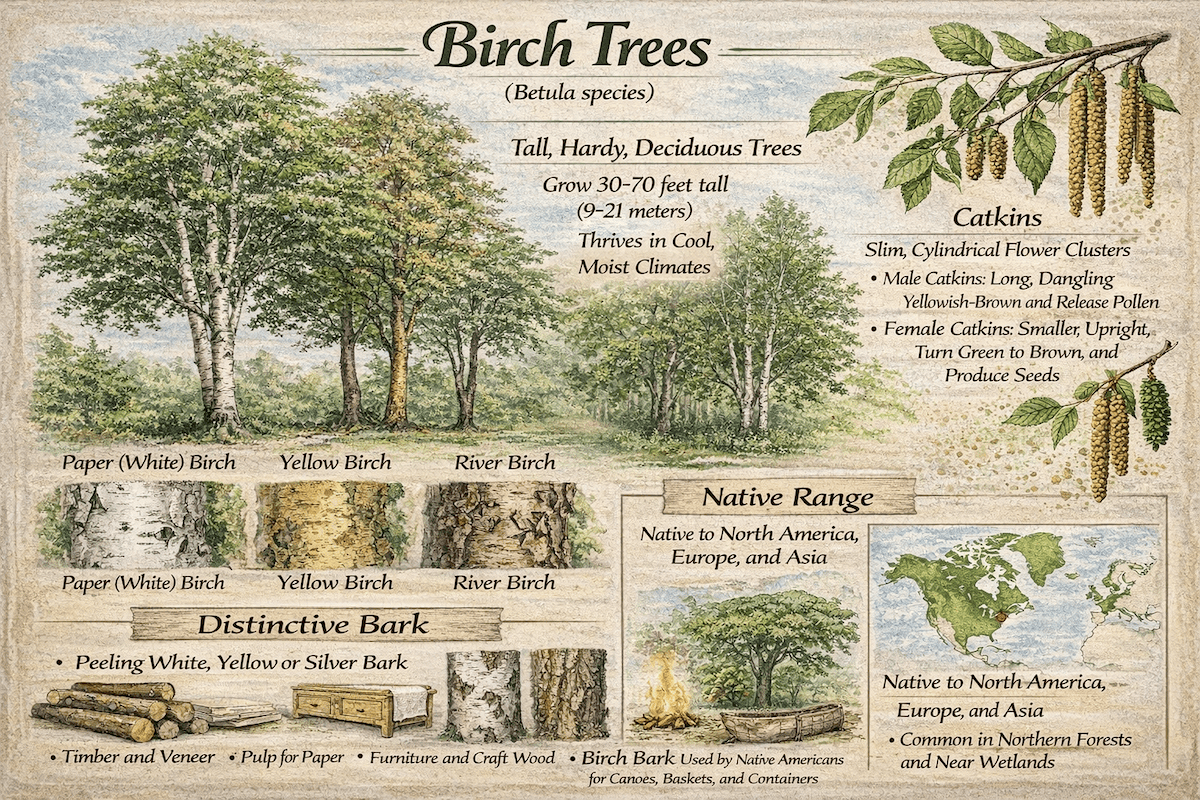
Wondering what birch trees are? Birch trees (Betula species) are fast-growing hardwoods known for their distinctive peeling bark, ecological value, and wide range of commercial uses.
🌳 Quick answer: Birch trees are deciduous hardwoods that thrive in cool, moist climates and are valued for timber, veneer, syrup production, reforestation, wildlife habitat, and ornamental planting.
Key identifier: Many birch trees are recognized by their papery bark, fine twigs, and catkins, especially in cooler northern climates.
Examples: Common birch species include paper birch, yellow birch, river birch, and silver birch, each with distinctive bark, habitat preferences, and wood uses.
Birch trees (Betula species) are among the most recognizable hardwoods in the world, admired for their bright peeling bark, graceful form, and practical uses. From paper birch with its iconic white bark to yellow birch prized for fine furniture and flooring, birches combine ornamental appeal, wildlife value, and commercial usefulness.
These hardy deciduous trees thrive in cool, moist climates and are native across much of North America, Europe, and Asia. Birch trees help stabilize soils, support birds and wildlife, contribute to forest biodiversity, and provide products ranging from veneer and pulp to birch syrup and traditional bark crafts.
On this page you’ll learn about common birch species, how to identify them by bark and habitat, where they grow best, and why birch remains important for landscapes, forestry, restoration, and wood products.
Birch trees are more than just a source of high-quality timber—they also play an important role in forest ecosystems, soil improvement, wildlife support, and carbon capture. From yellow birch sawlogs to paper birch syrup, birch trees are valuable in both working forests and conservation projects.
Birch trees offer a rare combination of commercial value, wildlife benefits, and land restoration potential. Their contribution to timber production, soil health, wildlife habitat, and carbon sequestration makes birch a key species in sustainable forestry, rewilding projects, and mixed-species tree plantations.
Feel free to share this birch trees infographic on your website or blog. Please include a link back to this page as the source.
Yellow birch (Betula alleghaniensis) is widely considered the most valuable birch species and one of the premier native hardwoods of eastern North America. Found across eastern Canada and the northeastern United States, this species produces a dense, fine-grained wood that rivals maple and cherry in both strength and appearance.
Unlike lighter birch species, yellow birch is a true high-density hardwood, offering excellent durability, dimensional stability, and a smooth, attractive grain. These qualities make it highly sought after for fine furniture, cabinetry, flooring, veneer, and architectural millwork. Its warm golden tone and uniform texture allow it to be finished to resemble more expensive hardwoods, increasing its commercial appeal.
However, yellow birch is becoming increasingly scarce. Overharvesting, slow growth rates, and limited regeneration in natural forests have reduced the availability of large, high-quality trees. Today, premium logs command strong market prices, and there is growing interest in sustainable hardwood management and plantation-based production to meet future demand.
Paper birch (Betula papyrifera), also known as white birch, is one of the most recognizable trees in northern landscapes. Its brilliant white, peeling bark creates striking visual contrast in forests and residential settings, making it one of the most popular landscape trees in cool climates.
While paper birch does not typically produce high-value sawlogs, it plays an important role in pulpwood, biomass, and ecological restoration systems. It is often used in paper production, wood pellets, and renewable bioenergy, particularly in regions where fast-growing, adaptable species are needed to support sustainable forestry.
As a pioneer species, paper birch quickly colonizes disturbed areas, improving soil health and supporting biodiversity. It provides habitat and food for wildlife, making it valuable not just commercially, but also environmentally in reforestation and land recovery projects.
Often referred to as “gold in the forest,” yellow birch is a cornerstone species in the hardwood forests of Quebec and the northeastern United States. It thrives in cool, moist climates and is commonly found growing alongside species like white pine, maple, and beech.
The tree is easily identified by its distinctive golden-bronze bark, which peels in thin, curly strips, giving mature trees a textured, shimmering appearance. Despite its beauty and value, yellow birch grows slowly, especially in northern climates with long winters and short growing seasons.
High-quality yellow birch lumber is now priced competitively with, and sometimes above, certain imported hardwoods such as tropical hardwood species. This shift reflects both increasing demand and the limited supply of large-diameter, old-growth trees.
As a result, there is growing momentum around regenerative forestry, selective harvesting, and advanced plantation systems to preserve this species while unlocking its long-term economic potential. For landowners and investors, yellow birch represents a compelling opportunity at the intersection of timber value, sustainability, and forest restoration.
Paper birch (Betula papyrifera) and yellow birch (Betula alleghaniensis) are two of the best-known birch species in North America, but they serve different purposes in forestry, landscaping, and commercial use. While both are valuable trees, paper birch is best known for its bright white bark, ornamental appeal, and role in pulpwood, biomass, and birch syrup production. Yellow birch, by contrast, is a slower-growing but more valuable hardwood prized for premium lumber, furniture, flooring, and veneer.
In terms of appearance, paper birch is easy to recognize by its brilliant white, peeling bark, which makes it one of the most iconic trees of northern forests and residential landscapes. Yellow birch has a darker, golden-bronze bark that peels in fine curly strips, giving mature trees a more rugged and textured appearance.
Their growth habits also differ. Paper birch grows faster and is commonly used in shorter-rotation systems for pulp, pellets, and land restoration. It is a classic pioneer species, meaning it quickly colonizes disturbed ground and helps begin the process of forest recovery. Yellow birch grows more slowly, but produces denser, stronger, and more valuable wood, making it the preferred birch for high-end wood products and long-term timber investment.
From a site perspective, both species prefer cool climates and moist, well-drained soils, but paper birch is generally more adaptable to disturbed or open sites, while yellow birch performs best in mature forest conditions or carefully managed mixed-species plantations. For landowners, the choice often comes down to goals: paper birch for speed, restoration, and biomass; yellow birch for premium wood value and long-term returns.
| Feature | Paper Birch | Yellow Birch |
|---|---|---|
| Scientific name | Betula papyrifera | Betula alleghaniensis |
| Bark color | Bright white, peeling bark | Golden-bronze, curly peeling bark |
| Growth rate | Faster | Slower |
| Main value | Landscape use, biomass, pulp, syrup | Premium hardwood lumber, veneer, flooring |
| Best use | Restoration, short-rotation forestry, ornamental planting | Long-term timber value, fine woodworking, managed forests |
| Typical growing role | Pioneer species | Late-successional / mature forest associate |
| Commercial importance | Moderate, broad utility | High, premium wood markets |

Yellow birch (Betula alleghaniensis) is native to eastern Canada and the northeastern United States, where it is a dominant hardwood species in cool, moist forest ecosystems. Its highest natural concentration occurs in Quebec, Ontario, and the northern Appalachian region, where long winters and moderate summer temperatures create ideal growing conditions.
In terms of climate zones, yellow birch performs best in USDA Zones 3 through 7. It thrives in regions with cool summers, consistent rainfall, and high humidity, and it is particularly well adapted to northern hardwood forests, upland slopes, and moist valley soils.
Although its natural range is concentrated in Eastern North America, yellow birch can also be successfully grown in select western microclimates. Suitable areas include the coastal and inland mountain regions of British Columbia and Washington State, where maritime influence moderates temperatures and provides adequate moisture. However, site selection is critical—yellow birch does not tolerate prolonged heat or drought stress.
For optimal growth, yellow birch requires:
In plantation or managed forest settings, yellow birch is often integrated with species such as maple, beech, and white pine, where it benefits from mixed-species competition and improved soil structure. When properly sited, it can become a long-lived, high-value component of sustainable hardwood forestry systems.

Yellow birch wood is one of North America’s most versatile and valuable hardwoods, prized for its strength, durability, and refined appearance. It is a heavy, close-grained wood with a smooth, even texture that machines well and finishes beautifully. The wood displays a natural color range from creamy white sapwood to warm reddish-brown heartwood, giving it broad design flexibility across both traditional and modern interiors.
Thanks to its strength and stability, yellow birch is widely used in furniture manufacturing, cabinetry, hardwood flooring, interior doors, stair components, and architectural millwork. It is also a preferred material for veneer, where its consistent grain and attractive figure create high-end finishes, as well as tool handles, boxes, and specialty wooden products that require both durability and precision shaping.
One of yellow birch’s greatest advantages is its ability to accept stains and finishes exceptionally well. It can be polished to a smooth, high-quality surface and is often used as a cost-effective alternative to premium hardwoods such as teak and other imported species. This makes it especially valuable in large-scale interior applications where appearance and performance must be balanced with cost.
In addition to its modern uses, yellow birch has a long industrial history. It has been used in the production of charcoal, pulp, and wood-derived chemicals, including wood alcohol, tar, oils, and acetate of lime. Today, it continues to play an important role in both traditional woodworking and contemporary sustainable material systems.
With increasing demand for high-quality domestic hardwoods, yellow birch is gaining renewed attention as a sustainable, high-performance alternative to imported tropical woods—offering a compelling combination of beauty, strength, and long-term value.

The following comments were collected from a national wood products discussion forum using yellow birch hardwood primarily in the United States.
Yellow birch hardwood flooring is a happy medium between the hardness of hard maple and the stability of red oak. It has a close, maple-like grain pattern, is slightly softer than hard maple, and offers more of a golden color spectrum. Yet it approaches the stability of red oak. So, if you’re looking for a natural floor species similar to maple, with workability comparable to red oak, yellow birch is an excellent candidate. The golden tones of this species are perfect for bringing brightness and warmth to a space.
“We sell a lot of birch hardwood at our flooring business here in New York State. It’s quite popular because of its durability and unique color variations. Most of our planking is the standard 3- and 4-inch widths in 6- and 7-foot lengths. We often get requests for wider planks, and I wish we could offer them because we could charge two to three times the price for 10- and 12-inch boards—but we just can’t get them. Year after year, we see the availability of wider planking sizes get smaller and smaller while prices for birch wood continue to rise.”
“My family has been farming for more than 200 years in a small town near the Quebec border. All the farms around us have small woodlots for firewood and timber. We cut timber from our 50 acres every five years to supplement our farm income. This year, I wish we had more birch; demand for birch wood has skyrocketed since the province of Quebec laid off most of its forest workers due to the low number of harvestable trees.”
“A friend of mine suggested I consider tapping my birch trees for syrup just like they do for maple syrup. It turns out you can make more money from birch syrup than maple—apparently it’s a delicacy. Syrup from birch trees—who knew!”
“My wife and I are considering starting a tree plantation on our property here in Ohio. Others in the area have done something similar, planting Christmas trees, pines, and poplars. We were thinking of planting hardwoods because they’re worth more and there don’t seem to be many hardwood tree plantations around. After a little research, we found out that we could make quite a lot of money planting birch trees mainly because of the current shortage and high commercial value. We think we’d be ahead of the curve with this because we can’t seem to find nurseries that sell yellow birch; we would have to contract them to grow seedlings for us.”
Paper birch trees are often referred to as “Canada’s tree” because of their natural range across nearly the entire country. Paper birch can be found in every province and territory and also grows in some northern regions of the United States, particularly around the Great Lakes and northern New England.

Paper birch (Betula papyrifera) thrives in cold northern climates and is best suited to regions with cool summers, cold winters, and reliable soil moisture. In North America, its natural range extends across much of Canada, Alaska, and the northern United States, especially throughout the Great Lakes region, New England, the northern Rockies, and upper Midwest.
In terms of climate adaptability, paper birch generally performs best in USDA Zones 2 through 6, with the strongest performance in areas that avoid prolonged summer heat. Although it is highly cold hardy, paper birch can struggle in hot, humid southern climates where heat stress, drought, and insect pressure reduce vigor and lifespan.
This species grows best in well-drained, slightly acidic soils rich in organic matter. It prefers sites with consistent moisture but does not perform well in waterlogged conditions. In the wild, paper birch often appears on disturbed ground, burned areas, forest edges, and recently opened sites, where it acts as a classic pioneer species by quickly colonizing land and helping initiate forest recovery.
Because of its adaptability and rapid early growth, paper birch is valuable for reforestation, habitat restoration, and landscape planting in cooler climates. It is especially useful in mixed plantings with other northern species, where its bright white bark, light canopy, and ecological role add both visual appeal and forest diversity.
For the best long-term results, plant paper birch in locations that provide:
When matched to the right site, paper birch is one of the most rewarding northern trees for ornamental landscapes, naturalized plantings, and early-successional forest systems.

Paper birch (Betula papyrifera)—often called “canoe birch”—is one of the most iconic and culturally significant trees in North America. Known for its brilliant white, peeling bark and adaptability to harsh northern climates, paper birch has served as both a practical resource and a symbol of resilience for centuries.
Indigenous peoples skillfully used birch bark to construct lightweight, watertight canoes that could navigate vast networks of rivers and lakes. These canoes were so efficient and durable that early explorers and fur traders quickly adopted them, replacing heavier wooden boats and transforming transportation across North America’s wilderness.
Birch bark was one of the most important natural materials used by Indigenous cultures across northern North America. Its unique properties—lightweight, waterproof, and easy to shape—made it ideal not only for canoes, but also for shelters, containers, baskets, and even writing surfaces.
The widespread adoption of birch bark canoes by fur traders and early settlers helped shape trade routes, exploration patterns, and economic development across Canada and the northern United States. Today, paper birch remains a powerful symbol of innovation, sustainability, and connection to the land.
Paper birch is a classic pioneer species, meaning it is one of the first trees to establish on disturbed or burned land. It helps stabilize soils, reduce erosion, and create conditions that allow other tree species to follow.
As leaves decompose, they enrich the soil with organic matter, improving long-term forest health. In addition, paper birch forests contribute to carbon sequestration, helping capture and store atmospheric carbon dioxide while supporting biodiversity and ecosystem recovery.
As demand grows for sustainable, renewable materials, paper birch is gaining renewed attention in modern forestry systems. Its rapid early growth, adaptability, and multi-use potential make it ideal for reforestation, biomass production, habitat restoration, and climate-smart forestry initiatives.
From ancient canoe construction to contemporary applications in wood products and environmental restoration, paper birch remains one of the most versatile and enduring trees in northern ecosystems—a true bridge between tradition and innovation.

Paper birch (Betula papyrifera) is one of the most recognizable and economically useful trees of Canada and the northern United States. Known for its bright white, peeling bark, fast early growth, and adaptability to cold climates, paper birch has long been valued for both practical wood products and emerging specialty markets.
Its wood is used in a wide range of everyday and industrial applications, including toothpicks, tongue depressors, veneer cores, pulp, biomass chips, wood pellets, and firewood. Paper birch is also widely used in the manufacture of Class 2 veneer, which is commonly applied in plywood construction, furniture components, packaging materials, and flooring underlay systems such as linoleum backers.
While paper birch does not usually command the premium lumber prices of yellow birch, it remains highly important because of its rapid establishment, broad utility, and value in regenerative forestry systems. It is especially attractive for northern landowners seeking a tree that can support biomass production, habitat restoration, erosion control, and specialty forest products from the same planting base.
One of the major advantages of paper birch is its faster growth rate compared to yellow birch, making it more suitable for shorter-rotation forestry. In favorable northern conditions, paper birch can often be managed on 20- to 30-year harvest cycles, particularly for pulpwood, bioenergy feedstock, and small-diameter wood products.
Tree farmers and forest managers often use staggered planting, selective thinning, and rotational harvest systems to create a more sustainable and continuous production model. This approach can generate periodic income while maintaining site productivity, improving wildlife cover, and supporting long-term soil recovery. In biomass-oriented systems, paper birch can serve as a productive component in birch wood biomass plantations, especially where demand exists for renewable energy feedstocks and local fiber supply.
Because paper birch is also a natural pioneer species, it performs well on disturbed land, burned areas, abandoned fields, and reclamation sites. This makes it especially valuable in projects that combine economic return with ecological restoration.
When most people think of tree syrup, they think first of maple. Yet birch syrup is an increasingly respected specialty product with strong culinary appeal and growing commercial interest. For tree farmers and specialty producers, birch syrup offers an opportunity to diversify income streams beyond timber, pulp, and biomass.
Birch syrup production remains a smaller and less developed industry than maple syrup, but that limited supply is part of what makes it attractive. As consumer interest grows in unique, natural, and regional food products, birch syrup stands out as a premium forest product with high-end market potential.
Paper birch offers something many tree species do not: multiple revenue possibilities from a single species. A well-managed stand can contribute to pulpwood, firewood, chips, pellets, veneer, wildlife habitat, and syrup production, depending on local conditions and management goals.
This versatility makes paper birch a compelling choice for growers interested in climate-smart forestry, diversified farm income, and northern land restoration. In mixed-species plantings, it can also function as a nurse tree, helping improve site conditions for other hardwoods and conifers over time.
As demand grows for renewable resources, regional wood supply, specialty food products, and sustainable land use, paper birch is regaining attention as more than just a beautiful northern tree. It is a species that bridges traditional forestry, ecological restoration, and modern bio-based markets.
From everyday manufactured wood products to premium syrup production, paper birch remains one of the most practical and culturally important trees of the North. For landowners, foresters, and growers, it represents a rare combination of beauty, usefulness, adaptability, and long-term opportunity.

Birch tree plantations are strategically managed systems designed to produce value from timber, biomass, syrup, ecological restoration, and carbon storage. When properly designed, they offer a powerful combination of economic return, environmental regeneration, and long-term land improvement.
Unlike unmanaged forests, modern birch plantations are built using precision spacing, species selection, and active management techniques that accelerate growth, improve wood quality, and create multiple revenue streams from a single acre of land.
With proper site selection, spacing, and management, birch plantations can serve as both a reliable income-producing asset and a regenerative land-use strategy.
To improve performance beyond traditional row planting, Tree Plantation has developed Crop Circle Tree Plantation systems. Instead of linear rows, trees are planted in circular and spiral patterns that optimize sunlight exposure, airflow, and root-zone efficiency.
These designs create more uniform growing conditions across the entire planting area, allowing for:
The result is faster growth, improved tree form, and shorter time to harvest. These systems are also ideal for multi-species agroforestry models, where diversity enhances both ecological stability and economic output.
Traditional birch plantations often rely on monoculture systems for simplicity, but this approach carries higher long-term risk. A more advanced strategy is to design multi-species plantations that combine trees with complementary growth rates, root structures, and market values.
High-performing companion species include:
For example, a well-balanced 10-acre plantation might include: 4,000 yellow birch, 4,000 sugar maple, and 4,000 white pine. This diversified structure:
One of the most effective ways to accelerate plantation success is to begin with advanced, well-developed seedlings. Tree Plantation specializes in producing tall, root-established birch trees that significantly outperform standard nursery stock.
Our seedlings typically average 8–10 feet in height, with strong root systems, minimal branching, and approximately 2-inch caliper at planting. This provides:
Integrating birch with maple and pine creates a balanced, high-performance plantation ecosystem. This approach aligns economic productivity with environmental stewardship by delivering:
For modern landowners, birch-based plantation systems represent more than just forestry—they are a scalable model for regenerative agriculture, climate-smart investment, and long-term land value creation.
Partner with us in a land management project to repurpose agricultural lands into appreciating tree assets. We have partnered with growingtogive.org , a 501(c)(3) nonprofit, to create tree-planting partnerships with land donors.
We have partnered with growingtogive.org , a Washington State nonprofit, to create a land and tree partnership program that repurposes agricultural land into appreciating tree assets.
The program utilizes privately owned land to plant trees that benefit both the landowner and the environment.
If you have 100 acres or more of flat, fallow farmland and would like to plant trees, we would like to talk to you. There are no costs to enter the program. You own the land; you own the trees we plant for free, and there are no restrictions—you can sell or transfer the land with the trees at any time.
Yellow birch (Betula alleghaniensis) is generally considered the most valuable commercially. Its strong, dense hardwood is prized for furniture, flooring, cabinetry, tool handles, and interior trim. High-grade, knot-free logs are often peeled into veneer for decorative panels and higher-end plywood products.
Yes. While they are no longer mass-produced, birch bark canoes are still crafted today by Indigenous artisans, traditional boat builders, and a small number of specialty makers. These canoes are valued both as functional watercraft and as works of cultural heritage and art, preserving knowledge that goes back centuries. You can sometimes find classes, museums, and small shops that showcase or commission new birch bark canoes.
Birch syrup is a niche, gourmet product, but it is becoming easier to find. Look for it at gourmet grocery stores, natural food shops, farmers’ markets, and online retailers that focus on regional or forest-based foods. Many small producers in northern regions sell birch syrup directly through their websites, often alongside maple syrup and other tree-derived products.
Copyright © All rights reserved Tree Plantation