


 INVEST
 PLANT
PLANT
 SOFTWOODS
 HARDWOODS
 CALCULATORS
 RESOURCES
 PROGRAMS

Softwoods
Learn More
Identify • Remove • Replace
Invasive trees are non-native species that spread aggressively, displace native plants, and change how land functions (light, water, soil chemistry, fire risk). This page helps you identify common offenders, understand impacts, and choose practical next steps—without guessing.
Some invasive tree species can spread thousands of seeds each year and may also reproduce through underground rhizomes or aggressive root systems. Once established, these trees can form dense monocultures that crowd out native plants, alter soil chemistry, and change fire behavior in entire landscapes. In many regions, early detection and responsible tree removal are essential to prevent long-term ecological damage.
Jump to: state-by-state guidance • control methods • what to plant instead • FAQs
Related planning hubs: Landscape trees • Black locust • Willow trees
Feel free to share this invasive tree species infographic on your website or blog. Please include a link back to this page as the source.
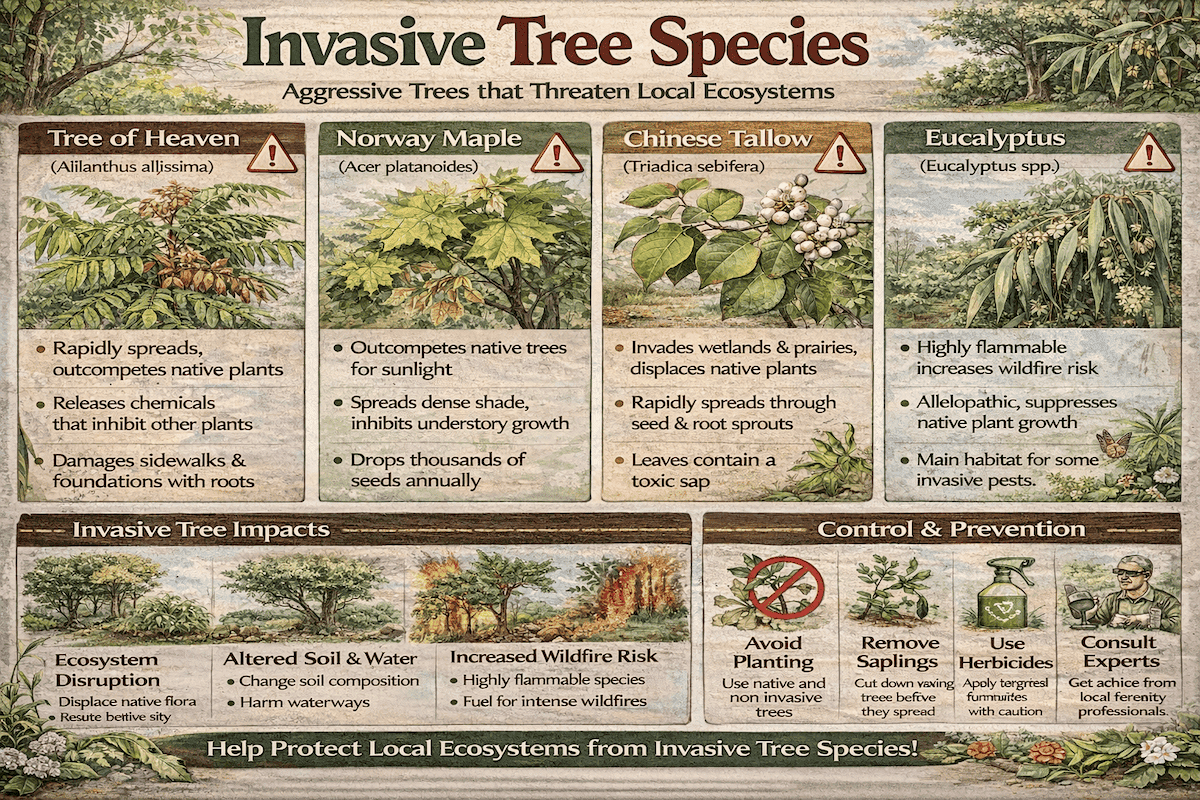
“Invasive” is state-specific: a tree that’s harmless in one region can be a serious problem in another. Use the quick selector below to jump to your state and get a simple, local-first checklist for finding the right official list (extension office, invasive species council, or department of agriculture).
If you’re unsure whether your tree is invasive, take clear photos of leaves, bark, fruit/seed, and growth habit—then ask your local extension office. For more information about invasive tree species in your state, click the link below.
Jump directly: AZ • CA • FL • TX • NY • WA (Full list below.)

These are general management strategies; always follow local regulations, site-specific recommendations, and product label directions for any herbicides or treatment methods used.
Non-native tree species can pose serious threats to biodiversity because they often adapt quickly to new environments and outcompete native vegetation for sunlight, water, nutrients, and space. Their aggressive spread can reduce the diversity and abundance of native plants, gradually changing the structure, composition, and ecological function of entire ecosystems, including sensitive habitats found in many American forests.
In many cases, invasive trees spread without the natural checks and balances that limit them in their native range. Without these predators, pests, or diseases, they may expand rapidly through rhizomes, seedlings, or vigorous root systems, forming dense stands that suppress native regeneration. Some species also introduce foreign pests and pathogens that local trees and shrubs are not equipped to resist, contributing to long-term ecological decline and, in extreme cases, local extinctions.
Non-native trees can also disrupt the complex relationships that native ecosystems depend on. They may interfere with pollination, alter wildlife movement patterns, reduce habitat quality, and even shift fire behavior by adding more flammable biomass or increasing ladder fuels. These ripple effects often extend well beyond the trees themselves, influencing birds, insects, mammals, soil organisms, and nearby plant communities.
Exotic tree species, another common term for non-native trees, represent a major global biodiversity challenge. When introduced into new landscapes, they can gradually homogenize local flora, replacing distinct native plant communities with fewer dominant species. This loss of ecological uniqueness weakens habitat diversity and can affect everything from wildlife populations to watershed function and climate resilience.
Exotic trees may also disrupt key ecosystem processes. Some species alter nutrient cycling by changing the amount and chemistry of leaf litter, shifting soil pH, or influencing decomposition rates. Others affect water availability by drawing heavily from the soil, changing groundwater conditions, or altering seasonal moisture patterns. These shifts can reduce ecosystem stability and make forests, grasslands, and wetlands less resilient to drought, storms, and wildfire.
The threat of exotic trees is not limited to natural areas. They can also impact farms, ranches, roadsides, parks, and urban landscapes by increasing management costs, interfering with infrastructure, and creating conditions that may eventually require aggressive control or tree removal. In many western states, invasive species management programs such as those described in the Colorado invasive tree species guide illustrate how quickly non-native trees can spread if left unmanaged.
Non-native tree species can have profound effects on local ecosystems, including one of the most visible: the alteration of natural and designed landscapes. Many invasive trees grow faster, spread more aggressively, and form denser canopies than native species, allowing them to dominate the visual character and ecological balance of a site.
Their impact below ground can be just as important. Some invasive trees change soil chemistry, lower soil moisture, or spread through extensive underground structures that make them difficult to control. Black locust, for example, is considered invasive in many grassland systems because of its aggressive growth habit and the compounds it releases into the surrounding soil environment. Invasive trees may also affect the water table, sometimes lowering it beyond the reach of nearby native plants.
Perhaps the most significant long-term impact of non-native tree species is their effect on biodiversity. By displacing native flora, changing habitat structure, and reducing ecological complexity, these trees can gradually destabilize ecosystems and diminish important environmental services such as carbon sequestration, water filtration, erosion control, and wildlife habitat protection.
The introduction of alien tree species has caused serious ecological damage in many parts of the world. One well-known example is the Australian paperbark tree (Melaleuca quinquenervia) in the Florida Everglades. Since its introduction, this species has spread across large areas, displacing native wetland vegetation and altering the hydrology of one of the world’s most important subtropical ecosystems.
Another example is the spread of Eastern red cedar (Juniperus virginiana) across the Great Plains. Although native to parts of eastern North America, it has expanded aggressively into prairie landscapes where it was historically limited. Originally planted for windbreaks and erosion control, it now reduces grassland habitat, crowds out native prairie species, and increases wildfire risk in many regions.
In coastal regions and Mediterranean climates, species such as eucalyptus trees have also demonstrated how fast-growing exotic trees can alter fire behavior, soil moisture, and wildlife habitat when introduced far outside their native range.

These case studies underscore the potential harm the introduction of non-native tree species can inflict on indigenous ecosystems. They highlight the importance of doing at least a little research before introducing a new tree to an area where it has never grown before.
After removing an invasive tree, the fastest way to prevent rebound is to replant. Choose species that match your site: moisture, sun, soil, and space. For yards and streetscapes, use vetted non-invasive choices from our Landscape Trees guide. For habitat and restoration, prioritize local native lists and mix canopy, understory, and groundcover layers.
Naturalized tree species—trees that have established self-sustaining populations outside their native range—are a growing global concern. While they may appear less aggressive than some well-known invasive species, their presence can still cause significant ecological change over time. Many naturalized trees gradually spread into surrounding landscapes, altering the structure of local ecosystems and placing long-term pressure on native plant communities found in ecosystems such as American forests.
As these trees expand their range, they can slowly alter soil chemistry, shade patterns, and moisture cycles in ways that reduce native biodiversity. In many cases, naturalized groves attract non-native insects, fungal pathogens, and plant diseases that further weaken local ecosystems. These subtle ecological shifts often occur gradually, making them difficult to detect until large areas have already been affected.
Once firmly established, naturalized trees can become extremely difficult to control. Many species reproduce rapidly through wind-dispersed seeds, underground shoots, or aggressive invasive tree root systems. As global trade and plant transport continue to expand, the accidental introduction of non-native plants, insects, and pathogens has accelerated, exposing native ecosystems to new environmental pressures almost daily.
Non-indigenous tree species can also disrupt ecosystems through hybridization. When non-native trees cross-pollinate with native species, they may produce hybrid offspring that alter the genetic integrity of local forests. These hybrids sometimes develop traits that allow them to grow faster, spread farther, or tolerate harsher conditions than either parent species.
Hybridization can therefore lead to a gradual loss of biodiversity. Some hybrid trees develop deeper or more aggressive root systems that outcompete nearby vegetation for nutrients and water. Over time, these changes can transform healthy forests into simplified ecosystems dominated by a few highly adaptable tree types.
In some situations, these hybrid trees become even more invasive than their non-native parents, spreading rapidly across landscapes and replacing native vegetation in forests, wetlands, and grasslands.
Pest tree species—often considered a subset of invasive trees—are particularly destructive because of their rapid growth, prolific seed production, and ability to colonize disturbed environments. Once established, these species can form dense monocultures that crowd out native plants and dramatically reduce habitat diversity.
Examples of these ecological impacts can be seen across the United States, from the spread of aggressive species in the West to heavily impacted regions in the Northeast such as California and New York. These cases demonstrate how quickly invasive or pest tree species can transform entire landscapes if left unmanaged.
One notable example is Paulownia (Empress Tree). This fast-growing species produces vast numbers of lightweight seeds that can remain dormant in soil for years. When conditions are favorable—particularly after disturbances such as fires, construction, or logging—these seeds germinate rapidly and colonize open land.
Paulownia also spreads aggressively through root sprouts and stump regrowth, making it difficult to eliminate once established. Its large leaves create dense shade that suppresses native plants, allowing the tree to dominate roadsides, forest edges, and disturbed soils. Although valued for its attractive flowers and lightweight timber, Paulownia can become highly invasive outside its native range and pose a serious threat to native biodiversity.

Weed trees are invasive trees that spread more aggressively than most due the rapid uprise and expansion of t=root suckers. This prolific reproduction allows them to dominate landscapes, outcompeting native species for resources, which ultimately leads to a decline in native flora and fauna.
Black Locust (Robinia pseudoacacia), originally native to the southeastern United States, is considered a weed tree in many parts of the world where it has been introduced. Its invasive behavior can largely be attributed to its rapid growth, adaptability to various soil conditions, and efficient reproductive strategies. Black locust trees possess an extensive root system that produces suckers, leading to dense, clonal thickets that outcompete native vegetation for light, nutrients, and space. The tree's hardy seeds also have a high germination rate and can survive in the soil for several years, facilitating its spread over large areas. Furthermore, it has the ability to fix atmospheric nitrogen, altering soil nutrient dynamics and making conditions less favorable for native plant species. This tendency, combined with its resilience against pests and diseases, can lead to Black Locust dominating and disrupting local ecosystems when introduced outside of its native range.

Urban landscapes face significant threats from tree invaders, an alien wood that that has been intentionally introduced with unintended consequences. Thinking that the introduction of these trees would quickly beautify city streets and parks, city planners overlook the fact that these trees can significantly alter the localized bioscope of a city or town.
Tree invaders in city parks can have profound impacts on the local ecosystems. They often disrupt the balance of these green spaces, undermining biodiversity and even changing the aesthetics and usability of the parks.
The Norway Maple (Acer platanoides), native to Europe, is a common sight in many city parks across North America. Initially planted for its shade and fall color, it has since spread widely due to its ability to tolerate urban conditions. The tree produces a dense canopy that shades out undergrowth, reducing natural undergrowth and biodiversity. Its shallow roots often outcompete other plants like grass, for water and nutrients. Furthermore, the tree's seeds are easily spread by wind, allowing it to invade new areas rapidly, including natural forested areas that grow adjacent to parks.
The Tree of Heaven (Ailanthus altissima), native to China, is another common invasive tree in urban parks. It's a resilient tree that can grow in poor soil conditions and is resistant to pollution, making it suited to urban environments. However, its fast growth and prolific seed production help it to spread quickly and outcompete native species. The Tree of Heaven also releases chemicals into the soil that inhibit the growth of other plants, a process known as allelopathy, which further contributes to its invasive potential.
The Tree of Heaven (Ailanthus altissima), native to China, is another common invasive tree in urban parks. It's a resilient tree that can grow in poor soil conditions and is resistant to pollution, making it suited to urban environments. However, its fast growth and prolific seed production help it to spread quickly and outcompete native species. The Tree of Heaven also releases chemicals into the soil that inhibit the growth of other plants, a process known as allelopathy, which further contributes to its invasive potential.
In each of these cases, the invasive trees, once established, can prove challenging to manage due to their rapid growth, extensive root systems, and effective seed dispersal methods. Consequently, they pose significant threats to the biodiversity and ecological balance of city parks, necessitating active management strategies to mitigate their impact.
Invasive woody plants, which are predominantly classified as shrubs, are more than just a nuisance, they pose a serious threat to biodiversity.
Two notable examples of invasive woody plants, often found in the form of shrubs or bushes, are the Japanese Barberry and the Himalayan Blackberry.
Japanese Barberry (Berberis thunbergii) is a deciduous shrub native to Japan that has become invasive in several regions across North America and Europe. This plant was initially introduced for ornamental purposes due to its attractive, small yellow flowers, and bright red berries. However, it has since escaped cultivation and spread widely. The Japanese Barberry has a high shade tolerance, allowing it to invade a variety of habitats, including forests, grasslands, and wetlands. It forms dense stands that crowd out native plants and provide ideal conditions for ticks, raising public health concerns for Lyme disease. The plant's sharp spines also deter browsing by deer, giving it a competitive advantage over native species.
Himalayan Blackberry (Rubus armeniacus), despite its name, is native to Western Europe but has become highly invasive in North America, particularly along the west coast. It is known for its rapid growth, large, thorny brambles, and delicious fruit. It tends to dominate disturbed sites and open areas, forming dense, impenetrable thickets that exclude most other vegetation. The aggressive growth of Himalayan Blackberry can lead to reduced biodiversity and the displacement of native plants and animals. Its extensive root system also makes it difficult to remove once established, and its seeds are easily spread by birds and other animals that eat its fruit.

Effective management and control of invasive woody plants like Japanese Barberry and Himalayan Blackberry is crucial for preserving native ecosystems. This often involves a combination of mechanical removal, chemical treatments, and biological control methods.
Invasive timber species, non-native to the environments into which they are introduced, have an often under-recognized and far-reaching economic impact on our forests. An example that stands out is the global dissemination of the Eucalyptus tree, which has been introduced in numerous regions including Africa, South America, and Southeast Asia. This Australian native species was chosen because of its rapid growth rate and its versatility, becoming a staple in the paper and timber sectors. Yet, its considerable need for water has resulted in considerable diminution of water resources in some areas where it was introduced. This has, in turn, negatively affected the proliferation of indigenous species and disrupted the equilibrium of the local ecosystems. This has created significant problems for local economies dependent on diverse forest ecosystems for their livelihood, thus leading to socio-economic issues.
Similarly, the rapid growth of Acacia species, such as Acacia mearnsii (Black Wattle), introduced into South Africa for tannin production and timber, has turned out to be a double-edged sword. While these species provide short-term economic benefits, they spread aggressively, threatening the rich biodiversity of the native fynbos vegetation and the unique Cape Floral Kingdom, with serious economic consequences. The expenditure incurred in curbing these invasive species has been significant, and the resulting decrease in biodiversity has had a ripple effect on tourism and other sectors that depend on the distinctive local plant and animal life.
In terms of tree plantations, there's the case of Monterey Pine (Pinus radiata) plantations in New Zealand. Although this North American species has contributed to New Zealand's thriving timber industry, it is an invasive species outside of its plantations, colonizing native forests and out-competing local vegetation. The mitigation of such invasive impacts demands significant resources, thus further escalating the economic burden. All these examples underscore the profound and far-reaching economic impact that non-native, invasive timber species can have on our forests. Balancing the short-term economic gains of timber production against the long-term sustainability and health of our ecosystems presents a critical challenge to forestry management worldwide.
Invasive forest pests are a broad category that includes not only insects but also diseases and other harmful organisms. These pests pose a significant threat to forest health, biodiversity, and economic value. They can decimate whole populations of trees, affect wildlife habitats, disrupt ecosystem processes, and create hazardous conditions. Besides their ecological impact, invasive forest pests can also have severe economic consequences, affecting timber production, recreation, and property values. They can be especially problematic because they often lack natural predators in their new environments, allowing their populations to grow unchecked.
A particularly destructive example of an invasive forest pest is the Emerald Ash Borer (Agrilus planipennis). This small, metallic-green beetle is native to East Asia but has been causing widespread devastation to ash tree populations in North America since its accidental introduction in the early 2000s. The adult beetles feed on ash foliage, but the most damage is done during the larval stage. The larvae subsist on the inner bark of ash trees, interfering with the tree's capability to convey water and nutrients. This disruption eventually results in the tree's demise within a span of a few years. The Emerald Ash Borer has already killed tens of millions of ash trees across a vast range of North America, transforming forest landscapes and threatening the survival of ash species in their native habitats. Control and management strategies are ongoing and include measures such as the use of insecticides, biological control agents (parasitic wasps), and the promotion of resistant ash tree varieties.

The proficient handling of intrusive tree species demands a variety of approaches encompassing preventative actions, swift detection and response, along with sustainable control and restoration endeavors. Preventative measures are, arguably, the most economical method for managing invasive species, and they involve rigorous control over the importation and transport of non-indigenous flora.
To exemplify, several nations have implemented rigorous biosecurity protocols at their frontiers to avert the unintentional introduction of potentially invasive species. As an example, numerous nations enforce strict biosecurity precautions at their frontiers to avert the accidental introduction of species that could potentially become invasive. This can involve inspecting imported goods, quarantining potential threats, and implementing policies that limit or ban the importation of certain high-risk species.
Early detection and rapid response are also crucial in managing invasive tree species. In this context, technology makes a substantial contribution. Instruments like remote sensing and drones are deployed to oversee forests and identify the existence of invasive species. Once detected, a rapid response is vital to prevent the spread of the invasive species. This can involve physical removal of the plants, often done manually or with machinery, or through the use of targeted herbicides. Biocontrol is another method, which involves introducing natural predators or diseases of the invasive species into the environment, however, this must be done with great care to avoid unintentional consequences.
Long-term control and restoration efforts are also integral parts of managing invasive tree species. These may involve ongoing monitoring and removal efforts, as well as initiatives aimed at restoring native vegetation. For example, post-elimination of invasive trees, the subsequent step frequently involves replanting the affected zones with indigenous species. This action prevents the reestablishment of the invasive trees. This procedure, commonly referred to as "revegetation" or "reforestation", facilitates the regeneration of native ecosystems. Furthermore, it contributes to climate change mitigation efforts by absorbing carbon dioxide from the atmosphere. Education is also an essential component of long-term control, as public understanding and cooperation can significantly aid in the management of invasive species. Altogether, these strategies provide a comprehensive approach to the prevention and control of invasive tree species.
A tree is considered invasive when it’s non-native to a region and spreads aggressively—outcompeting native plants and altering ecosystem processes. Common traits include fast growth, prolific seed or root sprouting, and few local predators.
Common examples include tree of heaven, Bradford/Callery pear, Russian olive, tamarisk/saltcedar, Chinese tallow, and Norway maple in cooler climates. Exact lists vary by state—use the state-by-state section to confirm.
They can form dense thickets or monocultures, reduce biodiversity, change soil chemistry and water flow, and sometimes increase wildfire risk. They may also affect agriculture, infrastructure, and long-term forest health.
Integrated strategies work best: remove seedlings early, cut/girdle larger stems, and follow up for re-sprouts. Targeted treatments may be used where appropriate—always follow local guidance and product label directions.
Timing depends on species, but late summer through fall often improves root-kill for many woody invasives. Avoid spreading ripe seed—bag and dispose of reproductive material responsibly.
Replace quickly with site-appropriate native trees and shrubs (or vetted non-invasive landscape trees). Diverse plantings shade soil, stabilize banks, and reduce the chance of reinvasion. See what to plant instead.
Sometimes. Some cities require permits for any tree removal (especially street trees, riparian zones, or protected habitats). Check local bylaws and utility setbacks before cutting.
Copyright © All rights reserved Tree Plantation