


 INVEST
 PLANT
PLANT
 SOFTWOODS
 HARDWOODS
 CALCULATORS
 RESOURCES
 PROGRAMS

Softwoods
Learn More
Ash trees (Fraxinus) are among the most important hardwood species in North America, prized for their strength, flexibility, and wide range of uses—from flooring and furniture to tool handles and sports equipment.
Today, these trees face a major threat from the emerald ash borer, an invasive insect that has already destroyed millions of ash trees and continues to spread. As supply declines, healthy ash trees and high-quality ash wood are becoming increasingly valuable.
This guide will help you identify ash trees, understand their value, compare species, and explore solutions for preservation and reforestation.
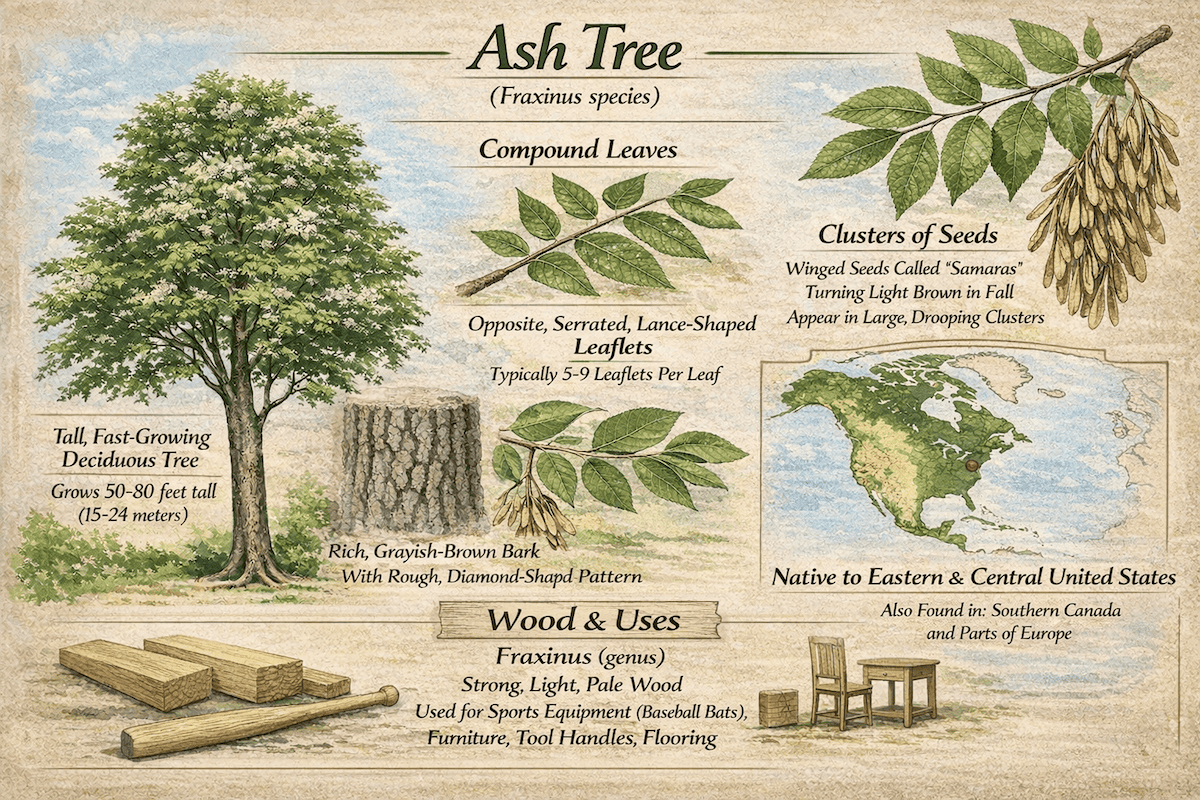
Ash trees (Fraxinus) are a group of medium to large deciduous hardwood trees found across North America, Europe, and Asia. In North America, species such as white ash, green ash, and black ash have long played an important role in forests, shelterbelts, and urban landscapes. They are valued for their upright form, light-filtered shade, wildlife value, and strong, flexible wood, which has been widely used for furniture, flooring, tool handles, and sports equipment.
Beyond their commercial value, ash trees contribute to ecosystem health and landscape resilience. They help stabilize soil, provide habitat and seasonal food for wildlife, and support biodiversity in both natural woodlands and planted environments. Their graceful branching habit, compound leaves, and distinctive bark also make them easy to recognize once you know the key identification features.
Ash trees can usually be identified by a combination of leaf, bark, branching, and seed traits. The most reliable features include:
Taken together, these characteristics make ash trees one of the easier hardwood groups to identify in the field, especially during the growing season when leaves and seed clusters are visible.
Ash species occupy a wide range of habitats, from bottomlands, streambanks, and moist woodlands to upland forests, farm edges, and city streets. Different species have adapted to different conditions. For example, green ash is often associated with floodplains and riparian areas, while white ash is commonly found on well-drained upland soils. This adaptability has helped ash trees become important components of both natural forests and planted landscapes.
Today, ash trees face a severe and ongoing crisis. The most destructive threat is the emerald ash borer, an invasive beetle that has killed millions of ash trees across North America. This pest has devastated urban and rural ash populations alike, especially in regions around the Great Lakes and throughout the eastern and central United States and Canada. As ash declines, forests lose an important canopy species, communities lose valuable shade trees, and wildlife loses food and habitat.
The damage caused by emerald ash borer is especially serious because the insect attacks the tree’s internal transport system. Adult beetles lay eggs on the bark, and once the larvae hatch, they tunnel beneath the bark and feed on the tissues that move water and nutrients through the tree. This feeding cuts off the tree’s circulation, causing progressive decline and often death within only a few years.
Other pressures, including drought stress, disease, and climate change , can make ash trees even more vulnerable. Rising temperatures, shifting rainfall patterns, and environmental stress may weaken trees and reduce their ability to resist insects and recover from damage. For this reason, ash conservation is becoming increasingly important, not only for timber and landscaping, but also for long-term forest restoration and biodiversity protection.
Although no single solution has stopped emerald ash borer everywhere, efforts such as seed collection, resistant tree selection, biological controls, and protected planting zones offer hope for the future. Preserving surviving ash populations and developing replanting strategies may help ensure that ash trees continue to be part of North American landscapes for generations to come.
Forestry experts and entomologists warn that emerald ash borer will kill up to 99% of ash trees in eastern North America if left unchecked. This level of mortality would fundamentally change forest composition, wildlife habitat, and urban landscapes. Many communities are already seeing dead ash trees lining streets, parks, and river systems.
The ecological impact is significant. Ash trees are important for bird species, insects, and understory plants that depend on their shade and leaf litter. Their loss also affects water quality and erosion control along streams and riverbanks. Economically, municipalities and homeowners face high costs for removing dead or hazardous ash trees and replanting with other species.
With ash populations declining across North America, innovative solutions are needed to preserve genetics, rebuild populations, and restore long-term ecosystem balance. One forward-thinking strategy is the development of protected ash tree plantations in regions less vulnerable to emerald ash borer pressure and extreme climate conditions.
By leveraging Crop Circle Tree Plantations , these sites can be designed to create optimized micro-climates that improve tree health, water efficiency, and resilience. The circular and spiral planting geometry helps reduce wind stress, enhance soil moisture retention, and improve sunlight distribution—factors that collectively strengthen ash trees and may reduce vulnerability to pests and disease.
Crop Circle plantations can be strategically located in lower-risk regions such as higher elevations, coastal climates, or areas with naturally reduced emerald ash borer populations. These environments can act as living sanctuaries where ash trees are given the best possible conditions to survive and mature.
Integrated planting designs may also include companion species, biodiversity buffers, and regenerative soil systems that improve overall ecosystem health. By creating balanced, diverse growing environments, these plantations can reduce stress on ash trees while supporting beneficial insects and natural pest controls.
One of the most critical roles of these plantations is to function as seed banks and genetic reservoirs. By growing and monitoring healthy ash trees, it becomes possible to identify individuals that show natural tolerance or resistance to emerald ash borer and environmental stressors.
Seeds collected from these resilient trees can be stored and distributed for future reforestation efforts, ensuring that ash genetics are not lost. Over time, this approach supports the development of stronger, more adaptive ash populations capable of re-establishing themselves in forests, urban landscapes, and agricultural systems.
The Crop Circle plantation model is not limited to ash trees alone. It offers a scalable framework for preserving threatened species worldwide, combining regenerative agriculture, smart design, and long-term ecological planning.
As new management tools, biological controls, and resistant tree strains emerge, these protected plantations can serve as launch points for large-scale restoration. By pairing seed collection, propagation, and strategic planting, it becomes possible to reintroduce ash trees into landscapes where they have been lost—helping to rebuild forests, restore biodiversity, and strengthen climate resilience.
Crop Circle ash plantations are more than conservation sites—they are living infrastructure for future forests, designed to protect today’s trees while preparing for tomorrow’s large-scale reforestation.
Feel free to share this ash tree infographic on your website or blog. Please include a link back to this page as the source.
White ash (Fraxinus americana) is one of the most iconic hardwood species native to eastern North America. Known for its tall, straight trunk and broad canopy, it typically grows 60–80 feet tall with trunk diameters reaching 2–3 feet. White ash is commonly found in mixed hardwood forests, where it contributes to canopy structure, biodiversity, and long-term forest stability. It also adapts well to urban environments and is frequently planted as a shade and ornamental tree.
One of its most distinguishing features is its vibrant fall color, with foliage turning shades of yellow, orange, deep red, and purple. In addition to its visual appeal, white ash supports wildlife by providing food, shelter, and nesting habitat, while its root system helps with soil stabilization and erosion control in both natural and managed landscapes.
White ash wood is widely regarded as one of the premier hardwoods in North America due to its exceptional strength, elasticity, and shock resistance. The wood is typically light to medium brown with a straight grain and moderately coarse texture, making it both durable and easy to work. It has long been a preferred material for furniture, flooring, cabinetry, tool handles, and sports equipment such as baseball bats, where performance and resilience are essential.
Beyond its commercial value, white ash has a history of use in traditional herbal medicine, where parts of the tree were used to treat ailments such as fever and respiratory conditions. Its adaptability and environmental benefits also make it a valuable species for reforestation and habitat restoration projects.
Despite its many strengths, white ash is currently under severe threat from the emerald ash borer, an invasive insect responsible for the loss of millions of ash trees across North America. This widespread decline has not only disrupted ecosystems but has also reduced the availability of high-quality ash lumber. As a result, white ash wood is becoming increasingly scarce and valuable, especially among woodworkers, builders, and artisans.
Ongoing conservation efforts—including seed collection, resistant tree selection, and strategic replanting—are critical to ensuring that white ash remains a part of future forests and landscapes. Preserving this species is essential not only for its economic value, but also for its ecological importance and cultural legacy.
White ash (Fraxinus americana) is known for its impressive size and longevity, historically reaching heights of 80–120 feet with exceptional specimens exceeding that. While rare accounts suggest trees over 200 feet tall and 6 feet in diameter, such sizes are extremely uncommon today. Most large, old-growth ash trees have either been harvested in past decades or lost to the widespread impact of the emerald ash borer.
Ash wood is widely regarded as one of the most versatile hardwood groups due to its strength, elasticity, shock resistance, and workability. Different ash species produce wood with slightly different characteristics, making each type suited to specific applications ranging from fine furniture to structural uses and traditional crafts.
Below is a comparison of the most common types of ash wood and their key qualities:
Overall, ash wood remains one of the most practical and widely used hardwoods, combining durability, workability, and aesthetic appeal. However, ongoing pressures from invasive pests and environmental stress are reducing supply, which may increase the long-term value and importance of ash in both commercial and conservation contexts.
White ash wood should be kiln dried before milling. I have been a professional floorman for years and have seen the effects that moisture can have on wood floors. First, it will acclimate to less than 12% and that takes more than a few weeks in the house. If you are in a very dry climate, it can go as low as 5%. In Oklahoma it varies from 6 to 9 % depending on the season. There will be seasonal movement if you have humidity fluctuation. Secondly, if you lay flooring with too high of a moisture content over a moisture barrier (not optional) and sand it flat, the top of the board will dry out faster than the bottom and the result will be cupping. Even if you are laying 1.5" flooring, wide plank will cup even more noticeably. If you re-sand, it will crown when it finally dries out completely, so remember, be safe and buy kiln dried ash.
When my parents passed away, I inherited the family farm, which I hadn't explored since I was a kid. The farm is large, about 800 acres including a 300-acre woodlot. I had a professional timber man survey the woodlot so I could get an idea of what was there wood wise. It turns out that 40 percent of the woodlot was populated white ash. My dad and his dad before him had managed the bush pretty good as most the white ash where over 100 years old and 150 feet tall. My timber man expressed interest in cutting the white ash out of there for $250,000, but I think I will continue to manage the forest and keep the farm in the family. Fortunately, I don’t need the money so it's nice to be able to leave them as is.
Green ash (Fraxinus pennsylvanica) is one of the most widespread and adaptable ash species in North America. This medium to large deciduous tree typically grows to 50–70 feet tall with a trunk diameter of up to 2 feet. It is most commonly found in riparian zones, floodplains, and lowland forests, but it can also thrive in upland environments, making it a highly versatile landscape and restoration tree.
Green ash is especially valued for its strong, flexible, and shock-resistant wood. The wood is typically light yellow to pale brown with a straight grain and moderately coarse texture. It is easy to work, machines well, and accepts stains and finishes, making it suitable for a wide range of applications including flooring, furniture, tool handles, cabinetry, and sports equipment.
Beyond its timber value, green ash plays an important role in landscape design and environmental restoration. It is frequently planted as a shade tree in urban and suburban settings due to its tolerance of varying soil conditions, drought, and pollution. It is also widely used for erosion control, windbreaks, and habitat restoration, particularly in areas prone to flooding.
Historically, parts of the tree—including the leaves and bark—have been used in traditional and herbal medicine to address ailments such as fever, coughs, and sore throats. While these uses are less common today, they reflect the tree’s long-standing value across cultures.
From a market perspective, green ash has traditionally been more abundant and affordable than other ash species such as white ash or black ash. However, this is changing. The spread of the emerald ash borer, along with environmental stress factors, has significantly reduced ash populations across North America. As supply declines, high-quality green ash lumber may become more valuable, increasing its appeal for woodworkers, landowners, and restoration projects.
Overall, green ash remains a highly adaptable, multi-purpose tree valued for its wood, environmental benefits, and role in reforestation and landscape resilience.

The ash tree genus (Fraxinus) includes a number of valuable hardwood species found across North America, Europe, western Asia, and parts of North Africa. While ash trees are often grouped together for their strong, flexible wood and recognizable compound leaves, individual species differ in habitat, size, wood characteristics, and historical uses. Some are associated with wetlands, others with upland forests, and several have developed unique cultural, commercial, or traditional uses that make them especially important.
Below are several notable ash tree species, including their identifying traits, native range, wood qualities, and practical uses.
Black ash (Fraxinus nigra) is a North American ash species typically found in wetland environments such as swamps, bogs, and riverbanks. It is a medium-sized deciduous tree that can grow to around 80 feet tall with a trunk diameter of up to 3 feet. Because of its preference for moist soils, black ash is often associated with lowland forests and riparian ecosystems.
Black ash is especially valued for its unique wood structure, which allows it to be split into thin, even growth-ring strips. This quality has made it one of the most important woods for basket weaving, furniture weaving, and traditional craftwork. It has long been prized by artisans and Indigenous basket makers for its flexibility and workability.
In addition to weaving, black ash wood is also appreciated for its strength, durability, and shock resistance. It has been used for tool handles, sporting goods, and other applications where toughness matters. The wood is generally light brown with a straight grain, fine texture, and relatively low density, making it easier to shape than many denser hardwoods.
As emerald ash borer continues to reduce ash populations, black ash has become increasingly scarce in many regions. This has increased both its conservation importance and its value among craftspeople and woodworkers who rely on its distinctive splitting qualities.
Blue ash (Fraxinus quadrangulata) is native to the eastern and central United States. It is a medium-sized deciduous ash that may reach 80 feet in height with trunks up to about 3 feet in diameter. The tree is named for the blue-green dye that can be extracted from its inner bark.
Blue ash wood is known for being hard, dense, and durable. It often shows an attractive grain pattern and has been used in flooring, furniture, tool handles, and other applications that require a strong and dependable hardwood. Compared with some other ash species, blue ash is often recognized for its toughness and structural value.
Historically, blue ash has also had medicinal significance. The inner bark contains compounds such as fraxin, which has been referenced in traditional remedies for ailments including fever, dysentery, and rheumatism. In addition to its wood value, blue ash is also planted for its ornamental appeal, including its bark, foliage, and overall form.
Like many ash species, blue ash faces pressure from emerald ash borer, making mature specimens and quality wood increasingly harder to find. This has increased interest in the species among landowners, urban foresters, and woodworkers.
Carolina ash (Fraxinus caroliniana) is native to the southeastern United States. It is generally a smaller ash species than white or green ash, usually reaching up to about 50 feet tall with a trunk diameter of up to 2 feet. It grows in a range of moist habitats, including swamps, floodplains, and wet forest margins.
The wood of Carolina ash is valued for its strength, durability, and shock resistance. These qualities make it suitable for tool handles, sports equipment, furniture, and general utility uses. It typically has a light brown color, straight grain, and fine texture, and it responds well to both hand and machine tools.
Beyond its use as a timber species, Carolina ash has also been valued for medicinal and ornamental purposes. Historical accounts note that Native American groups used preparations made from the bark to address a variety of ailments. In managed landscapes, it has also been planted as a shade and ornamental tree.
Because Carolina ash is affected by the same pest pressures facing other ash species, including emerald ash borer, its long-term availability and health are a growing concern. Even so, it remains an important regional ash species with both practical and ecological value.
Manna ash (Fraxinus ornus) is native to southern Europe, western Asia, and North Africa. It is typically a small to medium-sized deciduous tree, often growing to around 40 feet tall with trunk diameters up to 2 feet. Compared with larger North American ash species, manna ash is often admired as much for its cultural history and ornamental value as for its wood.
The tree is best known for the sweet sap, or “manna,” that can exude from the bark during summer. This substance has historically been used as a natural sweetener and in traditional medicine. Manna ash has long held a place in regional herbal and folk traditions, especially in Mediterranean areas.
Its wood is also useful, valued for strength, elasticity, and toughness. The wood is generally light brown to whitish with a straight grain and fine texture, making it suitable for furniture, tool handles, and specialty wooden goods. It works well with both hand and power tools and takes finishes cleanly.
While manna ash is not as commercially prominent as species such as white ash, it remains a versatile and attractive ash species with importance in woodworking, landscaping, and traditional use systems.
From maple to oak, hardwoods whisper of centuries past, their slow growth a testament to patience and value over time.
Partner with us in a land management project to repurpose agricultural lands into appreciating tree assets. We have partnered with growingtogive.org, a 501c3 nonprofit, to create tree planting partnerships with land donors.
We have partnered with growingtogive.org, a Washington State nonprofit to create a land and tree partnership program that repurposes agricultural land into appreciating tree assets.
The program utilizes privately owned land to plant trees that would benefit both the landowner and the environment.
If you have 100 acres or more of flat, fallow farmland and would like to plant trees, then we would like to talk to you. There are no costs to enter the program. You own the land; you own the trees we plant for free and there are no restrictions; you can sell or transfer the land with the trees anytime.
Emerald ash borer (EAB) is an invasive wood-boring beetle native to Asia that attacks ash trees (Fraxinus species). Adult beetles feed on foliage, but the real damage comes from the larvae, which tunnel under the bark and disrupt the tree’s ability to move water and nutrients. Once infested, an untreated ash can decline and die in as little as 2–4 years, which is why EAB has already killed hundreds of millions of ash trees across North America.
Look for a combination of stress symptoms rather than just one sign. Typical EAB indicators include:
If you see several of these signs on a confirmed ash tree, contact a certified arborist or your local forestry/extension office to confirm EAB and discuss treatment or removal options.
EAB cannot be eradicated at the landscape scale, but individual ash trees can often be protected if treatment begins early. High-value trees (large shade trees in yards, parks, or streetscapes) may be injected with systemic insecticides such as emamectin benzoate on a 2–3 year cycle. Soil drenches, trunk sprays, and other systemic products are sometimes used for smaller landscape trees. Successful programs usually combine:
Not automatically. If your ash tree is healthy, structurally sound, and important for shade or aesthetics, preventive treatment may be more cost-effective than removal and replacement. However, trees that already have extensive dieback, loose or splitting bark, or trunk decay can quickly become hazardous. These are often better candidates for removal, especially if they are near homes, roads, power lines, or play areas. An ISA-certified arborist can help you weigh treatment costs versus removal and replanting.
Yes, ash killed by EAB can often be processed into firewood or milled for lumber if harvested before the wood degrades. Always follow your region’s rules on moving firewood, because transporting infested logs can spread pests into uninfected areas. Many regions recommend burning ash wood close to where the tree was felled and avoiding long-distance transport.
When replacing ash trees, diversity is key. Planting a mix of native hardwoods and conifers reduces the risk that a single future pest or disease will wipe out your canopy again. Depending on your climate and site conditions, good alternatives may include oaks, maples, disease-resistant elms, walnuts, or other locally recommended species. Check with your local extension service or a reputable native plant nursery for region-specific tree lists.
Communities can reduce the impact of emerald ash borer with proactive planning instead of reacting after trees start failing. Helpful steps include:
Long-term, protected seed orchards and dedicated ash restoration projects can help preserve genetics for future forests, even as current stands decline.
Copyright © All rights reserved Tree Plantation