


 INVEST
 PLANT
PLANT
 SOFTWOODS
 HARDWOODS
 CALCULATORS
 RESOURCES
 PROGRAMS

Softwoods
Learn More
WIND • PROTECTION • MICROCLIMATE
Wondering how effective a windbreak can be? This windbreak calculator helps you estimate planting rows, spacing, and layout so you can reduce wind speed, protect soil, crops, livestock, and buildings, and create a more stable microclimate.
🌬️ Quick answer: A well-designed windbreak can reduce wind speed by 30–70% and protect an area extending up to 10–20 times the height of the trees downwind.
Example: A 30-foot-tall windbreak can protect an area up to 300–600 feet downwind, depending on density, spacing, and row design.
Windbreaks, also called shelterbelts, are belts of trees and shrubs planted in one or more rows to slow wind and reduce damage. Proper designs form a vegetative ladder that lifts and deflects wind upward, so that by the time it reaches your fields or buildings, it is moving slower and causing far less stress.
A windbreak, also called a shelterbelt, is a planted barrier of trees and shrubs arranged in one or more rows to reduce wind speed, protect soil, crops, livestock, roads, and buildings, and create a more stable microclimate. Instead of stopping wind abruptly, a properly designed windbreak slows and lifts airflow, reducing erosion, moisture loss, drifting snow, and plant stress.
Historically, poorly protected farmland in the North American Great Plains contributed to the “dirty thirties” Dust Bowl, where unprotected topsoil was stripped away by strong winds. Millions of trees were later planted in farm shelterbelts to reduce wind erosion, trap snow and protect crops. Today, large-scale windbreaks such as Africa’s planned “Great Green Wall” follow the same principle: tree belts slow encroaching desert, stabilize soil, and create corridors where crops, livestock and native ecosystems can recover.
A well-planned windbreak or shelterbelt will:
Use the Windbreak & Shelterbelt Calculator below to estimate how many trees you will need for each row in your design. Combine this tool with our Tree Spacing Calculator and Tree Carbon Calculator to plan a windbreak that protects your farm and builds long-term tree value at the same time.
Many agricultural regions experience prevailing winds that come from the same general direction most of the year. This is common on open plains, in mountain valleys, and along coastal agricultural zones in the U.S., Australia, Africa, China and elsewhere. In these areas it makes sense to design a windbreak that is oriented perpendicular to the prevailing wind and runs the entire length of the field or property line that needs protection.
To be effective, a windbreak must be both tall enough to provide a long downwind protection zone and porous enough to let some air through. A solid wall of trees or boards actually creates turbulence and strong eddies; an ideal windbreak lets about 40–60 % of the wind pass through, dropping overall wind speed without producing damaging gusts and swirls on the leeward side.
In temperate climates, using a mix of coniferous and deciduous trees provides year-round protection. Deciduous trees like poplar or walnut lose their leaves in winter but still provide some wind resistance with their branches, while evergreen conifers such as spruce, fir or pine maintain dense foliage and continue to protect livestock yards and buildings during cold months.
One classic example of a multi-row shelterbelt uses three distinct tree layers: tall, medium and low. This creates a vegetative “ramp” that gradually lifts and slows the wind.
Row 1 (Leeward, tall trees): Plant a row of tall, narrow trees such as Lombardy or Tower poplar spaced about 8 feet apart. These trees can reach 80–100 feet in height and form the final “lift” that carries wind up and over the protected area. The tight spacing closes gaps quickly and provides a high, narrow wind fence.
Row 2 (Middle, evergreen trees): Around 25 feet upwind from the first row, plant a double or triple row of evergreen trees such as Douglas fir or spruce. Trees are staggered in alternating rows so that the foliage of one row fills the gaps between trees in the next. This evergreen wall provides strong, year-round permeability—enough to slow the wind without creating a solid wall of resistance.
Row 3 (Windward, shrub layer): Another 25 feet upwind from the conifers, plant a row of shorter, flexible shrubs or willows. Willow whips bend and sway with the wind, creating a very effective “first lift” that takes the bite out of high-speed airflow at ground level. This low barrier begins the slowing process before the wind ever reaches the main conifer rows.
By the time the wind has passed through this three-stage system, its speed is greatly reduced. Over the first 10–15 times tree height downwind, crops and pastures experience significantly lower evapotranspiration, less lodging (crop blow-down), improved soil moisture retention and more comfortable conditions for grazing animals. In winter, the belt traps snow, building drifts where you want them and keeping laneways, yards and building entrances clearer.
Feel free to share this windbreak calculator infographic on your website or blog. Please include a link back to this page as the source.
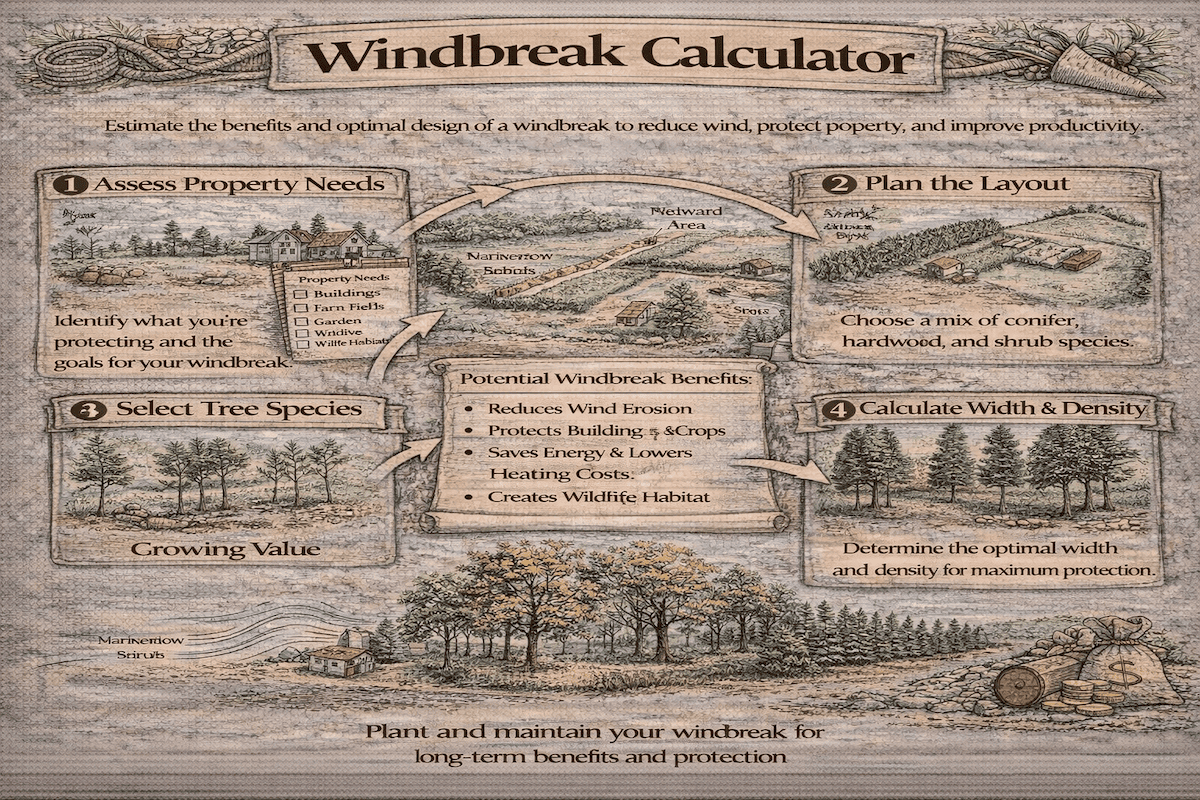
The best windbreak trees depend on your goals. Some species establish quickly and provide early shelter, while others deliver stronger long-term protection, higher durability, and added value through carbon storage, timber, wildlife habitat, or edible production. The table below compares common windbreak tree and shrub roles so you can match species to your climate, spacing, and long-term objectives.
| Tree Type | Typical Role in Windbreak | Growth Speed | Recommended Spacing | Density / Protection Level | ROI Timeline | Best Fit |
|---|---|---|---|---|---|---|
| Hybrid Poplar | Fast upper-row shelter, quick vertical lift | Very fast | Usually 8–12 ft | Moderate density; excellent for rapid early protection but less dense year-round than conifers | Fastest early payoff; short-to-medium term wind protection | Farms needing quick shelter and fast visual impact |
| Spruce | Core evergreen barrier, year-round wind reduction | Moderate | Usually 12–16 ft | High density; excellent winter protection and strong snow-catching ability | Medium-term payoff; strong long-term protection value | Cold climates, livestock yards, farmsteads, and snow-prone areas |
| Douglas Fir | Evergreen middle row, long-lived shelterbelt structure | Moderate to fast | Usually 12–16 ft | High density with strong year-round protection when staggered in multi-row systems | Medium-term payoff; durable long-term farm asset | Larger shelterbelts and farms seeking durable evergreen cover |
| Pine | Evergreen barrier or secondary conifer row | Moderate to fast | Usually 12–20 ft | Moderate-to-high density depending on species and pruning habits | Medium-term payoff; good blend of speed and durability | General-purpose windbreaks with year-round protection goals |
| Willow | Windward shrub or flexible low-row “first lift” | Very fast | Usually 4–8 ft | High low-level density; excellent for reducing ground scour and drifting snow | Fast early payoff; strongest value as support row rather than stand-alone barrier | Multi-row shelterbelts, wet soils, and living snow-fence designs |
| Walnut | Long-term deciduous upper row with added tree-value potential | Moderate | Usually 20+ ft | Lower winter density than conifers, but valuable as part of diversified mixed windbreaks | Long-term payoff; strongest value from timber, nuts, and land enhancement | Landowners seeking both shelter and premium tree value over time |
|
Shrub Mix (serviceberry, chokecherry, lilac, gooseberry, elderberry) |
Low windward row, edible shelterbelt, wildlife habitat | Fast to moderate | Usually 4–6 ft | Excellent low-level density; ideal for closing gaps and increasing biodiversity | Fast ecological payoff; medium-term food and habitat value | Homesteads, edible landscapes, wildlife-focused shelterbelts |
Bottom line: for the fastest protection, start with hybrid poplar or willow. For stronger year-round density, use spruce, Douglas fir, or pine. For long-term tree value, mixed systems that include deciduous hardwoods such as walnut can add protection plus future timber or nut returns.
Use this windbreak tree calculator to estimate how many tall trees you’ll need for the first row of your shelterbelt. This might be Lombardy poplar, hybrid poplar, fast-growing Paulownia, or another tall species suited to your climate and soil.
Not all farms experience a strong prevailing wind. In some regions, breezes shift direction throughout the day and across the seasons. In these cases, a single straight belt on one side of a field is less effective. Instead, you can design cross-plot windbreaks or perimeter shelterbelts that protect from all sides.
For cropland between 20 and 100 acres, a common design is a rectangular tree enclosure: three rows of trees planted around the entire perimeter of the field. The same tall–medium–short layering is used, but wrapped around all four sides. On larger blocks (100+ acres), several smaller rectangles can be placed side by side to create multiple protected compartments.
Commercial open-field forest nurseries and on-land fish farms often rely on networks of parallel cross-plot windbreaks. These belts keep seedling beds, ponds and raceways sheltered from desiccating winds and drifting snow, while still allowing machinery access along main lanes and harvest corridors.
The same planning used to design a windbreak can also be used to manage water. In wetter areas, a series of ditches and tree lines can help drain saturated soils and protect fields from flooding. In dryland and semi-arid regions, the approach is reversed: water is collected and stored.
Instead of a 60-foot-deep tree belt, you might excavate a 20-foot-wide by 10-foot-deep water collection trench along the edge of a field or following a contour. In extremely dry climates, the trench can be lined with a rubber or synthetic membrane to hold water longer. Trees and shrubs planted along both sides of the ditch benefit from increased moisture, while the tree roots and canopy help shade the water, reduce evaporation, and stabilize the banks.
Enterprising farmers can even treat these water breaks as small aquaculture systems. Provided water depth is adequate, hardy fish species can overwinter below the ice in cold climates, while the surrounding tree and shrub belts provide habitat for birds, pollinators and beneficial insects.
In areas where average wind speeds are less than about 20 miles per hour, windbreak design can be adapted to grow edible plants as well as trees. A “berry break” combines wind protection with food-producing shrubs and small trees.
Depending on your region, you might plant native species such as huckleberry, chokecherry, serviceberry and gooseberry, or commercial cultivars of blueberry, blackberry and raspberry. Fruit-bearing shrubs can be mixed with nitrogen-fixing species and hedge-forming trees to create a productive, wildlife-friendly shelterbelt that provides both protection and a harvest.
Windbreaks and shelterbelts are more than just protection from unpleasant weather; they are powerful climate-smart agriculture tools. Trees store carbon in their wood, roots and surrounding soil. Well-designed shelterbelts can capture several times more carbon per acre than the same number of trees scattered randomly across a landscape because:
Over time, a network of shelterbelts stitched across open farmland can function like a “carbon net” while also providing shade, beauty, wildlife habitat and higher resilience to drought and extreme weather.
The three calculators on this page help you determine how many trees or shrubs you’ll need for each layer of your shelterbelt design:
For the first calculator, enter the total length in feet of the property side or perimeter you want to protect and choose a spacing suited to the mature spread of your tall tree species. Narrow trees such as Lombardy poplar tolerate closer spacing than broad-crowned trees such as Paulownia or maple.
Use this calculator for the evergreen windbreak rows. In many designs, the second “row” is actually a triple staggered row of spruce, fir or pine to plug gaps and create a dense, year-round barrier.
Use these results to estimate carbon credits from your trees, to support forest carbon projects, or to understand the long-term climate value of planting trees on your land, farm, or urban property.
For the second-row calculator, again enter total length in feet and choose a spacing that matches your evergreen species. Remember that three staggered rows can often be planted at slightly wider in-row spacing because the staggered pattern closes wind gaps.
For the third-row shelterbelt calculator, you’ll typically be using shrub willow, dogwood, buffaloberry or other bush species that can be planted closer together. These low, flexible plants are your first line of defense against wind, snow and drifting soil.
Every shelterbelt, woodlot and tree plantation is a metric waiting to be measured. Use our free tree, wood and carbon calculators to plan, price and optimize your next planting.
Conventional row plantations often double-space softwoods at about 6 feet within the row for the initial planting, with the intention of thinning every second tree later for pole wood or pulp. Hardwoods that will be grown to sawlog size are usually not thinned as aggressively and are planted at wider spacing—typically 15–25 feet apart, depending on species and rotation length.
Row spacing is also critical. Machinery access for planting, tending and harvest requires clear lanes. Row spacing for softwood plantations often ranges between 20 and 25 feet, while large-crowned hardwoods such as oaks and maples may need 25–30 feet or more between rows to leave room for safe felling and skidding. Alternating species by row—maple in one row, oak in the next—helps diversify return on investment (ROI) and reduces the risk of a single pest or disease affecting the entire stand.
Mixing coniferous and deciduous trees in alternating rows further improves forest health and spreads market risk between sawlogs, poles, biomass and specialty products. Although a traditional row plantation can pack in more trees per acre than a spiral planting pattern, average tree growth rates are often slower due to competition and shading.
The best shelterbelt trees are hardy, climate-adapted species with dense crowns and good survival rates. Evergreen conifers such as spruce, pine, and juniper provide year-round wind protection, while deciduous trees like oak, maple, ash, or poplar add diversity and height. Low shrub rows (for example lilac, hawthorn, buffaloberry, or elderberry) help close ground-level gaps, reduce scour, and create wildlife habitat. Always match species to your local soils, moisture levels, and wind exposure.
Fast-growing species such as hybrid poplar, willow, and silver maple can provide early wind protection within a few years. However, they often have shorter lifespans or weaker wood and may need more pruning and replacement. For long-term performance, many growers combine fast starters with long-lived conifers like Norway spruce, white spruce, or Scots pine where suited. The quick growers provide immediate shelter while the conifers mature into the permanent windbreak.
Spacing depends on the species’ mature crown width and your target windbreak porosity. As a guide:
The goal is a moderately porous windbreak (roughly 40–60% solid) that slows and lifts the wind rather than creating severe turbulence.
A well-designed windbreak can significantly reduce wind speeds for about 10–15 times the mature tree height (H) downwind, with useful but smaller benefits out to roughly 20H. Upwind (windward) protection is more limited, usually around 2–5H. For example, a mature shelterbelt 40 ft tall can strongly influence wind speeds for 400–600 ft downwind, improving crop yields, reducing soil erosion, and making conditions more comfortable for livestock and farm buildings.
A single dense row is better than no windbreak, but most farms benefit from three to five rows, such as:
In snowy climates, you can add extra shrub or tree rows upwind of the main shelterbelt to catch drifting snow before it reaches roads, yards, or livestock areas.
Yes. Shelterbelts act as long, narrow forests that store carbon in wood and soil, reduce soil erosion, and improve water infiltration. By lowering wind speed, they reduce crop water loss and help protect fields and pastures during droughts and extreme weather. Strategically placed windbreaks along field edges, waterways, and farmyards are a proven tool for climate-smart agriculture.
Copyright © All rights reserved Tree Plantation