


 INVEST
 PLANT
PLANT
 SOFTWOODS
 HARDWOODS
 CALCULATORS
 RESOURCES
 PROGRAMS

Softwoods
Learn More
WILLOW • FAST GROWTH • BIOMASS
Wondering why willow trees are so fast-growing and widely used in plantations? Willow trees (Salix species) are among the most adaptable and rapid-growing trees, making them ideal for biomass, erosion control, and wetland environments.
🌿 Quick answer: Willow trees grow quickly, root easily, and can be harvested in short cycles, making them ideal for coppice systems, biomass production, and land restoration.
Examples: Willow is commonly used for bioenergy crops, windbreaks, streambank stabilization, agroforestry systems, and fast-return plantation projects.
Their ability to thrive in moist or marginal soils makes willow one of the most effective species for turning underutilized land into a productive and environmentally beneficial system.
Willow trees are among the most versatile trees you can plant in moist landscapes, along waterways, or on low-lying ground. They grow quickly, root easily, and can be used for shade, erosion control, windbreaks, biomass production, coppice systems, habitat recovery, and medicinal bark.
For landowners, growers, and designers, willow offers a rare combination of ornamental beauty, ecological value, and practical productivity.
Willow trees are especially valuable in short-rotation forestry, where rapid regrowth after cutting allows repeated harvest cycles without replanting. This makes them highly efficient for renewable biomass systems and carbon-focused land management.
Key insight: Willow’s speed, adaptability, and coppicing ability make it one of the most efficient trees for turning water-rich or marginal land into a high-performing system.
Willow trees (Salix species) are versatile, fast-growing softwood tree species native to wetlands and riparian areas, yet many varieties adapt well to a wide range of soils and temperate climates. They are one of the few tree groups that can generate value across multiple markets at once—including timber, biomass production, land restoration, windbreak systems, and even natural medicine—making them a powerful choice for landowners, smallholders, and commercial tree plantations.
From a forestry perspective, willow trees are ideal for short-rotation coppice systems, agroforestry projects, and renewable energy crops. Their combination of rapid growth, strong coppicing ability, and high water use makes them especially valuable on wet or marginal land that is too saturated for traditional crops. In addition, willows provide natural erosion control, shade, and habitat along streams, lakes, and drainage systems— improving both land productivity and environmental health.
Well-managed willow plantations can generate multiple income streams and ecosystem services from the same acreage. Key uses include:
Feel free to share this willow trees infographic on your website or blog. Please include a link back to this page as the source.
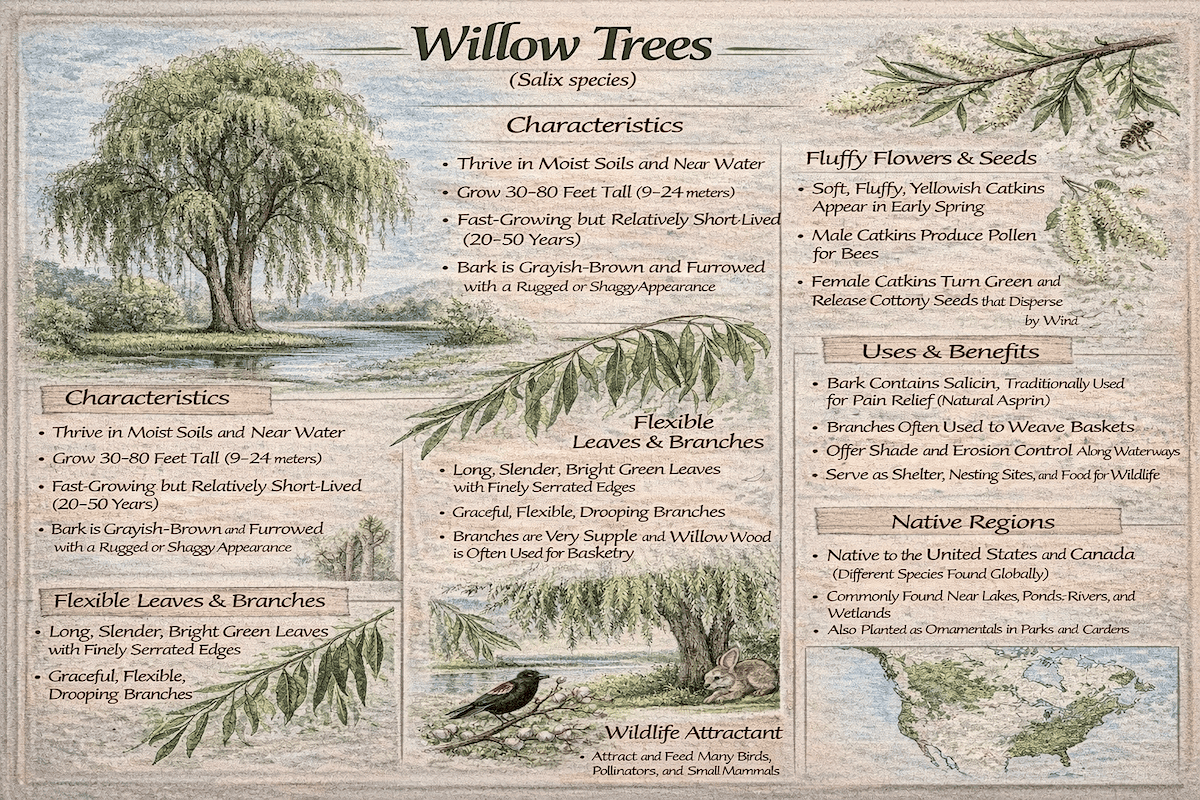
Willow biomass systems can produce fast returns through rapid growth, dense planting, and repeat harvests from coppicing. The calculator below helps you estimate per-acre yield, short-rotation harvest cycles, and long-term biomass potential so you can compare scenarios and plan with more confidence.
Use it to model: biomass output • coppice regrowth • planting density • renewable energy value
Estimate biomass yield, harvest cycles, coppicing performance, and per-acre profitability across multiple tree species and climate regions. Compare dry vs green tons and model short-rotation biomass systems with confidence.
Willow trees are easily recognized by their characteristic hanging branches that form a sweeping, inverted canopy. They are commonly found along riverbanks, lake shores, drainage channels, and wetlands, where they play a vital role in soil stabilization and erosion control while helping regulate water tables. Because of their high water demand, willow trees are generally unsuitable for arid, low-rainfall climates unless supported by irrigation systems.
With a growth rate of approximately 3 feet per year—or more in optimal conditions—willows develop early branching and naturally shorter trunks. While this growth habit can limit traditional sawlog production, targeted pruning and plantation management can transform willow into a viable commercial timber tree crop.
In well-managed tree plantations, species are selected to produce long, straight sawlogs for milling and pole wood. Willow’s excellent workability, light color, and ability to accept stains make it a valuable utility hardwood in markets that prioritize fast growth and machinability. These plantations perform best in water-rich environments—including wetlands, floodplains, and riparian zones—where other species struggle to thrive.
Willow cuttings are inexpensive and easy to establish, making them ideal for scalable planting systems. Many growers propagate willow using dormant cuttings placed directly into moist soil, eliminating the need for costly nursery stock. Once established, willow trees form dense, fast-growing stands that can be managed for short-rotation biomass production, timber, or integrated forestry systems.
To grow long, branch-free willow sawlogs, consistent pruning is essential. Each spring, lateral branches are removed from the main stem to promote vertical growth and produce a clean, straight trunk. This process is repeated annually for 4–6 years until trees reach approximately 20–25 feet in height, at which point trunk diameter begins to increase rapidly.
Over time, these managed stems develop into high-quality, knot-free logs suitable for veneer, specialty lumber, and value-added wood products. Plantation layout can be optimized using a tree spacing calculator for optimal plantation design , ensuring proper row spacing for equipment access, pruning, and efficient harvesting.
White willow (Salix alba) is widely considered the best species for timber production due to its fast growth, straight stem development, and light-colored wood. In some regions, hybrid willow cultivars may offer even greater performance depending on site conditions.
In mixed forestry systems, willow can also serve as a fast-growing nurse species—providing early income, wind protection, and site conditioning for slower-growing hardwoods such as black walnut trees, oak trees, and maple trees. This layered approach improves land productivity while diversifying long-term revenue streams.
Willow can be managed for either timber production or biomass energy, and the best choice depends on your land, water availability, harvest goals, and market access. Timber systems generally require wider spacing, longer rotations, and regular pruning to produce straighter, higher-value stems. Biomass systems typically use higher-density planting, shorter harvest cycles, and coppicing to maximize tons per acre and repeatable yield.
Many growers also use a blended strategy—managing some blocks for short-rotation biomass and others for longer-term timber, farm shelterbelts and windbreak design, or land restoration. The comparison below helps clarify which willow production model is the better fit for your site and business plan.
| Factor | Willow for Timber | Willow for Biomass |
|---|---|---|
| Primary goal | Grow straighter, larger stems for sawlogs, craft wood, wood veneer and panel products, and specialty lumber | Maximize fast regrowth, fiber production, and tons per acre for energy or pellets |
| Planting density | Lower density with more room for crown and trunk development | Higher density to increase total biomass yield per acre |
| Typical spacing | Wider spacing to allow pruning access and larger stem growth | Tighter spacing for short-rotation coppice systems |
| Management style | Requires pruning, training, and form correction for long, clear stems | Managed for fast regrowth, tree coppicing and repeated harvest cycles, and efficient harvest |
| Harvest cycle | Longer cycle to build trunk diameter and higher-value wood products | Shorter cycle, often every few years, depending on site and end use |
| Coppicing value | Useful in some systems, but often secondary to stem quality goals | Critical advantage that reduces replanting costs and supports repeat harvests |
| Equipment needs | More selective pruning, thinning, and harvesting practices | More efficient for mechanized cutting, wood chipping for biomass fuel, and bulk handling |
| Best land type | Moist, fertile ground where trunks can develop straight and clean | Wet or marginal land where fast fiber production is the main goal |
| Revenue model | Higher value per log, but longer wait for harvest | Earlier and more repeatable income from volume-based production |
| Best fit for | Growers targeting specialty wood, lumber, shelterbelts, and mixed forestry systems | Growers targeting biomass energy production and renewable fuel systems, pellets, renewable fuel, and high-density coppice plantings |
To compare layouts and estimate production potential, use the tree spacing calculator for willow plantation layouts, the wood pellet estimator for biomass production, and the tree value calculator for willow timber plantings.

Willow trees are among the most promising species for biomass energy production, particularly for manufacturing wood chips and wood pellets used in renewable fuel systems. Their rapid growth, high water uptake, and strong coppicing ability make them uniquely suited for short-rotation energy plantations.
In many policy frameworks, willow biomass is considered “carbon-neutral” because the carbon released during combustion is offset by the carbon absorbed during fast regrowth. In practice, short-rotation willow behaves more like a perennial energy crop than a traditional timber species—producing consistent yields over multiple harvest cycles.
This makes willow biomass highly attractive for industrial boilers, district heating systems, and biomass power plants seeking to replace or co-fire with fossil fuels. It also creates opportunities for landowners to participate in carbon sequestration and offset programs, particularly where willow plantations help reclaim marginal land, stabilize soils, and protect waterways.
Willow is one of the most effective species for tree coppicing and regenerative harvest cycles. After the first harvest, cut stumps rapidly produce multiple new shoots, transforming a single trunk into a dense cluster of fast-growing stems.
This coppicing ability dramatically improves long-term productivity while reducing replanting costs. Unlike traditional timber plantations that rely on wide spacing, willow biomass systems are planted at high density—often around 5 feet by 5 feet spacing—to maximize yield per acre. The result is a dense, hedge-like stand optimized for fiber production and efficient harvesting.
Weeping willow (Salix babylonica) and related hybrids are commonly used in biomass systems due to their fast growth, strong coppicing response, and adaptability to wet soils. In many regions, specialized hybrid willow cultivars are also selected to further improve yield, disease resistance, and site performance.
For landowners and growers, willow represents a plant-once, harvest-for-decades system—a compelling model for low-input, high-yield biomass production that supports renewable energy, carbon reduction, and sustainable land use.

Willow trees are highly effective for land reclamation, especially in low-lying wetlands, floodplains, and marginal land with limited agricultural value. Their high water consumption helps lower water tables and reduce standing water, making previously unusable land suitable for grazing, planting, or restoration projects.
With extensive, fibrous root systems, willows provide exceptional soil stabilization and erosion control along slopes, ravines, and riverbanks. They rapidly rebuild ecosystems—often within 3–5 years—by adding organic matter, improving soil structure, and creating habitat for wildlife while filtering excess nutrients from water systems.
Willows are particularly valuable in restoring degraded sites such as mine tailings, industrial zones, and disturbed land. As part of a reforestation and phytoremediation strategy, willow roots can absorb and immobilize certain heavy metals and contaminants. These compounds are stored within the biomass, helping stabilize the site while improving long-term soil health. Harvested material must be handled responsibly, but the land is left more productive and biologically active.
Willow trees are ideal for windbreak and shelterbelt systems due to their rapid leaf-out, dense canopy, and fast growth. Properly designed windbreaks can reduce wind speeds by up to 50–70% on the leeward side, protecting crops, livestock, buildings, and soil moisture.
Additional benefits of willow windbreak systems include:
Use the windbreak spacing and layout calculator to design optimal row spacing, tree density, and protection zones for farms, homesteads, and commercial operations.
Willow bark has been used for centuries as a natural remedy. It contains salicin, a compound related to the active ingredient in aspirin, making it effective for pain relief, inflammation, and fever reduction.
In addition to its analgesic properties, willow bark has mild antiseptic and antifungal benefits. It has traditionally been used in teas, tinctures, and extracts for treating minor infections and skin conditions. Modern herbal use continues, though regular use should be discussed with a healthcare professional—especially for those taking blood thinners or aspirin-based medications.
Willow plantations offer a unique opportunity to generate multiple revenue streams from the same land base. Smaller branches unsuitable for fuel can be harvested for medicinal bark, while larger stems can be processed into biomass energy products, wood chips, pellets, or specialty lumber.
By integrating timber, biomass, and herbal production, growers can diversify income, reduce risk, and maximize land value. These systems become even more powerful when combined with tree carbon sequestration and carbon credit programs , ecosystem service payments, and long-term land restoration strategies.

Design effective willow windbreaks, shelterbelts, and living fences by using the windbreak calculator to determine spacing, row layout, and expected protection zones.
Willow wood is a lightweight, soft hardwood known for its straight grain, fine texture, and pale creamy-yellow color. One of its most distinctive characteristics is its exceptional flexibility and shock resistance, making it ideal for applications that require bending, shaping, or weaving.
For centuries, willow has been used in basketry, woven products, bentwood furniture, tool handles, sporting goods, and specialty craft items. Its ability to bend without cracking allows artisans and manufacturers to create durable, lightweight structures that would be difficult to achieve with harder woods. In modern production, willow continues to play a role in both traditional craftsmanship and commercial wood manufacturing.
From a woodworking perspective, willow is highly valued for its easy machining, smooth cutting properties, and excellent workability. It accepts nails, screws, and adhesives well, and can be sanded to a fine finish for paint-grade furniture, interior components, and decorative pieces. However, due to its relatively low density, it may develop surface “fuzzing” during finishing, which can be resolved with fine sanding.
While willow is not considered a durable or decay-resistant wood species, it performs well in indoor applications such as cabinetry components, paneling, shelving, and light-duty furniture. For exterior or ground-contact use, more durable species like western red cedar or Douglas fir timber are typically preferred due to their superior resistance to moisture, insects, and rot.
Commercially, willow wood is widely used for pallet stock, crates, packaging materials, and low-cost furniture components. Its rapid growth and availability make it an important resource in sustainable forestry systems, particularly where fast-turnover wood supply is needed.
For landowners and small-scale growers, willow offers a unique advantage as a multi-purpose tree crop—providing material for craft wood, biomass, erosion control structures, and garden applications. Its affordability and ease of use also make it a favorite among DIY builders for projects such as trellises, garden fencing, raised beds, and natural landscaping features.
Willow trees are fast-growing trees and shrubs in the Salix genus, known for their slender leaves, flexible branches, and graceful appearance. Some species, such as the weeping willow, are famous for their drooping form, while others are grown for biomass, erosion control, baskets, hedgerows, and habitat value. Willows are especially associated with moist soils and streamside landscapes.
Willow trees grow best in full sun with moist, fertile soil. They thrive near ponds, streams, wetlands, drainage areas, and other locations where water is readily available. Although many willows tolerate a range of soil types, they generally perform best where the ground does not stay dry for long periods.
Many willow species are considered very fast-growing trees. Under favorable conditions, some can grow several feet per year, especially when planted in moist soil with good sunlight. Their rapid growth makes them useful for privacy screens, windbreaks, erosion control, and short-rotation biomass plantings.
Willows are highly versatile and are often used for ornamental landscaping, erosion control, streambank stabilization, wildlife habitat, shade, biomass production, and living structures. Certain species are also valued for coppicing, basket weaving, and phytoremediation projects because of their vigorous regrowth and extensive root systems.
Willows are commonly planted near water because they naturally prefer moist or wet conditions and help stabilize soil with their dense root systems. Their roots can reduce erosion along pond edges, creek banks, and drainage channels, while their canopies provide shade and habitat in riparian environments.
Yes, willow trees are known for having strong, wide-spreading, moisture-seeking roots. That makes them excellent for holding soil in place, but it also means they should be planted well away from foundations, septic systems, underground pipes, patios, and other structures. Give willows ample room so their roots can expand safely.
Willow trees benefit from regular pruning to remove dead, damaged, or crossing branches and to maintain a balanced shape. Many willows respond very well to coppicing or pollarding, depending on the species and intended use. The best time for heavier pruning is usually during dormancy, though light cleanup can be done as needed.
Because willows grow quickly, they can sometimes develop brittle wood, storm breakage, cankers, borers, aphids, and fungal diseases, especially if stressed. Poor siting in dry soil can also shorten their lifespan. Good spacing, proper watering, and occasional structural pruning help reduce many common willow problems.
Before planting a willow, choose a location with full sun, moist soil, and plenty of space. Avoid planting too close to buildings, driveways, water lines, or septic systems because of the aggressive roots. If you want a willow for beauty, habitat, or erosion control, match the species to the site so it can perform well without becoming a maintenance problem.
Softwoods, the pioneer species of the temperate forest, grow quickly to leave their mark on the landscape for centuries. Many, like willow, can be planted in short-rotation systems that generate timber, biomass, and ecosystem services in a single rotation.
Explore each species page to compare growth rates, wood properties, and potential returns from tree plantations designed for timber, biomass, and carbon.
Partner with us in a land management project to repurpose agricultural lands into appreciating tree assets. We have partnered with Growing to Give , a 501(c)(3) nonprofit, to create tree-planting partnerships with land donors. Together, we can establish willow and mixed-species plantations that restore soil, protect water, and generate long-term value.
We have partnered with Growing to Give , a Washington State nonprofit, to create a land and tree partnership program that repurposes agricultural land into appreciating tree assets.
The program utilizes privately owned land to plant trees that benefit both the landowner and the environment—combining income potential from timber or biomass with measurable ecological gains.
If you have 100 acres or more of flat, fallow farmland and would like to plant trees, then we would like to talk to you. There are no costs to enter the program. You own the land; you own the trees we plant for free, and there are no restrictions; you can sell or transfer the land with the trees anytime.
Copyright © All rights reserved Tree Plantation