INVEST
 PLANT
PLANT
 SOFTWOODS
 HARDWOODS
 CALCULATORS
 RESOURCES
 PROGRAMS

Softwoods
Learn More
LOBLOLLY PINE • TIMBER • PLANTATIONS
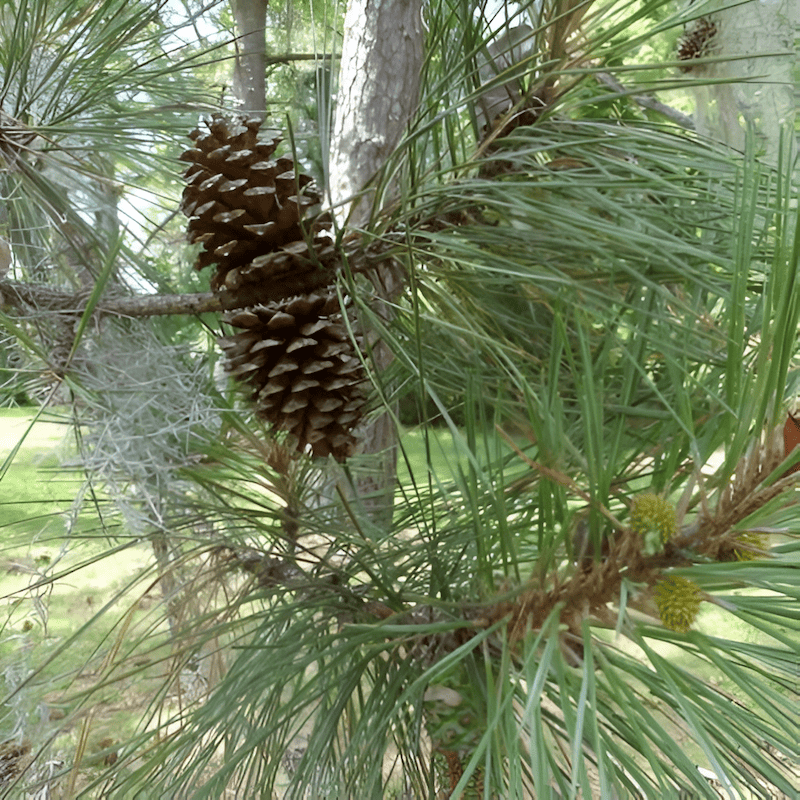
Wondering what a loblolly pine plantation is? A loblolly pine plantation is a managed forest system designed to produce timber, pine straw, pole wood, and long-term financial returns using fast-growing Loblolly Pine (Pinus taeda). These plantations are widely used across the southeastern United States for their high yield, rapid growth, and predictable harvest cycles.
🌲 Loblolly pine is one of the fastest-growing commercial tree species in North America — making it ideal for scalable forestry and land-based investment.
On this page, we’ll explore how loblolly pine plantations work, why they are so productive, and how spacing and management decisions affect long-term returns.
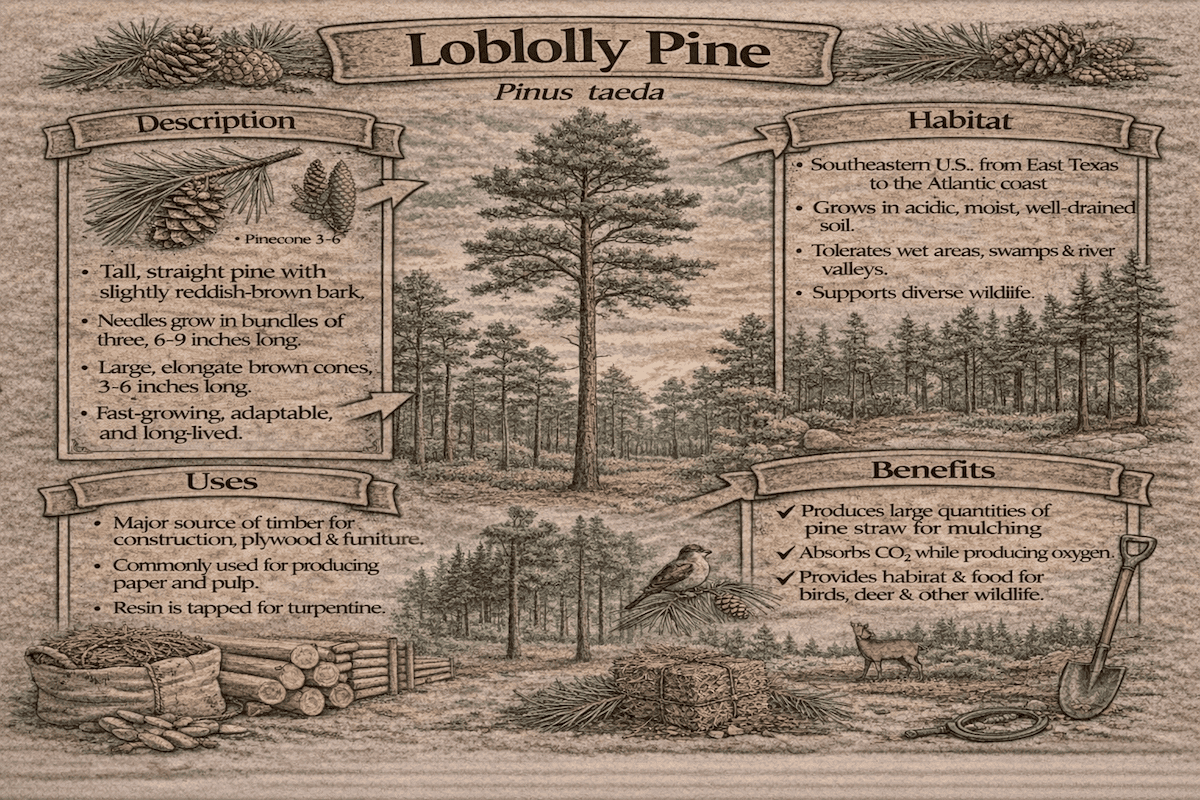
Definition: A fast-growing southern pine used for lumber, utility poles, pulpwood, pine straw, and carbon-focused forestry systems.
Native Range: Southeastern U.S. — from East Texas to the Atlantic Coast, thriving in warm climates and well-drained soils.
💡 Did You Know? Loblolly pine can reach 60–90 feet in just a few decades and is a key species for carbon sequestration and sustainable timber investment.
With strong market demand and consistent growth performance, loblolly pine plantations are widely used in commercial forestry, reforestation, and long-term land investment strategies.
Proper spacing is one of the most important factors in a successful loblolly pine plantation. Spacing directly affects tree form, growth rate, product type, and long-term financial returns.
Wondering how far apart to plant loblolly pine? The most common spacing ranges balance early competition with long-term tree development.
Plantation layout should also consider soil type, slope, drainage, access, and intended product mix. High-density systems are often used for pole production, while wider spacing supports sawtimber and structural lumber development.
When properly designed and managed, loblolly pine plantations generate income through pine straw harvesting, thinning operations, pole wood production, and final timber harvest, while also improving soil stability, protecting watersheds, and storing significant carbon.
Feel free to share this loblolly pine infographic on your website or blog. Please include a link back to this page as the source.
Modern Crop Circle loblolly pine plantations use innovative spiral planting patterns to maximize growth and simplify management. Trees are spaced 10 feet apart along precise, geometrically segmented spirals, which are mapped and verified using drone technology and GPS-guided equipment. This design improves light distribution, reduces competition, and creates clean access corridors for harvesting equipment, log trucks, and pine straw collection.
Spiral patterns also make it easier to prune and thin the stand, inspect tree health, and integrate carbon-credit, wildlife habitat, and recreational objectives into a single plantation design. The result is a highly productive, multi-purpose forest that supports both financial and ecological goals.
Loblolly pine seedlings are widely used for reforestation, afforestation, shelterbelts, and commercial timber plantations. Where possible, landowners should plant genetically improved seedstock selected for rapid growth, straight stems, tight knots, and resistance to common diseases such as fusiform rust.
Two-year-old bundled seedlings are often preferred for their higher survival rate, stronger root systems, and more rapid early height growth after transplanting. Seedlings should be purchased from reputable regional nurseries that specialize in southern pine genetics and match seed sources to the local climate and growing zone.
Most nurseries sell loblolly pine in bundles of 50 to 100 seedlings, packed in burlap or heavy plastic to protect roots during transport and planting. Upon delivery, inspect your seedstock for healthy, white root tips, green needles, and firm stems, and plant as soon as site preparation and soil moisture conditions are favorable.
Establishing a Crop Circle loblolly pine plantation costs approximately $900 per acre, based on an average density of 600 trees per acre. This includes site preparation, drone-guided transplanting of 12-inch, 2-year seedlings, and initial fertilization. By year 11, culling every second tree generates intermediate revenue while allowing the remaining crop trees to double their trunk diameter.
Strategic fertilization at key growth stages further increases volume and improves stem quality, positioning the stand for high-value pole, post, and saw-timber markets.
Year 11: ≈ $1,000 per culled acre from fence post and small-diameter pole sales.
Pine Straw Revenue: ≈ $200 per acre from pine straw in years 7, 14, and 21.
Year 22: ≈ $3,000 per acre from mature timber and pole harvest.
Total Cost: $180,000 (including planting, thinning, harvesting, and fertilization).
Total Revenue: $460,000.
Total Profit: $280,000 over the 22-year rotation, plus long-term carbon storage and soil-health improvements.
*Returns are illustrative and vary based on site quality, genetics, management practices, and market conditions.
Estimate total costs, pine straw income, thinning revenue, final harvest value, profit, and ROI for a loblolly pine plantation. Adjust acreage, planting density, and revenue assumptions to model your own plantation scenario.
Estimate total board feet, merchantable volume, and approximate timber yield for a loblolly pine plantation. Use this calculator to model harvest output based on acreage, surviving trees per acre, average DBH, merchantable height, and form factor.
Enter your plantation assumptions and click Calculate Yield.
Enter your plantation assumptions and click Calculate ROI.
Estimate bales needed, total material cost, recommended depth (2–3 inches), and a simple refresh/top-up schedule. Ideal for pine straw landscaping projects and planning harvest economics on loblolly pine plantations.

Loblolly pine, one of the key softwood timber trees, is highly adaptable to various soil types and growing conditions. It performs especially well in sandy loam and well-drained coastal plain soils, which are common in Georgia, South Carolina, Alabama, Mississippi, Louisiana, and the Florida Panhandle. This fast-growing southern pine is primarily cultivated for pole wood, pulpwood, framing lumber, and engineered wood products, while also providing valuable wildlife cover and watershed protection.
Across its range, loblolly pine is sometimes called Oldfield Pine, North Carolina Pine, Arkansas Pine, or Shortleaf Pine in local trade, although true Shortleaf Pine (Pinus echinata) is a separate species. Regardless of the regional name, loblolly pine remains one of the primary species used in Tree Plantation designs for commercial timber and carbon-offset projects.
A case study conducted by forestry researchers at Auburn University in Alabama examined how different fertilizer treatments affect loblolly pine growth on degraded, low-fertility soils converted from row-crop agriculture to pine plantations. Initial soil tests showed low organic matter, nutrient deficiencies, and acidic pH—conditions common on exhausted farm fields across the South.
Researchers evaluated several fertilization treatments, including urea (nitrogen source), diammonium phosphate (nitrogen and phosphorus), triple superphosphate (phosphorus), and a control group with no added fertilizer. Over three growing seasons, both soil properties and tree growth were monitored.
The study concluded that targeted fertilization can dramatically boost loblolly pine performance on degraded soils, especially when combined with proper spacing, weed control, and timely pruning. Fertilizer type, rate, and timing should always be matched to site-specific soil tests and the landowner’s management objectives (pole wood, saw-timber, carbon, or mixed products).
Pine straw—the naturally shed needles of southern pines—is a valuable by-product of loblolly pine plantations. In the American Southeast and Southwest, pine straw is widely used for landscaping, gardening, and erosion control because it is lightweight, easy to spread, and visually attractive.
Landscape contractors, garden centers, and nurseries favor pine straw mulch because it stays loose instead of forming a hard crust, allowing air and water to penetrate into the soil. This improves soil aeration, moisture retention, and root health around trees, shrubs, and foundation plantings.
Pine straw is a highly popular organic ground cover thanks to its rich auburn color and soil-building benefits. It naturally discourages some common garden pests such as termites, which are prevalent in warm climates. As pine straw decomposes, it slowly releases nitrogen and organic matter, acting as a gentle, long-lasting fertilizer while suppressing weed growth and protecting tree trunks from rot by buffering soil moisture.
Pine straw is especially effective for controlling erosion on slopes, roadbanks, and unstable soils. It helps stabilize the soil surface and provides a protective layer against wind, rain splash, and surface runoff, making it a preferred mulch for storm-water and conservation plantings.
From a business perspective, pine straw can be harvested by raking and loading it loose, or by baling it into compact rectangular or round bales for easier handling and transport. Baled pine straw is often delivered to job sites and distributed with truck-mounted Hiab equipment or small tractors, creating an additional recurring revenue stream for loblolly pine plantations between timber harvests.

Pole wood refers to timber harvested from small- to medium-diameter trees used in construction, fencing, utility lines, and landscaping across the southern United States. Trees destined for pole wood are typically between 4 and 12 inches in diameter at breast height (DBH), with straight, low-taper trunks and minimal defects.
Pole wood is ideally suited for uses where a round or cylindrical shape is desired, such as fence posts, vineyard and orchard stakes, utility distribution poles, playground structures, and retaining timbers. On farms and ranches, pole wood is commonly used to build barns, sheds, animal pens, and perimeter fencing. Compared to squared posts and beams, pole wood is more economical to produce and can be harvested on shorter rotation cycles.
The choice of tree species for pole wood varies by region and use. In some markets, hardwoods like oak or hickory are prized for heavy-duty posts, while in many southern states, loblolly pine and other southern yellow pines dominate the pole, post, and treated-wood markets. The quality and price of pole wood depend on species, age, growth rate, straightness, and knot size.
As a sustainable, versatile, and cost-effective timber product, pole wood is an attractive option for landowners seeking shorter-rotation, cash-flow generating harvests within a longer-term loblolly pine management plan.
Loblolly pine is renowned for producing exceptionally straight pole wood, widely used for fence posts, treated poles, and utility infrastructure. In year 11 of a Crop Circle rotation, cull wood is harvested primarily for fence posts and small poles. By year 22, the remaining high-quality crop trees are harvested for utility poles, framing lumber, engineered wood, and premium construction timber.
Loblolly pine stands out for its naturally straight growth habit, minimal taper, and high strength-to-weight ratio. These traits make it highly sought after by pole mills, sawmills, and treating plants, where it often commands a premium over less uniform species or poorly managed stands.
Softwoods, the pioneer species of the temperate and subtropical forest, grow quickly, capture carbon efficiently, and leave their mark on the landscape for generations.
Partner with us in a land management and reforestation project to repurpose agricultural lands into appreciating tree assets. We have partnered with GrowingToGive.org , a 501(c)(3) nonprofit, to create tree-planting partnerships with land donors who want to see their land restored, protected, and productively managed.
We have partnered with GrowingToGive.org , a Washington State nonprofit, to create a land and tree partnership program that repurposes agricultural land into long-term tree assets.
The program utilizes privately owned land to plant trees that benefit both the landowner and the environment. Plantations can be designed for timber income, wildlife habitat, carbon sequestration, erosion control, or a combination of all four.
Use our tree spacing, value, and carbon calculators to model your own loblolly pine investment strategy.
If you have 100 acres or more of flat, fallow farmland and would like to plant trees, we would love to talk with you. There are no upfront costs to enter the program. You own the land; you own the trees we plant for free, and there are no restrictions—you can sell or transfer the land with the trees at any time.
Pine straw is lightweight, easy to spread, and slow to break down, so it protects soil and roots for months at a time. The interlocking needles help it stay in place on slopes, and it often costs less than shredded wood mulch. In southern landscapes it also delivers a soft, natural look that complements shade and ornamental trees.
In most gardens, a 2–3 inch layer of pine straw looks good and works well for about 6–12 months, depending on sun, rainfall, and foot traffic. Color will fade first, but it continues to insulate roots and suppress weeds. You can lightly “fluff” and top up thin spots rather than replacing the entire mulch layer each season.
Pine straw itself does not automatically attract insects, but piling it too deeply against house siding, foundations, or tree trunks can trap moisture and create hiding spots for pests. Keep mulch pulled a few inches back from structures and stems, and maintain the proper depth so you support healthy soil life without encouraging unwanted insects.
Yes. Loblolly pine is valued for its straight stems, relatively low taper, and strong southern yellow pine wood. Managed plantations can supply small-diameter logs for fence posts and short poles at mid-rotation, and larger trees at final harvest go into utility poles, framing lumber, and other structural timber products. Proper spacing, pruning, and thinning all help maximize pole wood quality.
Yes. Well-designed loblolly pine plantations can earn money long before the final clearcut. Landowners often rake and bale pine straw mulch for landscape markets and conduct thinning or cull harvests that yield fence posts, pole wood, and small logs. These early and mid-rotation revenues help offset establishment, fertilization, and management costs while the best crop trees grow into high-value pole and saw-timber sizes.
Copyright © All rights reserved Tree Plantation