


 INVEST
 PLANT
PLANT
 SOFTWOODS
 HARDWOODS
 CALCULATORS
 RESOURCES
 PROGRAMS

Softwoods
Learn More
Bamboo is one of the most versatile and widely used plants on the planet. For thousands of years, cultures around the world have relied on bamboo for construction, tools, textiles, food, and everyday household items. Its unique combination of strength, flexibility, and rapid growth makes bamboo one of the most valuable renewable plant resources available today.
Often referred to as a "green steel" of the plant world, bamboo can be stronger than many hardwoods while remaining lightweight and flexible. Because of these qualities, bamboo plays an important role in sustainable construction, eco-friendly manufacturing, and modern alternatives to plastics and synthetic materials.
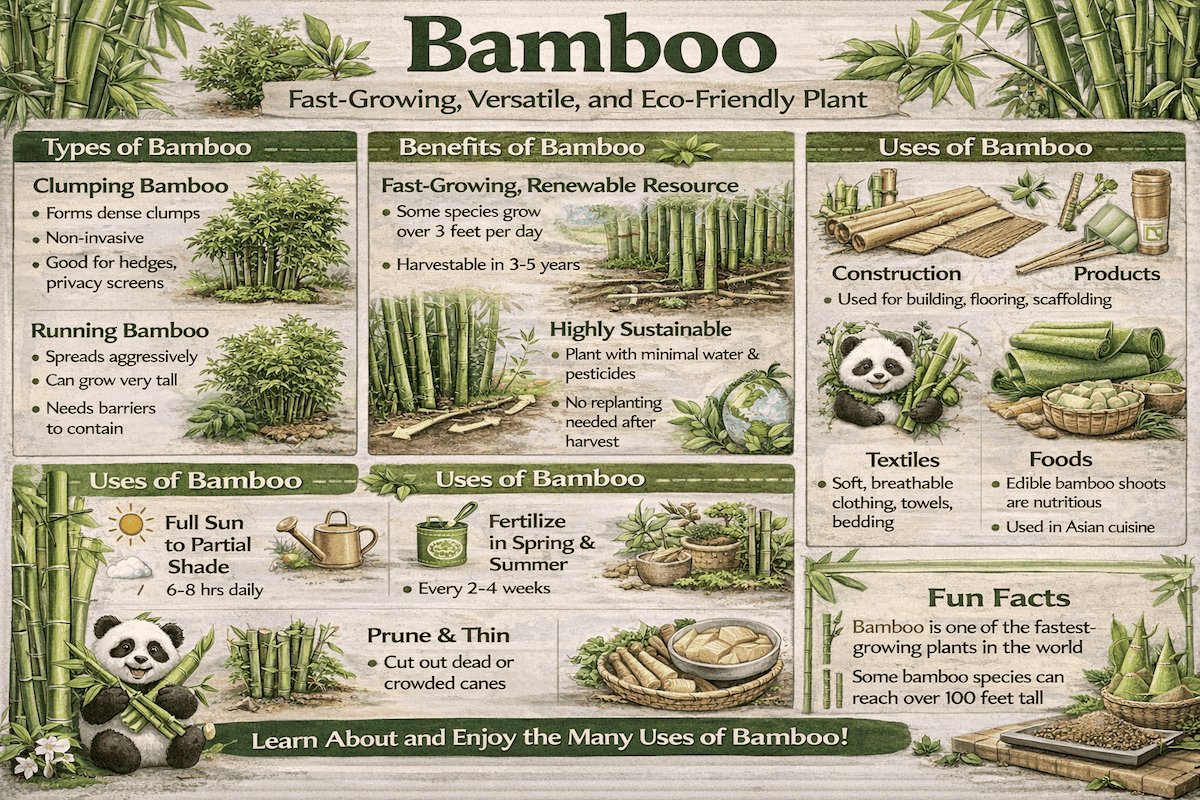
Some bamboo species can grow more than 3 feet (91 cm) in a single day, making bamboo one of the fastest-growing plants on Earth. Because bamboo regrows after harvest without replanting, it is considered one of the most sustainable natural materials available.
Today bamboo is used in an extraordinary range of applications, from traditional construction materials to modern eco-products. Below are some of the most common ways bamboo is used and the properties that make it so valuable.
Because bamboo requires relatively little water, grows rapidly, and regenerates after harvest without replanting , it is considered one of the most environmentally friendly plant resources available. As interest in sustainable materials continues to grow, bamboo is becoming an increasingly important solution for eco-friendly construction, renewable products, and sustainable agriculture.
Feel free to share this bamboo infographic on your website or blog. Please include a link back to this page as the source.
Woody bamboo is increasingly cultivated as a biomass crop to supply renewable fuel for power generation plants that are transitioning away from coal and other fossil fuels. Because bamboo is one of the fastest-growing and highest-yielding renewable plants on Earth, it has become an attractive alternative to traditional timber biomass sources. Bamboo plantations can produce large volumes of usable material while helping reduce pressure on natural forests.
Unlike most hardwood trees, which may take decades to mature, many bamboo species reach harvestable size in just 3 to 5 years. After each harvest, new shoots emerge from underground rhizomes, allowing bamboo stands to regenerate quickly without the need for replanting. In addition, bamboo has an impressive ability to capture and store carbon, making it an important plant in climate-friendly biomass systems.
Growing bamboo for biomass offers several advantages compared with other biomass crops such as wood or corn. These benefits include:
Several bamboo species are commonly cultivated for biomass production due to their rapid growth and high yield potential:
As the global demand for renewable energy and sustainable materials continues to grow, bamboo is gaining attention as a high-yield, climate-friendly biomass crop. Its rapid growth, regenerative harvesting cycle, and ability to capture carbon make bamboo a promising component of future renewable energy systems.

As electrical power generation plants move away from burning fossil fuel coal, direct combustion bamboo biomass can be introduced as a co-generation fuel that burns cleaner with less particulates and therefore is less polluting.
Plant clear areas could be colonized by bamboo four times faster than most native plants and trees.
Bamboo has a higher compressive strength than wood, brick or concrete and a tensile strength that rivals steel. Giant Bamboo is the largest member of this grass family and is used by the construction industry in Asia. It can be trained to grow into most constructive shapes including bowed rafters and parabolic arches making ideal for the rafters of a roof and covered enclaves.
Bamboo is frequently used as the vertical support component for post and beam construction. It is also used to erect scaffolding; it is not uncommon to see bamboo scaffolding ten stories tall. A Bamboo scaffolder is a trade in Asia much like a carpenter, electrician or plumber in the West and takes years of apprenticeship to master.

Learn more about sustainable planting, useful landscape species, and eco-friendly alternatives made from natural materials.
Explore trees used in gardens, yards, and designed outdoor spaces to add shade, beauty, structure, and habitat value.
Read the guide →Discover how bamboo can replace many single-use plastic products with renewable, reusable, and more sustainable alternatives.
Explore the guide →Bamboo is also widely used for fencing and structural posts. Its natural strength, durability, and resistance to moisture allow bamboo poles to last for decades in the ground—even in regions that experience heavy seasonal rains or monsoon climates. Long runs of bamboo fencing are common in many parts of Asia and Latin America where the plant grows abundantly.
Although less common today, bamboo can also be used as a mold jacket when forming products made from hardening resins or composite materials. Because bamboo is lightweight and inexpensive, it has historically been used as temporary formwork when pouring concrete. Once the concrete has cured and the forms are removed, the bamboo can often be reused or recycled for other construction purposes.
Modern bamboo flooring is produced by laminating thin strips of bamboo into durable planks. This process was first refined by Japanese engineers, who developed techniques to compress and laminate bamboo fibers into strong building materials. Today, manufacturers around the world produce bamboo flooring that rivals many traditional hardwood products in strength and durability.
In addition to flooring, laminated bamboo is now commonly used for cabinetry, furniture, countertops, and decorative wall panels. Bamboo fibers are also increasingly processed into soft textiles used for clothing, bedding, and towels.
Landscape bamboo includes many ornamental varieties grown for gardens, parks, and commercial landscapes. Because most bamboo species flower only once every several decades—and sometimes more than a century—landscape bamboo plants are typically propagated from cuttings or divided rhizomes rather than from seed.
In commercial nurseries, bamboo spreads through underground rhizomes similar to the way strawberries propagate. Growers divide and transplant young shoots into containers, which are then shipped to garden centers and landscape suppliers. Through careful breeding and hybrid selection, horticulturists have developed several cold-tolerant “temperate bamboo” varieties that can survive light frost. These varieties allow bamboo to be grown successfully in regions such as the western United States and parts of the United Kingdom.
Many bamboo species are popular in landscaping due to their elegant appearance, rapid growth, and ability to create natural privacy screens. Some of the most widely planted landscape bamboo varieties include:

Partner with us in a land management project to repurpose agricultural lands into appreciating tree assets. We have partnered with Growing To Give , a 501(c)(3) nonprofit, to create tree planting partnerships with land donors.
Together with Growing To Give , a Washington State nonprofit, we’ve created a land and tree partnership program that repurposes agricultural land into appreciating tree assets.
The program utilizes privately owned land to plant trees that benefit both the landowner and the environment.
If you have 100 acres or more of flat, fallow farmland and would like to plant trees, we’d like to talk with you. There are no costs to enter the program. You own the land; you own the trees we plant for free, and there are no restrictions—you can sell or transfer the land with the trees at any time.
Contact Us to discuss land donations, consulting, or a land-and-tree partnership project.
Botanically, bamboo is a member of the grass family Poaceae, not a tree. It is classified in the subfamily Bambusoideae. Many species, however, grow with a very tree-like form—woody culms, branching tops, and heights that can exceed 60–100 feet—so bamboo is often grouped with woody biomass crops and even marketed as “bamboo trees.”
Clumping bamboo grows in tight, slowly expanding clumps. New shoots emerge close to the original plant, making it easier to manage in small gardens, containers, and foundation plantings. Popular clumpers include Fargesia and some Bambusa species. Running bamboo spreads via long underground rhizomes that can travel several feet per year. Genera such as Phyllostachys and Pseudosasa are classic running bamboos—excellent for privacy screens, windbreaks, and agroforestry shelterbelts, but they must be contained with barriers or regular root pruning to prevent them from becoming invasive.
Bamboo can become invasive, but only if the species and site are poorly matched. Running bamboos are vigorous spreaders and should always be planted with a physical rhizome barrier—typically 30–36 inch (75–90 cm) high-density polyethylene (HDPE)—or in raised beds and large containers. Barriers are installed vertically around the planting, with 2–3 inches (5–7 cm) left above the soil so rhizomes “surface” where you can prune them. Clumping bamboos have a much tighter growth habit and are the better choice for small yards or near property lines.
Yes. Many species adapt well to life in containers, especially compact clumpers such as Bambusa multiplex and hardy Fargesia selections. Use a large, heavy container with drainage holes; fill it with a high-quality potting mix that drains freely but holds enough moisture. Container bamboo needs more frequent watering and feeding than in-ground plants—typically deep watering several times a week in hot weather and balanced fertilizer every 6–8 weeks during the growing season. Divide or step up to a larger container every 2–3 years so the root mass doesn’t become completely root-bound.
In USDA Zones 5–7, look for cold-hardy clumping bamboo such as Fargesia nitida, Fargesia robusta, and related hybrids. These “temperate bamboos” tolerate light to moderate freezes and are less likely to run than many warm-climate bamboos. In milder coastal and southern climates (Zones 7–9), running species like Phyllostachys aureosulcata (Yellow Groove), Phyllostachys nigra (Black Bamboo), and Phyllostachys edulis (Moso) can be grown for screens, poles, and bamboo flooring feedstock, provided you install rhizome barriers and monitor spread.
Most running bamboos prefer full sun to light shade and moderate, even soil moisture. Many clumping bamboos, especially Fargesia, appreciate a bit more shade and cooler conditions. In general, bamboo does best in well-drained, loamy soil with consistent moisture—never permanently waterlogged, but not bone dry. Deep, infrequent watering encourages deeper roots and stronger culms. Mulch with shredded bark, leaves, or wood chips to conserve moisture and improve soil structure over time.
Under good conditions, bamboo is one of the fastest-growing plants on Earth—some species can extend new culms more than 30 inches (75 cm) per day during peak growth. For most woody species, culms reach full height in a single season and then gradually harden and strengthen. Harvesting usually begins when culms are 3–5 years old for structural use or biomass feedstock. Because the underground rhizome system remains intact, new shoots emerge after harvest without replanting, making bamboo a highly renewable crop.
Yes. Large woody species such as Moso bamboo (Phyllostachys edulis), Giant Bamboo (Dendrocalamus asper), and Guadua (Guadua angustifolia) are widely grown as high-yield biomass crops. They mature quickly, produce a large volume of culms per acre, and can be chipped for combustion, pelletized, or used in bio-based composite products. Bamboo’s rapid regrowth and high carbon sequestration rate make it an attractive option where utilities are transitioning away from fossil fuels and looking at more sustainable feedstocks.
In many parts of Asia, Giant Bamboo and related species serve as structural timber for homes, bridges, scaffolding, and post-and-beam frameworks. Bamboo has a compressive strength higher than many softwoods and a tensile strength that can rival steel, especially when culms are properly seasoned and treated. Laminated products—engineered planks created from glued bamboo strips—are now common in flooring, cabinetry, and furniture. Proper treatment against decay and insects is essential if bamboo is to be used outdoors or in long-term structural applications.
For tall privacy screens, many gardeners use running bamboos like Phyllostachys aurea (Golden Bamboo), Pseudosasa japonica (Arrow Bamboo), and Phyllostachys nigra (Black Bamboo). These species create dense vertical walls of foliage and can quickly hide fences or neighboring buildings. However, they must be contained with properly installed rhizome barriers. Where spread is a concern, clumping species such as Fargesia nitida (Chinese Fountain Bamboo) offer more manageable screens for smaller lots, patios, and near foundations.
Bamboo is increasingly used to replace single-use plastics in items like straws, cutlery, toothbrush handles, and reusable shopping bags. Its fibers can be pulped into tissue, paper, and packaging, or processed into textiles for clothing and linens. Because bamboo grows rapidly on relatively poor soils with low water and fertilizer inputs, it can be an important part of a more sustainable, circular materials economy—especially when combined with reforestation and climate-smart land management.
When responsibly grown and harvested, bamboo is a highly sustainable resource. It sequesters large amounts of carbon in its rhizomes and culms, protects soil from erosion, and can rehabilitate degraded land. In comparison to slow-growing hardwoods, bamboo produces usable biomass much faster, reducing pressure on natural forests. The overall environmental impact depends on how it is cultivated, harvested, and transported—local or regional production generally has a smaller footprint than heavily processed, long-distance imports. Pairing bamboo planting with anti-desertification measures and careful water management can magnify its ecological benefits.
Many bamboos exhibit “gregarious flowering,” where plants of the same clone flower at roughly the same time, sometimes after 60–120 years. After flowering, culms often decline or die back. This is a normal part of bamboo’s life cycle, but it can surprise gardeners when a seemingly vigorous grove suddenly deteriorates. Replacement usually involves removing old culms and replanting new stock of a different clone or species. For most home gardeners, this event is rare enough that bamboo still provides decades of useful screening, poles, and ornamental value before a replant is needed.
Copyright © All rights reserved Tree Plantation