 INVEST
 PLANT
PLANT
 SOFTWOODS
 HARDWOODS
 CALCULATORS
 RESOURCES
 PROGRAMS

Softwoods
Learn More




Discover the Douglas fir tree—one of the fastest-growing and most valuable softwoods in the world—known for its strength, carbon capture power, and role in sustainable forestry
🌲 Did you know? Douglas fir is one of the tallest and most commercially important trees in western North America. In the right conditions, it can soar well over 200 feet tall, store large amounts of carbon, and produce some of the strongest softwood lumber used in construction—making it a powerhouse for both forests and forestry.
Native to western North America, Douglas fir (Pseudotsuga menziesii) is one of the most productive and ecologically important tree species in the world. It naturally ranges from British Columbia through the Pacific Northwest and into the Rocky Mountains and Sierra Nevada of California. These trees thrive in cool, moist climates with consistent rainfall and well-drained soils, from sandy loams to heavier clay-based compositions.
Under optimal conditions, Douglas fir can grow from sea level to elevations of 7,000 feet, requiring deep, nutrient-rich soil to reach its full potential. In coastal temperate rainforests, these trees routinely exceed 200 feet in height, with massive trunk diameters that define old-growth forests. Their iconic conical shape, dense evergreen needles, and fresh forest aroma also make them a popular choice as Christmas trees, bringing a piece of the wild indoors each year.
While Douglas fir is native to North America, its versatility and value have made it a globally cultivated species. Today, it is widely grown in regions with similar temperate climates, including the United Kingdom, France, Germany, Switzerland, and New Zealand. Its rapid growth, strong wood, and adaptability have positioned it as a leading species for both commercial forestry and landscape planting.
In Europe, Douglas fir plantations are a major source of high-quality structural timber, used in construction, flooring, and engineered wood products. In Asia, including parts of China and Japan, it is cultivated for timber, pulp, and specialty wood applications. Meanwhile, New Zealand has developed extensive Douglas fir plantations that support both domestic construction and global export markets, mirroring its importance in western Canada and the United States.
Douglas fir trees are not only valuable for timber—they are also highly effective at capturing airborne pollutants and improving environmental quality. Their dense, year-round needle structure acts as a natural filtration system, trapping particulate matter, dust, and airborne toxins directly from the air.
These trees can absorb and process pollutants such as nitrogen oxides, ozone, and sulfur dioxide, transferring them into their tissues or into the surrounding soil. There, beneficial microorganisms help break down these compounds into less harmful substances. This makes Douglas fir an excellent choice for urban planting, roadside buffers, and air quality improvement zones.
In addition to pollution capture, Douglas fir trees provide cooling shade, reduce surface temperatures, and help mitigate the urban heat island effect. Their evergreen canopy also supports wildlife year-round, offering shelter and habitat for birds and small mammals while enhancing the visual appeal of urban and suburban landscapes.
Douglas fir is widely recognized as a high-performance carbon sequestration tree due to its fast growth rate, large biomass, and long lifespan. As these trees grow, they absorb carbon dioxide from the atmosphere and store it in their wood, roots, and surrounding soil.
A mature Douglas fir can capture significant amounts of carbon annually, and when planted at scale, the impact becomes substantial. For example, a well-managed stand of Douglas fir can sequester tens to hundreds of tons of carbon per acre over its growth cycle, making it a powerful tool in climate-smart forestry and carbon offset strategies.
Beyond carbon capture, Douglas fir plantations contribute to long-term environmental resilience by stabilizing soils, improving watershed health, and supporting biodiversity. When managed sustainably, these forests provide a rare combination of economic value, ecological function, and climate benefit.
Feel free to share this Douglas fir infographic on your website or blog. Please include a link back to this page as the source.
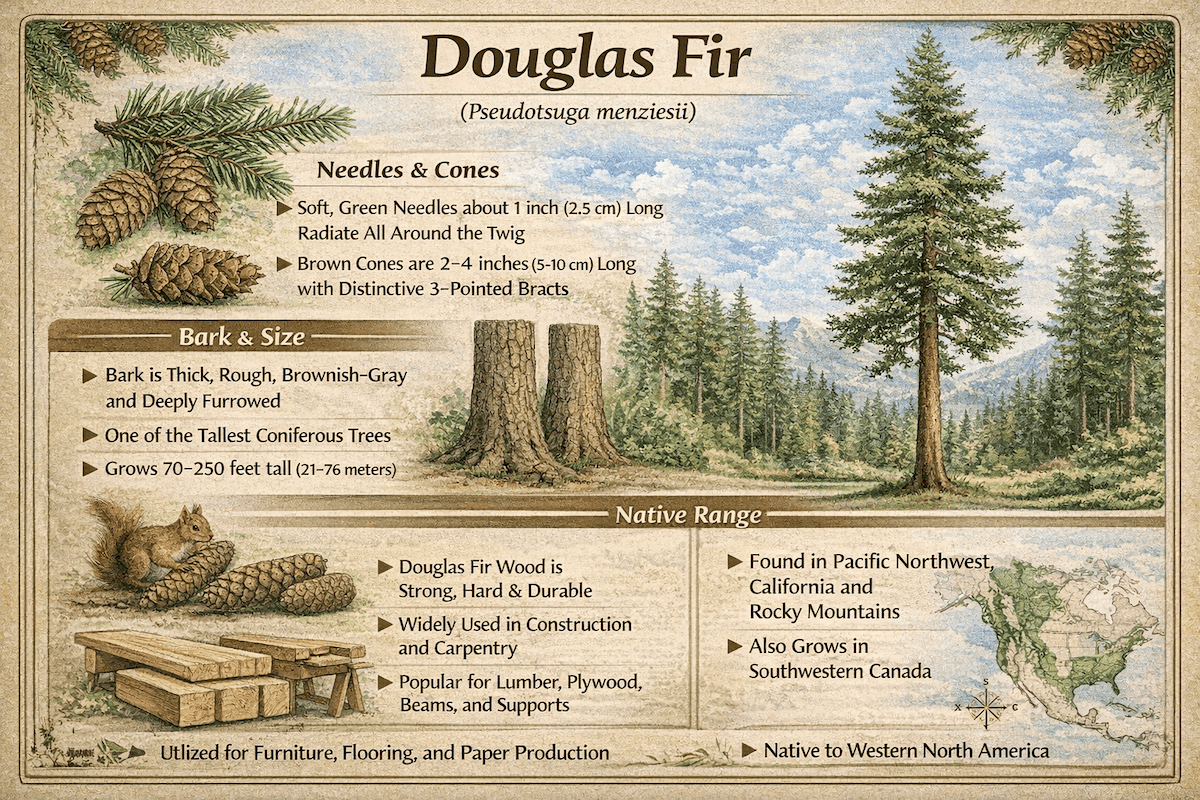
Douglas fir is one of the most valuable timber species in the world, prized for its exceptional strength, stability, and durability. Its wood has a high strength-to-weight ratio, straight grain, and excellent load-bearing capacity, making it a preferred material for structural applications such as beams, posts, joists, framing lumber, and heavy timber construction. From residential homes to large-scale commercial buildings, Douglas fir remains a cornerstone of modern construction.
Among timber products, knot-free Douglas fir sawlogs—especially those measuring 30 inches or more in diameter—command premium prices in the marketplace. Clear, knot-free wood is classified as top-grade structural timber because the absence of knots allows the wood fibers to run uninterrupted, significantly increasing strength, uniformity, and workability. In fact, clear lumber can be several times stronger than knotty wood, making it ideal for high-performance structural and architectural uses.
Knots, while natural, introduce weak points in lumber. As a general rule, each knot reduces structural integrity, and multiple knots can quickly downgrade a board from premium to standard construction grade. Lumber with numerous knots is still widely used, but it is typically limited to applications where maximum strength and visual clarity are not critical. This grading system is a key driver behind the price differences seen in Douglas fir timber products.
Today, clear Douglas fir wood is increasingly rare, particularly in large dimensions such as wide planks and beams exceeding 24 inches. Historically, these premium materials were sourced from old-growth forests, where trees grew slowly over centuries—often 500 to 1,000+ years— producing dense, uniform, knot-free wood. With most old-growth stands already harvested or protected, the supply of large clear timber has diminished significantly, increasing its value in specialty markets.
This scarcity presents a compelling opportunity for modern forestry. By implementing long-term plantation management strategies—including proper spacing , pruning, and thinning— tree farmers can intentionally grow higher-quality Douglas fir suitable for premium markets. Pruning lower branches early in the growth cycle, for example, helps produce longer sections of clear, knot-free wood as the tree matures.
From an investment perspective, Douglas fir offers both economic and environmental returns. With relatively low seedling costs (often around $3 per tree), a managed growth cycle of 25–40 years, and the potential to produce multiple high-value sawlogs per tree, growers can achieve strong long-term yields. At the same time, Douglas fir plantations contribute to carbon sequestration, soil stabilization, and ecosystem restoration, making them a powerful tool in climate-smart forestry.
Whether viewed as a premium construction material or a long-term forestry investment, Douglas fir stands out as a species that delivers strength, value, and sustainability—a rare combination that continues to drive its global demand.
To truly grasp the scale and longevity of Douglas fir trees, one need only look at Big Lonely Doug, an iconic and powerful symbol of old-growth forests on Vancouver Island, Canada. Standing alone in the middle of a clear-cut landscape, this towering giant reaches approximately 230 feet in height, with a massive trunk measuring over 20 feet in diameter. Estimated to be between 900 and 1,500 years old, Big Lonely Doug predates modern civilization, having grown through centuries of natural history.
What makes this tree especially striking is not just its size, but its isolation. Once surrounded by a dense, ancient forest of similarly massive trees, Big Lonely Doug now stands as a solitary survivor—left behind during logging operations as a seed tree. Its towering presence in an otherwise cleared landscape creates a powerful visual contrast that captures both the grandeur of old-growth ecosystems and the scale of forest loss over time.
Old-growth Douglas fir forests are among the most biologically rich and structurally complex ecosystems in North America. Trees like Big Lonely Doug provide critical habitat for birds, mammals, and countless microorganisms, while also storing vast amounts of carbon accumulated over centuries. Their thick bark, towering height, and deeply rooted systems make them remarkably resilient to natural disturbances such as fire and storms.
Today, Big Lonely Doug stands as both a living monument and a call to action. It reminds us of what once covered vast portions of the Pacific Northwest—and what remains at risk. While many old-growth forests are now protected, continued efforts in conservation, sustainable forestry, and reforestation are essential to ensure that future generations can experience forests of this scale and significance.
In its quiet solitude, Big Lonely Doug tells a story of endurance, loss, and hope. It is a testament to the resilience of nature—and a powerful symbol of why protecting old-growth forests matters more than ever.
Douglas fir (Pseudotsuga menziesii) thrives along the West Coast of North America, where it has long been the dominant species for softwood lumber production. From California through Oregon, Washington, and into British Columbia, Douglas fir forests have supplied timber for homes, bridges, ships, and infrastructure for more than a century. Known for its exceptional strength-to-weight ratio, straight grain, and durability, it remains one of the most valuable commercial tree species in the world.
After nearly three centuries of intensive logging, only a small portion of the original old-growth Douglas fir forests remain. Many of these ancient stands—some with trees over 200 feet tall and centuries old—are now protected within national parks, state forests, and conservation areas across the United States and Canada. These preserved ecosystems not only showcase the towering majesty of Douglas fir, but also serve as living reminders of the importance of sustainable forestry and long-term resource management.
As demand for timber increased globally, Douglas fir was introduced to other regions with compatible climates. One of the most notable success stories is New Zealand, which launched an ambitious reforestation and plantation forestry program in the late 20th century. By incorporating species such as Californian redwood and Canadian Douglas fir, New Zealand rapidly developed a highly productive and export-driven forestry sector. Today, it ranks among the leading exporters of Douglas fir timber, second only to Canada.
Douglas fir plantations are now a cornerstone of New Zealand’s forestry industry. First introduced in the mid-1800s, the species proved exceptionally well-suited to the country’s climate and soils. Over time, it became a preferred species for producing high-quality structural timber, valued for its strength, stability, and versatility in construction.
The majority of Douglas fir plantations are located on New Zealand’s North Island, where favorable growing conditions support relatively rapid growth and consistent wood quality. Plantation design and management practices closely follow global forestry standards, including careful site preparation, optimized spacing, and ongoing stand management.
Thinning operations are typically carried out at key growth stages to reduce competition, improve tree form, and increase the diameter of remaining trees. These practices help maximize long-term value and produce higher-grade timber. Depending on the intended end use—such as framing lumber, engineered wood products, or specialty applications—harvesting generally occurs between 25 and 35 years after planting.
Beyond timber production, Douglas fir plantations in New Zealand provide a range of additional benefits. Their deep and stabilizing root systems are widely used for erosion control, particularly on sloped or vulnerable landscapes. They are also planted along waterways to support riparian restoration, helping to protect soil, improve water quality, and create habitat for native species.
In some settings, Douglas fir is also valued as an ornamental tree, appreciated for its symmetrical form, evergreen foliage, and distinctive cones. These qualities make it suitable for parks, large properties, and landscape designs where both beauty and function are desired.
Today, New Zealand’s Douglas fir plantations represent a model of modern, sustainable forestry—balancing economic productivity with environmental stewardship. By combining efficient plantation management with responsible land use practices, the country continues to demonstrate how forestry can support both local economies and long-term ecological resilience.
Douglas fir trees grow fast, much faster than hardwoods and significantly faster than most softwoods except for California Sequoia and Redwood, Fast growth makes this tree extremely valuable for commercial plantations because timber investors can recoup their investment faster than they would from hardwood tree plantations.
Douglas fir is a prized species for commercial softwood tree plantations, particularly in the western United States, where it is native.
The number of trees per acre in a Douglas fir plantation can vary depending on the intended use and management strategy. For timber frame dimensional beam and lumber, production , tree densities can range from 200 to 1000 trees per acre, with higher densities typically resulting in smaller, straighter trees that are suitable for sawlogs.
The spacing between softwood trees in a plantation can also vary depending on the management strategy and site conditions. In general, spacing between trees can range from 6 to 20 feet, with wider spacing resulting in larger trees with wider branches.
The spacing between parallel rows of trees can also vary but is typically around 10 to 12 feet in commercial plantations. This spacing allows for efficient use of equipment and provides enough space for trees to grow without being too crowded.
Thinning is an important management practice in softwood tree plantations, including Douglas fir. Thinning involves removing some trees from the plantation to promote the growth and development of the remaining trees. Strategic thinning helps to reduce competition for light, water, and nutrients, thereby improving the overall quality of the trees. Thinning is typically done at regular intervals, such as every 5 to 10 years, depending on the growth rate of the trees and the desired final product.
The average time to harvest a Douglas fir plantation can vary depending on the intended use and management practices. Timber harvests occur between 30 and 60 years after planting, depending on the desired size and quality of the trees. Some plantations may be harvested earlier for other uses, such as Christmas tree production.
Terrain, Timber & Management
Many commercial tree species require certain types of soil and terrain for optimum growth. Others grow best at a genetically determined altitude. And still others require an adequate amount of rainfall to flourish. The reverse is true with Douglas fir; probably the most adaptable softwood tree able to grow in a wide variety of environments. Douglas fir does as well on mountain slopes as it does in river valleys. It also grows well in the shadow of the Rocky Mountains where only a few inches of rain fall each summer. Douglas fir grows best however in low coastal areas that receive significant amounts of rainfall; some trees grow over 200 feet tall and 20 feet across like Old Doug on Vancouver Island.
Douglas fir is regarded as superior structural lumber. Twice as strong as spruce and pine, fir wood is used for beams and floor joists in residential and commercial buildings. A laminated beam made from this tree equals the strength of a glulam, a type of manufactured beam used to span open spaces and support the bearing load of a floor, wall or roof structure. Douglas fir lumber generally dries without warping keeping walls and floors straight and true. Douglas fir wood can be used indoors or outdoors as a decorative finish. It covers well (paint or stain), is extremely durable and can last for years. The strength comes for its tight wood grain, not seen in other types of softwood.
Douglas Fir Wood Products
Douglas fir is used for exposed and non-exposed structural post and beams, glulam laminates, shake roof shingles, exterior finishes, interior trim and moldings, telephone poles, mid-priced furniture, and railway ties.
Douglas fir oil is an essential oil that is extracted from the needles of the Douglas fir tree (Pseudotsuga menziesii) using steam distillation, which releases an oil that is pale yellow with a fresh, woody, and slightly sweet aroma.
Douglas fir oil is valued for its therapeutic properties and is used in aromatherapy and natural medicine. Fir oil has anti-inflammatory, antiseptic, and decongestant properties, making it useful for respiratory issues, muscular aches and pains, and a variety of skin conditions. It is also believed to reduce stress and anxiety when it is rubbed on a person’s forehead.
In addition to its therapeutic uses, Douglas fir oil is used in perfumes, soaps, and other personal care products for its pleasant scent. Fir oil can be used to flavor certain foods and beverages, like chewing gum and soft drinks.

With thoughtful pruning and creative vision, Douglas fir trees can be transformed from traditional forest giants into striking landscape features—true examples of living art. By selectively shaping growth, including techniques such as controlled topping and strategic branch removal along the trunk, a Douglas fir can be trained into a sculptural form reminiscent of an “Arizona Palm”. The result is a bold, architectural tree that immediately captures attention—especially in regions like the Pacific Northwest, where palm-like silhouettes are unexpected and visually compelling.
This approach blends arboriculture with design, allowing homeowners, landscape architects, and developers to create focal-point trees that stand apart from conventional plantings. Whether used in residential gardens, commercial properties, or public spaces, a sculpted Douglas fir introduces a unique vertical element that draws the eye and creates a memorable sense of place.
Beyond aesthetics, Douglas fir trees are highly functional in urban and suburban environments. Their dense evergreen canopy is effective at capturing airborne pollutants, including dust and particulate matter, helping to improve air quality. At the same time, their shade reduces surface temperatures, contributing to the mitigation of the urban heat island effect—a growing concern in cities worldwide.
Douglas firs also play an important role in atmospheric balance. Through photosynthesis, they absorb carbon dioxide and release oxygen, contributing to what can be thought of as a localized “oxygen-rich microclimate” around the tree. While all trees participate in this exchange, the size, needle density, and year-round foliage of Douglas firs make them particularly effective contributors to cleaner, fresher air in their immediate surroundings.
In addition to environmental benefits, Douglas fir trees provide valuable wildlife habitat, offering shelter and nesting sites for birds and small animals. Their evergreen structure ensures year-round coverage, making them especially beneficial in colder climates where deciduous trees lose their leaves.
Incorporating Douglas fir into a landscape—whether in natural form or as a sculpted statement piece—delivers a powerful combination of beauty, function, and ecological value. From pollution reduction and shade to habitat creation and artistic expression, these trees offer a rare opportunity to merge environmental performance with inspired design.

Where the planting site is relatively flat and level, a circle tree plantation can provide an efficient and visually distinctive plantation design. Developed by Tree Plantation LLC, this concept uses a geometric planting layout in which fir trees are arranged along an Archimedean spiral, with each tree spaced at measured intervals to support healthy growth and long-term stand management.
In the Pacific Northwest, this spiral-based plantation design offers more than aesthetics. The circular pattern can help reduce the impact of strong winds by breaking up the uniform exposure often found in conventional straight-row plantations. This may encourage more balanced crown development and more uniform top growth across the plantation, especially where wind pressure would otherwise push trees unevenly.
Another advantage of the circle tree plantation is access. The spiral configuration naturally creates curved pathways between planting bands, making it easier to move through the stand for inspection, pruning, maintenance, and selective thinning. These access corridors can support a long-term timber management strategy, including thinning around year 30 and a first harvest around year 60, depending on species, site quality, and management goals.
Beyond productivity, circle tree plantations introduce a design philosophy that blends forestry, geometry, and land stewardship. Rather than relying solely on rigid grid planting, the spiral layout offers a more adaptive and potentially resilient planting system that can combine practical forest management with a striking landscape pattern.
Interested in growing Douglas fir? Contact us for more information about partnerships, collaborations and turn-key plantation projects.
Softwoods, the pioneer species of the temperate forest, grow quickly to leave their mark on the landscape for centuries.
Partner with us in a land management project to repurpose agricultural lands into appreciating tree assets. We have partnered with growingtogive.org, a 501c3 nonprofit, to create tree planting partnerships with land donors.
We have partnered with growingtogive.org, a Washington State nonprofit to create a land and tree partnership program that repurposes agricultural land into appreciating tree assets.
The program utilizes privately owned land to plant trees that would benefit both the landowner and the environment.
If you have 100 acres or more of flat, fallow farmland and would like to plant trees, then we would like to talk to you. There are no costs to enter the program. You own the land; you own the trees we plant for free and there are no restrictions; you can sell or transfer the land with the trees anytime.
Douglas firs are built for steep, wet, and sometimes fire-prone terrain. Their thick, corky bark helps protect the living tissue underneath from surface fires, while deep, wide-spreading roots bind soil on hillsides and stabilize slopes. Narrow needles with a waxy cuticle reduce water loss during summer drought, and tall, straight trunks allow them to capture light even in dense stands. Winged seeds are carried by the wind, helping the species colonize disturbed areas. Below ground, Douglas fir roots form partnerships with mycorrhizal fungi, which dramatically boost water and nutrient uptake and help trees tolerate stress.
Douglas fir forests support a full community of wildlife. Large, old trees provide nesting cavities and broken-top platforms for birds such as spotted owls, woodpeckers, and other cavity nesters. Seeds and cones feed squirrels, chipmunks, and many small mammals, while dense younger stands offer shelter for deer and elk. On and under the bark, you’ll find insects, fungi, mosses, and lichens that in turn support amphibians and birds. Fallen logs and needle litter create moist microhabitats that are essential for salamanders and rich soil biota. In old-growth stands, Douglas fir is especially important for species of concern, including the marbled murrelet, which nests high on large, mossy limbs.
Old-growth Douglas fir forests are typically dominated by trees 250–500+ years old that can reach over 250 feet tall and 10–15 feet in diameter. These ancient stands store enormous amounts of carbon in trunks, roots, and deep forest soils, making them critical natural climate solutions. Structurally, they feature layered canopies, standing dead trees, and massive “nurse logs” that host new seedlings, fungi, and invertebrates. This complexity supports intricate food webs and many rare or specialized species. Historically, the tight- grained, durable wood from old-growth Douglas fir was prized for high-value structural timber, but today the priority for most remaining stands is conservation—protecting their ecological, cultural, and carbon values while shifting timber production to well-managed second-growth plantations.
Copyright © All rights reserved Tree Plantation






