


 INVEST
 PLANT
PLANT
 SOFTWOODS
 HARDWOODS
 CALCULATORS
 RESOURCES
 PROGRAMS

Softwoods
Learn More
WOODLOTS • TIMBER • LONG-TERM VALUE
Wondering what a woodlot is and how much it may be worth? A woodlot is a small managed forest that can provide timber, veneer, wildlife habitat, carbon storage, recreation, and long-term land value.
🌲 Quick answer: A healthy woodlot can contain trees at many stages of growth—from seedlings and saplings to timber and veneer-quality trees—each contributing to both ecological value and future income potential.
Examples: A managed woodlot may include young regeneration, sawtimber, high-value hardwoods, and premium veneer logs, all of which affect the overall value of the land.
A woodlot is typically privately owned and may range from a few acres to several hundred acres. Within a healthy woodlot you will often find trees at every stage of development—from newly emerging seedlings and young saplings to mature timber trees and high-value veneer logs.
Well-managed woodlots provide far more than timber. They support wildlife habitat, improve soil health, store carbon, protect water quality, and create recreational opportunities such as hiking, hunting, and birdwatching.
A single mature hardwood tree can produce veneer logs worth hundreds or even thousands of dollars depending on species, size, and log quality. Properly managed woodlots can become long-term natural assets that increase in value as trees mature.
Historically, nearly every farm included a woodlot that supplied timber for buildings, fencing, and firewood. Today many woodlots are underused or unmanaged, but with thoughtful planning they can become valuable income-producing assets while still delivering environmental benefits.
The Woodlot Estimator helps you approximate the potential value of trees growing on your property by identifying and counting trees at different growth stages.
To estimate the value of your woodlot, walk through your property and count the approximate number of tree assets in each category. Then enter the totals into the estimator below.
Once these numbers are entered, the estimator generates an approximate dollar value for the trees currently growing on your woodlot. This simple exercise can reveal how even a small forest may represent a significant long-term natural investment.
Key insight: The value of a woodlot depends not only on the number of trees, but also on the mix of age classes, species quality, and how many trees may eventually produce timber or veneer logs.
Estimating the value of a woodlot involves evaluating trees at different stages of growth. This estimator provides a simple way to approximate the economic value of seedlings, saplings, standing timber, and veneer-quality trees on your property.
Follow these steps to calculate the estimated value of your woodlot:
Because tree species, size, and market conditions vary, the results provide a general estimate rather than a professional timber appraisal. However, the estimator offers a useful starting point for landowners, forest managers, and investors evaluating the potential value of a woodlot.
The value of a woodlot depends on far more than simply counting the number of trees on the property. Foresters and timber buyers evaluate several biological and economic factors when estimating the potential value of a forest stand. Understanding these factors can help landowners make better decisions about planting trees, thinning, and long-term forest management.
When using a woodlot estimator or evaluating standing timber, the following characteristics typically have the greatest influence on total value.
| Factor | Why It Matters |
|---|---|
| Tree Species | Some species command far higher market prices than others. Hardwood species such as oak, maple, walnut, and cherry often produce valuable lumber or veneer, while many softwoods are primarily used for construction lumber or pulp. |
| Tree Size (Diameter / DBH) | Larger trees generally have higher value because they yield more usable lumber. Foresters commonly measure tree diameter at breast height (DBH) to estimate timber volume and potential board-foot yield. |
| Trunk Straightness | Straight trunks produce longer, more usable boards and are easier to mill into high-quality lumber. Crooked or heavily leaning trees often produce lower-value wood. |
| Defects and Knots | Knots, cracks, insect damage, rot, and other defects reduce lumber quality and decrease the price buyers are willing to pay for standing timber. |
| Veneer Quality | Trees that produce veneer logs—large, straight trunks with minimal defects—can be worth several times more than ordinary timber because veneer wood is used in high-value furniture, cabinetry, and architectural panels. |
| Access to Market | Transportation costs play a major role in woodlot economics. Forest stands located close to sawmills, veneer mills, or timber buyers are typically more valuable than remote stands that require difficult harvesting or hauling. |
| Site Conditions | Soil quality, slope, drainage, and climate all influence how quickly trees grow and the quality of wood they produce. Healthy growing conditions generally result in faster growth and higher-value timber. |
| Age and Management History | Woodlots that have been properly managed through thinning, pruning, and regeneration practices often produce higher-quality trees and better long-term timber value. |
Because these factors vary widely from one property to another, two woodlots with the same number of trees can have dramatically different economic values. Careful forest management and thoughtful agroforestry planning can help increase both ecological health and long-term financial value.
Trees in a woodlot gain economic value as they grow and mature. Seedlings and saplings typically have low individual value but can be valuable when planted at scale, while mature trees used for lumber or veneer can be worth significantly more.
The following comparison illustrates how value generally increases as trees move through different growth stages.
| Tree Stage | Typical Value Range | Main Use |
|---|---|---|
| Seedlings | Low value per tree, but valuable in large quantities | Forest restoration, nursery production, reforestation projects, and transplant stock. |
| Saplings | Higher than seedlings | Young trees suitable for landscaping, orchard establishment, and future timber production. |
| Standing Timber | Moderate to high value depending on species and size | Harvested for lumber, sawlogs, construction materials, and general wood products. |
| Veneer Trees | Highest value | Premium logs used for veneer sheets, fine furniture, cabinetry, musical instruments, and specialty wood products. |
Because of these differences, two forests with the same number of trees can have dramatically different economic value. Factors such as species, tree size, trunk quality, and management practices determine whether a tree becomes ordinary timber or high-value veneer wood.
Tree seedlings growing on a woodlot represent the earliest stage of future timber value. In many cases these young trees can be identified as individuals roughly 10 to 20 feet tall with a caliper (diameter) of 1–2 inches. The most valuable seedlings often develop in the shaded understory of a healthy woodlot, where they grow tall and relatively branch-free as they stretch toward filtered sunlight beneath the forest canopy.
These straight, vigorous young trees can be carefully tagged and selectively harvested for transplanting. When properly handled, seedlings can be excavated and containerized for resale, relocation, or use in new planting projects. Many landowners use woodlot seedlings as a source of planting stock for projects focused on planting tree seedlings and expanding forest cover through reforestation initiatives.
Tall, slender seedlings that have developed straight trunks are often called tree whips. These young trees can be excavated from the woodlot and transplanted into containers or pyramidal wooden planters where they can continue growing until they reach a desirable size.
Once established, these tree whips may be planted into open fields, windbreaks, or future tree plantations. This process allows landowners to convert naturally occurring forest regeneration into valuable planting stock for timber production, landscape projects, or restoration plantings.
Portable woodlot hand excavators—sometimes called tree spades or tree transplanters—are small handheld tools designed to dig out and relocate young trees. These tools allow landowners to carefully remove seedlings and tree whips while preserving the root system.
Most hand excavators consist of several sharp blades or spades attached to a handle or compact frame. The blades are inserted into the soil around the young tree to create a root ball, allowing the plant to be lifted out of the ground along with surrounding soil that protects the roots.
After removal, the seedling can be transported to a new location and planted into prepared soil or containers. These tools are especially useful in woodlots where large machinery cannot easily access the forest floor.
Because they are lightweight and easy to operate, portable tree excavators are widely used for small-scale forestry work such as harvesting woodlot tree whips, relocating volunteer seedlings, and preparing young trees for planting in restoration, landscaping, or new timber plantations.

Feel free to share this woodlot estimator infographic on your website or blog. Please include a link back to this page as the source.
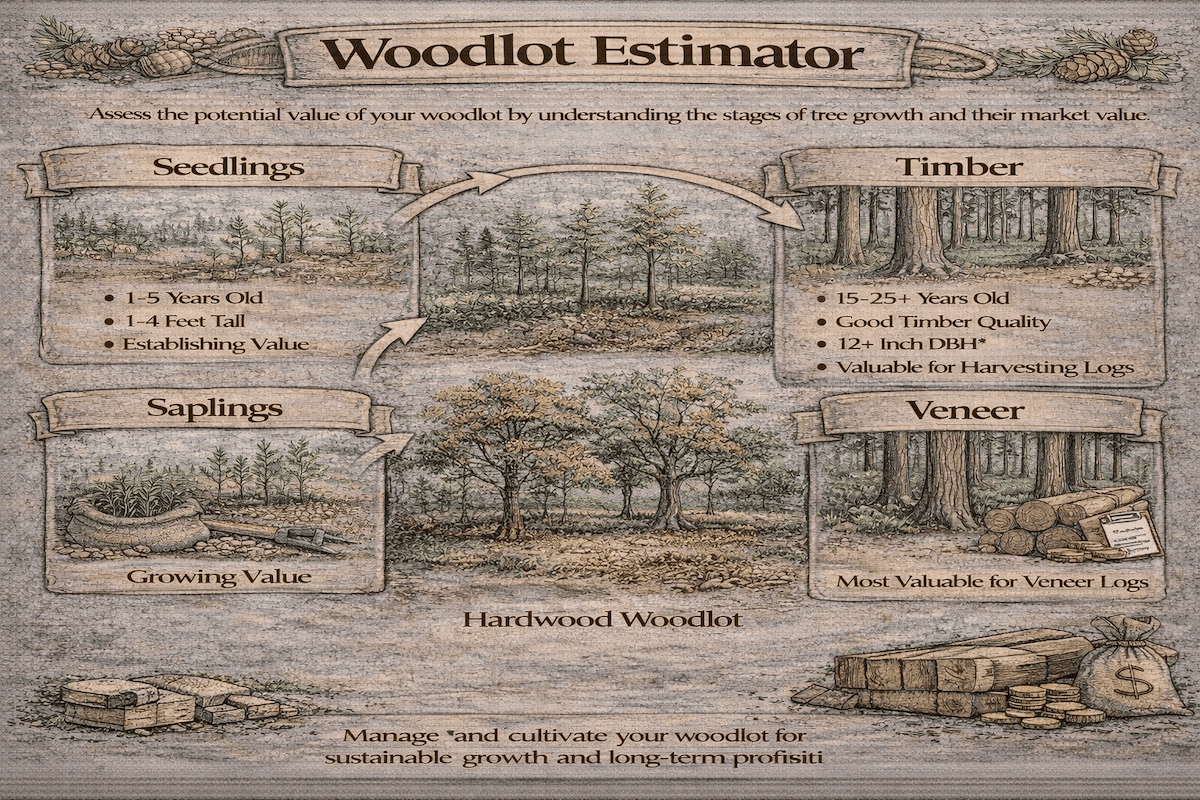
Woodlot tree saplings represent the next stage of forest development after seedlings and young tree whips. These trees can often be identified as individuals roughly 20 to 50 feet tall with a trunk diameter of about 5 to 8 inches. At this stage of growth, saplings begin to accumulate measurable timber value while still offering multiple management options for landowners.
Depending on the tree species and wood quality, saplings growing in a woodlot may be harvested for pole wood, firewood, or biomass products such as wood pellets. Softwood species are often preferred for pole wood and utility uses, while lower-grade hardwoods may be better suited for fuel production. Resources such as national forests demonstrate how forests managed over time can produce a diverse mix of timber, fuelwood, and ecological benefits.
In some cases, well-formed saplings can be transplanted rather than harvested. Landowners may relocate young trees from a dense woodlot into open fields or new planting areas to establish a future forest stand. When carefully managed, this process can help create an instant forest while improving spacing and growth conditions for the remaining trees. These practices are closely related to methods used in planting tree seedlings and broader forest restoration and conservation efforts.
Hydraulic shovel tree excavators—often called tree spades or woodlot tree excavators—are specialized machines designed to transplant trees safely from one location to another.
These machines typically feature a hydraulic arm equipped with several large blades or “spades.” The blades are inserted into the soil around the base of the tree, cutting a circular root ball that surrounds and protects the root system.
Once the root ball is secured, the hydraulic system lifts the tree out of the ground along with a large mass of surrounding soil. The tree can then be transported to a prepared planting location where the same machine can dig the new planting hole.
Although hydraulic tree spades are highly effective for relocating saplings and young trees, careful planning is essential. Minimizing root disturbance, maintaining soil moisture, and properly watering the transplanted tree all play important roles in ensuring that relocated woodlot saplings survive and continue growing into valuable timber trees.

Compare other wood-based value and fuel tools to better understand firewood output, pellet needs, and forest product potential.
Estimate firewood volume, stack size, and heating potential for split logs and cordwood.
Use the calculator →Calculate pellet needs for heating, compare fuel planning, and estimate wood pellet usage more accurately.
Explore the estimator →Standing timber trees growing on a woodlot represent one of the most valuable stages in the life of a forest. These mature trees are often between 50 and 100 feet tall with trunk diameters ranging from 12 to 18 inches or more. At this stage, trees begin to produce sawlogs that can be milled into high-value lumber for construction, furniture, and specialty wood products.
Landowners with access to a portable sawmill can harvest selected trees and mill the logs directly on the property. After milling, lumber is typically air-dried or naturally cured for a full season before being used or sold. Once properly dried, boards can be planed, dressed, and finished to produce dimensional lumber suitable for building materials, cabinetry, flooring, and woodworking projects.
The most valuable standing timber trees are those that produce long, straight sections of clear wood with minimal knots or defects. Trees that grow tall and straight in dense forest stands often develop these desirable characteristics because competition for sunlight encourages upward growth and fewer lower branches.
Many valuable hardwood species are commonly found growing in woodlots and natural forests. Examples include black cherry trees, maple trees, and oak trees, all of which are widely prized for their strong, attractive lumber used in furniture, cabinetry, flooring, and interior finishes.
Your woodlot may also contain future clear-grained sawlogs—trees that are carefully managed and allowed to mature in order to produce premium lumber. These trees are selected based on their straight trunks, consistent growth, and lack of defects. Over time, proper thinning and forest management can help encourage these trees to develop into high-value timber assets.
The ultimate size and value of standing timber trees will depend on species, site conditions, and how long the trees are allowed to grow. In many cases, mature timber trees can eventually reach diameters of several feet and produce logs that are suitable for structural lumber, architectural millwork, and other high-value wood products.

Woodlot veneer sawlogs represent the highest-value trees that may be growing on a property. These mature trees are often 80 to 200 feet tall with trunk diameters ranging from 20 to 40 inches or more. Veneer-quality trees are prized because they produce large sections of straight, defect-free wood that can be sliced into thin sheets used for wood veneers in furniture, cabinetry, architectural millwork, and high-end interior finishes.
Many landowners are surprised to discover that a few veneer-quality trees may already be growing in older or neglected bush lots. The most valuable veneer logs typically contain a long section of clear, branch-free trunk, which allows mills to produce premium Grade-1 veneer. Because of this rarity, a single veneer tree can sometimes be worth hundreds or even thousands of dollars depending on the species, size, and wood quality.
Veneer sawlogs can occur in a variety of hardwood species, with some of the most sought-after being walnut, cherry, maple, and oak. These species develop strong, attractive grain patterns that make them ideal for decorative wood products and fine woodworking.
Compared with other timber trees, veneer sawlogs are typically older and more carefully developed. They usually exhibit a straight trunk, minimal knots or defects, and a consistent grain pattern. In natural forests, trees that grow slowly within dense stands sometimes develop these characteristics as they compete for sunlight.
Many veneer-quality trees originate from forests that have matured over long periods of time, similar to the structure found in old-growth forests. Proper management of a woodlot—including thinning, protecting high-quality stems, and allowing selected trees to mature—can increase the likelihood that some trees will eventually develop into valuable veneer sawlogs.
Every tree planted is a metric waiting to be measured. Use our free online tree calculators to plan tree plantations, woodlots, windbreaks, and carbon projects.
Together, these tools help you design profitable, climate-smart tree projects, from small homestead woodlots to commercial tree plantations and carbon forests.
Partner with us in a land management project to repurpose agricultural lands into appreciating tree assets. We have partnered with growingtogive.org , a 501(c)(3) nonprofit, to create tree-planting partnerships with land donors.
We have partnered with growingtogive.org , a Washington State nonprofit, to create a land and tree partnership program that repurposes agricultural land into appreciating tree assets.
The program utilizes privately owned land to plant trees that benefit both the landowner and the environment.
If you have 100 acres or more of flat, fallow farmland and would like to plant trees, then we would like to talk to you. There are no costs to enter the program. You own the land; you own the trees we plant for free, and there are no restrictions; you can sell or transfer the land with the trees anytime.
Copyright © All rights reserved Tree Plantation