


 INVEST
 PLANT
PLANT
 SOFTWOODS
 HARDWOODS
 CALCULATORS
 RESOURCES
 PROGRAMS

Softwoods
Learn More
Growth • Biomass • Returns
Hybrid poplar is one of the best trees for landowners who want rapid growth, short rotations, biomass production, pulpwood, and early financial return. In good conditions, these trees can grow 5–8 feet per year, making them ideal for short-rotation forestry, windbreaks, carbon capture, erosion control, and renewable energy systems.
If your goal is to turn open land into a productive tree crop quickly, hybrid poplar offers a rare combination of speed, versatility, coppice regrowth, and commercial value.
Hybrid poplar is a family of fast-growing poplar crosses planted for biomass, pulpwood, and short-rotation timber. In good conditions, many plantings can add 5–8 feet of height per year during early growth—making hybrid poplar a top choice when speed matters.
The “best” stock and spacing depends on how many trees you’re planting, your rotation length, and how much labor and survival risk you can afford—tradeoffs you can model with the tools below.
Jump to: spacing • biomass • economics • FAQs
Model your plan: Tree Spacing Calculator • Tree Value Calculator • Wood Pellet Estimator
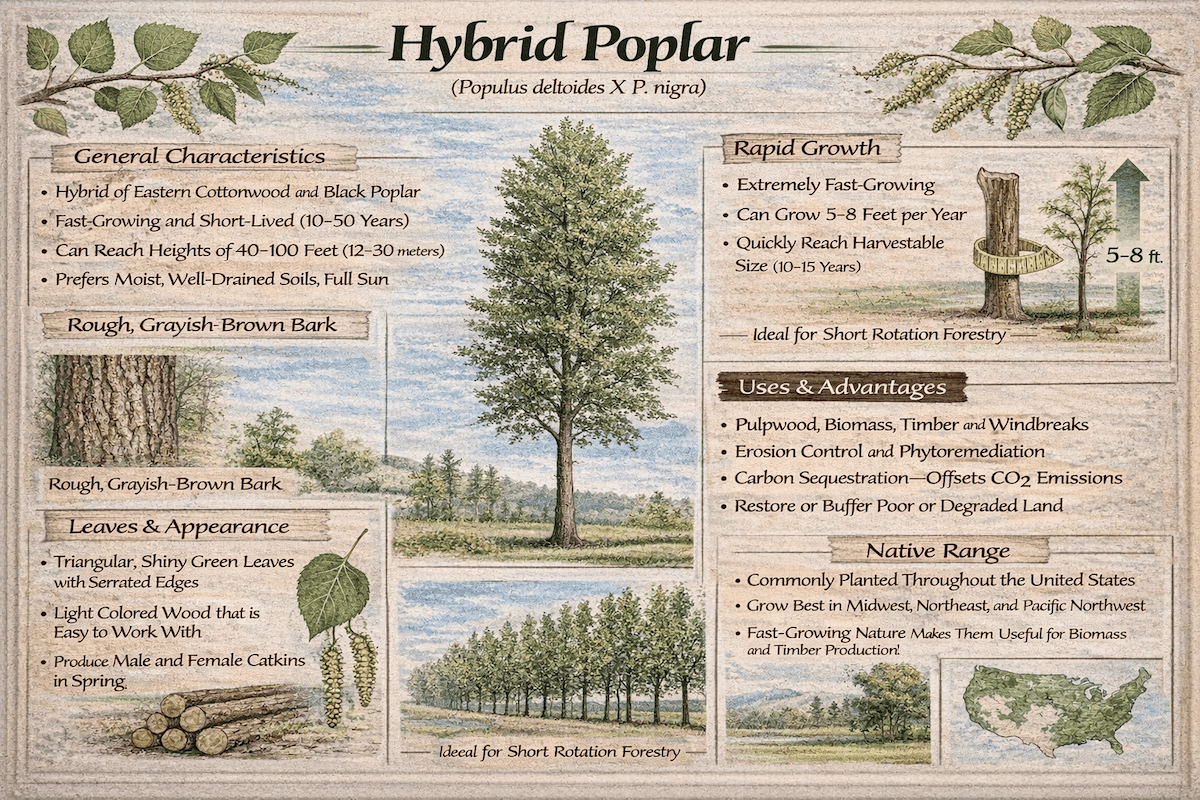
Feel free to share this hybrid poplar infographic on your website or blog. Please include a link back to this page as the source.
| Factor | Hybrid Poplar | Typical Hardwood Timber |
|---|---|---|
| Growth speed | Very fast (often 5–8 ft/yr early) | Moderate (often 1–2 ft/yr) |
| Rotation length | Short (5–20 years common) | Long (30–80+ years) |
| Primary uses | Biomass, pulpwood, panels | Veneer, lumber, furniture |
| Regrowth after harvest | Often coppiced in some systems | Usually replanted |
Hybrid poplar profitability is mostly a function of trees per acre × survival × yield × price. You can build a fast, realistic back-of-napkin model using tools you already have on TreePlantation.com.
Tip: Make 3 scenarios—conservative, expected, optimistic—by changing only survival and price. That’s often enough to decide if the rotation pencils out.
Hybrid poplar trees, commonly classified among fast-growing softwood tree species, are widely recognized for their exceptional growth rates, adaptability, and commercial versatility. These trees perform well across a broad range of soils and climates, but thrive best in deep, well-drained loam soils with consistent moisture, full sun exposure, and moderate temperatures.
Under optimal conditions—loose, nutrient-rich soil, adequate rainfall or irrigation, and temperatures near 75–85°F—hybrid poplar can grow 3–5 feet per year in early stages, with some improved varieties exceeding 6 feet of annual growth. This rapid development makes hybrid poplar one of the most efficient tree crops for short-rotation forestry and high-yield land use.
Modern hybrid poplar varieties were developed through selective breeding and cross-pollination of species such as Cottonwood, Quaking Aspen, Balsam Poplar, and Lombardy Poplar. Beginning in the 1970s, researchers focused on improving growth rate, disease resistance, and climate adaptability, resulting in highly productive hybrids that transformed the economics of tree farming.
With growth rates of up to 5–6 feet per year and harvest cycles as short as 5–7 years for biomass, hybrid poplar stands out as one of the most efficient tree crops for modern forestry and renewable energy systems.
In well-managed plantations, growers can generate $25,000–$50,000+ per acre within 10–12 years, while benefiting from multiple harvest cycles through coppicing—reducing replanting costs and maximizing long-term returns.
The introduction of high-performance hybrid poplar varieties helped drive a major expansion in commercial tree plantations, particularly in the pulp, paper, and biomass energy sectors. Today, a significant portion of hybrid poplar acreage is dedicated to biomass production systems, where fast growth and short harvest cycles provide a reliable source of renewable energy feedstock.
From an economic standpoint, hybrid poplar offers a compelling value proposition. With proper management, an acre of hybrid poplar can generate gross revenues ranging from $25,000 to $50,000 by year 10–12, with the potential to double that value by year 18–20 depending on market conditions, spacing, and end use.
Unlike many traditional forestry systems, hybrid poplar supports short rotation cycles of 5–7 years for biomass and 10–20 years for timber and pulpwood. Combined with its ability to regenerate through coppicing (stump sprouting), growers can achieve multiple harvest cycles from a single planting—significantly reducing replanting costs and improving long-term return on investment.
As demand continues to grow for renewable materials, carbon sequestration solutions, and sustainable land use systems, hybrid poplar stands out as a high-efficiency tree crop that bridges the gap between economic performance and environmental impact.
Hybrid poplar plantations offer one of the most attractive economic profiles in modern forestry. With rapid growth, short rotation cycles, and multiple revenue streams, they are increasingly used in commercial timber production, biomass energy systems, carbon markets, and land restoration projects.
For landowners, farmers, and investors, hybrid poplar represents a high-efficiency tree crop capable of delivering strong returns while improving soil health, reducing erosion, and contributing to climate-smart land use.
Hybrid poplar is widely recognized as a leading species for biomass energy production , particularly in short-rotation forestry systems. Its rapid growth, uniform fiber quality, and ability to regenerate after harvest make it ideal for renewable energy applications.
Many farmers are converting underutilized or fallow land into hybrid poplar plantations to diversify income and create a reliable, renewable fuel source. These trees are used in ethanol production, wood pellet manufacturing, and biomass-fired power plants, providing a consistent and scalable feedstock.
With harvest cycles as short as 5–7 years, hybrid poplar delivers a steady revenue stream while maintaining long-term productivity. After each harvest, new shoots emerge from the existing root system, allowing for continuous production without replanting—a key factor in improving long-term profitability and reducing operational costs.
As demand for renewable energy and carbon-reducing solutions continues to grow, hybrid poplar stands out as a strategic crop for both economic return and environmental impact.
Estimate biomass yield, harvest cycles, coppicing performance, and per-acre profitability across multiple tree species and climate regions. Compare dry vs green tons and model short-rotation biomass systems with confidence.
Hybrid Poplar biomass is highly versatile, supporting various energy production methods, including combustion, gasification, and pyrolysis. It can be burned directly to generate heat and electricity or processed into biofuels like ethanol or biodiesel. This adaptability has made it an important renewable energy resource.
An added environmental benefit is its role in mitigating climate change. Through photosynthesis, Hybrid Poplar trees absorb significant amounts of carbon dioxide from the atmosphere . When the biomass is used for energy, the carbon released is offset by what was absorbed during growth, making it a carbon-neutral energy source.
While Hybrid Poplar thrives on marginal land, its growth potential is exceptional in ideal conditions. In fertile soil with a good climate and adequate rainfall, these trees can reach heights of 30 feet in just 5 years. For farmers seeking a secondary crop on fallow farmland, Hybrid Poplar tree farms offer an attractive and profitable opportunity.
Establishing a successful hybrid poplar plantation requires thoughtful site preparation, proper spacing, and consistent moisture management. Because hybrid poplar is a fast-growing, high-demand tree crop, early-stage decisions directly impact long-term yield, rotation cycles, and overall profitability.
In regions with low or inconsistent rainfall—such as interior valleys of Oregon, Washington, and other semi-arid zones—supplemental irrigation is often essential to achieve optimal growth rates of 5–8 feet per year.
Step 1: Site Preparation
Begin by tilling or ripping the soil to break up compaction and incorporate existing vegetation.
This improves aeration, root penetration, and nutrient availability. Removing competing weeds at this stage
is critical for early establishment.
Step 2: Grading and Leveling
Level and grade the site to create a uniform planting surface. Proper grading improves
water distribution, prevents pooling, and ensures consistent tree growth across the plantation.
Step 3: Ground Cover Installation
Apply biodegradable ground cover or weed barrier fabric, preferably dark-colored to absorb
solar heat. This creates a microclimate heat sink that accelerates early growth while also
suppressing weeds and conserving soil moisture.
Step 4: Irrigation System Setup
Install a drip irrigation system where rainfall is insufficient. Hybrid poplar responds
extremely well to consistent moisture, and drip systems provide efficient, targeted water delivery while
minimizing evaporation loss.
Step 5: Planting Stock and Spacing
Use rooted cuttings or root seedlings rather than branch cuttings for faster establishment
and higher survival rates. Spacing should align with your production goals:
Step 6: Early Growth Management
Monitor weed pressure, irrigation levels, and nutrient availability during the first growing season.
Hybrid poplar establishes quickly, but early competition can significantly reduce growth rates
if not properly managed.
Step 7: Harvest Timing
Trees are typically ready for harvest when the trunk reaches a 6–10 inch caliper at
approximately one foot above ground level. Depending on spacing, climate, and management practices,
this can occur within 3–7 years in short-rotation systems.
With proper planning and management, hybrid poplar plantations can deliver high yields, rapid rotations, and multiple harvest cycles through coppicing, making them one of the most efficient tree crops for biomass energy, pulpwood, and sustainable forestry systems.
One of the most powerful advantages of hybrid poplar is its ability to regenerate after harvest through a process known as tree coppicing and regrowth management . By harvesting trees in early spring—just as sap begins to rise and buds start to form—you trigger rapid regrowth from the existing root system.
Within 2–4 weeks after cutting, multiple new shoots (typically 4–6) will emerge from the stump. These shoots benefit from an already established and extensive tree root system, allowing them to grow significantly faster than newly planted trees.
During the first growing season, allow all shoots to develop. Then, depending on your production goals, you can manage the regrowth for optimal performance:
Because the established tap root system remains intact after harvesting, coppiced hybrid poplar can achieve accelerated growth rates in successive cycles, often outperforming first-generation plantings. This makes it an ideal species for sustainable forestry systems, biomass energy production, and high-efficiency land use.
With proper management, a single planting can produce multiple harvest cycles over time—reducing replanting costs while increasing long-term productivity per acre.

Hybrid poplar thrives across a broad portion of North America, generally aligning with the native range of indigenous poplar species. These trees perform well throughout Canada, the Great Lakes region, the Northeast, the Pacific Northwest, and parts of the Upper Midwest, where moisture, soil depth, and seasonal temperature variation support rapid growth.
In terms of hardiness, hybrid poplar is typically well suited to USDA Zones 3 through 9, making it one of the most adaptable fast-growing tree crops available. However, optimal performance depends less on zone alone and more on water availability, soil quality, and site selection.
Peak growth rates are achieved in low-lying, well-drained areas with consistent moisture, such as river valleys, floodplains, and irrigated agricultural land. Deep, fertile soils with good water-holding capacity can dramatically increase annual growth—often exceeding 5–8 feet per year under ideal conditions.
In drier or more arid regions, hybrid poplar can still be successfully grown with supplemental irrigation and proper spacing. Shelterbelts, windbreak systems, and managed plantations in western states can benefit from hybrid poplar’s rapid establishment and canopy development, even in more challenging climates.
Whether planted for biomass production, timber, wind protection, carbon sequestration benefits, or land restoration, hybrid poplar’s wide geographic range and adaptability make it a reliable choice for both commercial forestry systems and environmental restoration projects across North America.

Hybrid poplar wood is valued for its lightweight structure, straight grain, and affordability, making it one of the most practical and widely used utility hardwood alternatives in North America. The heartwood typically ranges from light cream to yellowish-brown, often accented with subtle gray or green streaks, while the sapwood appears pale yellow to nearly white and is not always clearly separated.
One of the more distinctive visual features of poplar is the presence of mineral staining, which can create vibrant hues of purple, green, red, or yellow—commonly referred to as “rainbow poplar.” While these color variations are largely cosmetic, they add unique character for certain applications.
The wood grain is generally straight, uniform, and fine to medium in texture, allowing for consistent machining and finishing. Because of its relatively low density, poplar can develop a slight surface “fuzz” when sanded, which is easily corrected with fine-grit sanding and proper finishing techniques to achieve a smooth, clean surface.
Hybrid poplar’s combination of fast growth, ease of processing, and wide availability makes it a preferred material across multiple industries—from construction and manufacturing to paper and engineered wood products.
For growers and manufacturers alike, hybrid poplar represents a high-efficiency wood resource—delivering consistent quality, rapid renewability, and broad industrial application across modern wood markets.
I thought I would try planting some hybrid poplar on my farm. Since I had room, I thought I would plant two separate acres to test harvest volume between the two plots before I planted more land. I planted trees pretty close together, so I had somewhere in the neighborhood of poplar 9,000 trees an acre give or take. I let the first acre grow untouched, but I thinned every second hybrid poplar tree from the second acre. The idea was to compare harvestable wood volume. What I found was that I made twice the money from the thinned acre and the trees where bigger and healthier too! The trees where much thinner on the first acre and many had developed cankers on the trunks. I also noticed that 1,000 or more trees had died off from lack of sunlight – so I guess that first acre was trying to thin itself. So, from this I will definitely plant trees close together but thin them in year 4 or 5. I’m going to let them grow a little longer as well – probably 10 to 12 years. It’s also nice that I can use my profit from both acres to plant 100 acres in hybrid poplar trees.
I divided a large acreage into 20, 10-acre sections to create an ongoing income stream for the farm and my kids. The first section was planted in 2008 using hybrid poplar clones shipped in from out of state. It took about 10,000 seedlings to plant out the section. I repeated this over the next 10 years and now have half of my tree acreage planted in hybrid poplar – 10 more years to go before annual harvests. The trees in the first section are 40 feet tall with 8-inch trunks. To look out over the farm and see the tree sections at different heights is something to see. The paper mill has offered to buy all I grow at a cut and ship price of $6,000 per acre starting in year 20. Although that is below the best wholesale price I found when I started, I think $60,000 income every year would be great for the farm; and I don’t have to do any work and that’s a good thing considering the millions of spiders that have spun webs all through the hybrid poplar stands. I wouldn’t want to walk through there at night; it would make a great Halloween attraction. One thing I have notices as well is that there are not as many insects around – it must be the spiders.
Partner with us in a land management project to repurpose agricultural lands into appreciating tree assets. We have partnered with growingtogive.org , a 501(c)(3) nonprofit, to create tree-planting partnerships with land donors.
We have partnered with growingtogive.org , a Washington State nonprofit, to create a land and tree partnership program that repurposes agricultural land into appreciating tree assets.
The program utilizes privately owned land to plant trees that benefit both the landowner and the environment.
If you have 100 acres or more of flat, fallow farmland and would like to plant trees, we would like to talk to you. There are no costs to enter the program. You own the land; you own the trees we plant for free, and there are no restrictions—you can sell or transfer the land with the trees at any time.
Poplar and hybrid poplar wood are versatile, lightweight hardwoods commonly used for furniture frames, cabinetry, interior trim, doors, shelving, drawer parts, and paneling. Because it machines easily and has a smooth, uniform grain, it’s also popular for paint-grade millwork, plywood cores, pallets, crates, and paper products. Many makers use poplar as a hidden structural wood, or as a core veneered with more decorative hardwoods.
Poplar is considered a soft hardwood. Its strength is perfectly adequate for light furniture, interior framing, casework, and built-ins, but it is not as strong or as dent-resistant as oak, maple, or ash. For heavy load-bearing applications, stair treads, or high-abuse areas, builders usually choose a harder species or engineer the design (thicker sections, better support) to compensate.
Poplar is famous as a top-tier paint-grade wood. Its fine, even grain accepts primer and paint very well, producing a smooth finish with minimal grain telegraphing. For best results, sand through the finer grits, spot-prime any mineral streaks, then apply a quality primer and topcoat. Poplar will take stain, but mineral streaks and color variation can lead to a blotchy look—another reason it’s often painted or veneered rather than stained clear.
Lumber sold as “poplar” can come from several species. In North America, most commercial boards are from yellow poplar (Liriodendron tulipifera), also called tulip poplar or tulipwood—technically not a true Populus but widely accepted in the trade. True poplars include white poplar (Populus alba), black poplar (Populus nigra), and various hybrid poplars grown in plantations for fast-rotation timber, biomass, and pulp. Hybrid poplar plantations provide a renewable, short-rotation source of this light, workable wood.
Untreated poplar is not naturally weather durable. It tends to absorb moisture, which can lead to swelling, warping, and decay if it’s exposed directly to rain and soil. For exterior projects, poplar can be used if it is well sealed, painted, and kept off the ground, but it will still not match the longevity of naturally durable species like cedar, redwood, or teak. For outdoor decks, fences, or constantly wet conditions, choose more rot-resistant woods or pressure-treated material instead.
Copyright © All rights reserved Tree Plantation