 INVEST
 PLANT
PLANT
 SOFTWOODS
 HARDWOODS
 CALCULATORS
 RESOURCES
 PROGRAMS

Softwoods
Learn More




A complete guide to growing black walnut trees for high-value timber, veneer logs, and long-term investment. Learn how spacing, pruning, and plantation design impact profitability and tree value over time
BLACK WALNUT • TIMBER • LONG-TERM VALUE
Wondering why black walnut trees are so valuable? Black walnut (Juglans nigra) is one of the most prized hardwoods in North America, valued for its rich dark heartwood, premium veneer potential, and long-term timber investment appeal.
🌳 Quick answer: Black walnut is valuable because it combines scarcity, beauty, strong market demand, and high-end end uses such as furniture, cabinetry, veneer, flooring, and gunstocks.
Examples: Premium black walnut logs may be used for veneer, heirloom furniture, architectural millwork, interior paneling, specialty flooring, and carved wood products.
Black walnut trees (Juglans nigra) are among the most valuable hardwoods in North America, prized for their rich dark heartwood, strong market demand, and exceptional use in furniture, cabinetry, veneer, flooring, and gunstocks. Few native trees combine beauty, utility, and long-term investment potential as powerfully as black walnut.
What makes black walnut especially valuable is the rarity of large, straight, knot-free trunks capable of producing premium sawlogs and veneer logs. Because these trees grow slowly and require decades of careful pruning, spacing, and site management, high-quality black walnut remains scarce — and scarcity helps support strong prices for exceptional timber.
On this page you’ll learn how black walnut trees grow, why their wood commands such high value, how plantations are designed for profit, legacy wealth, and conservation, and what growers can do to improve the odds of producing high-value walnut timber over time.
Black walnut trees (Juglans nigra) are among the most profitable and prestigious hardwood species in North America, valued for their rich dark heartwood, exceptional lumber quality, and long-term investment potential. From premium veneer-grade logs to high-end furniture wood, black walnut stands at the intersection of beauty, utility, rarity, and wealth-building forestry.
For growers willing to think long term, black walnut can function as a form of living capital. A well-managed walnut plantation or mixed hardwood stand can produce periodic value through thinnings, land appreciation, wildlife habitat enhancement, and ultimately premium sawlog or veneer harvests.
The high value of black walnut has created a darker side of the market: timber theft. Because a single mature walnut tree can be worth thousands of dollars—and exceptional veneer trees far more— black walnut has repeatedly been targeted by illegal cutters.
These incidents underscore a simple truth: black walnut is valuable enough to steal. Mature trees in parks, estates, old farmyards, and cemeteries can collectively represent enormous hidden timber wealth.
Clear, knot-free black walnut wood represents the highest tier of value in the walnut market. Veneer mills and specialty lumber buyers pay premium prices for logs with long, straight trunks, minimal taper, and clean faces free from knots, cracks, sweep, scars, or other defects.
Achieving that quality does not happen by accident. Trees must be given the right growing conditions from an early age, with competition managed carefully to encourage upward growth and minimal lower branching. In many cases, selective pruning, proper spacing, and long-term stand management are essential.
Several factors influence black walnut log value:
The rarest and most valuable black walnut trees combine large diameter, long clear boles, beautiful color, and minimal defects. These are the logs most likely to enter premium veneer markets, where prices can be dramatically higher than ordinary sawlog values.
Black walnut is a long-term timber investment. It may take 30 to 50 years or more for a walnut tree to reach the size and form required for high-value sawlog or veneer production, depending on site quality and management. That long timeline is exactly why premium trees are so scarce—and why they remain so valuable when they finally mature.
The value of a black walnut tree can range from a few hundred dollars to several thousand dollars per tree, depending on its size, straightness, health, diameter, and wood quality. Small landscape trees or younger trees may have limited timber value, while mature trees with long, straight, defect-free trunks can command premium prices in sawlog and veneer markets.
In general, the most valuable black walnut trees are those with large diameters, tall clear boles, minimal knots, rich dark heartwood, and strong veneer potential. A walnut tree growing in an open yard may look impressive, but if it has heavy branching low on the trunk, twisting, scars, or metal embedded in the wood, its commercial timber value may be much lower than a straighter forest-grown tree.
For rough planning purposes, black walnut tree values often fall into ranges such as:
| Tree Size | Value Range |
|---|---|
| Small | $50–$200 |
| Medium | $200–$1,000 |
| Mature | $1,000–$5,000+ |
| Veneer Grade | $5,000–$10,000+ |
The only reliable way to determine actual market value is to consider diameter at breast height (DBH), merchantable log length, log grade, local demand, and current timber market conditions. That is why many landowners use a tree value calculator as a starting point before contacting a consulting forester, veneer buyer, or timber appraiser.
If your goal is long-term wealth building, the key is not just owning a black walnut tree — it is growing one with the form and quality required to reach premium log status. Spacing, pruning, site quality, and patience all play a major role in determining whether a tree becomes ordinary firewood, a standard sawlog, or a truly valuable veneer tree.
Feel free to share this black walnut tree infographic on your website or blog. Please include a link back to this page as the source.
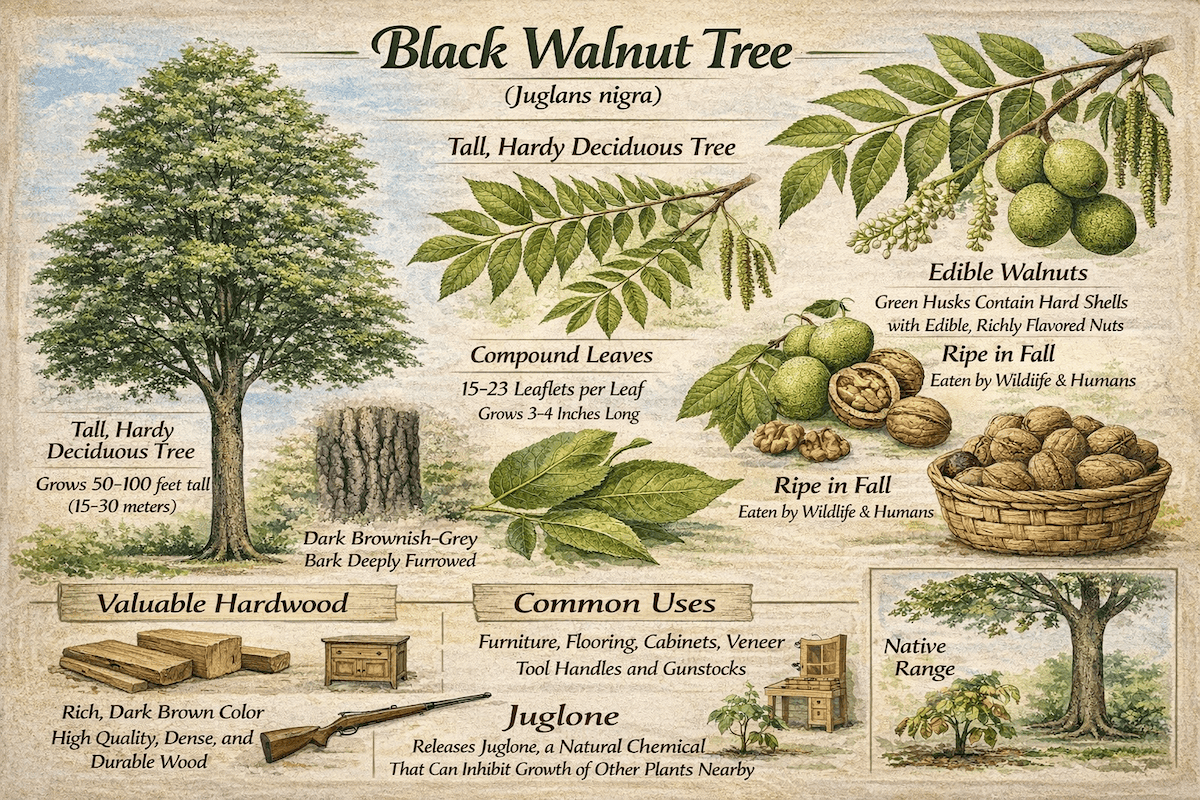


For timber wood investors, the primary concern is not whether black walnut is a valuable tree—that is well-established. The real question is how to grow black walnut trees in a way that maximizes long-term returns while balancing risk, rotation length, and site conditions.
Black walnut is not a “get-rich-quick” tree. A well-managed black walnut plantation is a multi-decade investment, one that rewards patience and sound silviculture. For high-value veneer logs, you may be looking at a 30–40 year rotation at minimum, with 50 years or more required for exceptional specimens. Investors focused on legacy portfolios, generational wealth, or conservation-aligned assets are often best suited to this species.
The primary appeal of planting black walnut trees in rows is control—control over spacing, site selection, pruning, and thinning. When you plant in rows with consistent spacing, you can:
Over decades, good management pays for itself. A stand that begins with hundreds of seedlings per acre may be thinned down to a fraction of that number, leaving only the straightest, fastest-growing, and most defect-free trees to reach maturity.
Designing a commercial hardwood tree plantation requires careful planning. Spacing, species selection, terrain, and long-term objectives (timber production, conservation, or recreation), and local climate and soil conditions all influence the outcome. For black walnut, minimum requirements include:
Rows are typically laid out using GPS, flags, or laser alignment tools to ensure straight lines and consistent spacing. This allows crews to efficiently move through the plantation for planting, maintenance, and harvesting. In some designs, alley cropping systems are used, with crops or grazing integrated between rows of trees during the early establishment years.
A basic model might include:
With this approach, each surviving tree represents a carefully selected, high-potential asset in a long-term timber portfolio.
Every black walnut tree begins as a seed, but not all seeds are equal. Selecting seed from known, high-performing parent trees can dramatically improve the odds of producing straight, fast-growing, disease-resistant offspring. Some growers rely on seed orchards or grafted stock from proven parent trees to ensure genetic quality from the start.
The early years (0–10) are all about establishment and survival. This includes:
From years 10–25, the focus shifts to form and growth: encouraging straight boles and minimizing low branches that could become knots. Proper pruning during this period is essential for creating high-value logs.
After 25–30 years, the stand transitions into a phase where incremental value growth accelerates as diameter increases. This is when thinning decisions have the greatest impact and when the stand gradually transforms from a crowded plantation into a park-like forest of widely spaced, high-value trees.
While straight rows are standard in industrial forestry, black walnut also lends itself to spiral and cluster-based planting designs that combine aesthetics, biodiversity, and timber production. Spiral designs can create visually stunning landscapes that double as productive plantations, especially on estates, agroforestry projects, or eco-tourism properties.
In a spiral layout, trees are planted along a geometric curve that winds outward from a central point. This can:
Mixed-species designs pair black walnut with compatible hardwoods, nitrogen-fixing species, or shade-tolerant understory crops. This can:
The challenge in mixed systems is maintaining adequate spacing, light, and resources for black walnut to achieve its full potential. Careful species selection and spatial planning are critical.
Not all species are compatible with walnut due to juglone, a natural compound produced by black walnut that can inhibit the growth of sensitive plants. However, many hardwoods and shade-tolerant species coexist well, including:
Other compatible plants include certain grasses, forage species, and shade-tolerant shrubs that can coexist under walnut canopies.

One of the greatest appeals of black walnut is its premium pricing relative to many other hardwoods. However, prices vary widely depending on grade, geography, log size, and market conditions.
Key markets include:
Prices for veneer-grade walnut logs can reach into the thousands of dollars per log in some markets, particularly for exceptional specimens. Lower-grade material still finds use in flooring, paneling, and secondary products, but the real returns come from managing for the highest possible grade.
Successful walnut investors:
Beyond dollars and board feet, black walnut plantations contribute significantly to ecological health and long-term stewardship.
Benefits include:
For many landowners, these non-monetary returns are as important as the timber income. Planting black walnut becomes not just an investment, but a living legacy.
Whether you are planning a modest grove or a large-scale plantation, black walnut offers a rare combination of beauty, durability, and financial potential—provided you are willing to think in decades, not quarters.
From maple to oak, hardwoods whisper of centuries past, their slow growth a testament to patience and value over time.
In a spiral forest design, black walnut trees can serve as the anchor species around which other complementary species are planted. Spirals can be designed with variable spacing to optimize light, airflow, and access. They also reinforce the sense of long-term stewardship—each ring representing a new chapter of growth.
Tree Plantation, a division of New Leaf Technologies, designs spiral plantations that combine:
Spiral forests can function as:
In this context, black walnut is more than a cash crop—it is a structural and symbolic centerpiece of a living, evolving landscape.
Tree Plantation LLC, a division of New Leaf Technologies, specializes in designing and implementing spiral plantations tailored to investors, institutions, and landowners seeking both ecological and financial returns. Each project is site-specific, taking into account soil type, climate, water availability, access, and the landowner’s long-term goals.
Spirals can be laid out using GPS-guided mapping, drones, and on-the-ground surveying. The geometry is both functional and aesthetic—curves are adjusted to suit slopes, existing features, and desired sightlines. During implementation, crews follow detailed layout plans to ensure precision, whether the plantation is mono-cropped or mixed with other species.
Mono-cropping ensures equal tree spacing, resulting in uniform growth and predictable timber outcomes. This can simplify management, harvesting, and marketing, particularly for investors focused on a single, high-value species like black walnut. Mono-cropped plantations can also be planted closer together, optimizing space.
In certain cases, incorporating a mix of environmental support trees, nitrogen-fixers, and companion species enhances resilience and provides additional value streams. Mixed plantations can produce wildlife habitat, secondary timber products, nuts, fruit, and other crops, while improving ecological stability and long-term site health.
Common tree species often grown with black walnut include:
Other compatible plants include certain grasses, forage species, and shade-tolerant shrubs that can coexist under walnut canopies. Properly designed spirals can layer these species in rings or clusters, balancing competition and mutual benefit.
Whether configured in straight rows or elegant spirals, a black walnut plantation is a long-horizon asset. With thoughtful planning, professional management, and patience, it can deliver both meaningful ecological benefits and strong financial returns over time.

Black walnut (Juglans nigra) is naturally scattered rather than abundant, and many of the best stands were heavily logged in the 19th and 20th centuries. The species also has specific site requirements—deep, fertile, well-drained soils—and grows slowly compared with many other hardwoods. Because relatively few large-scale plantations have been established, truly mature, veneer-grade black walnut trees are scarce, which helps keep prices and standing timber values high.
Clear, knot-free black walnut produces the largest, most continuous faces of dark heartwood for veneer and premium lumber. Veneer mills and furniture makers pay a premium for logs with long, straight boles and at least 10–12 feet (3–3.6 m) of clear trunk, because they can slice or saw wide, defect-free panels. Knots, sweep, cracks and mineral streaks all reduce grade and shorten board lengths, so careful pruning and spacing over many decades are key to growing high-value, clear stems.
Growing black walnut for profit requires patience and precise management. Key challenges include:
Good planning, early pruning, and scheduled thinnings can dramatically increase the share of trees that reach premium log grades over time.
Black walnut wood has a dense, usually straight grain with good shock resistance, which helps it resist splitting and checking. This combination of strength and toughness makes it ideal for furniture joinery, flooring, gunstocks, stair parts, and other applications where screws, nails, and fasteners must hold securely over decades. Compared with many ring-porous hardwoods, properly dried walnut is stable and less prone to sudden splits.
Black walnut plantations and mixed-species stands provide multiple ecological benefits:
Managed correctly, a black walnut plantation can be both a timber asset and a conservation tool in a broader forest, farm or watershed plan.
The economic potential of black walnut is high for investors willing to think in decades. Properly managed stands can produce a mix of veneer logs, sawlogs, and lower-grade material for specialty products. Returns improve when:
Tools like the Tree Value Calculator and Woodlot Estimator can help model rotations, stand value, and long-term returns for black walnut under different spacing and management scenarios.
Copyright © All rights reserved Tree Plantation