


 INVEST
 PLANT
PLANT
 SOFTWOODS
 HARDWOODS
 CALCULATORS
 RESOURCES
 PROGRAMS

Softwoods
Learn More
As cities continue to grow denser and hotter, the need to reconnect urban life with living systems has become more urgent than ever. Biohybrid trees offer one of the most intriguing responses to this challenge. These innovative structures combine living plants with engineered frameworks and smart technologies to create installations that function somewhere between a tree, a green wall, a shade structure, and an urban infrastructure system.
In practical terms, biohybrid trees are designed to bring some of the most valuable functions of natural trees into places where conventional tree planting may be difficult or slow to achieve. In dense urban corridors, plazas, rooftops, transit zones, and highly paved environments, soil volume, underground utilities, heat stress, and maintenance limitations can all restrict the success of traditional urban forestry. Biohybrid trees help address this gap by combining vegetation with supportive structures that can be tailored for constrained spaces.
These systems can provide shade, cooling, air-quality improvement, biodiversity support, rainwater capture, and even renewable energy generation , depending on their design. Just as important, they create a visible symbol of how cities can evolve toward more regenerative and human-centered environments. Rather than replacing natural trees, biohybrid trees are best understood as a complementary strategy—one that expands the ways greenery and ecological function can be integrated into the built environment.
In this article, we explore the concept of biohybrid trees, including what they are made of, how they function, where they are best placed, and why they are increasingly relevant to the future of urban environments. We also look at examples that show how living plants and technology can work together to transform streetscapes, public spaces, and smart city design.
Biohybrid trees are a fusion of natural and synthetic components, designed to deliver many of the benefits associated with natural trees while also adding features that respond to the practical needs of urban landscapes. Their purpose is not purely decorative. They are often conceived as multi-functional urban systems that combine ecological services with architectural performance and, in some cases, digital or energy-generating capabilities.
At their core, biohybrid trees are intended to improve the environmental quality of the spaces around them. Their planted components can help cool the surrounding air, filter particulates, reduce glare, soften hardscapes, and provide habitat for insects and birds. The structural elements can extend these benefits by supporting climbing plants, creating vertical greenery, and positioning systems such as irrigation lines, sensors, or photovoltaic surfaces in ways that maximize performance.
The primary goals of biohybrid trees often include improving air quality, creating shade, lowering urban heat, supporting biodiversity, and enhancing visual appeal. In some cases, they are also designed to function as educational or symbolic landmarks that communicate a city’s commitment to innovation, sustainability, and climate resilience. More advanced concepts may incorporate smart lighting, environmental monitoring, misting systems, or solar-powered features that add value beyond what a conventional tree canopy alone can provide.
Because of their flexibility, biohybrid trees can serve many different roles. In one setting, they may act as a cooling structure in a plaza. In another, they may function as a green energy sculpture, a modular habitat system, or a vertical greening support for areas where conventional planting pits are too limited. This ability to combine beauty, function, and environmental performance is what makes biohybrid trees especially attractive in modern city planning.
Most biohybrid trees consist of a supportive structural framework combined with living vegetation. The framework may be made from metal, engineered composites, recycled materials, or other durable components designed to withstand weather and urban wear. This skeleton acts as the support system for plants, irrigation, and optional technologies, allowing the installation to function in locations where a conventional tree might struggle to establish.
The living component may include climbing vines, mosses, shrubs, epiphytes, or other plant species selected for their adaptability, growth habit, and climate suitability. In some systems, the structure acts almost like an artificial trunk and canopy that hosts vegetation over time. In others, the design resembles a vertical garden or modular ecological tower, with plant life distributed across a sculptural or tree-like frame.
Biohybrid trees can also integrate solar panels, rainwater harvesting elements, irrigation systems, LED lighting, sensors, or air-quality monitoring technology. These additions transform them from passive landscape objects into active urban infrastructure. For example, solar surfaces can generate power for nearby lighting or charging systems, while integrated sensors can help cities collect data on temperature, humidity, or particulate pollution.
Placement is critical to success. Biohybrid trees are particularly valuable in urban areas that lack sufficient green space or where heat, hard paving, and limited root zones make conventional tree planting difficult. They are well suited to public plazas, transportation corridors, rooftops, schoolyards, business districts, shopping streets, and redevelopment zones. In these settings, they can provide immediate environmental and visual benefits while longer-term natural tree canopy is established—or where natural canopy simply cannot be developed at adequate scale.
They are also useful in highly visible civic locations where cities want to demonstrate sustainable design in action. By placing biohybrid trees in strategic public spaces, planners can create installations that are not only functional, but also educational and iconic.
As these examples show, biohybrid trees are not defined by one single form. Instead, they represent a broader design philosophy—one that seeks to combine living systems, renewable technology, and urban functionality in ways that improve city life. As climate pressures intensify and cities search for new tools to reduce heat, improve livability, and restore ecological value, biohybrid trees may become an increasingly important part of the urban landscape.
Feel free to share this biohybrid trees infographic on your website or blog. Please include a link back to this page as the source.
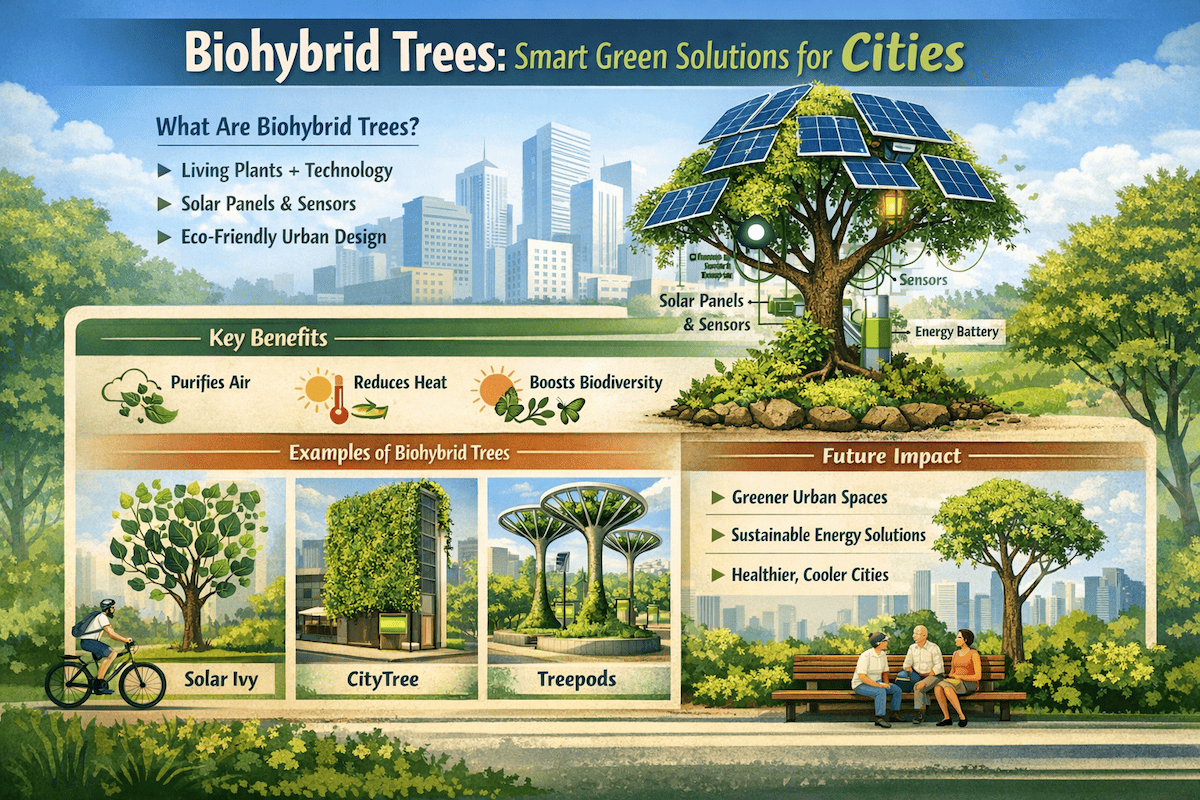

Biohybrid trees deliver a wide range of practical, environmental, and social benefits, making them an increasingly attractive solution for modern cities facing climate, density, and livability challenges.
In many cases, biohybrid trees provide immediate environmental benefits in areas where natural trees would take years—or may never be able—to establish. This makes them especially useful in high-density urban environments with limited soil access or extreme conditions.
Today, biohybrid trees are still an emerging technology, but they are rapidly gaining attention as cities search for scalable solutions to climate adaptation, air pollution, and urban livability. Pilot projects and installations are already demonstrating how these systems can be deployed in public spaces, transportation hubs, and redevelopment zones.
As materials, plant science, and smart technologies continue to advance, future biohybrid tree systems are expected to become more efficient, modular, and adaptable. Innovations may include improved plant integration, higher-efficiency solar components, automated irrigation, and AI-driven environmental monitoring.
In the coming decades, biohybrid trees could play a significant role in:
Rather than replacing natural forests or urban tree canopies, biohybrid trees are best viewed as a complementary solution—one that bridges the gap between nature and technology. By combining the strengths of both, they offer a forward-looking approach to designing cities that are greener, smarter, and more sustainable.
As urban populations grow and environmental pressures increase, biohybrid trees may become a defining feature of next-generation city design—where ecology and innovation work together to shape healthier urban ecosystems.
Copyright © All rights reserved Tree Plantation