


 INVEST
 PLANT
PLANT
 SOFTWOODS
 HARDWOODS
 CALCULATORS
 RESOURCES
 PROGRAMS

Softwoods
Learn More
ORNAMENTAL • SHADE • FOUR-SEASON COLOR
What is a Japanese maple tree? Japanese maples (Acer palmatum) are compact ornamental trees prized for delicate foliage, vibrant seasonal color, and graceful branching structure, making them ideal for gardens, patios, and landscape focal points.
🍁 Quick answer: Choose your Japanese maple based on climate (zone), sun exposure, and mature size—these three factors determine long-term health, color quality, and overall performance.
Welcome to a deeper look at Japanese maple trees—compact, four-season landscape stars that work as well in a container on a patio as they do beside a pond or in a classic Japanese garden. Native to Japan, Korea, and China, these prized ornamental maple trees are beloved for finely cut foliage, brilliant fall color, and elegant form.
Japanese maples come in a wide range of forms: upright, weeping, dwarf, and mounding. Some stay under 6 feet tall—perfect for containers or small courtyards—while others slowly reach 15–25 feet and serve as stunning specimen or landscape trees in larger yards.
The name Acer palmatum comes from its palm-shaped leaves, divided into lobes like an open hand. This distinctive foliage, combined with elegant branching, has made Japanese maples a symbol of beauty, balance, and seasonal change for centuries.
Before selecting a cultivar, match your tree to your USDA hardiness zone, sunlight conditions, and available space. Most Japanese maples perform best in zones 5–8, though some varieties tolerate more heat or cold.
In cooler climates, red-leaf cultivars such as Bloodgood and Emperor hold their color well in full sun. In hotter regions, they benefit from protection against intense afternoon sun. Green-leaf varieties like Green Cascade tend to be more heat tolerant and forgiving.
Size is equally important. Upright varieties typically reach 10–20 feet, making them ideal as focal points or small shade trees. Dwarf and weeping types stay under 8 feet and are perfect for containers, patios, and detailed landscape designs.
Japanese maples thrive in well-drained, slightly acidic soil rich in organic matter. Avoid waterlogged areas, strong drying winds, or locations with excessive reflected heat— especially in warmer climates.
Next step: Compare growth habits, leaf types, and mature sizes below to find the best Japanese maple for your specific climate and landscape design.
Key insight: The right placement and cultivar selection matter more than anything— when matched correctly, Japanese maples can thrive for decades with minimal intervention.
Feel free to share this Japanese maples infographic on your website or blog. Please include a link back to this page as the source.
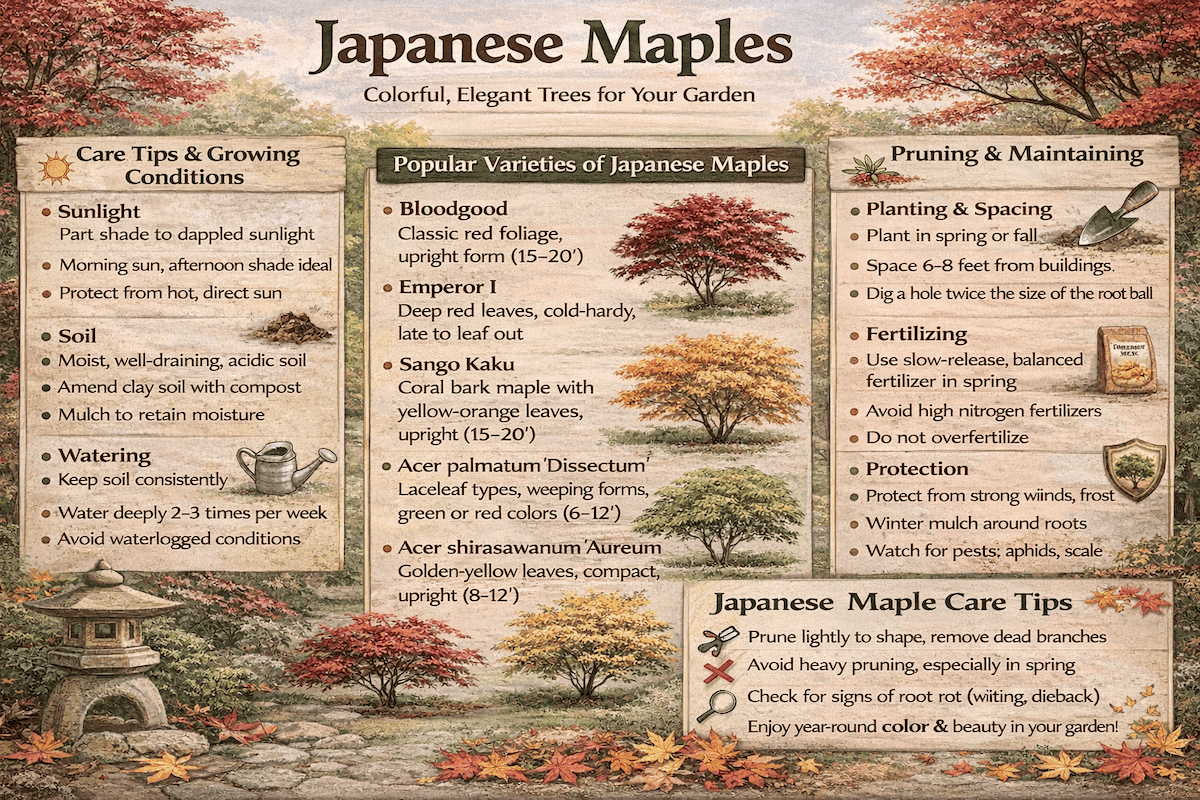

Choose the best Acer palmatum type for your site, estimate spacing and tree count, assess leaf-scorch risk, and plan container sizing and watering—using a fast, planning-level tool.
What sets Japanese maples apart from many other ornamental trees is their four-season beauty. In spring, new leaves emerge in luminous shades of lime, bronze, or cherry red. Through summer, foliage settles into rich greens, purples, or burgundy tones. When autumn arrives, the show intensifies—leaves flare into flaming reds, oranges, and clear golds that can outshine almost any other tree.
In traditional Japanese gardens, these color changes are celebrated as part of the yearly rhythm of nature. Japanese maples are placed carefully to frame views, reflect in ponds, or highlight stone lanterns and bridges. Their branches twist and arch, creating a living sculpture that looks beautiful even when the tree is leafless in winter.
Bark adds another layer of interest. Some cultivars have smooth gray or olive bark, while others display rough, dark texture. Standout selections like Sango Kaku (the famous Coral Bark Maple) show brilliant coral-red stems in winter, glowing against snow, evergreens, or dark fence lines.
Japanese maples are deciduous, so autumn is their star season. As days shorten and nights cool, chlorophyll in the leaves breaks down and the underlying pigments are revealed. Depending on the cultivar, leaves may shift from green to orange, scarlet, crimson, or even neon pink tones.
After the leaves drop, the tree isn’t “finished” for the year—its intricate branch structure suddenly becomes visible, adding a delicate tracery to the winter garden. When placed against evergreens or an architectural wall, the bare silhouette is as striking as any sculpture.
This steady transformation through the year—spring flush, summer depth, autumn fireworks, and winter structure—is a big reason Japanese maples are prized as high-value landscape trees despite their relatively small size and slow growth.
Foliage color is one of the main factors to consider when choosing a Japanese maple. Classic red-leaf varieties like Bloodgood, Emperor, and Red Dragon emerge in rich burgundy or wine red in spring and often deepen as the season progresses. In fall, they can shift toward glowing crimson or scarlet, making them excellent focal points in front yards and near entryways.

Green-leaf varieties such as Green Cascade and certain forms of Emperor bring a softer, more tranquil presence to the garden. Their fresh green foliage blends effortlessly with flowering shrubs, perennials, and conifers, creating layered plantings that feel natural and balanced. These selections also reflect the quiet elegance often associated with traditional Japanese trees used in temple gardens and landscape design. In autumn, many green-leaf Japanese maples glow in shades of clear yellow, amber, or warm orange, offering beautiful contrast when planted near darker red cultivars.
Deep purple and maroon foliage is another hallmark of popular cultivars such as Crimson Queen and Dissectum Atropurpureum. These varieties carry finely cut, lace-like leaves that stand out dramatically against lighter green backgrounds. When used thoughtfully, they can anchor a mixed planting bed, echo the tones of brick or dark stone architecture, or guide the eye along a pathway or garden entrance. Their rich color palette is one reason Japanese maples remain among the most celebrated ornamental Japanese trees in landscape design worldwide.
Unlike towering sugar maples commonly grown for timber or maple syrup, many Japanese maples are naturally compact. This makes them especially valuable in modern urban landscapes, townhouse gardens, and patio courtyards where space is limited but homeowners still want a distinctive ornamental tree.
Dwarf Japanese maples such as Shaina and some forms of Inaba Shidare grow slowly and typically remain between 3–6 feet tall over many years. Their dense branching structure and finely textured foliage make them ideal for containers, courtyard gardens, or entryway plantings where a full-size tree would overwhelm the space. These compact forms capture the sculptural beauty often seen in traditional Japanese trees while fitting comfortably into smaller residential landscapes.
Weeping Japanese maples are particularly admired for their cascading, umbrella-like forms. Cultivars such as Tamukeyama, Crimson Queen, and Red Dragon drape their branches downward in graceful layers of foliage, sometimes sweeping close to the ground. Planted beside water features, along stone paths, or on a gentle slope, these trees introduce movement, texture, and a peaceful sense of balance that reflects the design philosophy of classic Japanese gardens.

As members of the Aceraceae family—home to around 130 species of maples—Japanese maples share traits with larger trees like sugar maples and paperbark maples. But they are unique in their combination of small stature, finely cut leaves, and immense cultivar diversity.
In Japan, Acer palmatum has been cultivated for centuries around temples, tea houses, and private homes. Many famous cultivars were selected generations ago and passed down through families and nurseries. Today’s gardeners continue that tradition by grafting and propagating choice selections to keep desirable forms alive.
This long history in Japanese gardens has shaped how we use the trees today: as specimen trees, as subtle background structure, and as symbolic reminders of the beauty of seasonal change.
Japanese maples shine when used intentionally in landscape design. A single upright tree can serve as a focal point at the end of a path or near a front entry. Groupings of two or three maples with different heights and colors can create a layered composition that looks good all year.
They pair beautifully with stone lanterns, gravel paths, moss, and water features in traditional Japanese Zen Gardens, but they’re equally at home in more informal woodland or cottage gardens. Their modest mature size lets them fit where larger shade trees would be too big or heavy.
Japanese maples are especially effective in partially shaded areas. Dappled light through taller trees helps prevent leaf scorch on sensitive cultivars and makes colored foliage appear to glow. Planting them on the east or north side of a building, or under high limbed-up canopy trees, often yields the best leaf color and overall health.

Shaded or partially shaded garden locations help protect Japanese maples from harsh afternoon sun, which can scorch the delicate foliage of lace-leaf and finely cut varieties. In warmer climates, the ideal placement often provides morning sun with afternoon shade, allowing the tree to develop strong color without stress. This balance of light and protection is a key principle in caring for many ornamental Japanese trees, which are traditionally grown in settings where filtered sunlight enhances their form and seasonal color.
In Japanese-style gardens designed to evoke peace and contemplation, Japanese maples are often placed where their beauty can be appreciated up close—from a quiet bench, garden path, deck, or tea house veranda. Their finely textured leaves, graceful branching, and changing colors invite visitors to slow down and observe the landscape in detail. For indoor spaces inspired by this same aesthetic, natural scenes such as tree and forest wall murals are sometimes used to echo the calm, layered atmosphere created by Japanese garden plantings.
Pruning plays an important role in keeping a Japanese maple healthy while preserving its natural elegance. The goal is not to force the tree into a rigid shape, but to highlight its organic branching structure—removing dead, damaged, or crossing branches and gently opening the canopy so light and air can circulate through the interior.
The best time to prune most Japanese maples is during the dormant season in late winter or very early spring before new growth begins. At this stage the tree’s structure is easier to see, and pruning cuts heal quickly once growth resumes. Heavy pruning during midsummer or just before frost should be avoided, as it can stress the tree and reduce its vigor.
Always use sharp, clean pruning tools and make cuts just outside the branch collar so the tree can seal wounds naturally. Begin by removing broken or rubbing branches, then step back to evaluate the overall shape. Small, careful cuts that preserve the tree’s flowing form are far more effective than aggressive pruning that disrupts the natural character of these graceful Japanese trees.
Many Japanese maple cultivars are also prized in the art of bonsai. Their delicate branching, relatively small leaves, and dramatic seasonal color allow growers to create miniature trees that capture the appearance of mature forest specimens in a compact form.
Training a Japanese maple bonsai requires patience and careful attention over time. Growers shape the tree through root pruning, branch selection, and gentle wiring to guide growth. For many gardeners, caring for a bonsai becomes a meditative practice—an opportunity to observe the subtle seasonal changes of one of the most beloved ornamental Japanese trees in an intimate, living work of art.

Whether grown in the ground or as bonsai, Japanese maples reward close observation. Every bud, twig, and leaf expresses the artistry of nature on a small, intimate scale.
With so many cultivars available, it helps to know a few tried-and-true names when you visit a nursery or browse online. Here are some of the most popular and reliable Japanese maple varieties for home landscapes:
Bloodgood – Classic upright tree with deep red leaves that hold color well through summer and flare brighter in fall. Excellent focal point for front yards and entries.
Emperor – Similar to Bloodgood but slightly faster growing and often better at leafing out later in spring, helping avoid frost damage in colder climates. Rich purple-red foliage.
Crimson Queen – Lace-leaf weeping variety with cascading branches and finely cut, crimson leaves. Ideal beside patios, ponds, and rock gardens.
Tamukeyama – Another outstanding weeping tree with arching branches and red to purple-red foliage that handles heat better than some dissectum types.
Dissectum Atropurpureum – Classic lace-leaf Japanese maple with deeply cut purple leaves; often grafted to form a low, umbrella-shaped tree.

Among the most distinctive Japanese trees, coral bark Japanese maples are celebrated for their glowing winter branches. While many ornamental trees fade into the background during the colder months, these maples become dramatic focal points as their smooth young bark turns vivid shades of coral, red, or orange. When sunlight strikes the branches on a frosty morning, the effect can be striking—making coral bark varieties some of the best trees for year-round landscape interest.
In spring and summer, coral bark Japanese maples produce soft green foliage that brings a light, airy texture to the garden. As autumn approaches, their leaves typically transition to warm shades of yellow and gold, often edged with orange or red. This seasonal sequence— fresh spring foliage, graceful summer canopy, golden fall color, and brilliant winter bark— gives coral bark maples exceptional four-season appeal.
Sango Kaku (Coral Bark Maple) – One of the most widely planted coral bark Japanese maples, known for its upright growth habit and vivid coral-red branches that glow brightly in winter. Its soft green leaves create a gentle canopy during the growing season and turn golden with red edging in autumn, making it an excellent specimen tree for four-season landscapes.
Beni Kawa – A close relative of Sango Kaku, Beni Kawa is valued for its bright red winter bark and slightly smaller, more compact growth habit. It develops fresh green foliage in spring that transitions to rich yellow fall color. Because of its manageable size and vibrant winter branches, Beni Kawa is well suited for small gardens, courtyards, and foundation plantings.
Winter Flame – This cultivar produces some of the most intense winter branch color among coral bark Japanese maples. Young twigs display fiery shades of orange-red that deepen as the weather cools. Winter Flame typically remains somewhat smaller than many upright maples, making it an attractive choice for compact landscapes or as a focal point near patios and garden paths.
Inaba Shidare – Weeping red variety with strong cascading habit and deep maroon foliage; excellent as a specimen on slopes or beside water.
Red Dragon – Lace-leaf maple with intense red foliage that keeps its color well into summer and fall; compact habit makes it suitable for smaller gardens.
Green Cascade – Graceful, weeping green-leaf variety with flowing branches and bright green foliage that turns gold and orange in fall; ideal for soft, woodland designs.
Shaina – Compact dwarf Japanese maple with dense branching and bright red leaves, perfect for containers, foundation plantings, and tight urban spaces.
To keep your Japanese maple thriving, plant it in well-drained, organic-rich soil, water regularly during the first few seasons, and mulch lightly to conserve moisture and moderate soil temperature. Avoid heavy fertilizing, especially with high-nitrogen lawn fertilizers, which can encourage weak, lush growth at the expense of color and structure.
In hot climates, provide afternoon shade and wind protection, especially for lace-leaf varieties. In colder regions, planting near a building or in a sheltered courtyard can help buffer winter winds and late spring frosts.
Japanese maples are more than just ornamental trees; they are living expressions of nature’s artistry. Their changing colors, refined forms, and subtle seasonal shifts invite us to pay attention and to appreciate beauty in every phase of the year.
Whether you are designing a new landscape, refreshing a small courtyard, or starting a bonsai collection, adding a Japanese maple can bring elegance, character, and a sense of calm to your space. With the right cultivar for your climate and yard, and a bit of thoughtful care, your tree will reward you for decades.
One of the greatest strengths of Japanese trees such as Japanese maples (Acer palmatum) is their versatility. With hundreds of cultivars available—from dwarf container trees to graceful specimen trees—there is a Japanese maple suited to almost every landscape style. Choosing the right variety for your garden type helps ensure the tree thrives while creating the visual impact you want.
Courtyard gardens benefit from trees that provide structure without overwhelming the space. Japanese maples with elegant branching and moderate size work particularly well in these enclosed settings. Cultivars such as Bloodgood and Emperor I offer upright forms and rich red foliage that create beautiful focal points while maintaining manageable growth.
In courtyards surrounded by walls or buildings, Japanese maples also benefit from filtered light and protection from harsh winds. Their layered branches cast soft shadows and help transform compact outdoor spaces into calm, garden-like retreats.
Many dwarf Japanese maple cultivars thrive in containers, making them excellent choices for patios, decks, and balconies. Compact varieties such as Shaina, Beni Hime, and Koto No Ito grow slowly and maintain an attractive form even in limited soil volumes.
Container-grown Japanese maples allow gardeners to enjoy the beauty of ornamental maple trees even when yard space is limited. Placing a potted maple near outdoor seating areas lets you appreciate the tree’s delicate leaves, seasonal color, and graceful silhouette up close.
Homeowners with small yards often choose dwarf or weeping Japanese maple varieties that stay naturally compact. Cultivars such as Crimson Queen, Red Dragon, and Inaba Shidare typically remain under 10 feet tall and wide, creating dramatic focal points without dominating the landscape.
These smaller trees provide vibrant color and architectural beauty while leaving room for shrubs, perennials, and groundcovers. Their layered branching and fine foliage texture make even modest gardens feel sophisticated and carefully designed.
In traditional Japanese garden design, Japanese maples are often used as contemplative focal points placed beside stones, water features, or winding paths. Weeping varieties such as Tamukeyama and Dissectum Atropurpureum are especially popular because their cascading branches create a sense of movement and balance within the landscape.
These trees complement other classic elements of Japanese gardens—such as moss, gravel paths, lanterns, and carefully placed boulders—while highlighting the seasonal transitions that define Japanese garden aesthetics. In autumn, their brilliant red and orange foliage often becomes the centerpiece of the entire landscape.
Whether planted as a specimen tree, grown in a container, or incorporated into a traditional garden design, Japanese maples remain among the most versatile and beautiful ornamental Japanese trees available for modern landscapes.
Most Japanese maples (Acer palmatum) are happiest with morning sun and afternoon shade, especially laceleaf (dissectum) varieties with finely cut foliage. In cooler climates, many upright Japanese maples tolerate full sun as long as the soil stays evenly moist and the site is protected from hot, drying winds.
Japanese maples thrive in slightly acidic, well-drained, organic-rich soil. Avoid heavy, waterlogged clays or spots with standing water, which can lead to root rot. If your soil is dense, plant a little high and mound or amend for drainage, then add 2–3 inches of organic mulch—keeping it a few inches away from the trunk to prevent rot and pests.
Prune lightly in late winter or midsummer to preserve the tree’s natural shape. Focus on removing dead, damaged, crossing, or inward-growing branches rather than “shearing” the canopy. Avoid heavy pruning in early spring when sap is rising and during extreme summer heat. Always use clean, sharp tools and step back often to keep the tree’s graceful structure intact.
Leaf scorch is usually caused by too much afternoon sun, hot drying winds, or inconsistent watering. Shallow, frequent watering can also stress the roots. Help prevent scorch by giving Japanese maples deep but infrequent soakings, adding organic mulch to keep roots cool, and choosing a site with morning sun and dappled afternoon shade—especially for laceleaf and red-leaf cultivars.
Yes, Japanese maples do very well in containers, especially dwarf and weeping varieties. Use a high-quality, well-draining potting mix and a container with ample drainage holes. Container trees dry out more quickly than in-ground plantings, so check moisture often and water thoroughly when the top inch of soil is dry. Feed lightly in spring and repot every 2–4 years to refresh the soil and prevent root binding.
Laceleaf Japanese maples (dissectum types like ‘Crimson Queen’ and ‘Tamukeyama’) have finely cut, lacy foliage and a low, cascading or weeping habit. They’re ideal near patios, water features, and in small gardens. Upright Japanese maples (such as ‘Bloodgood’ or ‘Emperor’) have broader leaves and a tree-like form, growing taller and making excellent focal points or small shade trees in the landscape.
Grafted Japanese maples reliably reproduce the color, leaf shape, and growth habit of a named cultivar, so you know exactly what you’re getting. Seed-grown Japanese maples can be beautiful, but they are genetically variable and may not match the parent tree’s foliage color or form. For specific looks—such as ‘Bloodgood’, ‘Sango Kaku’, or ‘Crimson Queen’—choose a grafted plant from a reputable nursery.
Copyright © All rights reserved Tree Plantation