


 INVEST
 PLANT
PLANT
 SOFTWOODS
 HARDWOODS
 CALCULATORS
 RESOURCES
 REFOREST

Softwoods
Learn More
REFORESTATION • FOREST RESTORATION • LAND RECOVERY
Reforestation is the process of restoring tree cover on land that was previously forested, rebuilding ecosystems, biodiversity, soil stability, water systems, and carbon storage.
🌱 Quick answer: Reforestation means returning trees to damaged or cleared land using the right species, spacing, and long-term management so the land can recover into a healthy, resilient forest.
Reforestation is not just planting trees—it is a long-term land restoration strategy. It is used to recover forests lost to deforestation , wildfire, logging, storms, drought, pests, agriculture, and land degradation.
When done correctly, reforestation improves erosion control, water retention, biodiversity, carbon sequestration, and overall land resilience, while also supporting future timber value, ecosystem services, and long-term land productivity.
Start with the fundamentals: acreage, site conditions, species selection, spacing, and time horizon. Use the planner below to turn a reforestation idea into a clear, actionable planting strategy.
VISUAL GUIDE • TREE PLANTING • FOREST RECOVERY
Reforestation works by moving a damaged, cleared, burned, or degraded site through a planned recovery process: site assessment, species selection, planting design, establishment care, and long-term forest management. The goal is not simply to plant trees, but to rebuild a living forest system that can survive, grow, and improve over time.
Evaluate soil, slope, rainfall, drainage, sunlight, access, erosion risk, and previous land use.
Match tree species to local climate, soil, elevation, moisture, biodiversity goals, and long-term use.
Plan tree spacing, planting density, rows, clusters, access routes, buffers, and mixed-species zones.
Reduce weeds, improve planting areas, manage erosion, protect soil, and prepare the land for seedlings.
Plant seedlings at the right depth, protect young trees, water where needed, and monitor survival rates.
Manage competition, pests, thinning, carbon growth, wildlife habitat, watershed health, and forest resilience.
The strongest reforestation projects combine ecology, planning, spacing, protection, and patience. A forest can begin with seedlings, but it becomes resilient through years of monitoring, adaptive management, and stewardship.
REFORESTATION METHODS • FOREST RECOVERY • LAND DESIGN
Reforestation can happen in several ways depending on the condition of the land, the project goals, the available budget, and how quickly forest recovery is needed. The main types include natural regeneration, assisted natural regeneration, plantation forestry, and agroforestry systems.
Natural regeneration allows forests to regrow from existing seeds, roots, stumps, nearby trees, and natural ecological processes. This method works best where soil is healthy, seed sources remain nearby, and the land has not been severely degraded.
Best for: low-disturbance sites, protected areas, forest edges, and land with strong natural recovery potential.
Assisted natural regeneration helps a recovering forest by removing barriers to growth. This may include controlling weeds, protecting young trees from grazing, reducing fire risk, improving soil conditions, and selectively planting trees where natural recovery is weak.
Best for: degraded land that still has some native seedlings, seed banks, or nearby forest influence.
Plantation forestry uses planned tree planting to establish forests for timber, carbon storage, erosion control, land restoration, or long-term economic value. It usually involves selected species, defined spacing, planting rows, and active management.
Best for: timber production, carbon projects, commercial forestry, and large-scale land restoration.
Agroforestry combines trees with crops, livestock, or other productive land uses. This approach can restore tree cover while also producing food, shade, habitat, soil improvement, carbon value, and diversified income.
Best for: farms, degraded agricultural land, food forests, silvopasture, alley cropping, and climate-smart land design.
In many successful projects, these methods are combined. A site may use natural regeneration in one area, assisted recovery in another, plantation-style spacing where structure is needed, and agroforestry zones where food production, income, or livestock integration are part of the long-term plan.
GLOBAL FOREST DATA • RESTORATION TARGETS
Reforestation matters because forest loss remains a global challenge. According to the FAO Global Forest Resources Assessment 2025 , the annual rate of net forest loss has slowed, but the world still lost an estimated 4.12 million hectares of net forest area per year from 2015 to 2025.
FAO reports that global net forest loss has slowed compared with previous decades, but millions of hectares are still being lost each year.
World Resources Institute reported that tropical primary forest loss reached 6.7 million hectares in 2024, driven heavily by fire.
The UN Decade on Ecosystem Restoration supports efforts to prevent, halt, and reverse ecosystem degradation across every continent and ocean.
These global numbers show why reforestation must be planned carefully. Planting trees is important, but lasting impact depends on site selection, species diversity, soil protection, water planning, survival rates, and long-term stewardship.
The strongest reforestation projects do more than replace trees. They rebuild forest function, protect watersheds, support wildlife habitat, store carbon, improve degraded land, and create long-term ecological and economic value.
REAL-WORLD APPLICATIONS • LAND RECOVERY • FOREST PROJECTS
Reforestation is used across a wide range of environments—from burned forests and degraded farmland to tropical ecosystems and carbon-driven restoration projects. Each use case has different goals, timelines, and planting strategies, but all focus on restoring long-term ecological function.
After severe wildfires, reforestation helps stabilize soil, reduce erosion, protect watersheds, and accelerate forest regrowth. Depending on burn severity, projects may rely on natural regeneration, assisted recovery, or full replanting.
Focus: erosion control, slope stability, watershed protection, and rapid forest recovery.
Reforestation can restore depleted or abandoned farmland by rebuilding soil health, improving water retention, reducing erosion, and reintroducing tree cover. In many cases, this evolves into agroforestry systems that combine trees with crops or livestock.
Focus: soil regeneration, water retention, productivity, and long-term land value.
Reforestation plays a key role in carbon sequestration by capturing atmospheric carbon and storing it in trees, soil, and biomass. These projects are often designed with long-term monitoring, growth tracking, and carbon accounting in mind.
Focus: carbon capture, long-term storage, measurable growth, and climate impact.
In tropical regions, reforestation helps restore biodiversity hotspots, rebuild complex ecosystems, protect watersheds, and support native species. Projects often emphasize diverse, multi-species plantings and long-term ecological restoration.
Focus: biodiversity, habitat restoration, water systems, and ecosystem resilience.
Many modern reforestation projects combine multiple use cases. A single project may support carbon capture, biodiversity restoration, watershed protection, and long-term economic value while adapting to local climate, soil, and community needs.
ADVANCED REFORESTATION • LAND VALUE • CARBON STRATEGY
High-performance reforestation goes beyond simply planting trees. It uses spacing optimization, mixed-species planting, carbon planning, yield stacking, and long-term land management to create forests that are more resilient, productive, and valuable over time.
Tree spacing affects growth rate, canopy closure, timber form, carbon accumulation, access, thinning, water competition, and long-term forest structure.
Goal: match spacing to the site, species, climate, soil, and long-term objective.
Mixed-species reforestation can improve biodiversity, reduce pest and disease risk, support wildlife, strengthen soil systems, and create a more resilient forest.
Goal: avoid fragile monocultures and build layered, climate-adapted forest systems.
Reforestation can stack multiple forms of value, including timber, fruit, nuts, biomass, carbon storage, habitat value, erosion control, water benefits, and future ecosystem services.
Goal: design the forest so ecological recovery and economic value grow together.
A well-designed reforestation project can increase long-term land productivity, improve resilience, support future harvests, enhance conservation value, and strengthen property-level climate performance.
Goal: turn degraded or underused land into a living, appreciating natural asset.
The best reforestation systems are designed like long-term living infrastructure. They restore forests, but they also create durable value through carbon, biodiversity, water protection, future yield, and land resilience.
Feel free to share this reforestation infographic on your website or blog. Please include a link back to this page as the source.
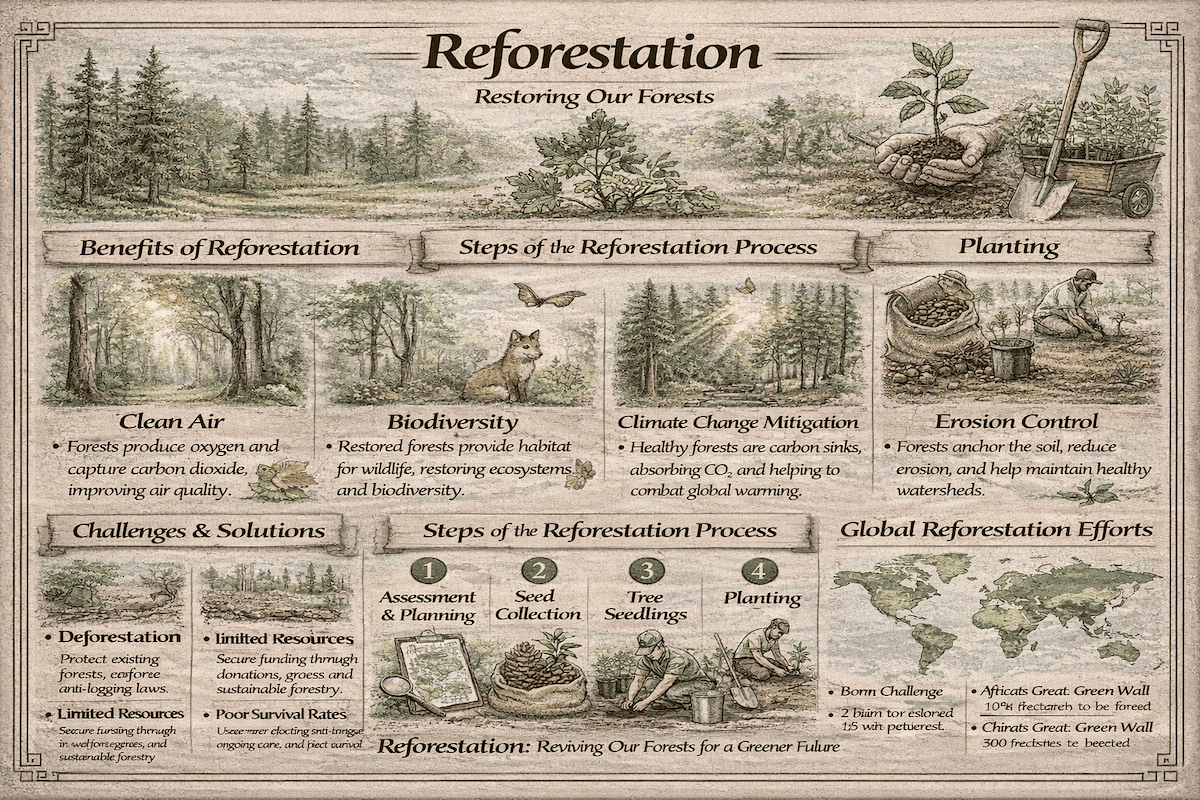
The benefits of reforestation go beyond planting more trees. Well-planned reforestation restores ecosystem function, strengthens landscapes, and creates long-term environmental and economic value.
| Reforestation Benefit | Why It Matters |
|---|---|
| Carbon capture | Trees absorb and store CO₂ as they grow, helping reduce atmospheric carbon. |
| Habitat restoration | Reforestation rebuilds shelter, food sources, and movement corridors for wildlife. |
| Soil protection | Roots stabilize soil, reduce erosion, and improve long-term soil structure. |
| Watershed health | Forests improve infiltration, reduce runoff, and help protect streams and groundwater. |
| Climate resilience | Forested landscapes better withstand heat, storms, and environmental stress over time. |
| Land value | Reforested land can gain long-term ecological, aesthetic, and productive value. |
Different sites require different reforestation methods. The best method depends on soil conditions, climate, slope, species, disturbance history, and project goals.
| Method | Best For | Main Advantage |
|---|---|---|
| Natural regeneration | Sites with nearby seed sources | Lower planting cost |
| Seedling planting | Most restoration and recovery projects | More control over species mix |
| Mixed-species planting | Habitat and resilience-focused sites | Greater biodiversity and structural diversity |
| Managed restoration | Degraded or difficult sites | Higher establishment success |
Reforestation works best when planting is planned. This interactive planner helps visualize tree spacing, estimated carbon impact, and long-term planting outcomes so you can better understand how a forest project may develop over time.
Use the planner to test species, layout, and planting progress. It is a simple way to move from a broad restoration idea to a more practical reforestation plan.
Black walnut is typically established using directly sown seed, 2-year bare-root seedlings, or 3-year plug/seedling transplants. In this planner scenario, 220 black walnut trees are planted within a 3.5-acre spiral layout, spaced 25 feet apart.
White oak is typically established using 2-year bare-root seedlings or 3-year plug transplants. In this planner scenario, 300 white oak trees are planted within a 3.5-acre spiral layout, spaced 20 feet apart.
Black cherry is typically established using 3-year seedling transplants, which offer strong survival rates when properly sited and maintained. In this planner scenario, 400 black cherry trees are planted within a 3.5-acre spiral layout, spaced 18 feet apart with 18 feet between spiral rows, allowing each tree adequate spacing for long-term crown development, root expansion, and soil health.
Hard maple (sugar maple) is typically established using 3-year seedling transplants, which offer strong survival rates when properly sited and maintained. In this planner scenario, 280 sugar maple trees are planted within a 3.5-acre spiral layout, spaced 22 feet apart with 22 feet between spiral rows, allowing each tree adequate spacing for long-term crown development, root expansion, and soil health.
Yellow birch is typically established using 3-year transplants, which offer strong survival rates when properly sited and maintained. In this planner scenario, 300 yellow birch trees are planted within a 3.5-acre spiral layout, spaced 20 feet apart with 20 feet between spiral rows, allowing each tree adequate spacing for long-term crown development, root expansion, and soil health.
American chestnut is typically established using 3-year hybrid transplants, which provide strong survival rates when properly sited and maintained. In this planner scenario, 220 American chestnut trees are planted within a 3.5-acre spiral layout, spaced 25 feet apart with 25 feet between spiral rows. This configuration ensures ample room for long-term canopy development.
Mahogany is typically established using nursery-grown transplants, often 2–3 years old, which offer reliable survival when properly sited and managed. In this planner scenario, 220 mahogany trees are planted within a 3.5-acre spiral layout, spaced 25 feet apart with 25 feet between spiral rows. This spacing supports long-term crown development, deep root expansion, and healthy airflow.
Teak plantings are commonly established with well-hardened nursery seedlings or clonal stock that are 2–3 years old, selected for uniform growth and durability. In this planner example, a total of 220 teak trees are arranged across a 3.5-acre spiral planting pattern. Trees are set on 25-foot centers, with equal spacing between spiral rows, creating an open structure that encourages strong trunk formation.
Rosewood is typically established using carefully raised nursery transplants, often 2–3 years old, to ensure strong early growth and successful establishment. In this planner scenario, 220 rosewood trees are integrated into a 3.5-acre spiral planting design. The trees are spaced at 25-foot intervals, with 25 feet between spiral rows, providing sufficient room for mature canopy spread and deep root development.
White pine is commonly established using 2–3 year nursery-grown plug transplants, which provide reliable survival when properly sited and cared for. In this planner scenario, 300 white pine trees are arranged within a 3.5-acre spiral planting pattern, spaced 20 feet apart with 20 feet between spiral rows. This layout balances efficient land use with sufficient room for mature canopy formation.
Western red cedar is typically established using 2–3 year nursery-grown seedlings, valued for their resilience and strong establishment when properly sited and maintained. In this planner scenario, 400 western red cedar trees are planted within a 3.5-acre spiral layout, spaced 18 feet apart with 18 feet between spiral rows. This spacing provides each tree with adequate room for vertical growth.
Hybrid poplar is commonly established using fast-growing nursery transplants or cuttings, selected for rapid early growth and high establishment success. In this planner scenario, 480 hybrid poplar trees are planted within a 3.5-acre spiral configuration, spaced 16 feet apart with 16 feet between spiral rows. This tighter, uniform spacing supports straight trunk formation and efficient canopy development.
Orchard apples are typically established using 8-foot spear transplants chosen for their quick establishment and vigorous early growth. In this planner scenario, 2,000 apple trees are integrated into a 3.5-acre spiral planting design, with trees spaced 6 feet apart and 10 feet between spiral rows. This high-density arrangement promotes manageable tree structure and controlled canopy development.
Orchard pears are typically established using 7-foot spear transplants chosen for their quick establishment and vigorous early growth. In this planner scenario, 2,000 pear trees are integrated into a 3.5-acre spiral planting design, with trees spaced 6 feet apart and 10 feet between spiral rows. This high-density arrangement promotes manageable tree structure and controlled canopy development.
Orchard peaches are typically established using 6-foot spear transplants chosen for their quick establishment and vigorous early growth. In this planner scenario, 2,000 peach trees are integrated into a 3.5-acre spiral planting design, with trees spaced 6 feet apart and 10 feet between spiral rows. This high-density arrangement promotes manageable tree structure and controlled canopy development.
Use the buttons to advance or reverse the future tree value
Build a tight internal-link cluster so visitors can move from model to model (and from model pages into species pages and calculators). This improves user flow, increases time-on-page, and strengthens topical relevance for search engines.
If you want a forest that survives and increases in value over time, plan beyond planting day. The highest-leverage work often happens before the first tree goes in the ground and in the first 2–3 years after planting.

Successful reforestation is a structured process—not just planting trees, but restoring a complete, functioning ecosystem. Each project is tailored to site conditions, climate, and long-term goals.
At Tree Plantation, we specialize in turning degraded land into thriving forests through climate-smart reforestation strategies. From planning to planting and long-term management, our approach ensures forests are designed to survive, grow, and deliver measurable results.
Our services include site evaluation, species selection, planting design, installation, and long-term forest management—helping you restore land while building environmental and financial value.
Start your reforestation plan: Define your acreage, goals, and timeline. Use the tools below to create a customized planting strategy tailored to your land.
Ready to restore your land? Schedule a reforestation consultation and receive a custom plan designed for your site conditions and long-term goals.
Reforestation projects can range from small private acreage to larger land restoration plans. Tree Plantation helps turn degraded, cleared, or underperforming land into a healthier forest through site assessment, species selection, planting design, installation, and long-term management.
Need help building a plan? Start with your acreage, site conditions, goals, and planting timeline. Then use the planner and calculators to shape a reforestation strategy that fits your land.
Ready to move from planning to implementation? Contact Tree Plantation for a custom reforestation proposal and project review.
Reforestation means replanting trees on land that used to be forest so the area can recover tree cover, ecological function, and long-term environmental value.
Initial establishment often happens within 1 to 3 years, but full forest development can take decades depending on species, climate, disturbance history, and management.
Reforestation helps capture carbon, rebuild habitat, protect soil, improve water systems, increase biodiversity, and strengthen long-term land resilience.
The best trees for reforestation depend on soil, climate, regional ecology, and project goals. Native and climate-adapted species usually provide the strongest long-term performance.
It can be. Some reforestation projects support future timber production, land appreciation, and carbon-related value while also delivering environmental benefits.
Start by evaluating your land, identifying your goals, selecting suitable species, and developing a planting and management plan. Contact Tree Plantation to begin planning your project.
Copyright © All rights reserved Tree Plantation