


 INVEST
 PLANT
PLANT
 SOFTWOODS
 HARDWOODS
 CALCULATORS
 RESOURCES
 PROGRAMS

Softwoods
Learn More
CARBON • EMISSIONS • REDUCTION
Wondering what a carbon footprint is? A carbon footprint is the total amount of greenhouse gases released by a person, household, business, product, or activity. These emissions are usually expressed as carbon dioxide equivalents (CO₂e) so carbon dioxide, methane, nitrous oxide, and other gases can be compared using one common measure.
👣 Quick answer: A carbon footprint measures the climate impact of energy use, transportation, food choices, consumption, and other daily activities by converting emissions into a single CO₂e total.
Examples: Driving a gasoline car, flying, heating and cooling a home, using grid electricity, buying goods, and eating carbon-intensive foods all contribute to your total footprint.
Carbon footprints are useful because they help people and organizations identify their biggest sources of emissions, compare scenarios, and target the most effective reduction strategies first. In many cases, the largest footprint drivers are home energy use, transportation, air travel, and consumption patterns.
Use our Carbon Footprint Calculator to estimate your emissions and identify the biggest opportunities for reduction.
Carbon footprints are measured in CO₂ equivalents (CO₂e) because some gases trap much more heat than carbon dioxide. For example, methane has a much stronger warming effect than CO₂ over shorter time periods, which is why it is converted into a CO₂e value for comparison.
Carbon footprints vary widely depending on location, lifestyle, income, transportation patterns, household size, diet, and energy source. These general benchmarks help put emissions into perspective:
Measuring a carbon footprint is the first step. Reducing it usually means focusing on the biggest emission sources first, such as driving less, improving home energy efficiency, switching to cleaner electricity, reducing waste, and making lower-emission purchasing decisions.
Measuring your footprint helps you identify the biggest emission sources first, reduce waste, lower long-term energy costs, and make smarter decisions about efficiency, clean power, transportation, and land-based carbon solutions.
A carbon footprint includes both direct emissions and indirect emissions. Direct emissions come from sources you own or control, such as vehicles, machinery , or on-site fuel use. Indirect emissions come from purchased electricity, transportation, food systems, products, and broader supply chains.
Whether you are evaluating a single household or an international company, a carbon footprint provides a clear way to measure climate impact and compare reduction strategies.
The largest contributors to a carbon footprint usually come from a few core categories:
For businesses, emissions are commonly grouped into three categories:
In many industries, the largest share of emissions sits in Scope 3, which is why supply chain planning, sourcing, logistics, and product redesign matter so much.
Measuring a carbon footprint starts with gathering activity data and converting it into CO₂e with recognized emission factors.
A dedicated carbon footprint calculator can help turn this raw data into a more practical estimate, while deeper planning tools can help identify which changes will have the greatest impact first.
Use our Carbon Footprint Calculator to estimate emissions from energy use, transportation, and lifestyle choices before building a reduction plan.
The best reduction strategies focus on the biggest, most persistent emission sources first.
Reduction should come first, but long-term climate planning often also includes tree-based and land-based solutions that remove carbon from the atmosphere over time.
Trees play a critical role in climate mitigation by absorbing carbon dioxide (CO₂) from the atmosphere as they grow and storing it in wood, roots, leaves, and surrounding soils. This natural process, known as carbon sequestration, helps reduce overall greenhouse gas concentrations and supports long-term climate stability.
Fast-growing and long-lived species—such as the Douglas fir tree— are especially valuable because they can capture significant amounts of carbon over decades while also producing high-quality timber and supporting forest ecosystems. Well-managed forests and plantations can act as powerful carbon sinks, contributing to both environmental restoration and sustainable resource production.
Tree-based solutions work best when they are part of a broader strategy that includes direct emission reductions, land stewardship, biodiversity protection, and long-term monitoring.
Explore how carbon trees and long-term carbon sequestration strategies fit into a broader plan for climate resilience.
Net-zero pathways are more rigorous because they require real structural reductions across operations, energy, products, and supply chains before relying on removals or offsets.
Not all trees store carbon at the same rate or over the same time horizon. The best carbon trees combine strong growth, long life spans, high wood density, and the ability to thrive in the right climate and soil conditions. Fast-growing trees can capture carbon quickly, while large, durable species can store it for decades or even centuries.
The best choice depends on your goal. Some landowners want rapid early biomass growth, while others prioritize long-lived timber species, reforestation, habitat restoration, watershed protection, or mixed-species climate resilience.
| Tree Species | Growth Speed | Carbon Strength | Best Use | Learn More |
|---|---|---|---|---|
| Douglas Fir | Fast to Moderate | Excellent long-term storage | Timber + forest carbon | Douglas Fir |
| Hybrid Poplar | Very Fast | Strong early carbon capture | Biomass + fast sequestration | Hybrid Poplar |
| Loblolly Pine | Fast | High plantation carbon value | Commercial forestry + carbon projects | Loblolly Pine |
| Western Red Cedar | Moderate | Strong durable storage | Long-term forest value | Western Red Cedar |
| Paulownia | Very Fast | Rapid biomass production | Agroforestry + short-rotation systems | Paulownia |
| Oak Trees | Slow to Moderate | Outstanding long-term carbon storage | Legacy forests + restoration | Oak Trees |
| Eucalyptus | Fast | High short- to mid-term uptake | Fiber, biomass, warm-climate projects | Eucalyptus |
| Mangroves | Moderate | Exceptional blue-carbon ecosystems | Coastal restoration + soil carbon | Mangroves |
The best carbon tree for one site may be the wrong choice for another. Climate, rainfall, soil depth, elevation, wind exposure, fire risk, and long-term management all matter. A fast-growing tree may store carbon quickly, but a slower-growing tree with denser wood and a longer lifespan may store more carbon over the long run.
Explore our Carbon Trees page for more species ideas, or use the Tree Carbon Calculator to estimate long-term sequestration.
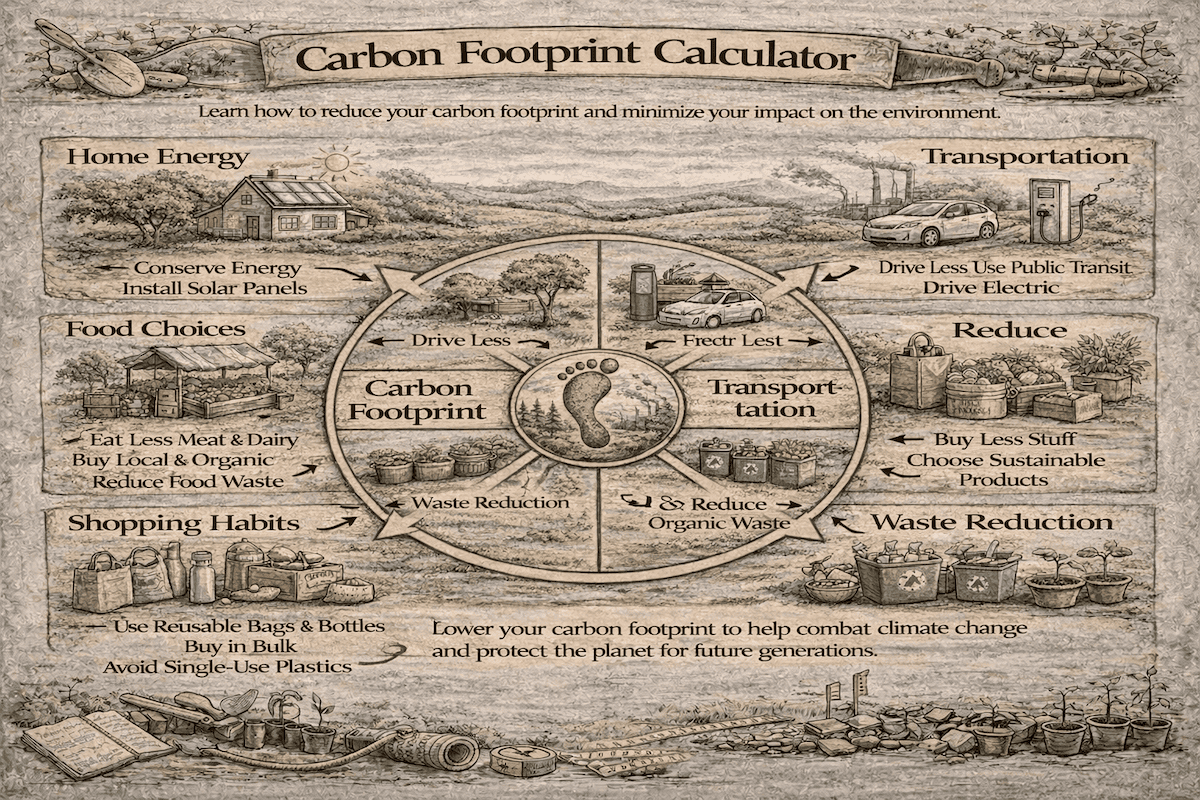
Feel free to share this carbon footprint calculator infographic on your website or blog. Please include a link back to this page as the source.

One proven approach to reducing the industrial carbon footprint is the strategic use of carbon credits and emission trading schemes (ETS). These tools do not replace direct emission reductions, but they help close the gap between current industrial reality and a low-carbon economy.
Carbon credits allow companies to compensate for a portion of their emissions by investing in projects that verifiably reduce or remove greenhouse gases elsewhere. High-quality projects include:
Emission trading schemes (also known as cap-and-trade systems) put a hard cap on total emissions in a region or sector and distribute a finite number of allowances. Companies that emit less than their allowance can sell or bank the surplus; those that emit more must buy extra permits or pay penalties. This market-based system:
Used responsibly, carbon credits and trading schemes help industries move faster down the path to carbon zero, while channelling capital into climate-positive projects around the world.
Achieving zero carbon emissions—often framed as “net-zero” or “carbon neutral” —is the ultimate destination for industrial decarbonization. Instead of relying only on offsets, a credible net-zero strategy prioritizes deep reductions in actual emissions and uses offsets only for the small residual portion that is technically or economically difficult to eliminate.
In practice, a robust industrial net-zero plan typically includes:
Companies that publicly commit to science-based targets, report progress transparently, and adjust their strategies as technology improves are the ones most likely to reach true carbon neutrality.
Industrial sustainability and corporate social responsibility (CSR) are no longer “nice-to-have” extras; they sit at the heart of long-term business resilience. Customers, investors and communities increasingly expect manufacturers and heavy industry to show how they are reducing their environmental footprint and supporting a just transition to a low-carbon future.
A sustainability-focused industrial strategy often includes:
By prioritizing sustainability and CSR, industries can reduce their carbon footprint, strengthen their brand, attract mission-aligned talent and create a more equitable, environmentally conscious industrial system.

A carbon tax is another powerful policy tool for shrinking the industrial carbon footprint. Instead of capping emissions and trading permits, a carbon tax sets a clear price on each tonne of CO2e emitted. Companies that emit more pay more; those that emit less, pay less.
This simple but effective signal:
By internalizing the hidden environmental costs of pollution, a carbon tax helps align industrial decision-making with society’s long-term climate goals and accelerates the shift towards a low-carbon industrial economy.
The rapid development and adoption of green technology is central to decarbonizing industry. Key innovation areas include:
By embracing these innovations, industries can dramatically reduce their carbon emissions while often cutting operating costs and improving reliability at the same time.

Around the world, leading companies are showing that industrial decarbonization is both technically feasible and commercially smart. Technology giants like Google and Microsoft are working to power data centers with 100% renewable electricity and investing heavily in energy efficiency and carbon removal projects. Automotive innovators such as Tesla have accelerated the shift from internal-combustion engines to electric vehicles, shrinking tailpipe emissions and driving demand for clean power.
Consumer brands including Unilever, Patagonia and IKEA have set aggressive climate targets, redesigned products and packaging, and partnered with suppliers to cut emissions across their entire value chains. Many also support reforestation and ecosystem restoration as part of their broader climate strategies, recognizing the long-term value of healthy forests, soils and watersheds.
These pioneers demonstrate that reducing the industrial carbon footprint can:
Reducing the industrial carbon footprint is essential for mitigating climate change and achieving a sustainable, climate-resilient future. Understanding the concept of an industrial carbon footprint, addressing the impact of greenhouse gas emissions, and implementing tools such as carbon credits, emission trading schemes and carbon taxes are all critical steps on this journey. Industrial sustainability, corporate social responsibility, and the rapid deployment of green technologies together form the engine that drives the transition towards zero carbon emissions.
By learning from industry leaders and aligning their strategies with the science of climate stabilization, companies of all sizes can actively contribute to reducing their industrial carbon footprint—and help build a safer, more sustainable world for future generations.
Start with the Carbon Footprint Calculator, then explore carbon trees and carbon sequestration to understand how emissions can be reduced and removed over time.
Measure your emissions with the Carbon Footprint Calculator, explore carbon trees, and learn how carbon sequestration can help remove carbon over time.
A carbon footprint is the total amount of greenhouse gases (GHGs) released into the atmosphere because of a person, product, company, or activity. These gases include carbon dioxide (CO₂), methane (CH₄), nitrous oxide (N₂O) and others, and are usually expressed together as CO₂-equivalents (CO₂e). Your footprint takes into account:
Whether we’re looking at an individual, a family, or an entire industrial supply chain, the carbon footprint gives a single, comparable measure of climate impact.
For businesses, carbon footprints are often broken into three “scopes” that show where emissions come from:
Understanding all three scopes is essential for serious industrial carbon footprint work, because most impacts (and opportunities to reduce them) sit in the wider supply chain and customer use phase.
Measuring a carbon footprint starts with collecting basic activity data and converting it to CO₂e using standard emission factors. For individuals, that usually means gathering:
Businesses go further, pulling data from utility meters, fleet fuel purchases, freight, procurement systems and waste records. The totals are then run through a carbon calculator or GHG accounting tool. Many people also use a tree carbon calculator to understand how much CO₂ could be balanced by long-term reforestation and forest protection projects.
The most effective strategies target the largest and most persistent sources of emissions. For households and small businesses, high-impact actions often include:
For larger industrial players, cutting Scope 1–3 emissions also means re-designing products, working with lower-carbon suppliers, optimizing freight and logistics, and investing in green technologies that make factories and supply chains much more efficient over time.
Yes—when done correctly, planting and protecting trees can help offset a portion of your carbon footprint. As trees grow, they draw CO₂ out of the atmosphere and lock it into trunks, roots, leaves and forest soils. This process, called carbon sequestration, is a key nature-based climate solution.
High-quality forest projects usually:
Tools like a tree carbon calculator can help estimate how much CO₂ a forest, plantation or restoration project might sequester over time. Offsets should complement, not replace, aggressive efforts to cut emissions at the source.
The terms are related but not identical:
In practice, net-zero pathways focus first on cutting emissions through efficiency, clean energy, circular design and nature-based solutions, then use carefully chosen offsets to address what cannot yet be eliminated.
Copyright © All rights reserved Tree Plantation