

 INVEST
 PLANT
PLANT
 SOFTWOODS
 HARDWOODS
 CALCULATORS
 RESOURCES
 PROGRAMS

Softwoods
Learn More
MUSHROOMS • SAFETY • IDENTIFICATION
Wondering how to identify poisonous mushrooms? Many toxic mushrooms closely resemble edible species, making safe identification extremely difficult without expert knowledge.
⚠️ Quick answer: Poisonous mushrooms contain natural toxins that can cause serious illness, organ failure, or death, and they should never be consumed unless identified with certainty by a trained expert.
Examples: Some of the most dangerous species include the Death Cap, Destroying Angel, and Deadly Dapperling— all of which have caused fatal poisonings worldwide.
Poisonous mushrooms are fungi that contain natural toxins capable of causing illness, organ damage, or death when eaten. These toxins may affect the liver, kidneys, nervous system, or digestive tract, and symptoms may appear hours or even days after ingestion. Many dangerous species closely resemble edible mushrooms, making correct identification extremely difficult without expert knowledge.
Poisonous mushrooms present a serious risk for foragers, gardeners, pet owners, and curious children who explore wooded areas, parks, and forest floors. While some wild mushrooms are edible and even considered culinary delicacies, others contain potent toxins that can cause severe mushroom poisoning, permanent organ damage, or death.
Among the most dangerous species are the Death Cap mushroom (Amanita phalloides), the Destroying Angel mushroom (Amanita virosa and related species), the Deadly Dapperling (Lepiota brunneoincarnata), and the Fool’s Mushroom (Amanita verna). These mushrooms are responsible for many of the world’s most severe and fatal mushroom poisonings.
This page provides a general safety overview of poisonous mushrooms and the risks associated with wild mushroom identification. It should not be used as a guide for deciding whether a mushroom is safe to eat.
Key rule: If you are not 100% certain of a mushroom’s identity, do not eat it.
Correctly identifying poisonous mushrooms is challenging even for experienced mushroom hunters and amateur mycologists. Some of the most dangerous species look nearly identical to edible mushrooms, especially during certain stages of growth.
Professional mycologists examine the entire organism and its environment when identifying a mushroom. Key diagnostic features include:
Because many toxic mushrooms resemble edible species, it is safest to avoid eating any wild mushroom unless it has been positively identified by a trained expert, local mycological society, or experienced mushroom club.
Feel free to share this poisonous mushrooms infographic on your website or blog. Please include a link back to this page as the source.
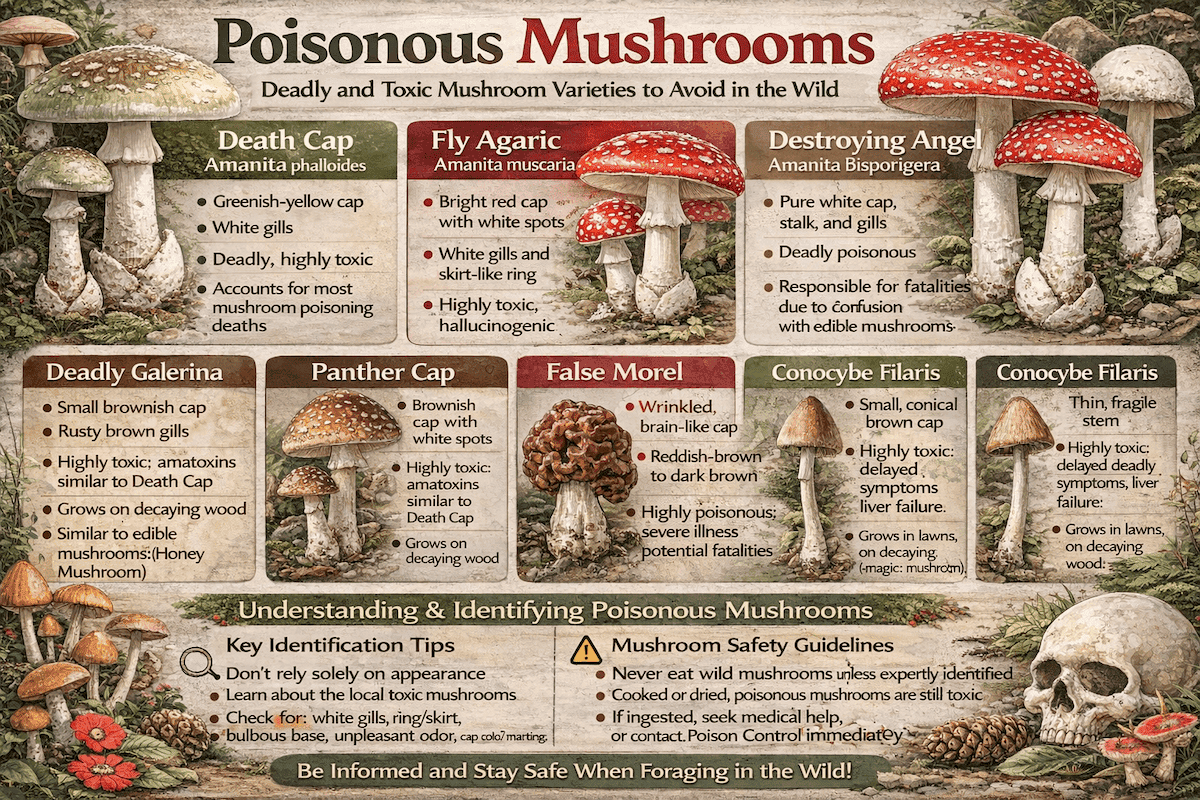
| Mushroom | Scientific Name | Primary Toxin | Potential Danger |
|---|---|---|---|
| Death Cap | Amanita phalloides | Amatoxins | Severe liver damage and potential liver failure |
| Destroying Angel | Amanita virosa | Amatoxins | Often fatal if consumed |
| Deadly Dapperling | Lepiota brunneoincarnata | Amatoxins | Severe poisoning and organ failure |
| Fool's Mushroom | Amanita verna | Amatoxins | Potentially fatal liver damage |
Many of the most dangerous toxic mushrooms found in the wild belong to the genus Amanita. This group includes the infamous Death Cap and several species commonly known as Destroying Angels. Together they are responsible for a large percentage of fatal mushroom poisonings worldwide.
These mushrooms produce powerful toxins known as amatoxins, compounds that damage cells in the liver and kidneys. Even a small amount can cause severe organ failure, and symptoms may not appear until many hours after ingestion. Like many other organisms discussed in our guides to mushroom trees and woodland ecology, toxic fungi play a complex role in forest systems, even when they pose a serious risk to people and pets.
Some of the world’s deadliest mushrooms can grow in surprisingly ordinary places, including parks, backyards, mulched beds, and beneath familiar trees such as oaks and birches. Because dangerous species may closely resemble edible mushrooms, even experienced foragers treat unknown mushrooms with extreme caution.
One of the greatest dangers is that these deadly mushrooms often grow in ordinary and accessible environments—along forest trails, in parks, and in landscaped yards. They may appear beneath familiar trees such as oak trees, beech, or chestnut, and sometimes emerge from lawns, wood-chip beds, or garden mulch. These same moist, organic environments also support a wide range of woodland life, including many forest insects, which share the same decaying wood, leaf litter, and root-zone habitats. Because of this, they can easily be encountered by hikers, gardeners, pets, and children.
The Death Cap mushroom (Amanita phalloides) is widely considered one of the most poisonous mushrooms in the world. A single mature mushroom can contain enough toxin to kill a healthy adult. Globally, it is responsible for the majority of fatal mushroom poisonings.
Death Cap mushrooms are typically medium to large in size, growing about 4–6 inches (10–15 cm) tall with a cap measuring 2–6 inches (5–15 cm) across. The cap is often greenish-yellow, olive, or pale brown, although coloration can vary widely and may sometimes appear nearly white.
Young specimens may show scattered whitish patches or warts on the cap surface, though these features often disappear after rainfall. The gills are white, closely spaced, and free from the stem. The stem itself is usually pale with a delicate skirt-like ring (annulus). At the base of the stem is a distinctive cup-shaped structure known as a volva, which may be partially hidden beneath soil or leaf litter.
Death Caps most commonly grow in deciduous forests and are strongly associated with hardwood trees such as oak, beech, and chestnut. They form symbiotic relationships with these trees, exchanging nutrients through underground fungal networks known as mycorrhizae.
Originally native to Europe, the Death Cap has spread widely through global trade and landscaping. Today it is established in many regions of North America, Australia, and other parts of the world. It frequently appears in urban parks, residential gardens, and landscaped areas where host trees have been planted.
Poisoning from Death Cap mushrooms occurs when amatoxins damage the liver and kidneys. Symptoms are often delayed for 6–24 hours after ingestion, which can give victims a false sense of security before the toxin begins causing severe internal damage.
Common symptoms of amatoxin mushroom poisoning include:
If you suspect that someone has eaten a Death Cap or another poisonous mushroom, seek emergency medical care immediately. Do not wait for symptoms to appear. Treatment typically requires hospital care and may include activated charcoal, intravenous medications, and intensive monitoring. In extreme cases, liver transplantation may be necessary to save the patient’s life.

The name Destroying Angel refers to several closely related species of all-white mushrooms in the genus Amanita. These mushrooms are among the most poisonous fungi in the world. Like the infamous Death Cap, Destroying Angels contain powerful toxins known as amatoxins, which attack the liver and kidneys and can be fatal if ingested.
Several species are commonly grouped under this name, including Amanita virosa, Amanita bisporigera, and Amanita ocreata. Although they vary slightly in appearance and geographic distribution, their toxic chemistry and health risks are nearly identical.
Destroying Angel mushrooms are typically medium-sized, growing about 5–10 cm tall with caps measuring roughly 5–15 cm across. When young, the cap is egg-shaped and enclosed in a protective veil. As the mushroom matures, the cap becomes convex and may flatten slightly.
The entire mushroom is usually pure white—including the cap, gills, and stem. The surface often appears smooth and silky. The gills are white, closely spaced, and free from the stem.
The stem typically measures 7–15 cm in height and features a delicate ring (annulus) near the upper portion. At the base of the stem is a distinctive cup-like structure called a volva, which is a key identifying feature of many deadly Amanita species. This volva may be partially buried beneath soil or leaf litter, making it easy for inexperienced observers to miss.
Destroying Angel mushrooms commonly appear in deciduous and mixed forests. They often grow in association with hardwood trees such as oak, beech, and birch trees. These mushrooms form symbiotic underground relationships with tree roots known as mycorrhizae, much like other fungi associated with mushroom trees and woodland ecosystems.
In addition to forests, they may also appear along woodland edges, in clearings, and occasionally in lawns or landscaped areas where host trees are present. Because of their bright white appearance and elegant form, they are sometimes mistaken for edible mushrooms such as field mushrooms or young button mushrooms—an error that can have tragic consequences. These same moist habitats may also support a wide variety of forest insects and other decomposer species that thrive in leaf litter, rotting wood, and shaded root zones.
Poisoning caused by Destroying Angel mushrooms follows a pattern similar to that of Death Cap poisoning and typically occurs in three stages:
Because amatoxin poisoning can be delayed and deceptive, any suspected ingestion of an Amanita mushroom requires immediate medical attention. If possible, bring a sample of the mushroom or clear photographs to the hospital so that poison specialists and mycologists can assist with identification and treatment decisions.
While Destroying Angels and Death Caps are responsible for many fatal cases, several other toxic mushrooms also pose serious risks. Examples include the Panther Cap (Amanita pantherina), Conocybe filaris, and the Autumn Skullcap (Galerina marginata). These mushrooms may cause severe neurological symptoms, gastrointestinal distress, or organ failure and should never be consumed.

Many people assume that dangerous mushrooms grow only in remote forests, but poisonous mushrooms frequently appear in urban environments. City parks, schoolyards, landscaped areas, and residential backyards often provide ideal conditions for fungi to grow. Moist soil, shade, wood chips, grass, and nearby trees can all support mushroom growth—even in heavily populated neighborhoods. These same ecological patterns can also be seen across both American forests and smaller managed green spaces within urban forests.
Some of the most dangerous species thrive in these environments. The Deadly Dapperling (Lepiota brunneoincarnata) is a small but extremely toxic mushroom that can appear in lawns, mulched garden beds, and landscaped park areas. Although modest in size, it contains powerful toxins similar to those found in the Death Cap and can cause severe illness, organ damage, or death if consumed.
Another hazardous species occasionally found in parks and gardens is the Fool’s Mushroom (Amanita verna). This mushroom closely resembles common edible mushrooms to the untrained eye, which makes it especially dangerous for inexperienced foragers. Like other deadly Amanita species, Fool’s Mushrooms contain amatoxins that attack the liver and kidneys.
Correctly identifying poisonous mushrooms requires years of study and experience with live specimens in natural settings. Many dangerous species closely resemble edible mushrooms, especially during early growth stages. For this reason, experts strongly advise against eating any wild mushroom unless it has been positively identified by a trained mycologist or a knowledgeable local mushroom club.
The symptoms of mushroom poisoning vary widely depending on the species involved and the amount consumed. Reactions may include mild stomach upset, severe vomiting and diarrhea, confusion, hallucinations, liver or kidney failure, and in extreme cases death. Children and pets are particularly vulnerable because even small quantities of certain toxins can be dangerous.
If young children or pets regularly play outdoors, it is wise to inspect your yard periodically and remove mushrooms that appear in play areas, gardens, or pet runs. This is especially important in shaded landscapes and natural recreation settings where people may be enjoying activities such as forest bathing without realizing that toxic fungi may be nearby.
Preventing mushroom poisoning begins with awareness and simple safety practices. The following guidelines can help reduce the risk of accidental exposure:
If someone may have eaten a potentially poisonous mushroom, seek medical help immediately. Do not wait for symptoms to appear. If possible, collect a sample of the mushroom or take clear photographs of the specimen and the area where it was growing. This information can help poison specialists and medical professionals identify the species and guide treatment.
With proper caution and respect for the risks, it is possible to appreciate the beauty and ecological importance of wild mushrooms without putting yourself, your family, or your pets in danger. A common rule among experienced foragers sums it up well: “If you are not 100 percent certain, do not eat it.”
Color alone cannot determine whether a mushroom is safe to eat. Deadly species may be white, brown, green, or yellow. Always examine the full mushroom, including the base, gills, ring, and habitat.
The National Park Service also advises visitors never to consume wild mushrooms unless they have been positively identified by an expert.
Learn more about how fungi interact with trees and discover practical forest safety information for hikers, landowners, and outdoor enthusiasts.
The answers below are for general education only. Never taste or eat a wild mushroom based on online photos or descriptions. Always rely on an experienced mycologist or local mushroom club for identification.
There is no simple visual test for toxic mushrooms. Many poisonous species closely resemble edible ones. Safe identification requires checking multiple features: cap, gills or pores, stem, ring, volva (sack at the base), spore color, habitat, and season – sometimes even microscopic traits. Never eat a wild mushroom unless an expert mycologist has positively identified it as safe. When in doubt, do not eat it.
Some of the most dangerous mushrooms include Death Cap (Amanita phalloides), Destroying Angels (Amanita species), certain Lepiota species (e.g. Deadly Dapperling), toxic Galerina species, false morels with gyromitrin, and muscarine-rich Inocybe and Clitocybe mushrooms. These contain potent toxins like amatoxins, gyromitrin, and muscarine that can cause liver failure, seizures, or life-threatening drops in heart rate. Local high-risk species vary by region – check with a local mycology club for area-specific guidance.
Symptoms depend on the toxin group and time since ingestion:
Any concerning symptoms after eating wild mushrooms are an emergency. Seek medical care immediately and contact poison control.
Treat it as a medical emergency:
Early treatment greatly improves outcomes; do not wait for symptoms to become severe.
No. Some of the most dangerous mushroom toxins, including amatoxins, are heat-stable. They survive boiling, frying, drying, freezing, and other home processing methods. Neither salt, vinegar, alcohol, nor “silver spoon tests” can reliably detect or neutralize toxins. The only safe approach is to eat mushrooms that have been correctly identified to species as edible.
Yes. Dogs are frequently poisoned by mushrooms in lawns, mulch beds, and tree plantings. Symptoms in pets range from vomiting and diarrhea to seizures and liver failure, depending on the species ingested. If your dog or cat has chewed or eaten a mushroom, contact your veterinarian or an animal poison control service immediately and bring a sample of the mushroom for identification.
Yes – and relying on these myths can be deadly. Some unsafe myths include:
These rules are false. Only accurate, species-level identification from experienced experts should be used to decide whether a mushroom is edible.
The safest way to learn is to focus on identification first, eating later:
Mushroom hunting can be a fascinating way to appreciate forests and woodland ecosystems, but it must always be done with respect for the very real risks of poisonous mushrooms.
Copyright © All rights reserved Tree Plantation