

Softwoods
Learn More
Traditional citrus orchards space trees in straight, linear rows with wide alleys for tractors, spray rigs, and harvest equipment. While this layout is convenient for machinery, it often works against the health and productivity of citrus trees. Wide open thoroughfares channel cold air through the grove, increasing the risk of frost pockets that can damage blossoms and young fruit. Repeated equipment passes compact the soil, reducing oxygen in the root zone and limiting root growth.
In many conventional groves, trees are irrigated from above with high-volume sprinklers or from below with basic drip lines that may not match the true shape of the root system. Overhead spray nozzles use a large amount of water and lose even more to evaporation and wind drift. Poorly designed drip irrigation can misplace water, leading to dry spots, shallow rooting, and wasted fertilizer. In water-stressed regions such as California, Arizona, Texas, and Florida, these inefficiencies translate into higher costs and lower yields.
A high-performance citrus orchard is designed from the soil up to grow more fruit on each tree while using less water and fewer inputs. Instead of simply planting trees in rows and hoping for the best, the grower optimizes spacing, irrigation, rootstock, and training systems to capture more sunlight, protect against extreme weather, and keep trees in peak production for decades. Modern layouts such as Crop Circle Citrus Orchards, based on Archimedean spirals, can dramatically increase fruit count per tree and yield per acre compared with conventional row orchards.
Designing orchards to grow citrus trees that carry more fruit per tree involves several interacting factors: irrigation design, soil health, rootstock choice, tree spacing, nutrition, and canopy management. All of these elements work together to determine how efficiently each tree converts sunlight, water, and nutrients into marketable fruit.
In summary, when designing a citrus tree orchard, it is important to think beyond simple row spacing. Matching irrigation, soil structure, rootstock, and tree training to your climate can significantly increase fruit count per tree and total yield per acre while using less water and fertilizer.
Unlike a traditional orchard planted in parallel rows, a Crop Circle Citrus Orchard uses Archimedean spirals that are geometrically arranged to lower water use, protect trees from seasonal temperature extremes, and improve production per acre. Spiraled plantings make it easier to follow contour lines, reduce erosion, and create subtle microclimates within the orchard. Cold air drains away more efficiently, and sunlight reaches trees at different angles throughout the day, reducing shaded zones and increasing photosynthesis.
Two main types of Archimedean spirals can be utilized in a citrus grove: open-space spirals and closed-space spirals. Open spirals emphasize larger trees with spreading canopies and long lateral branches, while closed spirals use closer spacing and support structures to create a highly productive fruiting hedge. Both designs aim to grow more fruit on every citrus tree and significantly increase the number of trees per acre compared with conventional row systems.
Because irrigation lines follow the spiral pattern, water is delivered precisely where the roots are, minimizing waste. The unique geometry of the spiral layout also appears to influence air movement, helping to moderate temperature swings and reduce the incidence of frost damage. Over time, growers report fewer disease issues and better pest balance as beneficial insects find shelter in the layered, continuous canopy rather than sparse rows broken by wide alleys.
Open space spirals space trees about 30 feet on center and allow each tree to branch out and cover an area roughly 20 x 20 feet in a Crop Circle Citrus Orchard planted with about 280 trees on 4 acres. The 4-acre orchard features two mirrored double spirals planted back-to-back so that adjacent spirals complement each other. Pruning, spray, and harvest equipment have ample room to crisscross throughout the orchard by following the curved irrigation lines or cutting across through carefully planned access points.
The open planting pattern encourages each tree to grow long, well-lit lateral branches that set more fruit along their entire length. As canopies mature, they begin to overlap just enough to shade the soil, reduce evaporation, and suppress weeds while still maintaining a bright, airy interior. This combination of better light distribution, stable soil moisture, and reduced frost exposure results in more blossoms, better fruit set, and larger total yields per tree.
Closed space spirals place citrus trees much closer together, typically about 10 feet apart. A vertical support structure is erected along the length of each irrigation line in each spiral. Tree branches are trained to grow horizontally from each side of the vertical trunk and tied to horizontal wires mounted on the support structure. Over time this creates a continuously fruiting hedge of citrus instead of individual free-standing trees.
After a few years of trial and error, these high-yield orchardists learned how to manage tree vigor and branch positioning so that each hedge remains thin, well-lit, and highly productive. In some cases, these hedged citrus spirals have surpassed the production of low-density orchards by 2:1 or more. Trees are planted just 2 feet apart and pruned into long, parallel hedges only 2–3 feet wide in full leaf. Tree rows set 10 feet apart still allow equipment to pass between hedges for spraying, mowing, and harvest.
The hedged system puts much of the canopy in the “golden zone” where light levels are ideal for fruit set and sizing. Because each spiral hedge is connected end to end, the orchard behaves like a single continuous canopy, stabilizing microclimate, buffering wind, and protecting blossoms from sudden temperature shifts. With careful pruning and irrigation, a closed space spiral can be an exceptionally efficient way to grow more citrus fruit per acre.
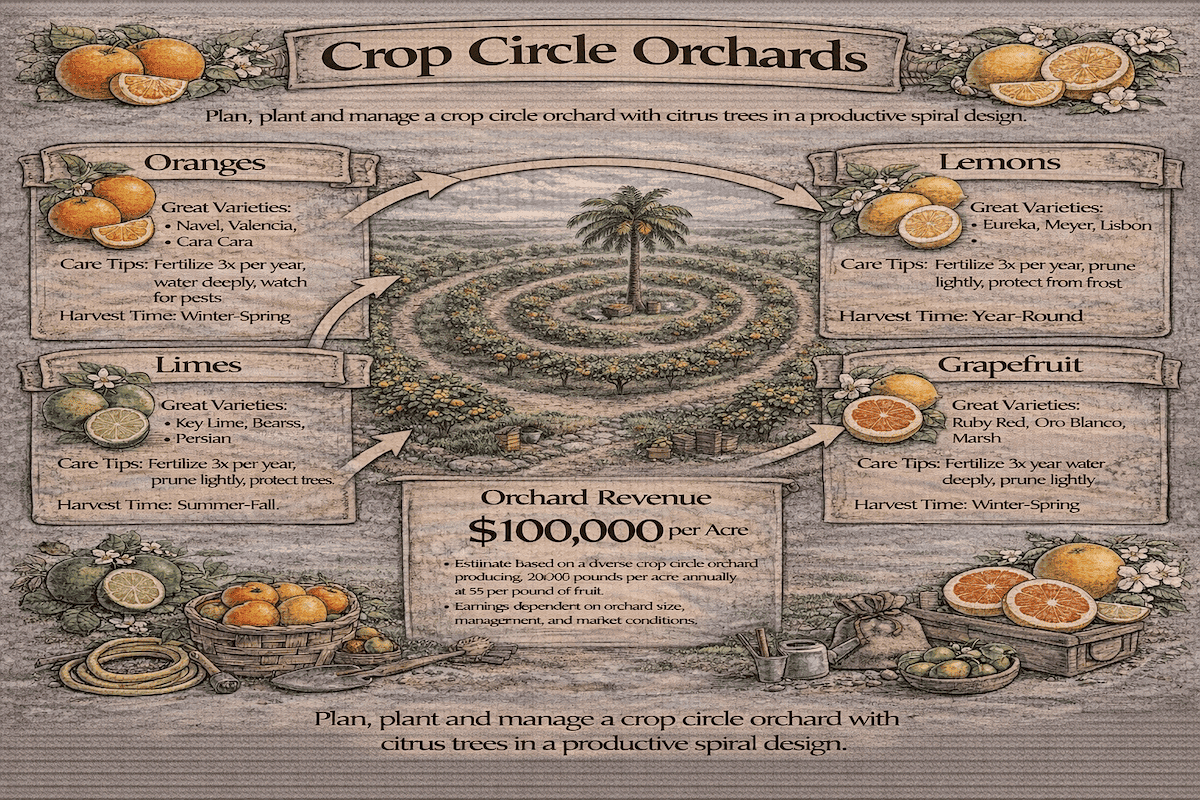
Crop Circle Orchards support all varieties of temperate climate fruit trees including Lemon, Lime, Orange, Grapefruit, Tangerine and Kumquat trees.
Initially, citrus trees were grown for their flowers rather than their fruit, which was considered inedible because heirloom fruit tasted bitter and sour – not sweet at all. As the use of fragrant flowers of citrus trees spread from India (where most citrus trees originate) to the Mediterranean, farmers began to experiment with the fruits, gradually cross breeding citrus trees until they started to produce sweeter fruit. Today, there are literally millions of acres of citrus trees growing in over 50 countries producing many varieties of citrus including new varieties of lemon, lime, orange, grapefruit, tangerine and kumquat.
A Crop Circle Citrus Orchard will produce between 40,000 and 60,000 oranges on average. Types of orange trees that are ideally suited for this system include Valencia oranges used for juicing, Navel oranges for eating and Blood oranges that look more like a grapefruit than an orange. Diseases common to conventional orange groves can be significantly diminished if not entirely eradicated growing oranges with the Archimedean spiral system. Some of these include spotting, cankers, and root rot. Some of insects repelled by the energy created within the Archimedean spiral include aphids, snails, scale and mealybugs.
There are many orange tree varieties, each with its unique characteristics in terms of fruit size, shape, color, flavor, and tree growth habits. Here are some of the most common orange tree varieties:
Other orange tree varieties include Seville, Pineapple, Trovita, and Jaffa oranges. Each variety has its own unique characteristics and is suited to different growing conditions and climates.
An Archimedean spiral will produce between 50,000 and 200,000 lemons depending on the lineal length of the spiral. All types of lemon trees are suitable for the Archimedean spiral orchard including Lisbon lemon, Meyer lemon and the unusual Pink Eureka lemon. Diseases common to lemon orchards like citrus scab, anthracnose, root rot and several types of fungus are a rarity in an Archimedean spiral orchard. Energy fields created by the spirals repel some of the insects that afflict traditional row orchards including spiders, fruit flies, aphids and mites.
Here are some of the most common lemon tree varieties:
Other lemon tree varieties include Genoa, Femminello, Villafranca, and Verna lemons. Each variety has its own unique characteristics and is suited to different growing conditions and climates. When selecting a lemon tree variety, it's important to consider factors such as climate, soil type, and disease resistance to ensure the best possible growing conditions for the tree.
Generally, more productive than lemon trees, lime trees produce about 300 limes per tree. A 4 acre open space Archimedean spiral produces approximately 85,000 limes, while a closed space Archimedean spiral yields over 340,000 limes per acre. Bearss lime, Kaffir lime and Key lime trees benefit from this system. As with Archimedean lemon production, many diseases are avoided and insects like spiders, fruit flies, aphids and mites may be repelled.
Here are some of the most common lime tree varieties:
Other lime tree varieties include Tahitian Lime, Rangpur Lime, and Australian Finger Lime. Each variety has its own unique characteristics and is suited to different growing conditions and climates.
Grapefruit is best grown in an open space Archimedean spiral. Grapefruit is large, setting heavy fruit intermittently throughout the tree. Tree branches need to be robust and quite large to support the weight. All types of grapefruit benefit from this growing system including Thompson grapefruit, Pink Grapefruit and Ruby Red grapefruit. Diseases common to row groves such as tristeza virus, psorosis, sooty canker, Rio Grande gummosis and yellow dragon disease can be greatly diminished or eliminated altogether. Some pests and insects can be eliminated as well, including citrus leaf miner, leaf scales and thrips.
Here are some of the most common grapefruit tree varieties:
Other grapefruit tree varieties include Marsh, Flame, and Thompson Pink. Each variety has its own unique characteristics and is suited to different growing conditions and climates.
Kumquat trees produce fewer fruit per tree than other variety of citrus tree including lemons and limes. Growing Kumquat in an Archimedean spiral would increase production and improve profits for a citrus orchardist. A fruit bearing tree will produce about 50 Kumquats averaging between 14,000 and 56,000 Kumquats per acre. Many types of Kumquats are suitable for these growing methods including Florida Kumquat, California Kumquats, Texas Kumquats and Australian Kumquats. Diseases common to Kumquats such as scab, algal leaf spot, greasy spot, anthracnose, melanose, fruit rot, stem-end rot and gummosis are minimized if not eliminated using the Archimedean spiral orchard system.
More about kumquat tree varieties:
Other kumquat tree varieties include the Jiangsu Kumquat, Fukushu Kumquat, and Centennial Variegated Kumquat. Each variety has its own unique characteristics and is suited to different growing conditions and climates.
Tangerine varieties like Dancy, Murcott and Clementine tangerines produce well in a an Archimedean spiral orchard. Spacing 1,500 trees along the spiraled irrigation lines of both back-to-back spirals will produce 100,000 tangerines on 4 acres. Damaging pests and disease are minimized by the energy field created within the spiral so an orchardist can grow organically without the use of harmful pesticides and herbicides.
There are several types of tangerine trees, each with its unique characteristics in terms of fruit size, shape, color, flavor, and tree growth habits. Here are some of the most common tangerine tree varieties:
Other tangerine tree varieties include the Murcott, Nova, and Page tangerines. Each variety has its own unique characteristics and is suited to different growing conditions and climates.
From maple to oak, hardwoods whisper of centuries past, their slow growth a testament to patience and value over time.
Partner with us in a land management project to repurpose agricultural lands into appreciating tree assets. We have partnered with Growing to Give , a 501(c)(3) nonprofit, to create tree-planting partnerships with land donors.
We have partnered with Growing to Give , a Washington State nonprofit, to create a land and tree partnership program that repurposes agricultural land into appreciating tree assets.
The program utilizes privately owned land to plant trees that benefit both the landowner and the environment.
If you have 100 acres or more of flat, fallow farmland and would like to plant trees, we would like to talk to you. There are no costs to enter the program. You own the land; you own the trees we plant for free, and there are no restrictions—you can sell or transfer the land with the trees at any time.
Tangerines (a type of mandarin) are usually smaller, sweeter, and easier to peel than oranges. They often have fewer seeds and looser skin, making them great for snacking. Oranges are larger with a tighter peel and a more balanced sweet–tart flavor, which makes them ideal for juicing and fresh eating. Both fit well in high-density and crop-circle citrus orchards.
For classic tart juice, Eureka and Lisbon lemons are top choices. They produce lots of juice with bright acidity and relatively few seeds, ideal for fresh lemonade and commercial juicing. If you want a slightly sweeter, less acidic juice with a floral note, choose Meyer lemons, which are a lemon–orange hybrid and perform well in intensive orchard designs.
Red grapefruit is often perceived as sweeter and less bitter and is rich in lycopene, which gives the flesh its red color. Pink grapefruit offers a middle ground with mild sweetness and moderate tartness, while white grapefruit tends to be the most tart and tangy. “Better” really depends on your taste and whether you’re targeting fresh eating, juicing, or specialty markets.
Spacing depends on rootstock vigor and equipment width, but most high-density citrus orchards range from 8–12 feet between trees and 12–18 feet between rows. In crop-circle or Archimedean spiral layouts, you can tighten spacing for smaller varieties and dwarf rootstocks while still keeping enough room for air flow, light penetration, and machinery access. Use the on-page citrus tree planting calculator to estimate trees per acre.
Crop-circle and Archimedean spiral citrus orchards are designed to improve light interception, air movement, and access compared with straight-row layouts. By training branches into long, productive walls of foliage and reducing wasted alley space, these designs can increase fruit set and yield per acre while also helping moderate temperature and reduce some pest pressure. They are especially useful where land or water is limited and growers want to grow more fruit per tree.
Citrus trees like consistent moisture but hate waterlogged roots. In most warm climates, target roughly 1–2 inches of water per week from rain and irrigation combined, adjusted for soil type and tree size. Drip irrigation and micro-sprinklers work best in high-density and crop-circle orchards because they deliver water directly to the root zone, reduce evaporation, and make it easy to add nutrients via fertigation. Mulching under the canopy also helps conserve soil moisture and suppress weeds.
Most common citrus types adapt well to crop-circle layouts, including Valencia and Navel oranges, Eureka and Lisbon lemons, Persian and Key limes, Ruby Red grapefruit, Nagami kumquats, and Clementine tangerines. Choose varieties that match your climate and market, then pair them with appropriate rootstocks for vigor control and disease resistance. For more ideas on complementary crops, see the fruit trees and nut trees pages.
Copyright © All rights reserved Tree Plantation