


 INVEST
 PLANT
PLANT
 SOFTWOODS
 HARDWOODS
 CALCULATORS
 RESOURCES
 PROGRAMS

Softwoods
Learn More
California • Invasives • Identification • Control
If you are trying to figure out “is this tree invasive in California?” this page is your fast field guide. It highlights commonly reported invasive trees and woody invaders in California, how to identify them, where they spread, what not to do during removal, and what to plant instead.
Best use: early detection + planning. Pair this page with the Invasive Tree Species master guide and the Tree Spacing Calculator when you are restoring or replanting a site.
Jump to: top invasive trees • how to identify them • what to plant instead • verify & report • control basics • FAQs

California is ecologically diverse, so the invasive species problem changes by habitat and region. This short list focuses on species that repeatedly show up in invasive inventories, restoration projects, and local management discussions.
Where it shows up: disturbed lots, roadsides, urban edges, post-fire sites.
Why it is a problem: spreads by seed and root suckers, rebounds aggressively after cutting.
Where it shows up: coastal belts, windbreak plantings, old groves, developed edges.
Why it is a problem: can alter habitat structure and increase fuel load and fire concerns in some settings.
Where it shows up: floodplains, drainage channels, riparian corridors, water edges.
Why it is a problem: crowds out native riparian vegetation and changes habitat and water dynamics.
Where it shows up: streams, rivers, ditches, wet corridors.
Why it is a problem: spreads by fragments, forms dense stands, and displaces native willows and other riparian plants.
Where it shows up: disturbed ground, edges, old plantings, dry-to-moderate sites.
Why it is a problem: creates dense root colonies and can spread beyond intended planting areas.
Where they show up: depends on county, watershed, and land-use history.
Why they matter: California programs vary by region, so always confirm locally before removal or reporting.
These pages work best when they help users make a quick decision. That means identify the species, verify the site, choose the control path, then plan replacement planting.
The fastest field workflow is usually: look at the habitat first, then check leaves, bark, flowers or seeds, and finally whether the plant is forming a dense stand or spreading from the roots.
| Tree | Leaves / foliage | Fast ID clue | Common setting |
|---|---|---|---|
| Tree-of-heaven | Large compound leaves | Strong odor when crushed; aggressive suckering | Urban edges, disturbed land, post-fire sites |
| Eucalyptus | Long narrow leaves | Peeling bark, aromatic foliage, dense grove habit | Coastal and inland planted zones |
| Tamarisk | Fine feathery foliage | Small pink flower spikes, shrubby tree form | Waterways and riparian corridors |
| Giant Reed | Tall cane-like stems with blade leaves | Dense riverbank colonies from rhizomes and fragments | Streams, ditches, rivers |
| Black Locust | Pinnate leaves | Thorns on young shoots and dense clone-forming spread | Disturbed soils and old planting zones |
Red flag: if one species is forming a dense patch and crowding out native plants, seedlings, shrubs, or riparian vegetation, that is often the strongest visual clue that you are dealing with an invasive spread problem.
There is no one-size-fits-all replacement tree for California. Pick species that match your exact site conditions: water availability, soil type, sun exposure, slope, habitat type, and fire context.
| Invasive tree or woody invader | Typical setting | Native alternatives to consider |
|---|---|---|
| Tree-of-heaven | Disturbed uplands, urban edges | Region-appropriate oaks, California sycamore, native buckeye, other site-matched natives |
| Eucalyptus | Coastal or inland planted groves | Coast live oak, valley oak, toyon, California bay, and other local habitat-appropriate natives |
| Tamarisk | Riparian corridors and floodplains | Native willows, cottonwoods, mulefat, and other riparian species matched to water conditions |
| Giant Reed | Water edges and ditches | Riparian grasses, native sedges, willows, and restoration plantings appropriate to the watershed |
| Black Locust | Edges, dry sites, old planted areas | Site-specific native shade trees, oaks, redbud, or other appropriate upland species |
Tip: when you replace multiple trees, plan spacing for the mature canopy, not the nursery pot size. Use the Tree Spacing Calculator before planting rows, screens, or restoration blocks.
These are the fastest paths to “is this invasive here?” and “what should I do next?”
Some of California’s most problematic invasive trees spread not only by seed, but also by root suckers, stump sprouts, and fragments moved by water or soil disturbance. That means cutting a tree without a management plan can sometimes make the infestation worse.
Invasive Tree Species (Weed Trees) — definitions, red flags, and prevention.
Map distributions and prioritize management by region.
Tip: before you remove a tree, confirm ID. Some invasive trees look like natives or beneficial ornamentals. Incorrect removal is costly, and site handling can be sensitive near waterways or regulated restoration areas.
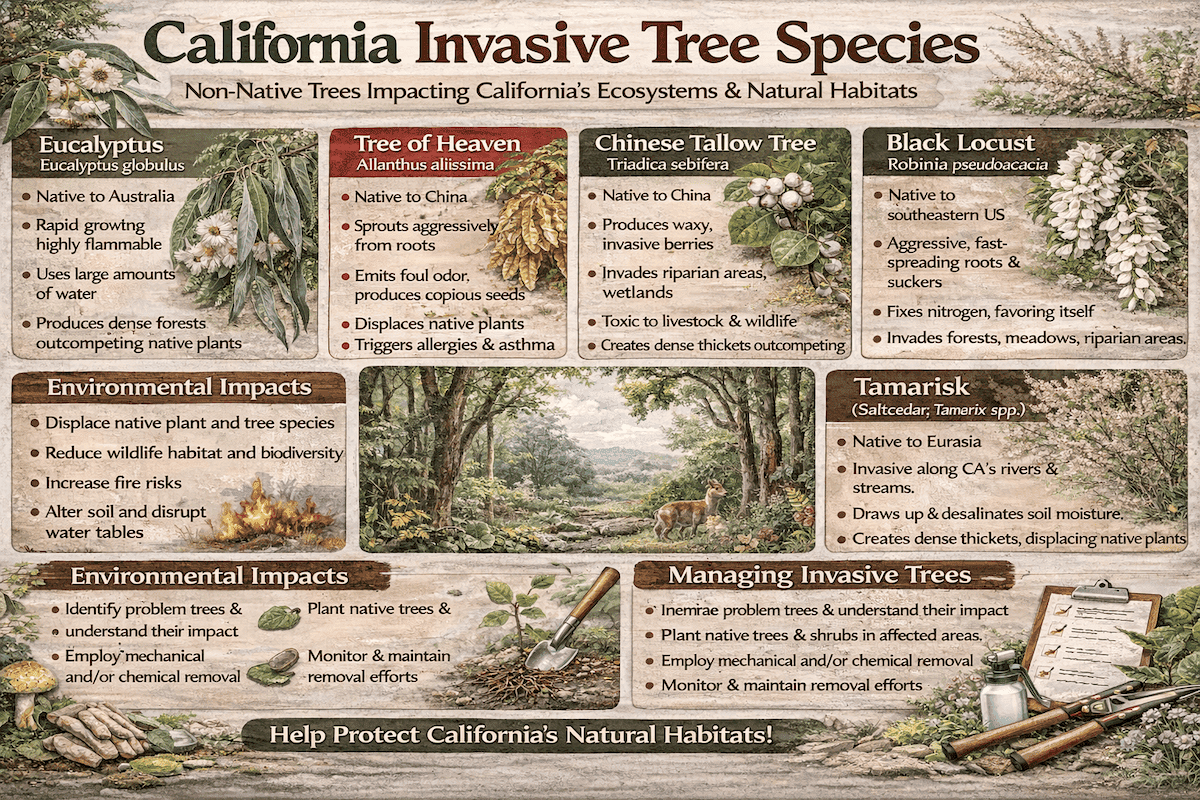
Feel free to share this California invasive tree species infographic on your website or blog. Please include a link back to this page as the source.
The best reports include clear photos and a precise location. The best control plans include follow-up.
Capture leaves, bark, flowers or fruit, the full canopy, and the surrounding habitat.
Use trusted profiles such as Cal-IPC plant profiles.
See whether it is already tracked in your area using CalWeedMapper.
Submit sighting info through local programs or mapping tools, including photos and a precise location.
Match the method to the species and site. Avoid spreading seeds, rhizomes, or fragments during removal.
Re-check the site for resprouts, seedlings, and root suckers. Most invasive tree control takes repeated visits.
High-risk sites: riparian corridors, disturbed lots, road edges, wildfire recovery areas, and unmanaged fence lines. If the tree is near water or sensitive habitat, coordinate before you act.
Most invasive tree control fails for one reason: the tree comes back. The best control plans focus on preventing resprouting, root suckering, and new seedling recruitment.
| Tree | Typical best approach | Difficulty | Regrowth risk |
|---|---|---|---|
| Tree-of-heaven | Species-specific cut and treatment approach timed to limit root rebound | High | Very High |
| Tamarisk | Mechanical removal plus repeated follow-up in riparian contexts | High | High |
| Giant Reed | Integrated control with careful fragment management and repeated monitoring | High | Very High |
| Eucalyptus | Site-specific phased removal where fuel, slope, and restoration goals matter | Medium | Medium |
| Black Locust | Repeated suppression of root suckers and restoration planting afterward | Medium to High | High |
Many invasives respond to cutting with aggressive resprouting. One poorly timed cut can create a thicker infestation.
Seeds, canes, rhizomes, and fragments can spread. Bag seed heads and avoid moving live plant material loosely.
After removal, open ground is an invitation for reinvasion. Replanting with appropriate natives helps stabilize the site.
Want a broader overview of weed trees and prevention strategy? Go back to: Invasive Tree Species.
Frequently tracked invasive trees and woody invaders in California include tree-of-heaven, eucalyptus in some settings, tamarisk or saltcedar, giant reed, and black locust. The exact concern depends on habitat, watershed, fire regime, and local land-use history.
Start with where it is growing — riparian edge, roadside, disturbed lot, post-fire ground, unmanaged field edge — then confirm with leaf shape, bark, flowers or seed, and whether it is forming a spreading patch or dense stand.
Not always. Many invasive trees resprout aggressively after cutting. The better workflow is usually: identify → verify → choose a control method → time it correctly → follow up → replant with natives.
No. Many non-native trees are not invasive. A tree is invasive when it spreads aggressively and creates ecological or management problems in natural or semi-natural areas.
Choose native trees and shrubs that match your exact California site conditions. Riparian zones often need willows, cottonwoods, and other wet-site natives. Upland replacements may include region-appropriate oaks, sycamores, buckeye, toyon, and other local natives.
Not always, but many species are difficult to control with cutting alone because of resprouting, root suckering, or fragment spread. The safest and most effective approach depends on the species and the site.
Copyright © All rights reserved Tree Plantation