


 INVEST
 PLANT
PLANT
 SOFTWOODS
 HARDWOODS
 CALCULATORS
 RESOURCES
 PROGRAMS

Softwoods
Learn More
CUT • STACK • HEAT
Wondering how much firewood you can get from a tree? This firewood calculator estimates pieces, face cords, and full cords based on tree diameter and typical firewood dimensions, so you can plan cutting, hauling, stacking, storage, and winter heating with real numbers.
🔥 Quick answer: A typical tree produces between 0.1 and 0.5 cords of firewood depending on diameter, height, species, and how efficiently the wood is cut and split. Small trees may yield mostly kindling, while larger trees in the 20–24 inch diameter range can produce ½ cord or more.
| Tree Diameter | Estimated Firewood Yield |
|---|---|
| 10 inches | ~0.1 cord |
| 16 inches | ~0.25 cord |
| 24 inches | ~0.5 cord |
Example: A 24-inch diameter tree can produce about ½ cord of firewood, or roughly 300–600 pieces, depending on log length, split size, species, and waste during cutting.
Use the calculators below to estimate firewood yield from a standing tree or a cut log, then compare results to standard cord measurements.
Jump to: Firewood in a Tree Calculator • Firewood in a Log Calculator • Cord Measurements • Hardwood vs Softwood • Log Splitters • Firewood FAQ
Before you fire up the chainsaw, it helps to know what you’ll actually get. Many people are surprised by how little usable firewood comes from a tree that looks huge in summer. Once leaves are gone, what you’re working with is the main trunk and a handful of larger branches—while smaller branches are often better turned into kindling.
Not surprisingly, small trees produce the least firewood. A 5-inch round tree (the maximum diameter you can use without splitting) around 50 feet tall may yield only a few dozen pieces plus kindling. A large tree with a 24-inch trunk and 120-foot height can yield hundreds of pieces—often around a half bush cord (or roughly 3 face cords), depending on how you cut and split.
Before digital tools such as an online firewood calculator, foresters, loggers, and landowners relied on several traditional methods to estimate how much usable wood volume a tree contained. These techniques required manual measurements and reference tables to determine the amount of wood that could be converted into firewood, logs, or lumber.
Although these older approaches can still be useful in forestry and timber cruising, they are often slower and less convenient than modern calculators designed to estimate how many cords of firewood a tree can produce.
Method 1 – DBH Measurement and Tree Volume Tables: Measure the diameter at breast height (DBH), which is the trunk diameter taken approximately 4.5 feet above the ground. Using this measurement along with the tree’s height and species, foresters consult tree volume tables to estimate the total wood volume in cubic feet. That volume can then be converted into cords of firewood or individual firewood pieces.
Method 2 – Diameter Tape (D-Tape): A specialized forestry tool called a diameter tape measures the circumference of a tree at breast height and automatically converts it into DBH. Once the diameter is known, foresters use species-specific volume tables to estimate total trunk volume and the amount of usable firewood.
Method 3 – Smalian’s Formula for Log Volume: Foresters sometimes estimate tree volume by dividing the trunk into log sections and calculating the volume of each section using Smalian’s Formula. This method requires measuring the diameters at both ends of a log section and the length of that section. The calculated volumes of multiple sections are then added together to estimate the total trunk volume before converting the result into cords or pieces of firewood.
Method 4 – Wood Weight and Density Estimates: Another method is to estimate the green weight of a tree using the average weight per cubic foot for that species. Once the approximate weight is known, it can be converted into wood volume using typical density values. From there, foresters estimate how many cords of firewood or pieces of split firewood the tree could produce.
Today, a much faster and simpler way to estimate the firewood yield of a tree is to use the firewood calculator below. Instead of consulting forestry tables or applying volume formulas, you can simply choose the diameter of the tree from the dropdown menu and press “Calculate.”
The calculator instantly estimates how many pieces of firewood can be produced from that tree based on typical trunk proportions and firewood dimensions.
If you enter a tree diameter of 5 inches or less, the calculator assumes the wood will be used as round, unsplit firewood. If the tree diameter is 6 inches or greater, the calculator estimates the number of split firewood pieces that can be produced.
Tree height is automatically factored into the calculation based on the diameter selected, so you don’t need to measure or enter tree height manually. This makes the calculator a convenient way to estimate the amount of firewood available from a standing tree before cutting, harvesting, or ordering logs for processing.
Feel free to share this firewood calculator infographic on your website or blog. Please include a link back to this page as the source.
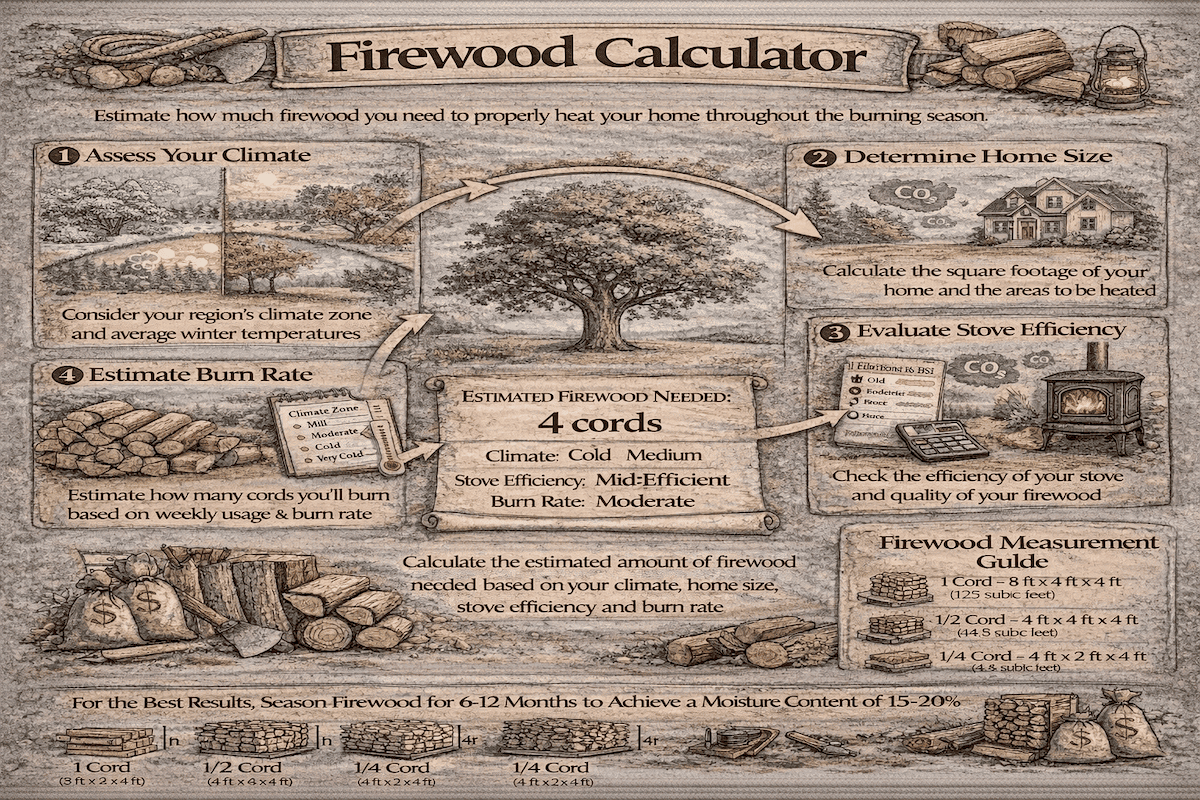
In many regions, homeowners can purchase sawlogs directly from a local mill, logging operation, or private woodlot owner and have them delivered to their property. Buying whole logs can often be more economical than purchasing pre-split firewood, but without estimating how many pieces of firewood each log will produce, it can be difficult to know how many logs to order.
The firewood log calculator below helps estimate how much split firewood can be produced from a single log. By entering the diameter and length of a log, the calculator estimates the number of firewood pieces that can be cut and split from that log. This tool is especially useful for people who cut their own firewood or who buy logs in bulk to process into a face cord, half cord, or full cord of firewood.
For example, using the calculator you will see that approximately four logs measuring 12 inches in diameter and 20 feet long can produce enough split firewood to make a face cord—roughly 200 pieces of 16-inch firewood. About 12 logs of the same size will produce a half cord (around 600 pieces), while approximately 38 logs of this size are needed to produce a full cord of split firewood.
To use the firewood log calculator, enter the diameter of the log in the first box and the length of the log in the second box, then press “Calculate.” The estimated number of split firewood pieces will appear in the results field below. These calculations assume an irregularly shaped firewood split approximately 16 inches long cut from a 20-foot log.
Keep in mind that logs delivered from sawmills or logging trucks are often 40 feet long. These longer logs are typically bucked into two 20-foot sections before being processed into stove-length firewood. By estimating the number of pieces produced from each log, you can plan your firewood supply more accurately and ensure you have enough wood for the entire heating season.
Firewood is typically sold by volume rather than by weight. The most common measurements are the bush cord, full cord, half cord, and face cord (also called a rack). You may also see small pre-packaged bundles sold at supermarkets, gas stations, and convenience stores. While these bundles are convenient for camping or a quick fireplace fire, they are usually the most expensive way to buy firewood when calculated on a cost-per-piece basis.
A typical retail bundle costing $3–$4 often contains only 4–7 pieces of firewood. It takes approximately 72 of these small bundles to equal a single face cord of firewood. In many regions, a face cord can often be purchased locally for about $50 delivered, while buying the same amount of wood in bundles could cost more than $200.
How Many Pieces of Firewood Are in a Cord?
One of the most common questions people ask when buying or cutting firewood is: how many pieces of firewood are in a cord? The answer depends on how long the pieces are cut, how thick they are split, and how tightly the wood is stacked. Still, there are useful averages that can help you estimate your firewood supply.
A typical face cord of firewood contains about 200 pieces of split firewood when cut to a standard stove length of 15–16 inches. A half cord contains about 600 pieces, while a full bush cord can contain roughly 1,200 pieces. These numbers are approximate, but they provide a practical way to compare stacked firewood volumes and estimate how much heat you will have for the season.
If your firewood is split into smaller pieces, you may have a higher piece count per cord. If it is cut into larger chunks for outdoor boilers, wood furnaces, or smoking meat, the total number of pieces may be lower. Species also matter. Dense hardwoods such as oak, maple, and hickory tend to produce heavier, longer-burning pieces, while lighter softwoods like pine and fir may be split into a different size depending on use.
| Firewood Amount | Stack Size | Approx Pieces |
|---|---|---|
| Face Cord | 8 ft × 4 ft × 16 in | ~200 |
| Half Cord | 4 ft × 4 ft × 4 ft | ~600 |
| Full Cord | 8 ft × 4 ft × 4 ft | ~600 |
| Bush Cord | 8 ft × 8 ft × 4 ft | ~1200 |
Large split firewood is commonly used for curing, smoking, and slow-cooking meats. These pieces are usually much longer than standard stove wood, ranging from 20 to 40 inches in length. Depending on the cooking method, the wood may be burned in an open pit, placed inside a smoker, or used to fuel a traditional barbecue cooker.
Certain wood species are especially prized for cooking. Hickory, maple, apple, and cherry are among the most popular smoking woods because they produce flavorful aromatic smoke. On the West Coast, alder, cedar, and bigleaf maple are also widely used.
Using the firewood calculator to estimate how much firewood is contained in a tree shows that producing a full bush cord of large split firewood typically requires a tree with a trunk diameter of about 24 inches and a trunk height of around 60 feet.
When selecting firewood, it is important to understand the difference between hardwoods and softwoods. Hardwoods generally burn hotter and longer because they have a denser grain structure and higher energy content. Species such as oak, maple, apple, and hickory are widely considered some of the best woods for fireplaces and wood stoves.
The heat value of firewood is often measured using a British Thermal Unit (BTU) chart, which ranks wood species from highest to lowest heat output. Dense hardwoods such as apple can sometimes burn for 24 hours or longer in efficient wood-burning stoves or masonry heaters.
Softwoods, such as pine and fir, generally burn faster and produce more soot and creosote, which can build up inside chimneys and flue liners. Because softwoods tend to spark more during combustion, a fireplace spark screen is recommended when burning these woods indoors.
For a festive touch during the holidays, many people toss a few pine cones onto the fire. Pine cones ignite easily, burn with lively colors, and create an attractive crackling sound in the fireplace.
Once you’ve used the firewood calculator to estimate how much firewood a tree can produce, the next step is splitting the logs. Several types of firewood log splitters are available, ranging from simple hand tools to powerful professional machines.
Manual Log Splitters: These basic tools rely on human power. A steel wedge attached to a handle is driven into the log with a maul or sledgehammer. Manual splitters are inexpensive and work best for smaller logs or occasional firewood splitting.
Electric Log Splitters: Electric models are popular for home use and can typically produce one or two face cords of firewood per season. An electric motor powers a hydraulic ram that pushes the log into a splitting wedge. Many units include wheels so they can be moved easily around the yard.
Gas-Powered Log Splitters: Designed for large volumes of wood, gas splitters are often towable behind a truck or ATV. These machines provide significant splitting force. Straight-grained species such as ash may require around 20 tons of ram force, while stubborn woods like elm can require much more pressure.
Kinetic Log Splitters: Kinetic splitters store energy in a flywheel and release it rapidly to split logs. They operate much faster than traditional hydraulic splitters and are popular with serious firewood producers who process large quantities of wood.
Screw-Type Log Splitters: These machines use a rotating screw to draw the log into a fixed wedge. Although slower, screw splitters are very effective for difficult species such as ironwood, elm, and dense deadwood. They are commonly used by professional firewood processors.
You can also use the online Firewood Calculator on Tree Plantation to estimate how much kindling a tree can produce. Simply enter the diameter of your tree in the kindling section of the calculator and press “Calculate.”
For example, a tree with a trunk diameter of 20 inches can produce just over one bush cord of split firewood—about 1,200 pieces of 12–16 inch × 3–6 inch split firewood. The same tree can produce nearly three times that amount—around 3,000 pieces—of 12–16 inch × 1–2 inch stacked kindling, which is ideal for starting fires in fireplaces, wood stoves, or outdoor fire pits.
Whether your wood comes from fast-drying softwoods like pine and fir, or long-burning hardwoods such as oak, maple, and hickory, converting smaller branches and split pieces into kindling ensures that nearly every part of a harvested tree can be used efficiently. Natural fire starters such as pine cones are also excellent for igniting fires quickly, while aromatic woods like sandalwood can add a distinctive fragrance when burned.
To estimate how much firewood a tree can produce, measure the trunk diameter (usually at breast height) and enter it into the firewood calculator. The tool estimates how many pieces of firewood the tree can yield based on typical trunk height, usable wood volume, and standard stove-length splits.
A typical full cord of firewood contains about 600 pieces of split firewood when cut to a standard length of 15–16 inches. The exact number varies depending on how the wood is split, the species, and how tightly the firewood is stacked.
A bush cord measures 8 ft × 8 ft × 4 ft and contains about 1,200 pieces of firewood. A full cord measures 8 ft × 4 ft × 4 ft and contains roughly 600 pieces. A face cord measures 8 ft × 4 ft with firewood stacked one piece deep and typically contains about 200 pieces.
The number of logs needed depends on their diameter and length. For example, about 38 logs that are 12 inches in diameter and 20 feet long can produce approximately one full cord of split firewood once the logs are bucked and split into stove-length pieces.
Hardwoods such as oak, maple, apple, and hickory generally burn hotter and longer because they are denser. Softwoods like pine and fir ignite quickly but burn faster and can produce more sparks and creosote if not properly seasoned.
The amount of firewood needed depends on climate and heating habits. Homes that rely primarily on wood heat in cold climates often burn 4–6 full cords per winter. Homes using wood occasionally for supplemental heat may only need 1–2 face cords.
Copyright © All rights reserved Tree Plantation