 INVEST
 PLANT
PLANT
 SOFTWOODS
 HARDWOODS
 CALCULATORS
 RESOURCES
 REFOREST

Softwoods
Learn More




A complete guide to the Great Green Wall—how Africa’s largest restoration initiative is reversing desertification, rebuilding ecosystems, improving food security, and creating climate resilience across the Sahel
GREAT GREEN WALL • AFRICA • DESERTIFICATION • REFORESTATION • CLIMATE SOLUTIONS
🌍 Quick answer: The Great Green Wall is an African-led land restoration initiative designed to combat desertification across the Sahel by restoring degraded land, planting trees, improving soils, supporting communities, and strengthening climate resilience.
The project has evolved from the idea of a single wall of trees into a wider network of reforestation, agroforestry, soil restoration, water harvesting, native species planting, and community-led land recovery efforts.
The Great Green Wall is one of the world’s most ambitious environmental restoration projects. Stretching across the Sahel region of Africa, it connects tree planting, regenerative agriculture, water conservation, soil health, food security, and poverty reduction into one large-scale land recovery strategy.
This guide explains what the Great Green Wall is, why it was created, where it is located, how it works, what progress has been made, and how restoration projects in countries such as Senegal, Niger, Ethiopia, and Mali are helping communities rebuild degraded landscapes.
Use the links below to jump to the main Great Green Wall sections, including project goals, restoration methods, ecosystem impact, human impact, progress data, case studies, and FAQ.
The Great Green Wall is one of the largest ecological restoration projects in the world. It aims to restore degraded land across Africa’s Sahel region by combining reforestation, sustainable land management, and community-led agriculture.
Originally envisioned as a continuous wall of trees, the project has evolved into a mosaic of restoration efforts across multiple countries. It focuses on improving ecosystems, livelihoods, and climate resilience.
The project was launched to combat desertification, land degradation, and food insecurity in some of the most vulnerable regions on Earth.
The Great Green Wall stretches across the Sahel region from West to East Africa, including countries such as Senegal, Mali, Niger, Chad, Sudan, and Ethiopia.
Feel free to share this Great Green Wall Project infographic explaining how Africa’s land restoration initiative helps combat desertification, restore degraded land, improve food security, build climate resilience, and support communities across the Sahel. Please include a link back to this page as the source.
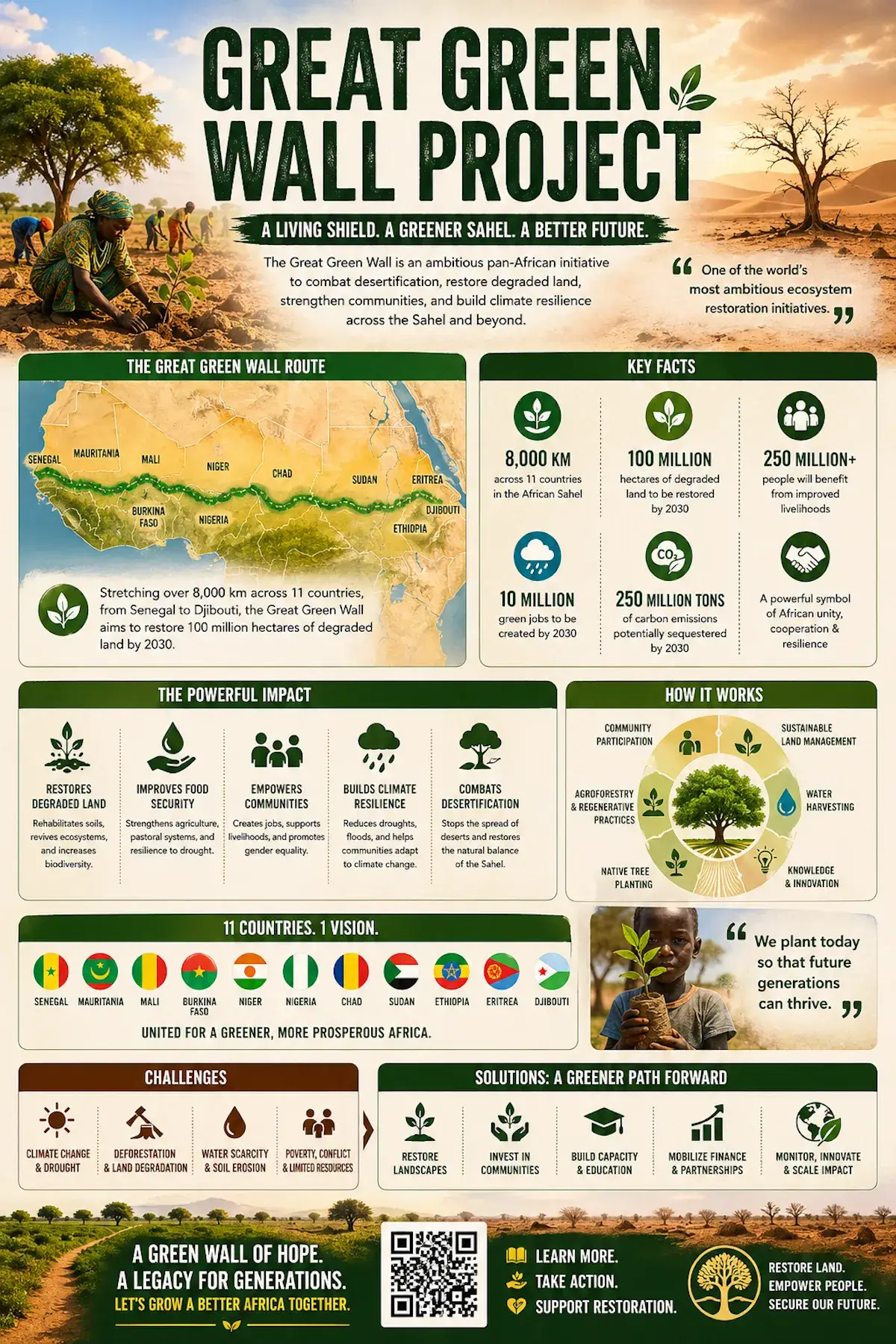
The Great Green Wall Project is designed to do more than plant trees. Its larger goal is to restore degraded landscapes, strengthen rural economies, improve food security, and help communities adapt to climate change across Africa’s dryland regions.
The Great Green Wall works through a combination of ecological restoration, community participation, and climate-smart land management. Instead of a single line of trees, it is now understood as a network of restoration projects adapted to local soils, rainfall, crops, grazing systems, and community needs.
When degraded land is restored, the benefits extend beyond tree cover. Healthy vegetation improves soil life, slows erosion, supports wildlife, increases moisture retention, and helps dryland ecosystems become more resilient.
The Great Green Wall is also a human development project. Restoring land can improve food production, create local jobs, reduce pressure to migrate, and help communities remain resilient during drought and climate stress.
Progress varies widely by country, funding level, local governance, and restoration method. Some areas have seen major success through natural regeneration and community-led land management, while other regions still face funding gaps and implementation challenges.
Several countries show how different restoration strategies can support the Great Green Wall vision. The strongest examples often combine local knowledge, farmer participation, native species, and long-term land stewardship.
| Category | Great Green Wall (Africa) | China Green Wall |
|---|---|---|
| Region | Sahel (Africa) | Northern China |
| Goal | Restore degraded land | Stop desert expansion |
| Approach | Community-led restoration | Large-scale tree planting |
| Focus | Food, jobs, ecosystems | Dust control, land stabilization |
| Scale | Multi-country initiative | National project |
FAQ • GREAT GREEN WALL • AFRICA • RESTORATION
A major African initiative to restore land and fight desertification.
Progress varies by country, but it has restored millions of hectares of land.
Multiple countries across the Sahel from Senegal to Ethiopia.
By restoring vegetation and storing carbon.
It supports ecosystems, food security, and human livelihoods.
Copyright © All rights reserved Tree Plantation