

Understand why groundwater levels are falling worldwide, how it impacts food, ecosystems, and climate resilience—and the proven strategies to recharge and protect water systems
Groundwater Depletion: Causes, Impacts, and How to Restore Water Systems
GROUNDWATER • WATER SCARCITY • AGRICULTURE • CLIMATE • ECOSYSTEMS
What Is Groundwater Depletion and Why It Matters for Water, Food, and Climate
A complete guide to groundwater depletion, including causes, impacts on agriculture and ecosystems, water table decline, and solutions like recharge systems and regenerative water management.
Quick Answer:
Groundwater depletion occurs when water is extracted faster than it is replenished. It leads to declining water tables, reduced agricultural productivity, ecosystem damage, and long-term water scarcity.
Definition:
Groundwater depletion is the long-term lowering of water levels in aquifers due to excessive extraction and insufficient natural recharge.
What Is Groundwater Depletion?
Groundwater depletion occurs when water is withdrawn from underground aquifers faster than it can be naturally replenished through rainfall and infiltration. Over time, this leads to declining water tables and reduced long-term water availability.
What Causes Groundwater Depletion?
The primary cause is excessive extraction for agriculture, cities, and industry, combined with reduced recharge due to climate change and land degradation.
Why Groundwater Is Important
Groundwater is a critical resource for drinking water, agriculture, and ecosystems. It supports billions of people and provides stability during drought periods.
Effects of Groundwater Depletion
Groundwater depletion affects far more than wells. As underground water reserves decline, farms, cities, wetlands, rivers, soils, and ecosystems all become more vulnerable to drought, heat, and long-term land degradation.
Declining water tables: Wells must reach deeper to access water, increasing pumping costs and reducing long-term water security.
Reduced crop yields: Less available irrigation water can stress crops, shorten growing seasons, and reduce farm productivity.
Land subsidence: When aquifers are overdrawn, underground layers can compact, causing the land surface to sink.
Loss of wetlands and ecosystems: Springs, wetlands, rivers, and groundwater-fed habitats can shrink or disappear.
Increased drought vulnerability: With fewer underground reserves, landscapes have less natural backup during dry years.
Groundwater & Aquifers
Groundwater is water stored below the surface in soil, sand, gravel, cracks, and porous rock. Aquifers are the underground layers that hold and transmit this water, making them essential natural reservoirs for farms, communities, rivers, and ecosystems.
What is groundwater: Water that has soaked below the surface and is stored in underground spaces between soil particles, sediment, and rock.
Aquifers explained: Natural underground storage systems that hold groundwater and release it through wells, springs, rivers, or wetlands.
Types of aquifers: Aquifers may be shallow, deep, confined, unconfined, porous, fractured, seasonal, or fossil water systems.
Confined vs unconfined aquifers: Unconfined aquifers are closer to the surface and recharge more directly, while confined aquifers sit beneath less permeable layers and may recharge slowly.
Groundwater Depletion Drivers
Groundwater depletion usually happens when water is removed faster than rainfall, rivers, floodwater, or soil infiltration can replace it. In drylands, this imbalance can grow quickly because recharge is limited and demand is often high.
Overpumping and extraction: Pumping more water than an aquifer can naturally replace lowers water tables and can permanently reduce storage capacity.
Agricultural water use: Farming is often the largest groundwater demand in dry regions, especially where crops depend heavily on irrigation.
Irrigation demand: High-water crops, inefficient irrigation, and hot climates increase groundwater withdrawals.
Urban water consumption: Growing cities increase demand for drinking water, landscaping, industry, and infrastructure.
Industrial water use: Manufacturing, energy production, mining, and processing facilities can place heavy pressure on aquifers.
Drought and reduced recharge: Less rainfall and fewer recharge events mean aquifers refill more slowly while pumping often increases.
Climate Change and Groundwater
Climate change is reshaping how water moves through the landscape. Shifts in rainfall timing, intensity, and distribution reduce the amount of water that can soak into the ground and replenish aquifers. In many regions, longer dry periods are combined with shorter, more intense storms—conditions that increase runoff while reducing infiltration.
Rising temperatures also increase evaporation from soil and surface water, while plants use more water under heat stress. Together, these changes reduce natural groundwater recharge and increase dependence on already stressed aquifers.
Agriculture & Groundwater Use
Agriculture is one of the largest users of groundwater worldwide, especially in dry and semi-arid regions where rainfall is not sufficient to support crops. When irrigation depends heavily on groundwater, aquifers can decline rapidly if withdrawals exceed recharge.
Irrigation and groundwater use:
Many farming systems rely on wells to supply water during dry periods, increasing pressure on underground reserves.
Water-intensive crops:
Crops such as alfalfa, rice, and certain fruits require large amounts of water, accelerating depletion in water-limited regions.
Inefficient irrigation systems (Crop Circle Farms):
Traditional irrigation methods can lose significant water through evaporation, runoff, and poor distribution. Water-efficient systems and regenerative approaches can reduce demand while improving yields.
Declining Aquifers Around The World
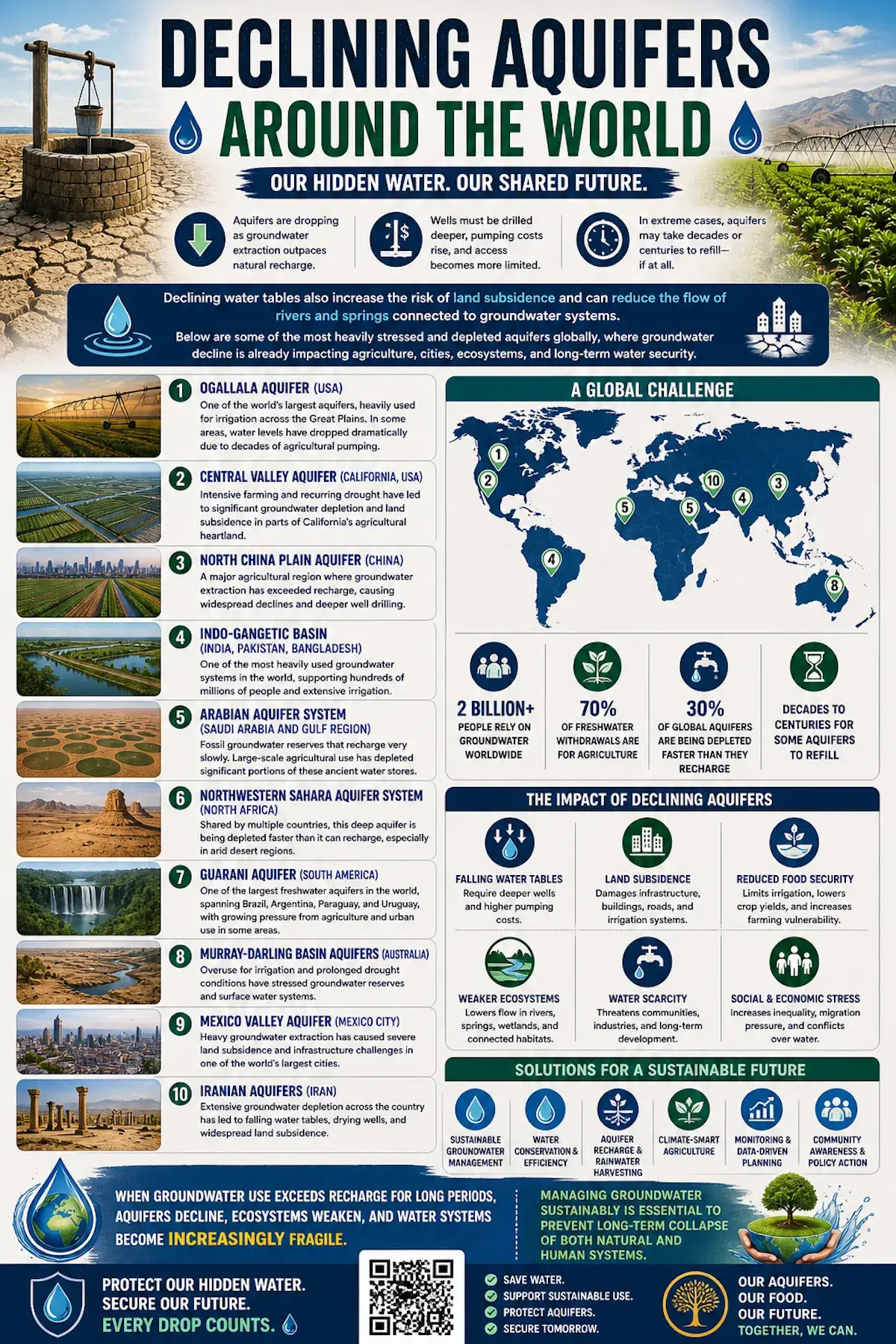
Aquifers are dropping in many parts of the world as groundwater extraction outpaces natural recharge. As levels fall, wells must be drilled deeper, pumping costs rise, and access becomes more limited—especially for small farms and rural communities.
In extreme cases, shallow wells run dry completely, and deeper aquifers may take decades or centuries to refill. Declining water tables also increase the risk of land subsidence and can reduce the flow of rivers and springs connected to groundwater systems.
Below are some of the most heavily stressed and depleted aquifers globally, where groundwater decline is already impacting agriculture, cities, ecosystems, and long-term water security:
Ogallala Aquifer (USA):
One of the world’s largest aquifers, heavily used for irrigation across the Great Plains. In some areas, water levels have dropped dramatically due to decades of agricultural pumping.
Central Valley Aquifer (California, USA):
Intensive farming and recurring drought have led to significant groundwater depletion and land subsidence in parts of California’s agricultural heartland.
North China Plain Aquifer (China):
A major agricultural region where groundwater extraction has exceeded recharge, causing widespread declines and deeper well drilling.
Indo-Gangetic Basin (India, Pakistan, Bangladesh):
One of the most heavily used groundwater systems in the world, supporting hundreds of millions of people and extensive irrigation.
Arabian Aquifer System (Saudi Arabia and Gulf region):
Fossil groundwater reserves that recharge very slowly. Large-scale agricultural use has depleted significant portions of these ancient water stores.
Northwestern Sahara Aquifer System (North Africa):
Shared by multiple countries, this deep aquifer is being depleted faster than it can recharge, especially in arid desert regions.
Guarani Aquifer (South America):
One of the largest freshwater aquifers in the world, spanning Brazil, Argentina, Paraguay, and Uruguay, with growing pressure from agriculture and urban use in some areas.
Murray-Darling Basin Aquifers (Australia):
Overuse for irrigation and prolonged drought conditions have stressed groundwater reserves and surface water systems.
Mexico Valley Aquifer (Mexico City):
Heavy groundwater extraction has caused severe land subsidence and infrastructure challenges in one of the world’s largest cities.
Iranian Aquifers (Iran):
Extensive groundwater depletion across the country has led to falling water tables, drying wells, and widespread land subsidence.
These examples highlight a global pattern: when groundwater use exceeds recharge for long periods, aquifers decline, ecosystems weaken, and water systems become increasingly fragile. Managing groundwater sustainably is essential to prevent long-term collapse of both natural and human systems.
Declining Aquifers Around the World Infographic
Feel free to share this declining aquifers infographic explaining how groundwater depletion, falling water tables, over-extraction, agricultural demand, land subsidence, and water scarcity are impacting regions across the world. Please include a link back to this page as the source.
Share This Declining Aquifers Infographic
Copy and paste the embed code below.
Groundwater Depletion and Desertification
Groundwater plays a critical role in maintaining vegetation, soil moisture, and ecosystem stability in drylands. When groundwater declines, plants lose access to reliable water sources, making it harder for vegetation to survive and regenerate.
As plant cover disappears, soil becomes exposed to heat, wind, and erosion. This accelerates land degradation and contributes directly to desertification, transforming productive land into dry, degraded landscapes.
Dryland Ecosystem Collapse
Dryland ecosystem collapse is often closely tied to long-term water loss. When groundwater levels fall and rainfall becomes less reliable, ecosystems lose their ability to support vegetation, wildlife, and soil health.
Without sufficient water, feedback loops can develop—vegetation loss leads to higher temperatures, reduced moisture retention, and further degradation. Over time, this can push landscapes toward irreversible tipping points.
Groundwater Recharge & Solutions
Reversing groundwater decline requires slowing water loss, increasing infiltration, and reducing demand. Effective solutions combine water management, land restoration, and more efficient agricultural practices.
Groundwater recharge techniques:
Methods such as recharge basins, infiltration trenches, check dams, and managed aquifer recharge help water move back into underground systems.
Water harvesting systems:
Capturing rainwater through swales, contour systems, and storage structures improves soil moisture and supports aquifer recharge.
Regenerative agriculture and water use:
Practices like soil building, mulching, reduced tillage, agroforestry, and efficient irrigation increase water retention and reduce groundwater dependence.
Comparison: Global Groundwater Usage
Sector
Water Use
Impact
Agriculture
Highest
Major depletion driver
Urban
Moderate
Growing demand
Industrial
Variable
Localized impact
Tipping Points
Aquifer collapse: Long-term overpumping can lower pressure, reduce storage, dry wells, and weaken connected rivers, springs, wetlands, and ecosystems.
Irreversible water loss: Some deep aquifers recharge so slowly that heavy depletion can function like permanent water loss on human time scales.
FAQ • GROUNDWATER
Groundwater Depletion FAQ
The lowering of water levels due to overuse.
Excessive extraction and reduced recharge.
It threatens water supply and ecosystems.
Yes, through recharge and conservation.
It can take years to decades depending on conditions.