

Topsoil is the engine of agricultural productivity—yet it’s being lost faster than it can regenerate. Understand the causes, global impact, and how to rebuild healthy, resilient soils
Topsoil Loss and Productivity Decline: Causes, Impacts, and Restoration Solutions
What Is Topsoil Loss, How It Reduces Productivity, and How to Prevent It
A complete guide to soil fertility loss, including why soil fertility is declining globally, how nutrients are depleted, how soil structure breaks down, and how regenerative agriculture can rebuild productive land.
Quick Answer:
Soil fertility loss happens when soil loses the nutrients, structure, biology, and water-holding capacity needed to support healthy plant growth. It is caused by erosion, continuous cropping, overgrazing, deforestation, chemical overuse, poor irrigation, salinization, and compaction.
Definition:
Soil fertility loss is the decline of a soil’s ability to provide nutrients, water, root support, microbial activity, and biological function for crops, plants, and ecosystems.
What Is Soil Fertility Loss?
Soil fertility loss is the decline of a soil’s ability to support healthy plant growth. Fertile soil must provide nutrients, water, oxygen, root space, microbial activity, and stable structure. When any of these systems decline, crop productivity and ecosystem health begin to fall.
Soil fertility includes chemical fertility, biological fertility, and physical fertility. Chemical fertility refers to nutrients such as nitrogen, phosphorus, potassium, calcium, magnesium, and micronutrients. Biological fertility refers to microbes, fungi, earthworms, and organic matter. Physical fertility refers to soil structure, aeration, infiltration, and water retention.
Soil fertility loss is closely related to soil degradation, but they are not exactly the same. Soil degradation is the broader decline of soil quality, while fertility loss focuses specifically on the soil’s ability to grow plants and cycle nutrients.
Types of Soil Fertility
Chemical fertility: The availability of essential nutrients such as nitrogen, phosphorus, potassium, calcium, magnesium, sulfur, zinc, iron, copper, manganese, and boron.
Biological fertility: The living side of soil, including bacteria, fungi, mycorrhizae, earthworms, insects, and decomposers that cycle nutrients and build organic matter.
Soil Fertility Loss Regions of the World Infographic
Feel free to share this soil fertility loss infographic explaining the worst soil fertility loss regions of the world, why soil fertility is disappearing, global hotspots, nutrient depletion, erosion, organic matter loss, poor water management, and solutions to restore soil health. Please include a link back to this page as the source.
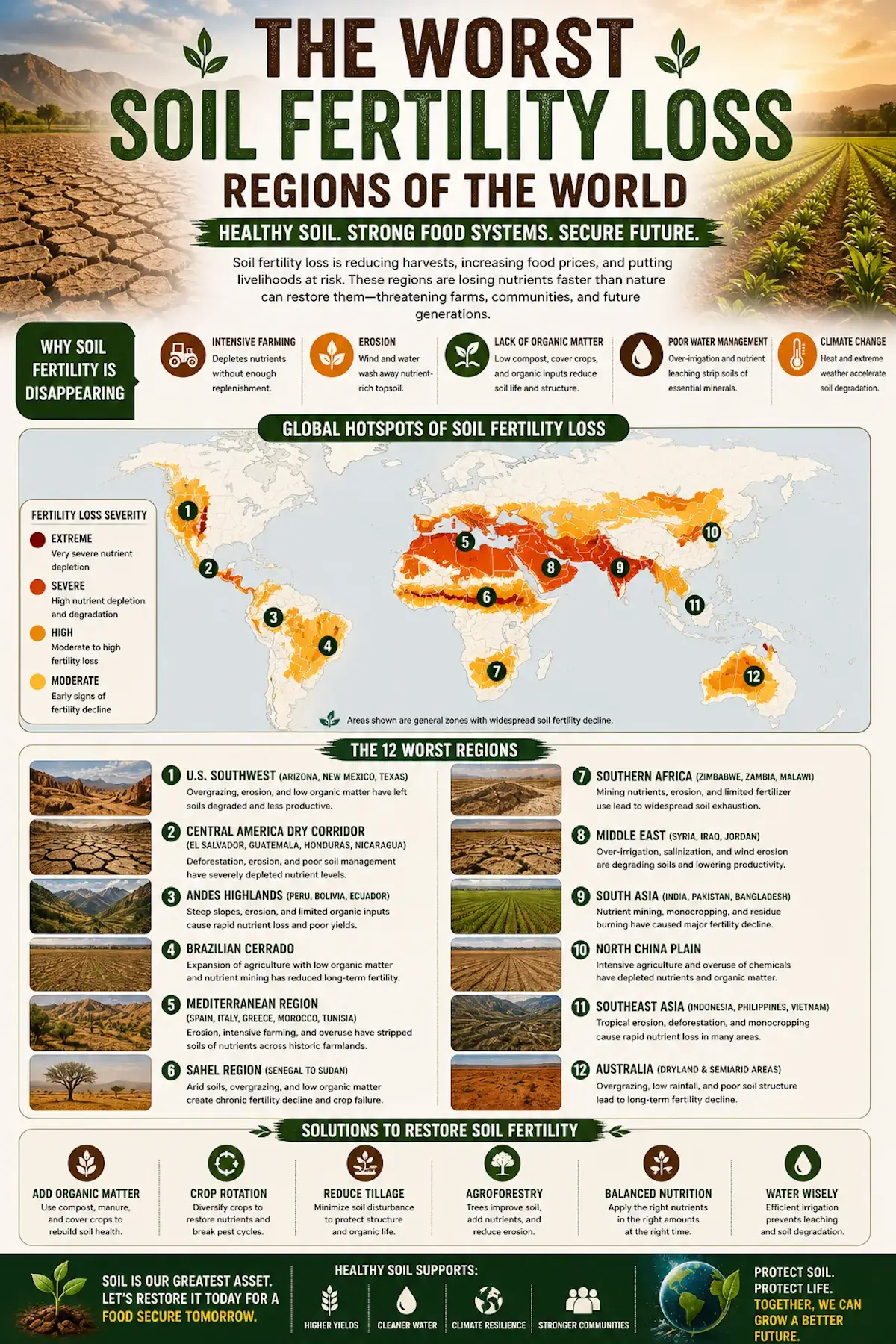
Share This Soil Fertility Loss Infographic
Copy and paste the embed code below.
Main Causes of Soil Fertility Loss
Nutrient depletion from continuous cropping: Repeated harvests remove nutrients faster than they are replaced.
Soil erosion: Wind and water strip away the nutrient-rich topsoil layer that supports plant roots, soil microbes, organic matter, and natural seed banks. Once this living surface layer is removed, the remaining soil often holds less moisture, contains fewer nutrients, and becomes harder for crops, grasses, and trees to reestablish without restoration.
Chemical overuse: Excess fertilizers and pesticides can disrupt soil biology and create nutrient imbalance.
Overgrazing and vegetation loss: Heavy grazing exposes soil, reduces root systems, and accelerates erosion.
Deforestation and land clearing: Removing trees eliminates root systems that anchor soil and protect it from wind and water erosion, while also reducing organic matter inputs from leaf litter and biomass. Without tree cover, soils are exposed to direct sun and rainfall, leading to higher temperatures, faster moisture loss, reduced microbial activity, and declining fertility. Over time, this loss of shade, structure, and biological support accelerates erosion, compaction, and long-term land degradation.
Poor irrigation and salinization: Inefficient irrigation practices—especially in arid and semi-arid regions—can cause water to evaporate or drain improperly, leaving behind concentrated salts in the root zone. Over time, this salt buildup disrupts soil chemistry, reduces nutrient availability, and makes it harder for plants to absorb water. High salinity can damage or burn crop roots, inhibit seed germination, and reduce microbial activity, ultimately leading to declining yields and long-term soil degradation if not properly managed.
Soil compaction from machinery: Heavy equipment compresses soil, limiting root growth, air flow, and water infiltration.
Essential Nutrients and Their Loss
Healthy soil functions as a living system that continuously cycles nutrients between minerals, organic matter, microbes, and plant roots. At the core of this system is a balanced supply of macronutrients and micronutrients. When this balance is disrupted, plant growth slows, resilience declines, and yields become less reliable.
The primary macronutrients—nitrogen (N), phosphorus (P), and potassium (K)—drive most visible plant functions, while a wide range of micronutrients support enzyme activity, metabolism, and overall plant health.
Nitrogen (N): Fuels leafy growth, chlorophyll production, and protein formation. It is highly mobile and easily lost through leaching, erosion, and volatilization.
Phosphorus (P): Supports root development, flowering, and energy transfer (ATP). It can become chemically locked in soil or lost when topsoil erodes.
Potassium (K): Regulates water movement, strengthens cell walls, and improves stress tolerance and disease resistance.
Micronutrients: Elements like zinc, iron, magnesium, manganese, copper, and boron are required in smaller amounts but are essential for plant metabolism, enzyme function, and crop quality.
When these nutrients decline—whether through erosion, leaching, or overuse—soil fertility drops and crops require more external inputs to maintain productivity.
How Nutrient Mining Happens
Nutrient mining occurs when more nutrients are removed from the soil than are returned. This imbalance gradually depletes soil reserves, leaving land less productive over time. In many conventional systems, nutrient removal is continuous, while replenishment is incomplete or inefficient.
Without organic inputs or biological cycling, soils lose their ability to self-regulate fertility and become increasingly dependent on external fertilizers.
Harvest removal without replenishment: Every crop harvest exports nutrients in grains, fruits, and biomass.
Monocropping systems: Repeatedly growing the same crop depletes the same nutrient profile year after year.
Low organic matter: Without plant residues, compost, or cover crops, nutrient cycling slows dramatically.
Leaching and runoff: Rainfall and irrigation can carry nutrients beyond the root zone or into waterways.
Soil Structure Breakdown
Soil structure refers to how soil particles bind together into aggregates, creating pore spaces that allow air, water, and roots to move freely. Strong structure supports microbial life, water infiltration, and root expansion. When structure breaks down, soils become compacted, crusted, and biologically inactive.
This physical degradation is often invisible at first but has major consequences for long-term productivity and resilience.
Compaction: Heavy machinery, repeated foot traffic, or livestock pressure compress soil and reduce pore space.
Surface crusting: Bare soil exposed to rain can form a hardened layer that blocks seed emergence and reduces infiltration.
Loss of aggregation: Without organic matter, soil particles separate and become more vulnerable to erosion.
Water Infiltration & Retention Loss
Fertile soil acts like a sponge—absorbing rainfall, storing moisture, and releasing it gradually to plant roots. As fertility declines, this function weakens. Water runs off instead of soaking in, and soils dry out more quickly between rainfall or irrigation events.
This shift not only increases drought risk but also contributes to flooding, erosion, and inefficient water use.
Runoff vs absorption: Degraded soils shed water instead of capturing it.
Shallow rooting: Compacted or infertile soils limit root depth and access to deeper moisture reserves.
Irrigation inefficiency: More water is needed to maintain crops as retention declines.
How Salts Destroy Soil Fertility
Salt accumulation is a major but often overlooked cause of soil fertility loss, especially in irrigated drylands. When water evaporates, dissolved salts remain behind and concentrate in the root zone. Over time, this disrupts soil chemistry and plant function.
High salinity makes it harder for plants to absorb water, even when moisture is present, effectively creating “physiological drought” conditions.
Irrigation buildup: Irrigation water often contains dissolved salts that accumulate with repeated use.
Poor drainage: Without proper drainage systems, salts cannot be flushed below the root zone.
Evaporation concentration: Hot, dry conditions accelerate water loss and leave salts behind.
Biological decline:
High salinity disrupts the living biology of soil by reducing microbial activity, damaging beneficial fungi, slowing organic matter breakdown, and weakening the natural nutrient cycles that plants depend on. As salts accumulate, soil organisms struggle to survive, roots become stressed, and the soil gradually loses its ability to support healthy plant growth. In dryland regions, this biological decline can accelerate broader ecosystem collapse by reducing vegetation cover, increasing erosion, and making recovery much harder without active soil restoration.
Farming Practices That Reduce Fertility
Modern agricultural systems can unintentionally accelerate soil fertility loss when short-term productivity is prioritized over long-term soil health. Repeated disturbance, limited diversity, and heavy reliance on external inputs can weaken natural soil processes.
Monocropping: Growing the same crop repeatedly reduces biodiversity and depletes specific nutrients.
Synthetic dependency: Chemical inputs can mask underlying soil health issues without rebuilding biology or structure.
Bare soil exposure: Leaving soil uncovered increases erosion, temperature extremes, and moisture loss.
Yield Decline and Food Security
As soil fertility declines, agricultural systems become less productive and more fragile. Farmers often need to apply more fertilizer, irrigation, and pest control just to maintain yields, increasing costs and reducing profitability.
At a broader scale, declining soil health threatens regional and global food security, especially in areas already facing water scarcity or climate stress.
Lower productivity: Crops grow slower and produce less when nutrients, water, and soil biology decline.
Rising input costs: More fertilizer, water, and amendments are needed to sustain yields.
Farmer vulnerability: Degraded soils increase exposure to drought, pests, and extreme weather.
Food insecurity: Long-term fertility loss reduces food availability, particularly in vulnerable regions.
Regenerative Agriculture Systems
Regenerative agriculture rebuilds fertility by restoring organic matter, soil biology, water retention, and plant diversity. Instead of treating soil as an inert growing medium, regenerative systems treat soil as a living ecosystem.
Soil-building farming methods: Compost, cover crops, mulch, crop rotation, reduced tillage, and living roots rebuild fertility.
Carbon farming: Increasing soil organic carbon improves water retention, fertility, and climate resilience.
Regenerative agriculture: Focuses on rebuilding soil health by increasing organic matter, restoring microbial life, and improving soil structure through practices such as cover cropping, composting, reduced tillage, and integrated livestock systems. These approaches enhance water infiltration and retention, reduce erosion, and naturally cycle nutrients, leading to healthier soils over time. The result is more stable yields, lower input costs, improved drought resilience, and long-term productivity that strengthens both ecosystems and farm viability.
Agroforestry systems: Integrating trees with crops and/or livestock creates layered, regenerative systems where roots stabilize soil, reduce erosion, and improve soil structure over time. Trees contribute organic matter through leaf litter, enhance microbial life, and cycle nutrients from deeper soil layers back to the surface. Their canopy provides shade that lowers soil temperatures and reduces evaporation, while roots improve water infiltration and retention. Together, these interactions increase long-term soil fertility, boost yields, and create more resilient farming systems that can better withstand drought, heat, and extreme weather.
Crop rotation planner: Helps design rotations that reduce depletion and improve soil recovery.
Global Soil Fertility Loss Data
Soil fertility loss is part of the larger global land degradation crisis. When topsoil, organic matter, nutrients, and soil biology decline, food systems become more fragile and restoration becomes more urgent.
Soil fertility loss is caused by erosion, continuous cropping, nutrient mining, overgrazing, deforestation, poor irrigation, salinization, compaction, and loss of organic matter.
Soil recovery can take months, years, or decades depending on the severity of degradation, climate, organic matter, biological activity, and restoration methods used.
Yes. Degraded soil can often be restored through compost, cover crops, mulching, reduced tillage, crop rotation, agroforestry, water management, and regenerative agriculture.
Some hardy crops, legumes, cover crops, grasses, and drought-tolerant plants can grow in poor soil, but long-term productivity improves when soil fertility is rebuilt.
No. Fertilizer can replace nutrients, but it does not fully restore soil structure, organic matter, microbial life, water retention, or long-term soil health.







