


 INVEST
 PLANT
PLANT
 SOFTWOODS
 HARDWOODS
 CALCULATORS
 RESOURCES
 PROGRAMS

Softwoods
Learn More
SOIL LOSS • EROSION RISK • DEFORESTATION PRESSURE
Estimate annual soil loss from rainfall, slope, soil erodibility, land cover, and erosion-control practices.
QUICK ANSWER • SOIL LOSS CALCULATOR
Use this calculator to estimate annual soil loss, erosion risk, topsoil vulnerability, and how much improvement may come from better groundcover, contour planting, mulching, tree cover, or other conservation practices.
For a broader look at forest clearing, land degradation, and restoration strategies, visit the main Deforestation guide.
Enter rainfall erosivity, soil erodibility, slope factor, cover factor, and conservation practice factor. If you are unsure, use the default values as a general erosion-risk estimate.
This calculator uses a simplified erosion-estimate structure based on the core idea behind the Universal Soil Loss Equation: rainfall erosivity × soil erodibility × slope factor × cover factor × conservation practice factor.
Lower cover and practice factors generally mean better soil protection. Trees, mulch, groundcover, contour planting, terraces, swales, and reduced disturbance can all reduce erosion risk by slowing runoff and protecting topsoil from direct rainfall impact.
Feel free to share this soil loss infographic on your website or blog. Please include a link back to this page as the source.
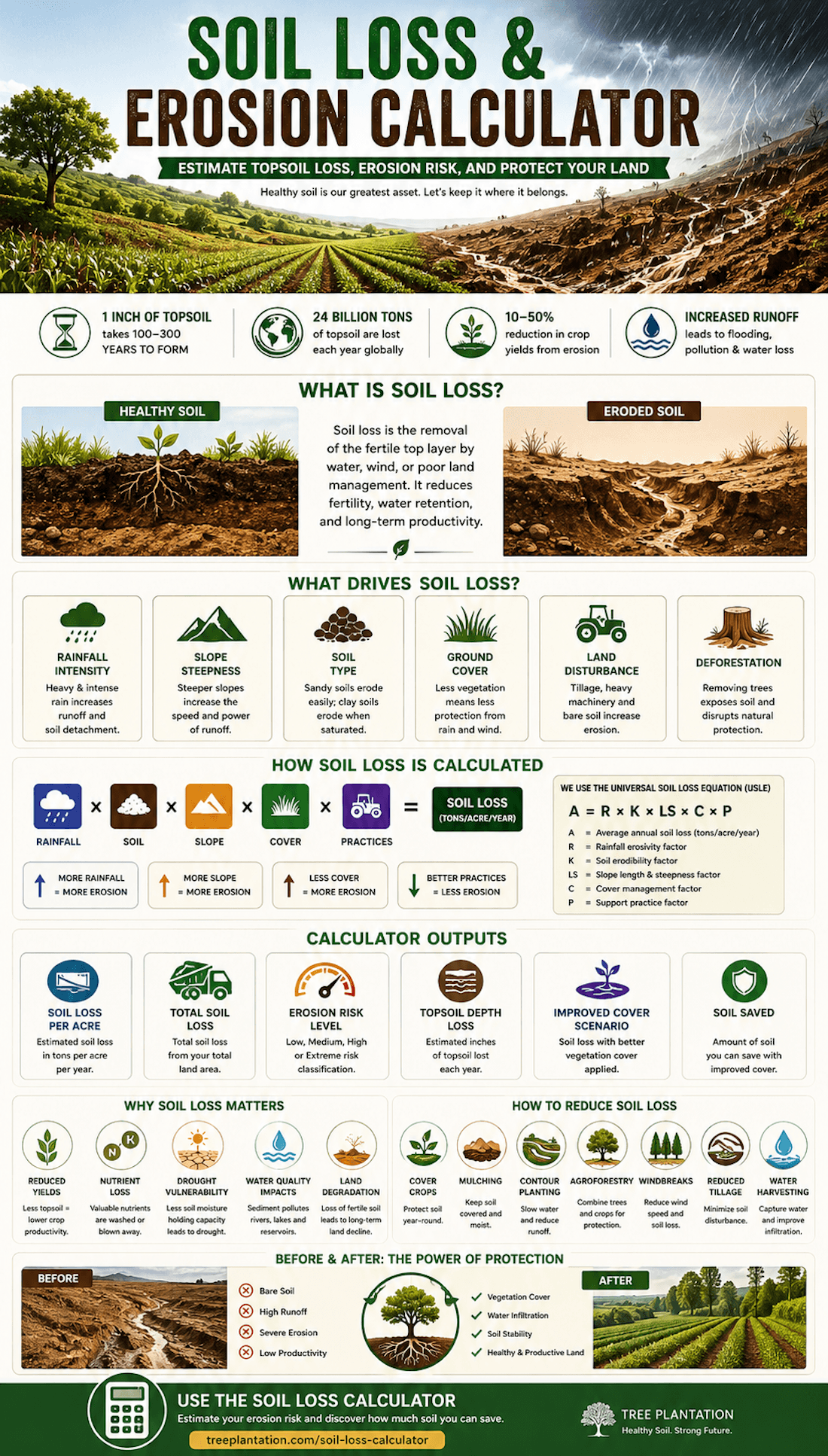
Topsoil is the living layer that supports roots, microbes, organic matter, water retention, and crop productivity. Once topsoil is lost, land can become less fertile, more compacted, more exposed to heat, and harder to restore.
Soil loss also affects forests and tree plantations. Erosion can expose roots, reduce seedling survival, wash away nutrients, damage streams, and make landscapes more vulnerable to drought, flooding, and desertification.
Forest cover protects soil by intercepting rainfall, holding soil with roots, adding organic matter, and reducing runoff speed. When forests are cleared, bare soil can erode rapidly, especially on slopes, degraded pasture, roads, burned land, or recently disturbed sites.
Soil loss is one of the hidden costs of deforestation. It can reduce land productivity and increase pressure to clear additional forest. To explore the larger forest-loss topic, visit the Deforestation guide.
If the calculator shows moderate or high soil loss, the land may benefit from immediate groundcover, mulch, contour planting, cover crops, windbreaks, check dams, swales, terraces, tree planting, or temporary rest from grazing and machinery.
Restoration works best when erosion control starts before the rainy or windy season. Rebuilding soil cover, organic matter, root structure, and water infiltration can help stabilize land before degradation becomes severe.
Understand causes, global trends, forest loss, and long-term environmental consequences.
Learn how wind and water erosion remove topsoil and weaken land productivity.
Explore how topsoil loss reduces fertility, water retention, and long-term growing capacity.
See how degraded soils can be rebuilt with vegetation, water management, and stewardship.
Estimate livestock pressure and reduce overgrazing damage before soil loss accelerates.
Design resilient tree systems that protect soil, store carbon, and support land recovery.
FAQ • EROSION • TOPSOIL LOSS
It estimates annual soil loss per acre, total soil loss across the affected area, erosion risk level, approximate topsoil depth loss, and potential soil saved through improved land cover.
Soil loss is commonly caused by rainfall impact, runoff, wind, steep slopes, bare ground, compaction, overgrazing, wildfire, poor drainage, road cuts, and removal of trees or groundcover.
Deforestation removes canopy cover, roots, leaf litter, and organic matter. Without those protections, rainfall hits soil directly, runoff speeds up, and topsoil is more easily washed or blown away.
Risk levels vary by soil type and climate, but sustained soil loss above natural replacement rates can reduce fertility, lower productivity, increase sediment runoff, and make restoration more difficult.
Soil loss can be reduced with mulch, cover crops, grassed waterways, contour planting, terraces, swales, windbreaks, reduced tillage, rotational grazing, tree planting, and maintaining year-round groundcover.
Yes. Trees help reduce erosion by intercepting rainfall, anchoring soil with roots, slowing wind, improving water infiltration, adding organic matter, and stabilizing slopes and streambanks.
Copyright © All rights reserved Tree Plantation