


 INVEST
 PLANT
PLANT
 SOFTWOODS
 HARDWOODS
 CALCULATORS
 RESOURCES
 PROGRAMS

Softwoods
Learn More
AMAZON • CLIMATE • BIODIVERSITY
Wondering why the Amazon Rainforest is so important? The Amazon is the largest tropical rainforest on Earth, playing a critical role in climate regulation, carbon storage, rainfall cycles, and global biodiversity.
🌎 Quick answer: The Amazon helps regulate the planet’s climate by storing vast amounts of carbon, producing moisture that drives rainfall systems, and supporting 10% or more of all known species on Earth.
Examples: The Amazon contains thousands of tree species, critical ecosystems like floodplain forests, and iconic plants such as the Amazonian water lily, along with diverse wildlife ranging from jaguars and macaws to amphibians and tree frogs.
The Amazon generates much of its own rainfall through a process called moisture recycling, where trees release water vapor that forms clouds and rain— helping sustain ecosystems far beyond the forest itself.
The Amazon is not just a forest—it is a planetary life-support system. Its health affects global weather patterns, carbon balance, and biodiversity at a scale unmatched by most ecosystems.
The Amazon Rainforest is one of the most important ecological systems on Earth. Often called the “lungs of the planet,” it stretches across much of northern South America and contains an extraordinary concentration of life, water, and stored carbon. Its vast forests influence rainfall, moderate temperatures, recycle moisture, and support a level of biodiversity unmatched in most other places on the planet. More than a beautiful and mysterious wilderness, the Amazon is part of the environmental machinery that helps keep the Earth livable.
The importance of the Amazon goes far beyond its size. It is one of the world’s greatest biodiversity hotspots, sheltering an immense variety of trees, vines, orchids, amphibians, reptiles, insects, birds, mammals, fish, and microorganisms. Many of these species exist nowhere else. In a single region, you may find towering canopy trees, medicinal plants, brilliantly colored birds, epiphytic bromeliads, and rare aquatic plants such as the Amazonian water lily. The Amazon is also home to highly specialized animals, from jaguars and macaws to poison dart frogs and delicate tree frogs that depend on stable humidity and intact forest layers.
Beyond biodiversity, the Amazon matters because it functions as a living climate regulator. Its forests absorb and store vast amounts of carbon, making them a critical part of global carbon sequestration. When intact, the forest draws carbon dioxide from the atmosphere and locks it into trunks, roots, leaf litter, and soils. When cleared or burned, much of that stored carbon is released back into the atmosphere, worsening climate change. This means the health of the Amazon is directly linked to the health of the planet.
The Amazon is also a human landscape. Millions of people live within and around it, including hundreds of Indigenous communities whose cultures, knowledge systems, and livelihoods are intertwined with the forest. Their experience in managing landscapes, identifying useful species, and protecting ecological relationships is part of what makes the Amazon not just a rainforest, but a living heritage region.
Feel free to share this Amazon Rainforest infographic on your website or blog. Please include a link back to this page as the source.
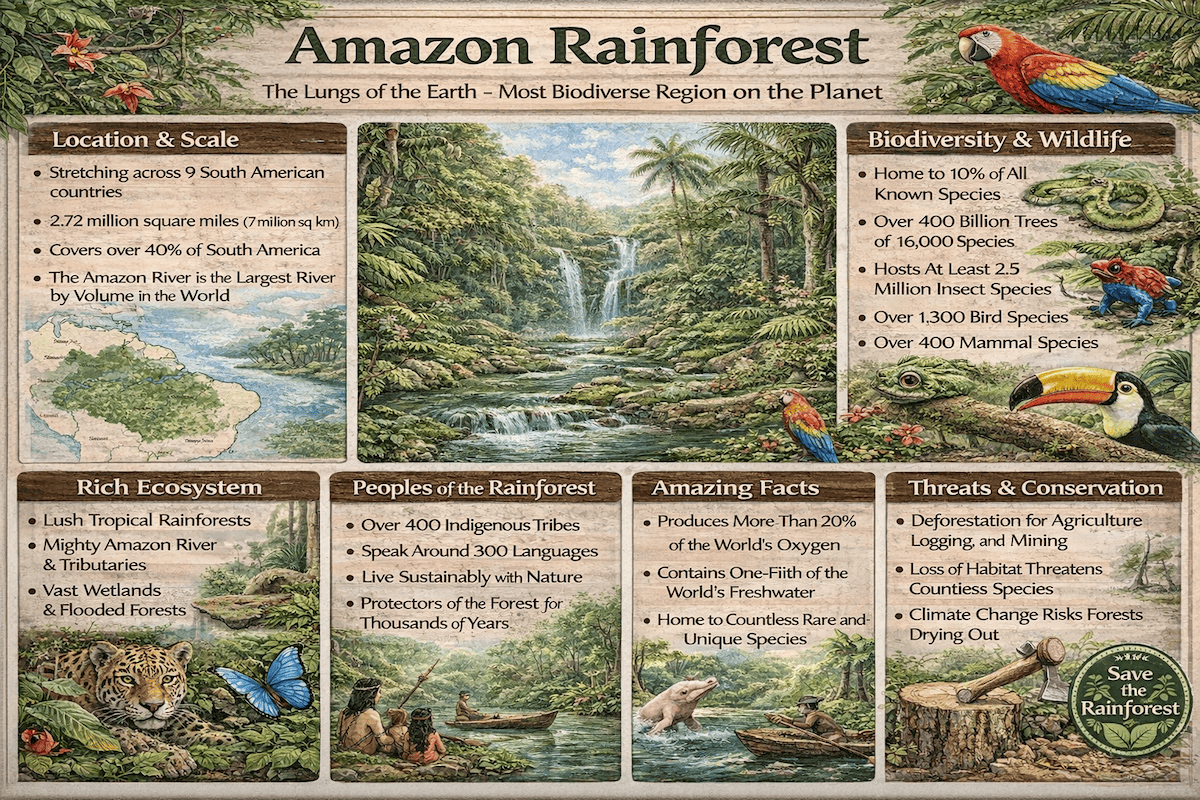
The Amazon plays a profound role in regulating regional and global climate systems. Trees release enormous quantities of water vapor through transpiration, helping generate clouds and rainfall across South America. These atmospheric “rivers” help transport moisture over long distances, influencing precipitation patterns far beyond the Amazon Basin itself. If the forest is degraded on a large enough scale, these water cycles begin to weaken, and the consequences can include drier conditions, reduced agricultural productivity, and more severe droughts across multiple countries.
This climate-regulating function is one of the reasons the Amazon is so frequently discussed in relation to carbon and warming. The world tends to focus on smokestacks, vehicles, and fossil fuels when discussing emissions, but forests are equally important in determining whether carbon stays in the ground, remains stored in living biomass, or enters the atmosphere. The Amazon is one of the great balancing systems in that equation.
As the forest shrinks, the risk grows that large areas could begin shifting from humid rainforest to drier woodland or degraded scrub. That transition would not only eliminate habitat for countless species, but would also reduce the Amazon’s ability to store carbon and regulate rainfall. In other words, the forest is valuable not simply because it is beautiful or species-rich, but because it is one of the pillars holding together broader environmental stability.
The greatest immediate threat to the Amazon is deforestation. Forest clearing has occurred in the region for decades, but in many places it has accelerated due to cattle ranching, land speculation, road expansion, mining, logging, and large-scale agricultural conversion. Slash-and-burn techniques remain especially destructive because they remove the forest rapidly, expose fragile soils, release carbon, and make it easier for cleared land to be converted to short-term production.
Once the forest canopy is opened, the landscape becomes hotter, drier, and more vulnerable to erosion and fire. In areas that once held dense humidity, the soil can quickly lose fertility when exposed. Forest edges become weaker, invasive pressures increase, and the land often enters a cycle of repeated degradation. What may begin as a single clearing can expand into a patchwork of fragmented habitats, roads, ranches, and burned forest scars.
Agriculture is a major force behind this transformation. The pressure to create more pasture and cropland continues to push into forest areas, often justified as economic development. Yet much of this expansion is ecologically expensive and short-sighted. Monoculture systems can replace highly diverse forest structure with simplified landscapes that support far fewer species and store far less carbon. Short-term gain comes at the cost of long-term resilience.
The implications are global. As more forest is cut or burned, the Amazon loses its ability to buffer drought, stabilize weather, and store carbon. Species vanish before they are fully studied. Watersheds are disrupted. Indigenous communities are displaced. The damage is not only local. It is part of a wider environmental crisis that connects forest loss to global warming, water instability, and biodiversity collapse.
The Amazon is frequently described as one of the most biologically rich places on Earth because it holds an astonishing density of life across multiple layers of habitat. Its rivers, floodplains, swamps, upland forests, and canopy zones each support different ecological communities. In a relatively small area, you might encounter orchids, bromeliads, monkeys, hummingbirds, poison frogs, butterflies, ants, medicinal shrubs, towering hardwoods, and aquatic species living in close ecological relationship.
The richness of the Amazon is part of what makes it central to conversations about diversity hotspots. It is not merely that the forest contains many species; it also contains countless interdependencies. Pollinators rely on flowering plants. Amphibians depend on moisture. Birds depend on fruiting cycles, nesting cavities, and insect abundance. Predators depend on large, uninterrupted hunting territories. Once fragmentation begins, many of these relationships start to unravel.
That is why rainforest loss is so alarming. We are not only losing trees. We are losing a web of ecological intelligence built over immense spans of time. Every acre cleared reduces the complexity of a system that cannot be easily rebuilt.
The Amazon is home to some of the most iconic species in the world. Plants such as the Amazonian water lily are symbols of the region’s beauty and evolutionary uniqueness. Fruiting plants and tropical herbs fill the understory, while giant trees compete for sunlight in the canopy. Some species, including wild relatives of banana trees , reveal how rainforest ecosystems contribute to broader agricultural history and food diversity.
The forest is also rich in traditional healing plants, many of which are connected to the broader world of medicine trees and ethnobotany. Indigenous knowledge has long identified useful bark, leaves, resins, roots, and fruits for treating illness and maintaining health. Every time a patch of rainforest is destroyed, humanity risks losing not only species, but also future medicines and knowledge systems still not fully documented by science.
Birds, insects, amphibians, and mammals all help animate this landscape. Butterflies and bees pollinate flowering plants. Ants recycle nutrients and shape soil processes. Jaguars regulate prey populations. Frogs signal changes in moisture and habitat quality. Forest pools, riverbanks, and tree hollows serve as nurseries for species that depend on stable hydrology. Even the seemingly decorative concept of tree gardens can help people better understand how layered planting systems mimic some rainforest functions by combining beauty, biodiversity, and productivity in one place.
Many of the Amazon’s most valuable trees are under pressure from logging, habitat loss, fire, and agricultural expansion. Some are targeted directly for timber, while others decline as intact forest conditions disappear. These trees are important not just economically, but ecologically. They provide shade, nesting structure, seed sources, wildlife food, and carbon storage across generations.
Among the better-known examples are mahogany trees, long prized for their beauty, workability, and commercial value. Unsustainable extraction has made mahogany a symbol of how market demand can threaten slow-growing forest giants. Likewise, teak trees, while more strongly associated with plantation forestry in other tropical regions, often appear in conversations about tropical hardwood demand and the pressure such markets place on natural forests.
Other important Amazonian species include Brazil nut, rubber tree, ipe, rosewood, kapok, copaiba, pau-brasil, catuaba, and jatobá. Some are valued for timber, others for oils, resins, nuts, fibers, fragrance, or medicinal uses. All of them are vulnerable when forests are repeatedly opened, burned, or converted to simplified landscapes.
Endangered tree loss is not only a forestry issue. When old-growth trees disappear, wildlife loses cavities, perches, nectar sources, fruit, and shelter. Water cycles are altered. Soil protection weakens. Carbon storage declines. In a rainforest, the loss of one dominant tree species can affect far more than its own survival.
The Amazon’s crisis includes far more than trees. Countless plants, insects, amphibians, reptiles, birds, and mammals are under increasing pressure. Orchid species, bromeliads, butterflies, bees, ants, turtles, and jaguars all face some combination of habitat loss, fragmentation, pollution, or altered water systems. In many cases, the danger is heightened because some of these species have very specialized ecological requirements.
Amphibians are especially vulnerable. Many frogs depend on stable humidity, small water bodies, shaded breeding zones, and intact forest cover. Sensitive species such as tree frogs can decline rapidly when canopy loss causes forest temperatures to rise and moisture levels to fall. For this reason, amphibians are often seen as indicators of forest health.
Pollinators also face increasing risk. Bees, butterflies, and other insects are essential to rainforest reproduction. When flowering cycles are disrupted or habitat is destroyed, pollination networks weaken. Ant diversity, which is extraordinarily high in the Amazon, can also collapse when forests are cleared and soils are exposed. Even aquatic and semi-aquatic animals, including turtles and fish, are vulnerable when watershed changes alter river flow, sedimentation, and breeding habitat.
The most troubling aspect of this loss is that science has not yet fully documented the Amazon. Many species likely remain undescribed. This means extinction may be happening not only to species we know, but also to species humanity has not yet had the chance to understand.
Protecting the Amazon is one of the most important environmental priorities in the world. The forest cannot be replaced by simple tree planting elsewhere, because what makes the Amazon valuable is not just tree cover, but the immense complexity of its soils, hydrology, species networks, and cultural history. That said, restoration still matters deeply. Reforestation, assisted regeneration, Indigenous land protection, stronger law enforcement, and climate-smart economic alternatives can all help reduce pressure on the forest and restore degraded areas.
Protection also requires a shift in how value is measured. A standing forest provides climate regulation, rainfall generation, biodiversity, pollination, medicines, food resources, soil stabilization, fisheries protection, and cultural continuity. Those functions are often more valuable over time than the short-term profits gained from clearing and burning.
The Amazon matters because it is one of the great living systems of Earth. It stores carbon, stabilizes climate, houses extraordinary life, and holds knowledge that humanity still barely understands. If we allow it to be steadily reduced and fragmented, the loss will not be confined to one region. It will be shared across the planet.
The future of the Amazon Rainforest is inseparable from the future of climate stability, biodiversity, and ecological resilience worldwide.
The Amazon Rainforest plays a critical role in regulating global climate, storing massive amounts of carbon through carbon sequestration, and supporting unmatched biodiversity. It also helps generate rainfall across South America and influences weather patterns worldwide.
Deforestation destroys habitats, releases stored carbon, disrupts rainfall patterns, and weakens the forest’s ability to recover. It also accelerates soil degradation and increases wildfire risk, leading to long-term ecosystem collapse.
The Amazon is home to millions of species, including jaguars, macaws, monkeys, insects, and amphibians like tree frogs. Many of these species are found nowhere else on Earth.
The Amazon is one of the world’s most important biodiversity hotspots due to its extraordinary concentration of plant and animal life. Its layered ecosystems support complex relationships between species, making it one of the most biologically rich regions on Earth.
The rainforest contains thousands of unique plant species, including the Amazonian water lily, towering hardwood trees, orchids, and medicinal plants used in traditional healing practices.
The Amazon absorbs billions of tons of carbon dioxide, helping slow climate change. Its forests act as a natural carbon sink, storing carbon in trees, roots, and soil while also cooling the planet through moisture release.
Valuable hardwood species such as mahogany trees and teak trees are under pressure from logging and habitat loss. Many other native species are also threatened as forests are cleared for agriculture.
Protecting the Amazon requires stronger conservation policies, sustainable land management, and large-scale reforestation. Approaches like agroforestry and tree gardens can help restore degraded land while supporting local communities and biodiversity.
Copyright © All rights reserved Tree Plantation