 INVEST
 PLANT
PLANT
 SOFTWOODS
 HARDWOODS
 CALCULATORS
 RESOURCES
 PROGRAMS

Softwoods
Learn More




Discover how trees, forests, and soils capture and store carbon—reducing emissions, improving soil health, and creating new opportunities through carbon credits and regenerative land management
CARBON • TREES • CLIMATE
Wondering what carbon sequestration is? Carbon sequestration is the process of capturing carbon dioxide (CO2) from the atmosphere and storing it in natural or engineered systems to help slow climate change and reduce the buildup of greenhouse gases.
🌍 Quick answer: Trees, forests, and soils absorb CO2 and store carbon in wood, roots, leaves, organic matter, and soil, making them some of the most important natural carbon sinks on Earth.
Examples: Carbon can be stored through reforestation, afforestation, healthy forest management, regenerative agriculture, soil building, and engineered carbon capture systems.
Carbon sequestration is one of the most important natural and technological strategies for slowing climate change . Trees, forests, and soils pull carbon dioxide from the atmosphere and store it in living biomass, organic matter, and long-term reservoirs.
This page explores how trees capture carbon, how soil stores carbon, and how approaches such as reforestation, regenerative agriculture, carbon credits, and carbon capture systems contribute to a lower-emission future.
Whether you are interested in forest restoration, carbon markets, land stewardship, or climate solutions, understanding carbon sequestration is essential to building healthier ecosystems and a more resilient planet.
Carbon sequestration is the process of capturing carbon dioxide (CO2) from the atmosphere and storing it in natural or engineered systems to help mitigate climate change. By removing excess CO2 from the air, carbon sequestration plays a critical role in slowing global warming, stabilizing ecosystems, and improving long-term environmental resilience.
Carbon can be stored in multiple reservoirs, including trees, forests, soils, oceans, and underground geological formations. Natural systems such as forests and agricultural soils act as powerful carbon sinks, while engineered solutions like carbon capture and storage (CCS) provide additional pathways for reducing atmospheric carbon.
While carbon sequestration is one of the most effective tools available for climate mitigation, it is not a standalone solution. It must be combined with emissions reduction strategies, renewable energy adoption, and sustainable land management practices to create a balanced and scalable path toward a low-carbon future.
Example: A healthy acre of growing trees can capture roughly about one ton of CO2 per year under average conditions, though the actual amount depends on species, climate, soil, and management.
Each method has unique advantages and limitations. No single approach can solve climate change alone—a diversified, integrated strategy is essential for meaningful long-term impact.
Trees capture carbon primarily through photosynthesis, a process that occurs during daylight hours. Through tiny pores in their leaves called stomata, trees absorb carbon dioxide from the atmosphere and combine it with water drawn up from their roots.
Using sunlight as energy, trees convert CO2 and water into glucose (sugars), which fuels growth. As trees grow, they store carbon in their wood, roots, bark, and leaves, effectively removing it from the atmosphere and locking it into long-term biological storage.
This process not only captures carbon but also releases oxygen, making trees one of the most efficient and cost-effective natural climate solutions available.
The amount of carbon a tree captures depends on factors such as species, age, climate, soil conditions, and management practices. Young, fast-growing trees typically absorb carbon more rapidly, while mature forests store vast amounts of carbon over long periods.
Although mature forests reach a balance between carbon uptake and release through decay, they remain critical long-term carbon reservoirs. Managed forests and plantations can be optimized to increase annual carbon capture while maintaining long-term storage.
On average, an acre of healthy, growing trees can capture approximately one ton of CO2 per year , though this varies widely depending on conditions and species selection.
Because of the urgent need to reduce atmospheric carbon, governments and markets have created systems such as carbon credits, allowing organizations to offset emissions by investing in carbon sequestration projects including reforestation, soil improvement, and forest conservation.

Carbon Markets & Financing
A carbon credit is a tradable environmental instrument that represents the reduction, removal, or avoidance of one metric ton of carbon dioxide equivalent (CO2e) from the atmosphere. Carbon credits are used by governments, businesses, and in some cases private individuals to help offset greenhouse gas emissions that are difficult to eliminate immediately.
These credits are generated through verified emission-reduction projects such as reforestation, forest conservation, renewable energy development, soil carbon improvement, and methane capture. By purchasing carbon credits, organizations can help finance projects that remove carbon from the atmosphere or prevent additional emissions from being released.
Carbon credits are typically bought and sold through regulated markets and voluntary carbon markets, using brokers, exchanges, registries, and specialized trading platforms. Their value depends on factors such as project credibility, verification standards, location, permanence, and the amount of measurable carbon captured or avoided over time.
For landowners, forest managers, and conservation programs, carbon credits can create an additional income stream tied to environmental stewardship. In the case of tree plantations and forest restoration, the value of a project may depend in part on how much carbon a forest captures and stores as it grows.
Governments, organizations, and private industry now invest heavily in carbon projects around the world. This has created a fast-growing financial ecosystem around carbon credits, offsets, and environmental markets. Some of the best-known examples include:
Green bonds are debt instruments created to finance projects with positive environmental or climate benefits. These can include renewable energy, reforestation, sustainable agriculture, watershed protection, and other projects that contribute to carbon reduction or environmental resilience.
Most green bonds are issued as “use of proceeds” bonds, meaning the funds raised are specifically allocated to approved environmental projects. They may also be structured as revenue bonds, project bonds, or asset-backed green securities, depending on the financing model.
Green bonds can be especially attractive because they often come with tax incentives, third-party certification, and strong appeal to environmentally focused investors. Standards and certification bodies help verify that bond proceeds are genuinely being directed toward climate-positive uses.
Green bonds are increasingly important in mobilizing large-scale capital for climate solutions. They allow institutional investors, funds, and private stakeholders to support environmental projects while also participating in long-term financial returns tied to sustainability performance.
The World Bank has been one of the most prominent issuers of green bonds, helping expand this market globally. Tree plantation, forest restoration, and land-based carbon projects can also be structured around green bond financing, where long-term value may be linked to timber growth, carbon capture, and ecosystem restoration.
Carbon capture and storage (CCS) is a technological approach designed to reduce the climate impact of large industrial emissions. It works by capturing carbon dioxide from major point sources such as power plants, cement facilities, steel mills, and other industrial operations, then transporting and storing that CO2 so it does not enter the atmosphere.
In most CCS systems, carbon dioxide is captured, compressed, and injected into deep underground geological formations for long-term storage. This process is intended to reduce the amount of man-made carbon dioxide contributing to global warming.
Carbon dioxide occurs naturally in the atmosphere and is essential to life on Earth in balanced amounts. However, the rapid increase in human-caused CO2 emissions since the Industrial Revolution has contributed significantly to rising global temperatures, shifting weather patterns, and other climate-related disruptions.
CCS is one of several tools that may help reduce emissions from sectors that are difficult to fully decarbonize. While it does not replace the need for renewable energy, efficiency improvements, and natural carbon sequestration through forests and soils, it may play an important supporting role in a broader climate strategy.

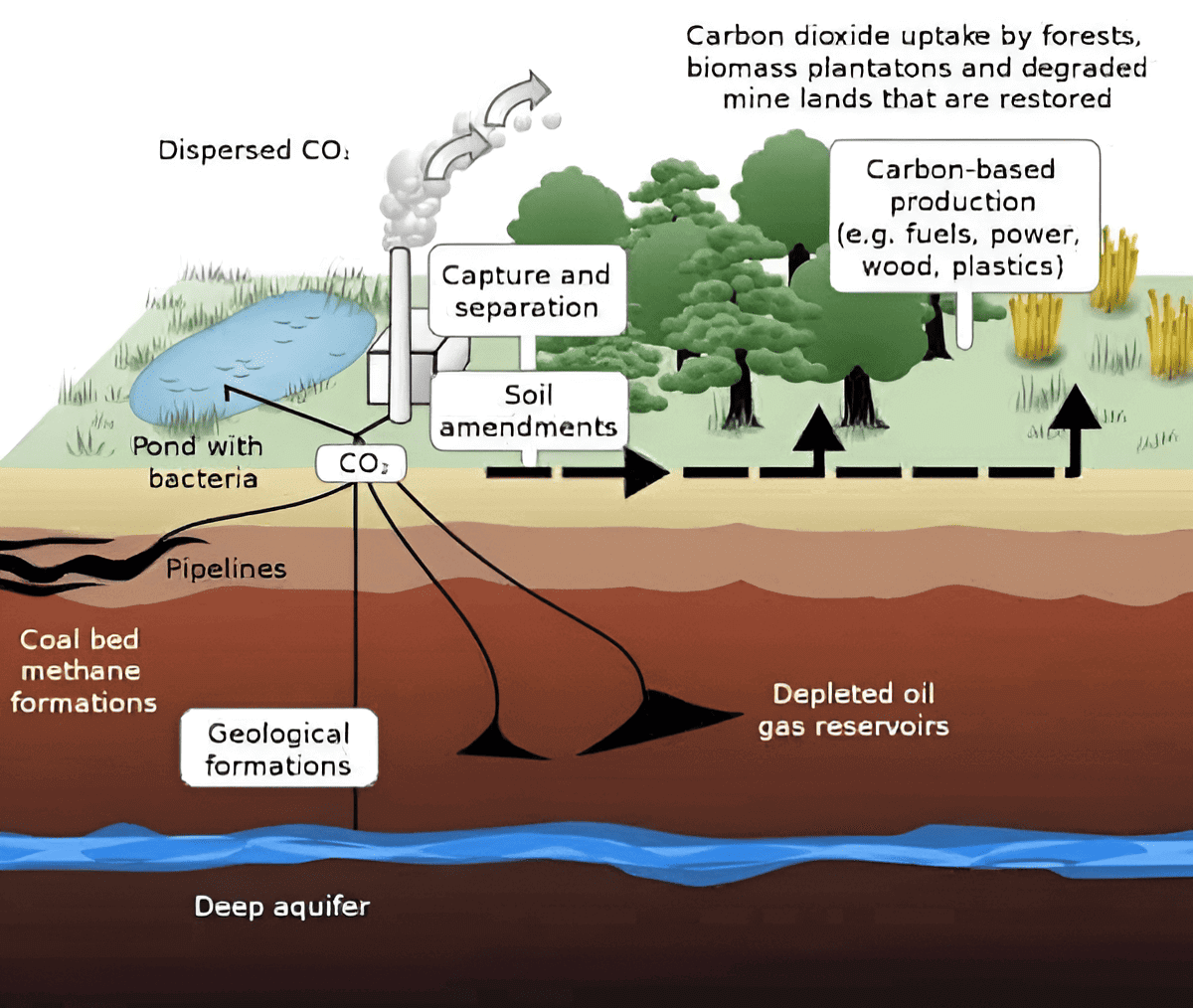
Governments around the world are investing in carbon capture and sequestration programs to reduce greenhouse gas emissions and slow climate change. These programs focus on capturing carbon dioxide (CO2) from industrial sources and the atmosphere, while also supporting natural carbon storage through forests, soils, and ecosystems.
In the United States, the Department of Energy (DOE) leads major initiatives to advance carbon capture technologies and reduce emissions from power plants and heavy industry. These programs focus on improving efficiency, lowering costs, and scaling deployment across two primary approaches: pre-combustion capture and post-combustion capture.
Pre-combustion carbon capture removes carbon dioxide before fossil fuels are burned. This process converts fuels such as coal or natural gas into a synthetic gas (syngas) composed mainly of hydrogen and CO2. The carbon dioxide is then separated and captured, while the hydrogen can be used as a cleaner-burning fuel.
The process typically involves three key stages:
Pre-combustion capture can significantly reduce emissions from industrial systems, but it remains capital-intensive and energy-demanding. Continued innovation is needed to improve scalability and cost-effectiveness.
Post-combustion carbon capture removes CO2 after fossil fuels have been burned. It captures carbon directly from flue gas emissions, making it one of the most adaptable solutions for retrofitting existing power plants and industrial facilities.
The process generally includes:
While highly flexible, post-combustion systems also face challenges related to cost, energy consumption, and long-term storage security. These systems are most effective when integrated into broader emissions reduction strategies.
Carbon sequestration occurs through both biological (natural) and engineered (technological) pathways. Biological sequestration captures carbon in living systems, while engineered solutions capture and store carbon through industrial processes.
Key biological methods include:
Biological carbon sequestration is one of the most cost-effective and scalable climate solutions, especially when combined with regenerative land management and ecosystem restoration.
Emerging technologies such as artificial carbon capture systems aim to remove CO2 directly from the atmosphere. These systems can begin capturing carbon immediately and can be deployed in locations where natural systems may not thrive.
However, artificial systems are currently far more expensive and energy-intensive than natural solutions. For example, a single high-cost artificial system may capture a similar amount of carbon as an acre of trees, but at a significantly higher financial and energy cost.
While artificial carbon capture may play a role in targeted applications—especially near emission sources—trees, forests, and soils remain the most efficient, scalable, and sustainable solutions for long-term carbon sequestration.
Copyright © All rights reserved Tree Plantation